
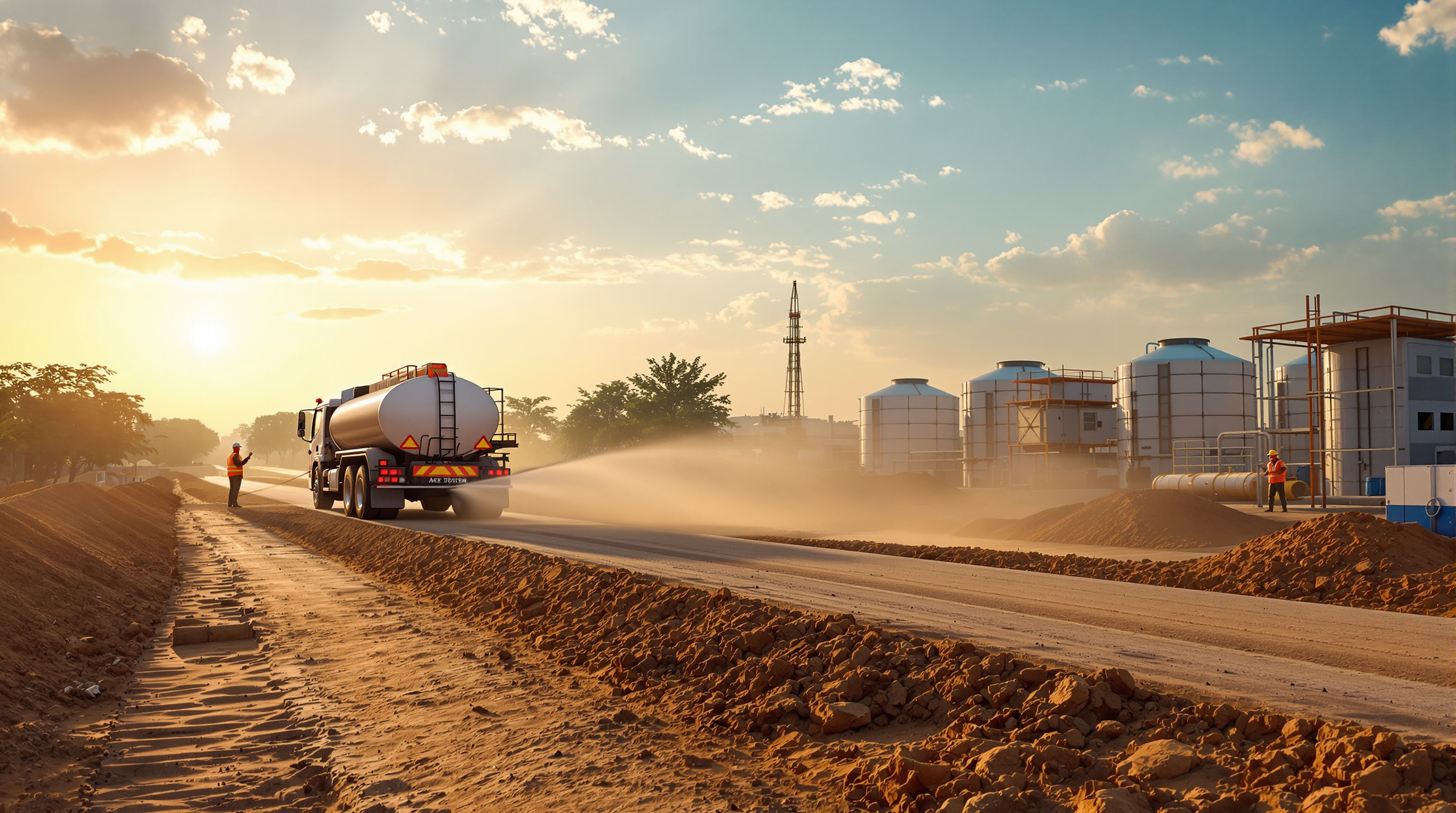
Treated Water for Construction Use: Curing, Dust Suppression & Compaction with STP Water
Whether STP-treated water can replace fresh water on site — for curing, dust suppression and compaction — the quality caveats that matter for concrete, and how much a large project actually saves by switching.
A large construction site is one of the thirstiest things a city builds. Curing a single floor slab of a high-rise can swallow tens of thousands of litres over a week; dust suppression on haul roads runs continuously through the dry season; earthwork compaction needs water sprayed layer after layer. On most Indian sites all of this is done with fresh water — bought in by tanker at a premium, or drawn from a borewell the neighbourhood also depends on. Meanwhile, a few metres away, the site's own Sewage Treatment Plant may be discharging thousands of litres of perfectly usable treated water every day.
Closing that loop — using treated water for construction instead of fresh — is one of the easiest, highest-return water moves a project can make. The catch is that "construction water" is not one thing. Some uses are entirely forgiving; one use, concrete, is genuinely fussy. This guide sorts out where treated water is safe to use as-is, where it needs a quality check first, and roughly what the switch is worth.
Curing, dust suppression and compaction together account for the bulk of a site's water demand — and none of them need drinking-water quality. Treated STP water is engineered for exactly this class of non-potable reuse.
Why the site is such a heavy water user
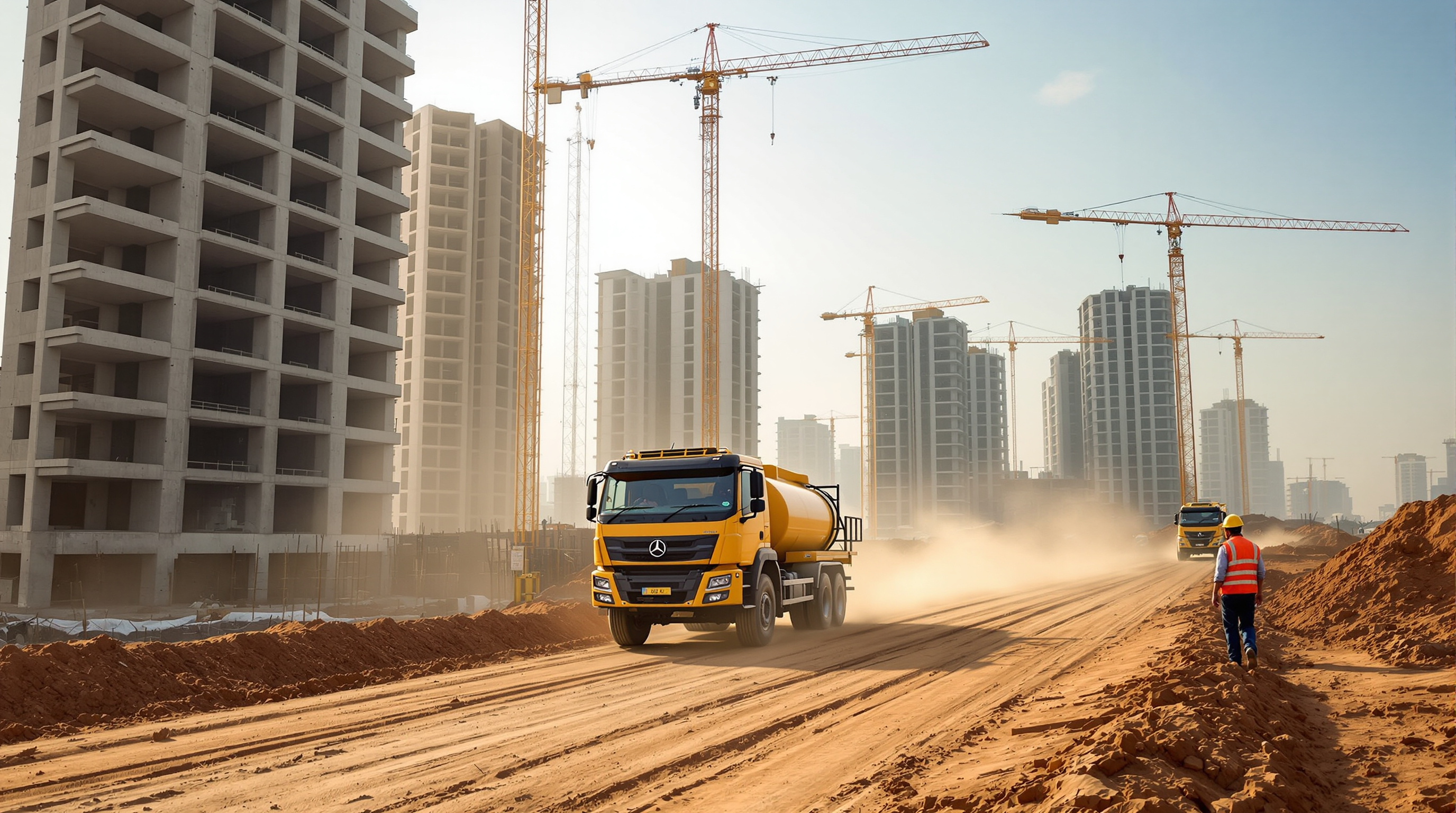
Before deciding what water to use, it helps to see where it goes. On a typical mid-to-large project the big consumers are:
- Curing — keeping fresh concrete and plaster wet so it gains strength. The single largest and most quality-sensitive demand.
- Dust suppression — spraying haul roads, stockpiles and demolition areas to keep particulate matter down (and to stay on the right side of air-quality rules).
- Earthwork compaction — adding moisture to soil and sub-base layers so they compact to the specified density.
- Washing — equipment, wheels, aggregate and the site itself.
Of these, only curing water touches the permanent structure chemically. Dust suppression, compaction and washing are all mechanical uses where the water simply needs to be wet, reasonably clean and free of anything that stains, smells or corrodes. That distinction is the key to the whole subject.
The forgiving uses: dust suppression, compaction, washing
For dust suppression and compaction, treated water from a well-run STP is a straight substitute for fresh — no reservations. These uses do not care about the fine chemistry that worries a concrete engineer; they care that the water is not full of visible solids, does not smell, and will not leave a crust or a health hazard where it is sprayed.
A properly treated effluent that meets CPCB reuse norms — low BOD, low TSS, disinfected — clears that bar comfortably. If your STP already produces water good enough for landscape irrigation or toilet flushing, it is more than good enough to damp down a haul road or moisture-condition a sub-grade.
The one practical caution is disinfection. Because workers walk through spray zones and mist drifts, the treated water used on site should carry a proper disinfection residual. A well-maintained chlorination system or UV disinfection stage handles this; it is the same water quality you would already insist on for any reuse where people are nearby.
The fussy use: curing concrete
Curing is where you must slow down. The water that keeps concrete wet while it hardens sits in intimate, prolonged contact with the reinforcement and the cement matrix. Aggressive ions in that water can attack the steel or interfere with the set — so the specification is genuinely strict, and it is set by IS 456, the concrete code.
The code's logic is simple: water fit for making and curing concrete should be roughly of the quality you would be willing to drink, with tight limits on the ions that harm concrete. The parameters that matter are not BOD or TSS — they are the dissolved salts:
| Parameter | Why concrete cares | Directional limit (IS 456 spirit) |
|---|---|---|
| Chlorides | Drive corrosion of embedded reinforcement steel | Strictly limited, tighter for RCC than plain concrete |
| Sulphates | Attack the hardened cement paste (sulphate attack) | Capped low |
| pH | Too acidic or alkaline disturbs the set | Kept near-neutral, not below ~6 |
| Organic matter / solids | Can retard setting and weaken the bond | Kept low |
| Suspended matter | Leaves surface deposits, weakens curing | Kept low |
Here is the honest position on treated sewage water for curing: ordinary secondary-treated STP effluent is usually fine on BOD and solids but can be too high in dissolved salts — chlorides, sulphates, total dissolved solids — because biological treatment removes organics, not salts. So treated water is not automatically curing-grade. It becomes curing-grade only when either the source sewage is low in salinity, or the plant includes a polishing step that pulls salts down.
The practical rules of thumb:
- Do not assume — test. Send a sample for the IS 456 water-quality parameters (chlorides, sulphates, TDS, pH, organics). One lab test settles the argument that no amount of eyeballing can.
- Polishing helps. An STP with a UF membrane or a full membrane bioreactor (MBR) train produces markedly cleaner, more consistent water. Where salinity is the problem, only an RO-type stage will bring TDS down — a step most reuse-grade STPs do not include.
- Match the water to the concrete. Even where treated water is borderline for structural RCC, it is often perfectly acceptable for lean concrete, blockwork, PCC and non-structural elements. Reserve fresh (or tested-compliant) water for the reinforced structure.
When in doubt, treat curing as the exception and everything else as the default: run the forgiving uses on treated water immediately, and gate curing behind a lab report.
What the switch is actually worth
The economics are what make this compelling. Fresh construction water is rarely cheap — on borewell-stressed urban sites it is trucked in, and tanker water can cost anywhere from a few hundred to well over a thousand rupees per kilolitre depending on the city and the season. A large project running many kilolitres a day for months turns that into a serious line item.
Treated water that your STP is producing anyway is, in effect, free of raw-water cost — you pay only for the pumping and any polishing. Diverting even a portion of a site's dust-suppression and compaction demand onto treated water can retire lakhs of rupees of tanker spend over a build, while easing pressure on the borewell and the municipal supply. During commissioning of the permanent STP, that treated water is available before the building is even occupied.
To put real numbers against your own site, the Water Reuse Savings Calculator converts a daily reuse volume and a tanker rate into a monthly saving, and the Water Balance Calculator helps you see how much treated water you actually have to spare against competing reuse demands.
Making it work on site
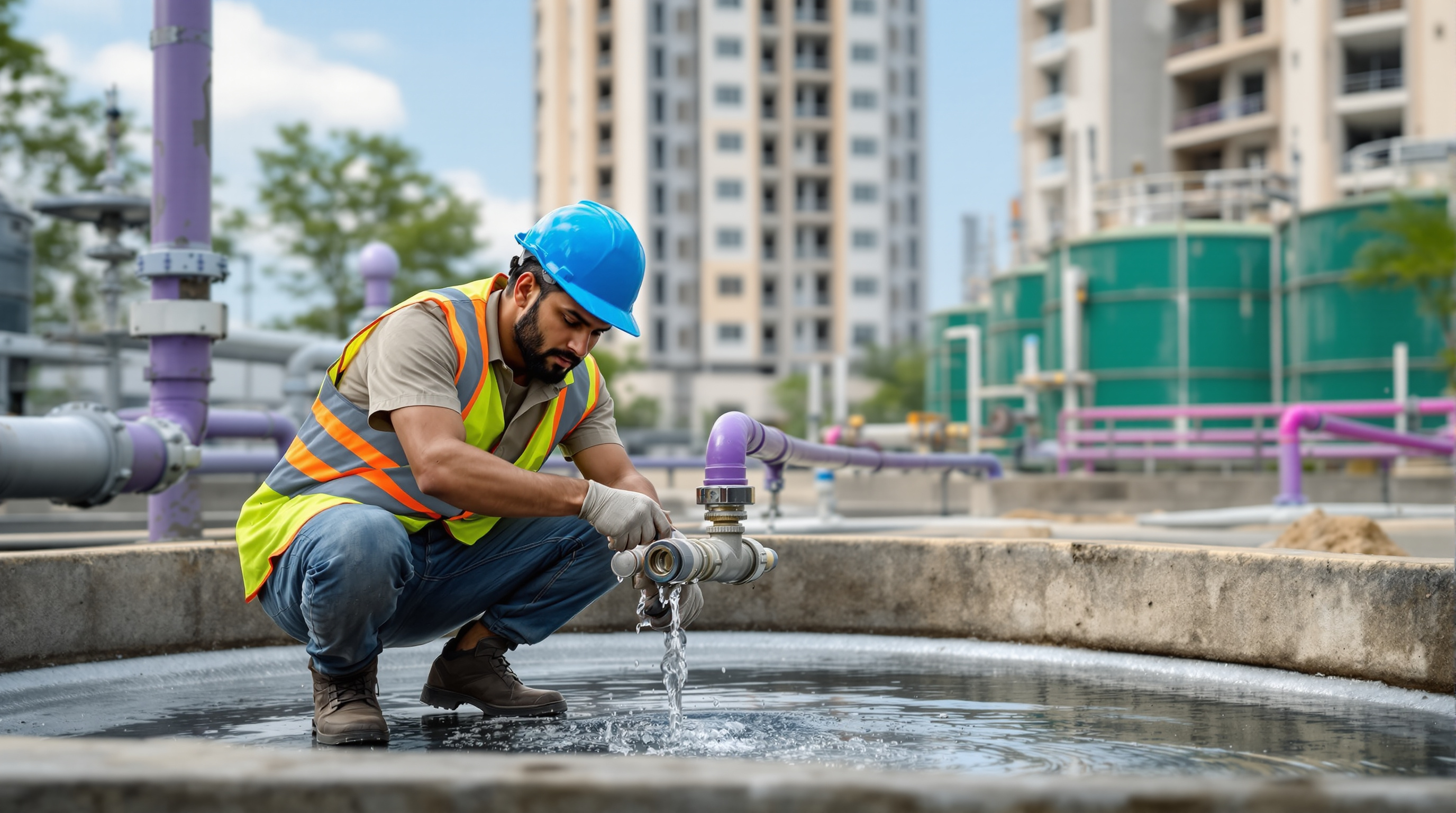
Turning the idea into practice takes only a few deliberate steps:
- Plumb a reuse line. Run treated water from the STP's treated-water tank to a filling point for bowsers and to the curing supply, clearly labelled and colour-coded as non-potable so no one confuses it with drinking water.
- Keep disinfection honest. Maintain the chlorine or UV stage so spray water stays hygienic for the workforce.
- Test before curing, then periodically. One baseline IS 456 test before you cure with it, and repeat tests if the sewage character or plant performance changes.
- Keep a fresh-water fallback for structural RCC curing if the treated water does not clear chlorides and sulphates.
The bottom line
Treated water for construction is a clear win for dust suppression, compaction and washing — use it as the default the moment your STP is producing reuse-grade water. For curing concrete, the answer is a qualified yes: the water must meet IS 456 limits on chlorides, sulphates, TDS and pH, and ordinary treated sewage often needs a polishing stage or a lab clearance before it earns that role. Get that one distinction right and a site can run most of its enormous water demand on water it was going to produce anyway — saving fresh water, tanker money and a stressed aquifer all at once.
To size the plant that feeds this loop, start with the STP Capacity Calculator; to understand the treatment stages that determine your water quality, walk the Sewage Treatment Plants guide library.
Export this guide
Related Guides — Deep-dive reading
Treated Water for Toilet Flushing: The Complete STP Reuse Guide
How dual plumbing, a dedicated flush tank and pump, colour-coded lines, and residual chlorine turn STP effluent into the single biggest water saving a building can make — done safely, without a single cross-connection.
Sewage Treatment PlantsROI of Water Recycling: Does an STP Actually Pay for Itself?
A numerate, honest look at the payback case for on-site sewage treatment in India — what a recycled kilolitre is really worth, what the plant costs to build and run, and how many years it takes to break even.
Sewage Treatment PlantsHow Does an STP Work? A Step-by-Step Explanation
Follow a single drop of sewage from the building drain to reusable water — through screening, settling, the living microbial heart of the plant, and final polishing — with every stage explained in plain language and no engineering background assumed.
Sewage Treatment PlantsRelated Tools — Try Free
Water Reuse Savings Calculator
Estimate the money you save by reusing STP-treated water instead of buying fresh supply, with daily, monthly and annual savings.
STP CalculatorWater Carbon Savings Calculator
Estimate the CO2 emissions you avoid each year by reusing treated water instead of fresh supply, with annual tonnes saved and a tree-equivalent.
SustainabilityChlorine Dose Calculator
Compute chlorine demand for water and sewage disinfection from daily flow and dose, returning chlorine consumption in kg/day and kg/month.
STP Calculator