
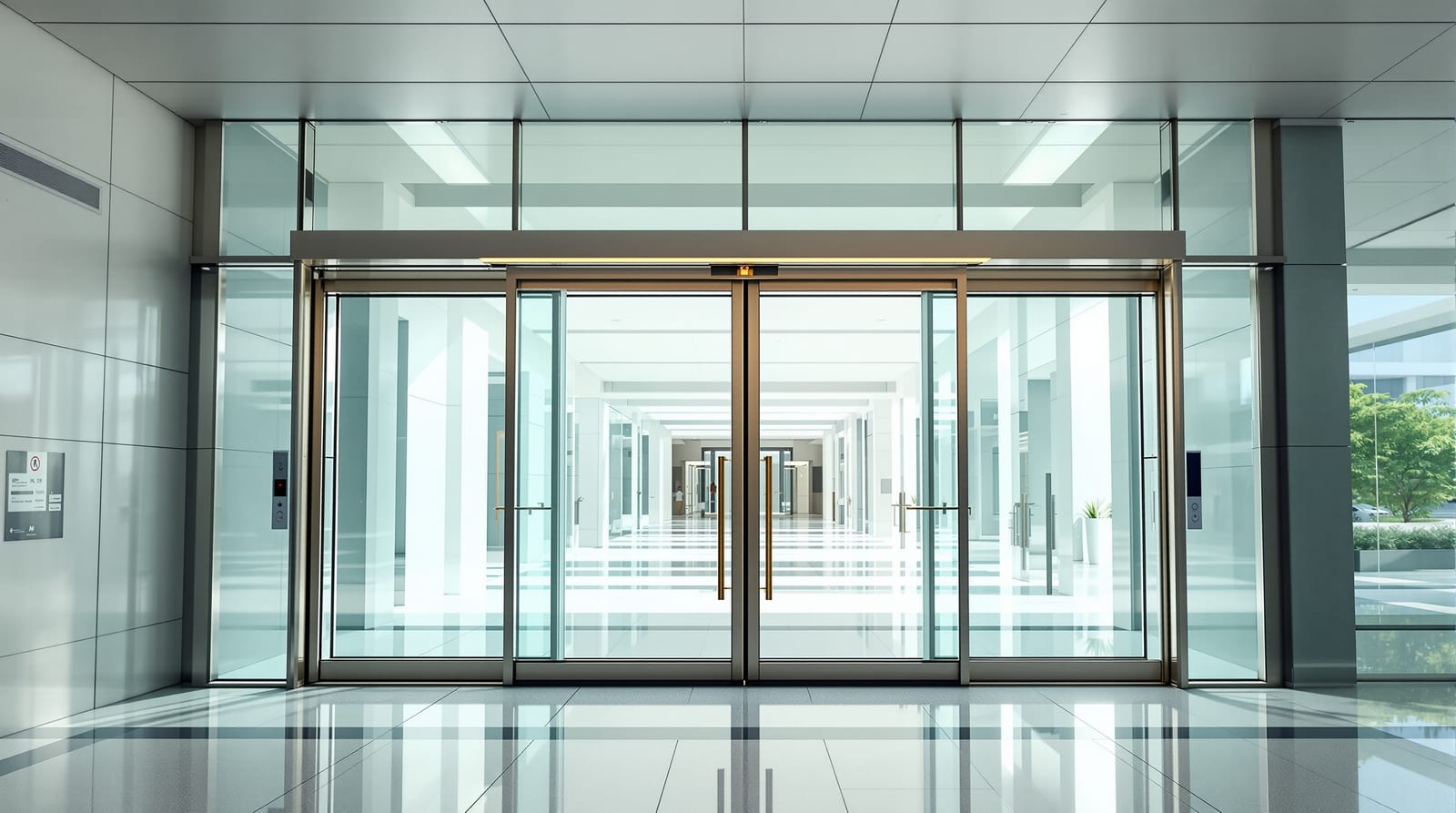
Telescopic Sliding Doors: Wide Auto Openings, India 2026
How nesting multi-leaf telescopic automatic sliders win wider clear openings in tight side reveals for hospitals, hotels and airports.
When a doorway must offer a wide barrier-free clear opening but the wall on either side is too short to park a single large panel, telescopic sliding doors solve the geometry. Instead of one leaf per side, a telescopic system runs two (or three) thinner leaves per side on synchronised tracks: as the door opens, the leaves nest and stack behind one another, so the parked pack is roughly half the width of an equivalent single-leaf slider. The result is a much wider clear opening squeezed into a tight side reveal — exactly what hospital corridors, hotel lobbies, airport terminals and retrofit entrances often demand. This guide is specifier-grade and India-specific; as with any project-engineered entrance, the final spec, operator selection and price come from a vendor survey against the actual reveal and traffic. For the broader picture see the complete door guide and the phase pillar on specialty doors.
How telescopic sliding doors differ from a standard auto-slider
A conventional automatic slider (covered in automatic sliding doors) has one moving leaf per side. To clear, say, a 2,000 mm opening with a bi-parting pair, each leaf is about 1,000 mm wide and needs roughly 1,000 mm of side wall to park against. If that side wall does not exist — a column close to the jamb, a perpendicular corridor, a glazed shopfront — the single-leaf slider simply will not fit.
The telescopic configuration splits each side into two leaves of about half the width, geared so the outer (fast) leaf travels twice the distance of the inner (slow) leaf and they finish flush in a nested pack. That pack is roughly half as wide as the single-leaf parked panel. So for the same clear opening you need far less side reveal; or, in a fixed reveal, you gain a substantially wider clear opening.
| Parameter | Single-leaf bi-parting slider | Telescopic (2 leaves/side) |
|---|---|---|
| Leaves per side | 1 | 2 (or 3) |
| Side reveal needed for a given opening | High (~ full leaf width) | About half |
| Clear opening in a fixed reveal | Standard | ~1.5-1.9x wider |
| Mechanism complexity | Lower | Higher (synchronising belt/pulley) |
| Relative cost | Baseline | ~25-50% more |
| Typical use | Most entrances | Tight reveals, wide openings |
The trade is mechanical: more leaves, more carriages, more hardware, a synchronising belt or pulley set, and a wider track header to house the nested pack. So choose telescopic when reveal or opening width forces it — not by default.
Where telescopic systems earn their place
- Hospitals & healthcare: wide gurney/bed clearance into theatres, ICUs and corridors where the adjacent wall is short. See hospital doors and operation theatre doors; hermetic OT entrances are a separate class (hermetic doors).
- Hotels & lobbies: grand entrance width without losing flanking glazing or signage zones.
- Airports & transit: high-throughput passenger flow with luggage trolleys, often paired with vestibules.
- Retail & retrofits: replacing a swing or narrow slider where structure limits the reveal.
Operators, configuration and safety
The operator is the heart of the system: a header-mounted electric drive (brushless DC motor, microprocessor controller, toothed belt) sized to the total leaf mass and duty cycle. Telescopic operators are purpose-built to drive the two-speed synchronised leaves; you cannot retrofit a single-leaf operator. Specify the duty rating honestly — an airport door cycling tens of thousands of times a month needs a heavier operator and continuous-duty motor than a boutique hotel side entrance.
Safety is governed by the operator's sensor suite. As a rule of thumb, fit presence and motion sensors on both faces, plus safety light-curtains or photocells down the leading edges and within the moving zone so a person standing in the threshold is detected before closing. For public buildings, the entrance must also offer an emergency escape path — usually a breakout (anti-panic) function where the leaves swing out manually in the direction of egress when pushed, satisfying the egress intent of NBC 2016. Confirm the breakout and fail-safe (battery/spring) behaviour against your fire consultant, because a powered entrance on an escape route must open under power failure.
Glass, leaf and frame options
Most telescopic entrances are glazed for transparency and prestige. Specify the leaf build to the climate and security need:
| Leaf / glazing | Build | Where it suits |
|---|---|---|
| Frameless / minimal-stile toughened | 10-12 mm toughened glass, slim top/bottom rail | Lobbies, retail — clean look |
| Aluminium-framed DGU | Double-glazed unit in thermally broken aluminium frame | Airports, AC entrances — energy saving |
| Laminated security glass | Toughened + PVB interlayer | Higher safety / mild attack resistance |
| Insulated solid panel | Aluminium skin + core | Service / back-of-house, climate barrier |
Use only safety glass (toughened or laminated) in any public power-operated door, and add manifestation markings at eye level so the glazed leaves are visible. For high-traffic conditioned spaces, pair the entrance with an air curtain or a vestibule to cut air exchange. Where the priority is heat-loss control rather than width, an insulated industrial door or high-speed door may be the better tool.
Cost bands in India (2026)
Telescopic systems are project-engineered: price varies with leaf count, span, glazing, operator duty, sensor package and breakout. Treat the figures below as indicative bands, supply-and-install, before 18% GST, and get a vendor quote against your reveal and traffic.
| Configuration | Indicative band (installed) | Notes |
|---|---|---|
| 2-leaf single-side telescopic, toughened glass | ₹1,80,000 - ₹3,50,000 | Light/medium duty operator |
| 2-leaf-per-side bi-parting (4 leaves), glass | ₹3,00,000 - ₹6,50,000 | Wide lobby / hospital entrance |
| 3-leaf-per-side, heavy duty + DGU | ₹6,00,000 - ₹12,00,000+ | Airport / high-throughput |
| Breakout + redundant sensors + UPS add-on | +₹40,000 - ₹1,50,000 | Egress-route entrances |
Lead times are typically several weeks because leaves, operators and sensors are configured to order. Indian and global suppliers active in automatic entrances include Gandhi Automations, ASSA ABLOY, Shakti Hörmann, Hörmann and Dormakaba-class players; frame these generically and confirm specs with the chosen vendor. Budget an annual maintenance contract — belts, carriages, sensors and the breakout mechanism need scheduled service, especially on high-cycle doors. Plan the wider entrance budget with the door cost calculator and screen options with the specialty door selector.
Specifying checklist
- Measure the actual structural reveal each side, then confirm telescopic is required (not a standard slider).
- Set the target clear opening and leaf count; confirm header depth for the nested pack.
- Match operator duty to real cycle counts; specify continuous-duty for transit/airport.
- Mandate dual-face presence/motion sensors plus leading-edge safety light-curtains.
- Specify breakout and fail-safe behaviour on any egress route; sign off with the fire consultant.
- Choose safety glazing + manifestation; add air curtain/vestibule for AC spaces.
- Lock in an AMC for belts, carriages and sensors.
For related entrance types see revolving doors, balanced doors and curved sliding doors; for touch-free actuation see touchless sensor doors.
Frequently asked questions
How much wider is the clear opening versus a normal slider?
In the same wall reveal, a 2-leaf-per-side telescopic system typically yields roughly 1.5 to 1.9 times the clear opening of a single-leaf bi-parting slider, because each parked pack is about half the width. The exact gain depends on leaf overlap, stile widths and track length, so confirm it on the vendor's reveal drawing.
Can a telescopic entrance sit on a fire-escape route?
Yes, if specified correctly. The door must include a breakout (anti-panic) function so the leaves swing manually in the direction of egress, and a fail-safe so it opens on power loss (battery/UPS or spring). Get the configuration signed off by your fire consultant against NBC 2016 egress requirements; a powered entrance that cannot open under failure is not acceptable on an escape route.
Why is it more expensive than a standard automatic slider?
More leaves, carriages and hardware, a two-speed synchronising belt/pulley set, a deeper track header and a purpose-built telescopic operator all add cost — typically about 25-50% over an equivalent single-leaf slider. You are paying for the geometry that wins width in a tight reveal.
What safety sensors are mandatory?
As a rule of thumb, fit presence and motion sensors on both faces plus safety light-curtains or photocells down the leading edges and across the moving zone, so anyone in the threshold is detected before the leaves close. For public buildings this is non-negotiable; specify the sensor package explicitly in the tender.
Glass or solid leaves — which should I pick?
Use glazed leaves (toughened or laminated safety glass with manifestation) for lobbies, hospitals and airports where transparency and prestige matter; choose insulated solid leaves for service entrances or where a stronger thermal/visual barrier is wanted. For conditioned spaces, pair either with an air curtain or vestibule to limit air exchange.
Is telescopic always the right answer for a wide opening?
No. If you have enough side reveal, a standard automatic slider is cheaper and simpler. Choose telescopic only when the reveal is too short for single leaves, or when you must maximise clear width in a fixed wall. It is a geometry solution, not a default upgrade.
Export this guide
Related Guides — Deep-dive reading
Automatic Swing Door Operators: Retrofit Guide India 2026
How to retrofit a normal hinged door to open by itself — full-energy vs low-energy operators, activation, safety and cost for Indian buildings.
Home Doors & EntrancesRevolving Doors in India: HVAC Savings Guide (India 2026)
How 3- and 4-wing manual and automatic revolving doors cut HVAC energy at Indian hotels, offices, airports and malls — sizes, throughput, safety and egress.
Home Doors & EntrancesAutomatic Sliding Door Mechanism Explained (India 2026)
Inside the operator kit, sensors, breakout and battery backup that make an automatic sliding door open, cushion and stay safe.
Home Doors & EntrancesRelated Tools — Try Free
Acoustic Privacy (STC) Visualizer
Indian healthcare acoustic visualizer — compare wall assemblies and noise sources, see received SPL after STC attenuation, and check FGI 2018 / IS 1950 / NABH speech-privacy compliance with live dual-canvas waveform.
Acoustic ToolMotorized Curtain Cost Calculator
Estimate the all-in cost to motorise curtains — motors, tracks, hub and installation.
Cost CalculatorHealing View Impact Calculator
Evidence-Based Design dashboard quantifying the recovery impact of nature view + daylight factor on analgesic use, length of stay, and HCAHPS patient-experience uplift. Calibrated against Ulrich 1984 (Science), Park & Mattson 2008, and the CHD EBD evidence base.
EBD Calculator