

STP for Senior Living Communities: Quiet, Reliable Sewage Treatment Near Homes
How to plan a sewage treatment plant for a senior living or retirement community in India — sizing for steady, all-day occupancy, keeping it silent and odourless beside residences, handling medical and laundry loads, and reusing water for therapeutic gardens.
A senior living community is one of the most demanding sites an STP designer will ever face — not because the sewage is unusual, but because the people are. Residents are home all day, every day. Many are sensitive to noise, smell and disruption. Some depend on medical care, mobility aids and regular laundry. And the whole point of the place is calm, dignity and greenery. An STP that is even slightly noisy, smelly or unreliable is not a minor engineering flaw here — it undermines the promise the community was sold on.
This guide walks through how to plan a stp for senior living the right way: understanding the wastewater these communities actually produce, choosing a technology that runs quietly and forgivingly, sizing it for steady occupancy, and turning the treated water into an asset for therapeutic landscaped gardens.
In an apartment block the STP serves people who leave for work by nine. In a senior living community it serves people who never leave — so it must be built to be neither seen, heard, nor smelled, twenty-four hours a day.
The senior living wastewater profile
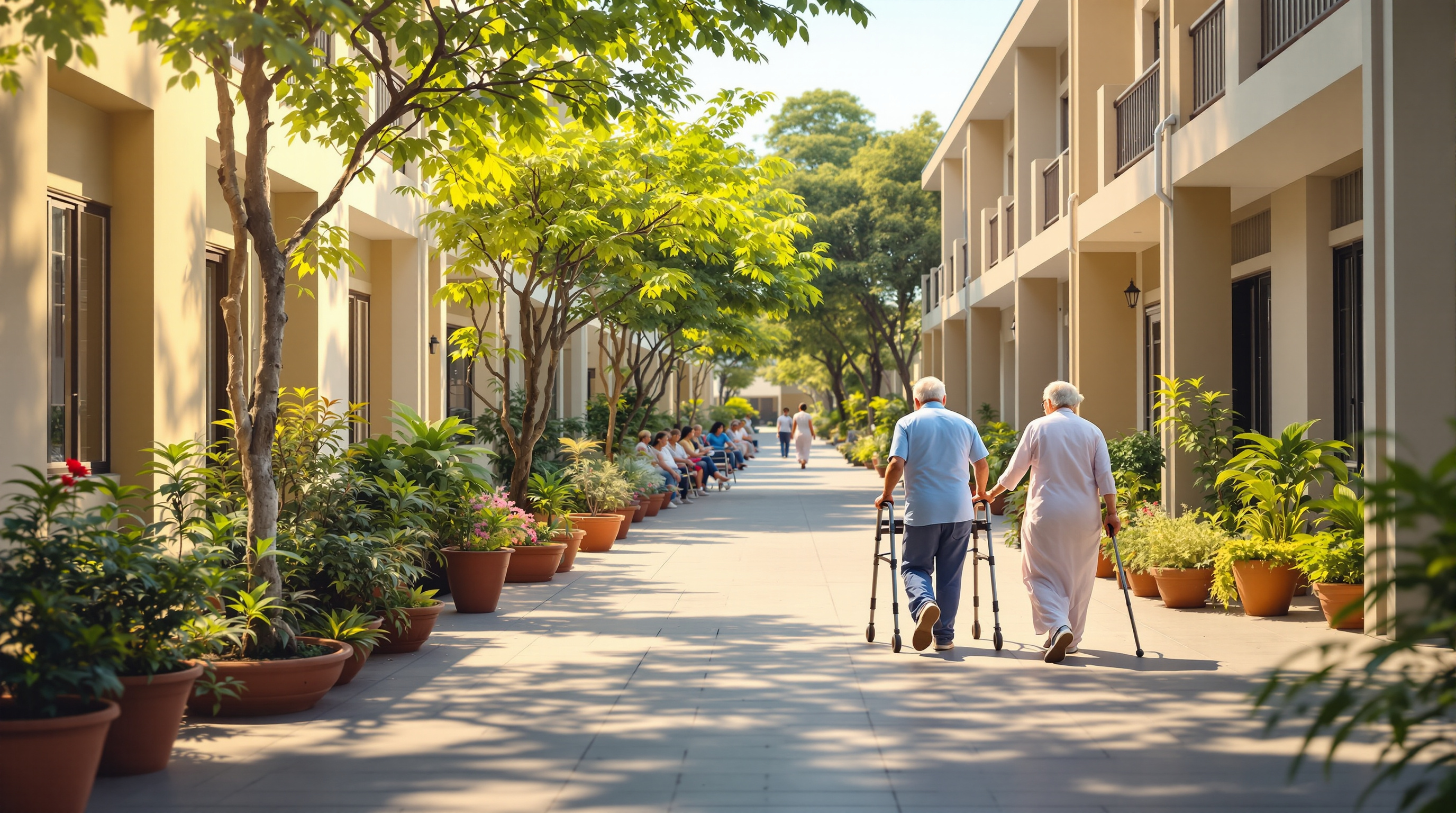
Before choosing any technology, understand what makes this building type's sewage distinct. If you are new to the underlying pollution measures, the wastewater characteristics guide explains BOD, COD, TSS and pH — the numbers every STP design turns on.
Steady, near-100% occupancy. Unlike a hotel or an office, a senior living community runs at full, predictable occupancy almost all year. Residents are present through the day, so per-capita water use sits at the higher end of the residential range — think 120–135 litres per person per day (LPCD) of supply for independent-living residents, higher again for assisted or care wings with staff, dining and laundry.
A gentler daily curve. There is no 7 a.m. school-and-office rush. Morning and evening peaks still exist, but they are broader and softer, spread across a slower routine. That means the equalisation tank works less against violent surges and more against a long, even baseline load — which actually helps biological stability.
Distinctive contaminants. Three things set senior living sewage apart from an ordinary apartment:
- Higher soft-water and detergent load. Frequent bathing, personal laundry and softened water raise surfactant and sometimes sodium content, which can nudge sludge behaviour.
- Pharmaceutical residues and clinical soft-loads. A care or nursing wing contributes trace medical waste. This is still domestic sewage suited to an STP — not industrial effluent needing an ETP — but the design should not be surprised by it.
- Wipes, adult incontinence products and cloth. This is the single most under-estimated challenge. These items clog bar screens and jam pumps relentlessly, and they are far more common here than in a family apartment.
Which STP technology suits — and why
The brief writes itself: quiet, odourless, reliable, forgiving to operate, and capable of reuse-grade water. That points firmly toward a handful of proven biological systems.
| Technology | Why it fits senior living | Watch-outs |
|---|---|---|
| MBBR (guide) | Compact, low sludge, stable through load swings, tolerant of a hands-off operator | Effluent needs good tertiary polishing for garden reuse |
| SBR / Extended Aeration (guide) | Very stable, robust, handles steady loads gracefully, simple to run | Slightly larger footprint; batch cycles need reliable controls |
| MBR (guide) | Highest, most consistent effluent quality — ideal for gardens residents touch | Higher capital and power cost; membranes need disciplined upkeep |
For most independent-living and mid-sized communities, MBBR or Extended Aeration/SBR hits the sweet spot of reliability and low operator burden. Where the treated water will irrigate therapeutic gardens, water features or lawns that residents walk barefoot on — or where a care wing raises the quality bar — MBR earns its higher cost by producing consistently clear, near-pathogen-free water. To weigh how any of these actually cleans the water stage by stage, see how an STP works.
Whatever the core process, three design moves matter more here than almost anywhere:
- Design for silence. House blowers — the loudest component — in an acoustic enclosure, on anti-vibration mounts, sited away from bedrooms and sit-out gardens. Specify low-noise blowers even at a premium.
- Design for zero odour. Keep tanks covered, vent through a carbon or biofilter deodoriser, and avoid the septic conditions that cause smell. A single bad-air day near a senior's balcony generates complaints for weeks.
- Design for redundancy. Standby blowers and duty/standby pumps are not luxuries. A community that cannot tolerate a two-day outage needs equipment that fails over automatically.
Sizing it right
Sizing starts, as always, from occupancy and water use — but with senior living you must resist the temptation to copy generic apartment numbers.
1. Count every resident and staff member, and separate independent-living, assisted-living and care-wing populations, since their LPCD differs.
2. Estimate water supply, then take sewage generation as roughly 80% of supply for the domestic streams, adding kitchen/dining and central laundry as distinct loads.
3. Apply the higher residential LPCD band to reflect all-day presence.
4. Add a peak factor — gentler than an apartment's, but still real — and build in redundancy on top.
The fastest way to convert a headcount into a design number is the STP Capacity Calculator, which turns occupancy into a treatment capacity in kilolitres per day (KLD) — the figure every layout, tank and blower is then sized around. Cross-check the flow assumptions with the sewage generation calculator.
A practical caution: do not undersize on the assumption that seniors use less water. The opposite is usually true — full-day occupancy, frequent bathing, laundry and medical washing often push demand above a comparable family apartment per head.
Reuse for therapeutic gardens

This is where a well-planned STP becomes a genuine amenity rather than a buried cost. Treated water in a senior living community naturally flows to:
- Toilet flushing — piped back in a separate line, the largest single reuse.
- Landscape and therapeutic-garden irrigation — the shaded walking paths, raised planters and lawns that are central to residents' wellbeing and physiotherapy.
- Water features and fountains — only where effluent quality is genuinely reuse-grade, since residents are close to it.
- Common-area washing and groundwater recharge.
Because residents interact so directly with the landscape, aim treated water at the reuse-grade end — BOD and TSS in the single digits — and disinfect reliably. But mind the disinfection method: over-chlorination leaves a smell that respiratory-sensitive elderly residents notice immediately. Many senior communities favour UV disinfection, or a carefully controlled low chlorine residual, precisely for odour comfort. For the fuller reuse and integration picture across a residential campus, the approach in the gated communities STP guide maps closely onto senior living layouts.
Compliance notes
A senior living community follows the same regulatory spine as any residential development in India: consent to establish and operate from the State Pollution Control Board, treatment to the applicable CPCB / state treated-water standards, and layout that respects NBC provisions for on-site treatment and reuse plumbing. Projects above the relevant size threshold must install an STP and demonstrate compliant effluent to secure occupancy approval. Because a nursing or care wing can raise scrutiny, document that its wastewater is domestic-strength and handled within the STP's design envelope rather than requiring separate effluent treatment.
Common mistakes and challenges
- Placing blowers near residences. The most frequent, most expensive-to-fix error. Locate and enclose them for silence from day one.
- Odour breakthrough near sit-outs and gardens. Uncovered tanks or unfiltered vents ruin the very spaces the community was built around.
- Screen and pump clogging from wipes and incontinence products. Specify robust screening and educate housekeeping; this is a daily O&M reality here, not an edge case.
- Over-chlorination. Chasing disinfection with excess chlorine creates a smell that irritates elderly residents — tune the dose or use UV.
- No redundancy. A single-blower, single-pump plant will eventually fail on the one day it must not.
- Under-sizing on the "seniors use less" myth. All-day occupancy usually means more flow per head, not less.
- A design that assumes an expert operator. These plants are often run by a small facilities team; favour forgiving, low-intervention technology and clear automation.
The bottom line
A stp for senior living succeeds or fails on three quiet virtues: it must be reliable enough that residents never think about it, silent and odourless enough that they never sense it, and clean enough that its water safely nourishes the gardens they walk in every morning. Get the technology choice, the noise-and-odour engineering, the honest sizing and the redundancy right, and the plant disappears into the landscape exactly as it should.
From here, browse the full Sewage Treatment Plants guide library for technology deep-dives, and spend a minute with the STP Capacity Calculator to turn your community's headcount into the KLD figure your design begins from.
Export this guide
Related Guides — Deep-dive reading
STP for Hotels: High Per-Guest Loads, FOG & Water Reuse Explained
Why hotel wastewater is heavier and swingier than an apartment's, which STP technology (MBBR vs MBR) actually fits, how to size for peak occupancy, and where the treated water pays for itself — in laundry, cooling and landscape.
Sewage Treatment PlantsHome Greywater Recycling Systems: Simple Reuse at Home
How a single house can recycle its bath, basin and laundry water for flushing and gardens — without a full sewage treatment plant. What to build, how to size it, where to reuse it, and the mistakes that turn a clever system into a smelly one.
Sewage Treatment PlantsApartment STP Planning Guide: Sizing, Space & Compliance
How to plan a sewage treatment plant for an apartment complex — sizing it from occupancy, choosing the right technology, finding space for it, plumbing it for reuse, and keeping it compliant and running for years.
Sewage Treatment PlantsRelated Tools — Try Free
Sewage Generation Calculator
Estimate the daily sewage a building generates and its peak flow in KLD from occupancy, LPCD, sewage return factor and peak factor.
STP CalculatorApartment STP Planner
Plan an apartment complex sewage treatment plant from flats and occupancy — get population load, sewage flow, recommended STP capacity in KLD, treatment technology and approximate space.
PlannerHealing View Impact Calculator
Evidence-Based Design dashboard quantifying the recovery impact of nature view + daylight factor on analgesic use, length of stay, and HCAHPS patient-experience uplift. Calibrated against Ulrich 1984 (Science), Park & Mattson 2008, and the CHD EBD evidence base.
EBD Calculator