
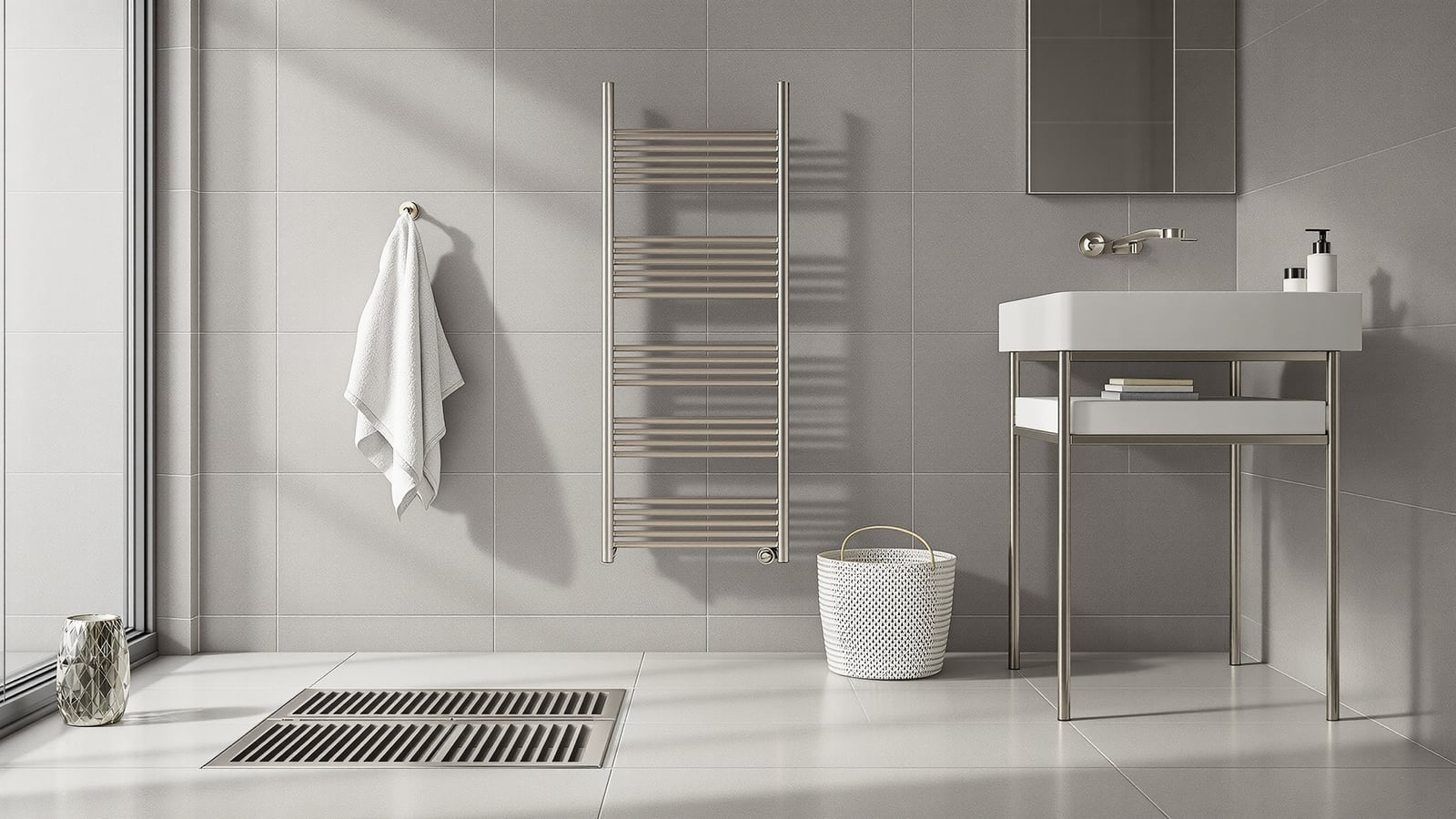
Stainless Steel Bathroom India: SS304 vs SS316, Rust-Proof Vanities, Shelves, Bars & Drains
The rust-proof workhorse of the Indian bathroom. Which grade actually resists corrosion in humid and coastal air (SS304 vs SS316), where stainless earns its place — vanity carcass and legs, shelves, towel bars, counters and floor drains — why finish and grade matter, how to beat hard-water spotting, and honest ₹ costs.
Nothing else in the Indian bathroom fails as quietly as the wrong metal. A chrome-plated towel bar blisters at the joint within two monsoons, a plywood vanity carcass swells and delaminates the moment water finds the cut edge, and a cheap floor drain pits and stains until it looks worse than the tile around it. Stainless steel is the answer to all three — the rust-proof workhorse that shrugs off 90% humidity, daily health-faucet splash and hard-water crust for a decade or more, if you pick the right grade and the right finish.
The catch is that "stainless" is not one material. It is a family of alloys, and the difference between SS304 and SS316 — or between a real stainless fitting and a mild-steel one flashed with a thin chrome skin — is the difference between a fitting that outlives the renovation and one that streaks orange in a year. This guide is India-first and practical: which grade to buy for inland versus coastal air, where stainless genuinely earns its place in the bathroom, why brushed beats mirror finish for real life, how to deal with hard-water spotting, and what it all costs.
This is a materials guide in the Studio Matrx bathroom hub. Read it up to the bathroom vanity guide for India for the main storage decision, and alongside bathroom open shelving, floor drains and traps and bathroom safety accessories.
Buy the grade, not the badge. A fitting stamped "stainless" tells you almost nothing — SS202 rusts, SS304 does not, and only SS316 survives salt air. Ask for the grade in writing, and for anything near the coast or the shower, pay the small premium for 304 as your floor, 316 as your ceiling.
What "stainless" actually means
Stainless steel resists rust because chromium in the alloy forms a microscopically thin, self-healing oxide layer over the surface. Scratch it and it re-forms; that passive film is the whole trick. But the amount of chromium and nickel — and the presence of molybdenum — varies enormously by grade, and that is exactly what decides how it behaves in a wet, sometimes salty, Indian bathroom.
- SS202 — the cheap grade you find on budget fittings and no-name accessories. Low nickel, high manganese. It looks identical to 304 on the shop shelf and rusts within months in a bathroom. Refuse it for anything wet.
- SS304 — the workhorse. Roughly 18% chromium, 8% nickel (the classic "18/8"). Excellent corrosion resistance in normal humid and hard-water conditions. This is the right default for almost every inland Indian bathroom.
- SS316 — "marine grade". Adds around 2% molybdenum, which dramatically improves resistance to chlorides — salt spray, coastal air, pool and heavily chlorinated water. The right choice within a few kilometres of the sea, or for anything permanently in the splash zone.
The single most useful habit is a field test on site: a small magnet. Ferritic and low-grade steels are strongly magnetic; austenitic 304 and 316 are only weakly magnetic or non-magnetic. A magnet that grabs hard is a warning sign, not proof of a fake, but combined with a grade written on the invoice it keeps most 202 out of your bathroom.
Where stainless earns its place
Stainless is not the answer to everything — a whole bathroom clad in steel is cold and clinical. Use it where its rust-proofing genuinely beats the alternatives.
- Vanity carcass and legs. This is the strongest case. Plywood and MDF carcasses rot from the cut edge the day water gets under the laminate; a stainless carcass or, at minimum, stainless legs and toe-kick simply cannot. A powder-coated SS304 frame with a stone or solid-surface top is one of the most durable vanities you can build in India. See the full comparison in the bathroom vanity guide.
- Open and corner shelves. Slim, strong and unaffected by damp — stainless is a natural for shower caddies and corner shelves that live permanently in the splash. It pairs well with the glass and teak options in the open shelving guide.
- Towel bars, rings, robe hooks and accessories. The classic failure point. A real SS304 towel bar outlives three chrome-on-brass ones. Grab bars for the elderly must be structural stainless, never decorative — covered in bathroom safety accessories.
- Counters and integrated sinks. Less common in homes, universal in commercial and institutional bathrooms because a seamless welded steel counter with an integral basin has no joint to leak and no grout to stain.
- Floor drains, gratings and channel drains. A stainless grating stays bright while a chromed-brass or mild-steel one pits and discolours. For linear channel drains and tile-insert gratings, 304 is standard and 316 is worth it in coastal homes — see floor drains.
| Component | Grade to specify | Why stainless wins here | Watch out for |
|---|---|---|---|
| Vanity carcass / legs | SS304 | Rot-proof, unlike ply / MDF | Thin gauge that flexes |
| Corner & open shelves | SS304 (SS316 coastal) | Damp-proof, slim, strong | 202 look-alikes |
| Towel bars & hooks | SS304 | Outlasts chrome-on-brass 3:1 | Hollow flimsy tubing |
| Grab bars (safety) | SS304, structural | Load-bearing, corrosion-proof | Decorative-only bars |
| Counter / integrated sink | SS304 | Seamless, no leak joint | Visible weld lines |
| Floor drain & grating | SS304 / SS316 | Stays bright, will not pit | Chrome-flashed mild steel |
Why grade and finish both matter
Grade decides whether it rusts. Finish decides how it looks after a week of real use — and in a hard-water Indian bathroom, that matters more than most buyers expect.
- Mirror / high-polish finish looks spectacular in the showroom and shows every water droplet, fingerprint and mineral spot the moment it is installed. On hard water it needs wiping after almost every use to stay looking good.
- Brushed / satin (matte) finish has a fine directional grain that scatters light. It hides water spots, fingerprints and minor scratches far better, and stays presentable with a fraction of the wiping. For Indian bathrooms — hard water, busy family use — brushed is almost always the smarter choice.
- PVD-coated finishes (matte black, brushed gold, gunmetal) are a physical-vapour-deposited colour layer over stainless. Good ones are genuinely durable; on the coast, insist the base metal under the PVD is 316, because the coating protects the look, not the steel.
On hard water, finish is not just cosmetic — it is a maintenance decision. A brushed SS304 fitting looks acceptable with a weekly wipe; the same fitting in mirror polish demands a daily one. Choose brushed and you buy yourself less housework for years.
Hard water, spotting and keeping steel bright
Stainless does not rust in normal use, but Indian hard water leaves a white or chalky mineral crust — calcium and magnesium scale — that people mistake for the steel "going off". It is deposit sitting on the surface, not corrosion of the metal, and it wipes away. True rust-coloured staining on a fitting almost always means it was low-grade 202, or that a nearby iron object (a rusting screw, steel wool left on the surface) bled onto it.
- Wipe dry after use where you can — a quick pass on the towel bar and counter stops spots before they build.
- Descale weekly with diluted white vinegar or a mild citric-acid cleaner; leave it a few minutes on stubborn scale, then rinse and dry. This lifts hard-water crust without harming the passive layer.
- Never use steel wool, harsh abrasives or chlorine bleach on stainless. Steel-wool fibres embed and rust; bleach attacks the chromium film. A soft cloth or a nylon pad is enough.
- Wipe along the grain on brushed finishes so any fine marks follow the existing brush lines and disappear.
- A whole-house softener or the point-of-use approach in the hard-water context reduces spotting on everything, stainless included.
The cost picture
Stainless costs more than chrome-plated or laminated alternatives up front, and repays it in not replacing things. Ballpark fitted ₹ ranges for a typical mid-range Indian city, SS304 unless noted:
| Item | Typical ₹ | Notes |
|---|---|---|
| SS304 towel bar, 600 mm | ₹600–1,800 | vs ₹250–600 chrome-on-brass that fails sooner |
| SS304 robe hook / ring | ₹250–900 each | brushed hides marks best |
| SS304 corner / shower shelf | ₹500–1,500 | 316 adds ~20–30% |
| SS304 grab bar (structural) | ₹900–2,500 | never buy decorative-only |
| SS floor drain + grating | ₹450–2,500 | 316 for coastal |
| Stainless vanity legs + toe-kick | ₹1,200–3,500 | cheap insurance under any cabinet |
| Full SS304 vanity carcass + frame | ₹12,000–35,000 | before top; rot-proof for life |
| Integrated SS counter + basin (fabricated) | ₹18,000–60,000 | commercial-grade seamless |
The premium for SS316 over SS304 is usually 20–40% on a given item — trivial on a towel bar, worth budgeting for coastal homes across every wet fitting. And the cheapest, highest-return move of all is simply putting stainless legs under a cabinet that would otherwise sit on the wet floor — a few thousand rupees that saves the whole carcass. Decide grade and finish during bathroom planning so the coastal-versus-inland call is made once, for everything.
References
- NBC 2016 (National Building Code of India), Part 9 — plumbing and sanitation services; fittings, drainage and bathroom fit-out context.
- IS 6911 — Stainless steel plate, sheet and strip: the grade specification (including 304 and 316 designations) behind bathroom fabrication.
- IS 6603 / IS 1570 — Stainless steel bars and chemical composition of alloy steels: grade definitions for fittings and hardware.
- IS 2556 — Vitreous sanitary appliances specification, for the sanitaryware stainless fittings sit alongside.
- IS 1172 — Basic requirements for water supply, drainage and sanitation, relevant to floor drains and gratings.
- CPWD Specifications — workmanship and material references for stainless steel fixtures and bathroom finishing.
Export this guide
Related Guides — Deep-dive reading
Bathroom Accessories Buying Guide India: How to Choose Towel Bars, Hooks, Holders & Hardware That Won't Rust
A buyer's decision guide to bathroom accessories and hardware for Indian homes — which material actually survives humidity (SS304 vs SS202 vs brass vs zinc vs plastic), concealed vs exposed fixing, matching finishes, ready-made sets vs individual pieces, good/better/best budget tiers, warranty, and how to spot cheap chrome-plated plastic sold as steel.
BathroomsBathroom Open Shelves India: Floating, Ladder, Niche & Corner Shelving That Survives Damp
A practical guide to open shelving in Indian bathrooms — floating, ladder, recessed-niche and corner shelves — which damp-proof materials actually last (teak, stainless, glass, WPC — never raw MDF), how to style them without clutter, where open shelves beat closed cabinets, how to fix them into tiled walls, and honest ₹ costs.
BathroomsHow to Choose a Bathroom Faucet in India: A Buyer's Guide to Cartridges, Brass & Fakes (2026)
A buyer's decision guide to CP fittings — the ceramic-disc cartridge that decides life in hard water, the brass-vs-zinc weight test, finish durability, warranty, honest good/better/best rupee tiers, and how to spot the huge fake-faucet problem in the Indian market.
BathroomsRelated Tools — Try Free
Cross-Ventilation Analyzer
Estimate airflow and air changes per hour (ACH) from room size, window areas, layout, and local wind — with NBC 2016 Part 8 compliance check.
Ventilation CalculatorMaterial Comparison Sheet
India's interior material cheatsheet — plywood, finishes, hardware, countertops, paints, waterproofing.
Reference GuideMonsoon-Readiness Checklist
Pre-rain home audit across 9 categories — terrace, drains, waterproofing, electrical, HVAC, pest, vehicles, documents.
Seasonal Audit