
Floor Drain India: Nahani Trap, Linear Drains & Anti-Odour Floor Traps (2026)
The round nahani grating versus modern linear channel drains, self-sealing anti-odour and anti-cockroach traps, the floor slope that makes any drain work, grating finishes, how many you need, cleaning and rupee ranges — built for the Indian whole-floor-wet bathroom.
Every Indian bathroom is, at heart, a room designed to get wet all over. We wash with a bucket and mug, spray a health faucet beside every WC, and rinse the whole floor to clean it. The single component that decides whether that water leaves quickly and quietly — or pools, smells and breeds mosquitoes — is the floor drain. It is the least glamorous fitting in the room and the one people notice most when it fails: the gurgle, the sewer whiff at 2 a.m., the cockroach that came up the pipe.
This guide is India-first. It covers the humble round nahani trap you grew up with, the modern linear (channel) drain taking over premium bathrooms, the anti-odour and anti-cockroach traps that stop what comes back up, and the floor slope and placement that make any of them actually work. Read it alongside the bathroom plumbing guide for India for the whole waste-and-supply picture, the plumbing traps guide for how water seals work, and the wet room design guide if your whole floor is the shower.
A floor drain is only as good as the slope feeding it and the water seal below it. A ₹4,000 designer grating over a flat floor and a dry trap will still pool and stink; a ₹300 trap on a correct fall stays sweet for years.
What a floor drain actually is
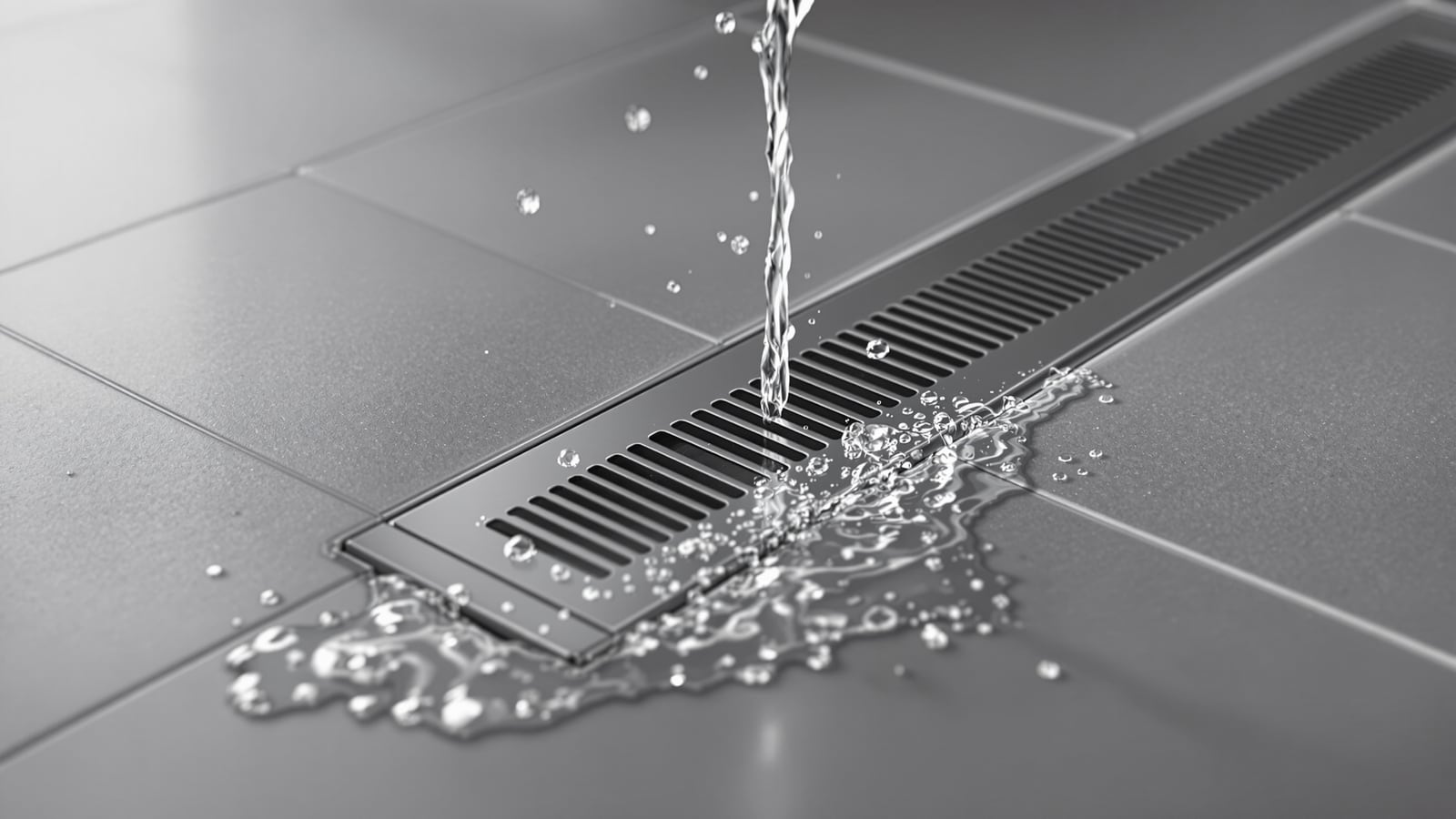
A "floor drain" is two things stacked together: a trap below the floor that holds a plug of water to block sewer gas, and a grating at the surface that catches hair and debris while letting water through. In Indian usage the whole assembly is the nahani trap (from nahana, to bathe) or simply floor trap.
- The trap is a P- or bottle-shaped chamber that stays permanently full of water. That water plug is your only barrier against foul sewer gases and, crucially, against cockroaches and insects crawling up the waste line. Lose the seal — through evaporation in an unused bathroom, or a badly vented line siphoning it dry — and the smell arrives.
- The grating is the visible face: a square or round perforated plate, or a long slotted channel. It filters solids and is the part you clean.
- The outlet connects to the waste pipe (typically 50 mm / 2 inch for a floor trap) which runs to the stack and down to the gully trap outside.
Get all three right and the floor is dry within a minute of the last mug of water. Get the trap wrong and you have a permanent low-grade smell no amount of phenyl will fix.
Round nahani grating versus linear channel drain
The classic Indian floor drain is a 100–150 mm square or round grating dropped over a bottle or P-trap in the middle or corner of the floor. It is cheap, universal and every plumber can fit it. The modern alternative is the linear (channel) drain — a long, narrow slot, typically 300–1200 mm, that runs along a wall or across the shower entry.
The difference is not only looks. A linear drain lets the floor fall in a single direction (one plane), which is far easier to tile flat and cleaner underfoot than the four-way "dish" fall a central round drain forces. That single-plane fall is why linear drains dominate walk-in wet rooms and large-format tiling — you avoid cutting big tiles into a shallow pyramid.
| Feature | Round nahani trap | Linear / channel drain |
|---|---|---|
| Typical size | 100–150 mm grating | 300–1200 mm slot |
| Floor fall needed | Four-way (dish) to a point | Single-plane, one direction |
| Best tile size | Small / mosaic | Large-format, even 600–800 mm |
| Drainage rate | Adequate | High — clears bucket floods fast |
| Cost (fitting + grating) | ₹300–₹2,500 | ₹3,000–₹18,000+ |
| Cleaning | Lift grating, clear hair | Lift full channel, remove basket |
| Best for | Standard Indian bathroom | Walk-in showers, wet rooms, premium |
For a normal family bathroom washed with a bucket, a good round nahani trap is perfectly correct and far cheaper. Spend on a linear drain where the shower is open (no tray, no kerb), where you are using large tiles, or where the look matters. Many Indian bathrooms sensibly use both: a linear drain at the shower and a discreet round nahani near the WC and bucket area.
Anti-odour and anti-cockroach traps
This is where cheap and good part ways. A plain floor trap relies only on its standing water. In a guest bathroom used twice a month, that water evaporates and the seal breaks — hence the "empty house smell". The fix is a self-sealing (anti-odour) trap insert: a silicone membrane, flap or floating ball that stays shut when dry and opens only under water flow. It gives you a second barrier that works even when the water plug has gone.
- Membrane / duckbill insert — a soft silicone flap that water pushes open and springs shut behind. The most common retrofit; drops into an existing nahani.
- Floating-ball / cup insert — a light cup rises to let water pass and seats back down to seal. Good against insects.
- Deep-seal bottle trap — a moulded trap with a 50–75 mm water seal (versus the shallow 25 mm of cheap traps) that simply holds water longer against evaporation.
- Anti-cockroach net/basket — a fine stainless basket that stops roaches and catches hair in one part.
For an Indian home, insist on a deep seal (50 mm minimum) plus a self-sealing insert in any bathroom that sits unused — guest baths, second-floor baths, holiday homes. It is a ₹150–₹700 upgrade that ends the single most common bathroom complaint. See the plumbing traps guide for how seal depth and venting interact so the trap is not siphoned dry in the first place.
Slope: the part everyone gets wrong
No drain works on a flat floor. Water needs a fall of 1:50 to 1:80 (roughly 12–20 mm drop per metre) toward the grating so it runs off instead of pooling. In our whole-floor-wet bathrooms this is not optional — the entire floor should shed toward the drain, not just a shower tray.
- Round drain: the floor must fall from all four sides to the central or corner grating — a shallow dish. Harder with big tiles, which is why small tiles suit central drains.
- Linear drain: the floor falls in one direction only, toward the channel. Easiest to tile flat and the reason linear drains pair with large-format tiles.
- Check before tiling: pour a bucket of water on the finished screed. It should run to the grating and leave no puddle. Fixing a flat floor after tiling means demolition — verify at screed stage.
Set the grating flush with or 2–3 mm below the finished tile, never proud of it, or water dams behind the rim. This slope-and-flush detail is exactly where good waterproofing and floor build-up meet the drain; the trap body must be sealed into the waterproof membrane so leaks cannot bypass it.
Gratings, finishes and placement
The grating is the one part you see and touch. Options in the Indian market:
- Stainless steel (SS 304) — the default; matte/brushed hides water spots, mirror-polished shows every mark. Choose 304 grade for hard-water corrosion resistance.
- Tile-insert grating — a shallow tray you fill with a piece of the floor tile, so the drain almost disappears. Popular in premium linear drains.
- PVC / ABS — cheapest, fine for utility and service bathrooms; can discolour over time.
- Anti-cockroach basket — a removable fine mesh inside the grating that also catches hair.
On placement: keep the drain away from the doorway (water should never run toward the door), position it at the lowest, wettest zone — under the shower and near the health-faucet/bucket area — and never directly under where you stand to bathe, so you are not on the grating. Match grip too: a floor that sheds fast still needs anti-skid tiles around the wet drain zone, because that is exactly where you are barefoot and soapy.
Cleaning and maintenance
Floor drains fail for two boring reasons: hair/debris clogs and dry traps.
- Weekly: lift the grating, pull out the hair mat and grit. A hair catcher or anti-cockroach basket makes this a five-second job.
- Monthly: pour a mug of water down any drain in a bathroom you rarely use, to top up the seal and keep insects out.
- Occasionally: flush with hot water and a little baking soda or enzyme cleaner to clear the greasy soap-scum film. Avoid strong acid down PVC lines.
- If it gurgles or smells: the trap is being siphoned dry or the line is poorly vented — a plumbing/venting fix, not a cleaning one. The bathroom plumbing guide covers venting.
| Item | Typical India range (2026) | Note |
|---|---|---|
| PVC/ABS floor trap + grating | ₹150–₹600 | Service / utility bathrooms |
| SS 304 nahani grating (100–150 mm) | ₹300–₹2,500 | Standard bathroom, matte hides marks |
| Self-sealing anti-odour insert | ₹150–₹700 | Retrofit into existing nahani |
| Deep-seal bottle trap | ₹400–₹1,500 | 50–75 mm seal, resists evaporation |
| Linear / channel drain (SS, 300–900 mm) | ₹3,000–₹18,000+ | Tile-insert versions cost more |
| Plumber fitting + slope screed | ₹500–₹2,000 | Getting the fall right is the real value |
References
- National Building Code of India (NBC 2016), Part 9 — Plumbing Services: floor traps, water seals and drainage of wet areas.
- IS 1729 — Sand cast iron spigot and socket soil, waste and ventilating pipes, fittings and accessories (traps).
- IS 12183 (Part 1) — uPVC pipes and fittings for soil and waste discharge, relevant to plastic floor traps.
- IS 2556 — Vitreous sanitary appliances (specification family covering traps and fittings).
- CPHEEO Manual on Sewerage and Sewage Treatment — water-seal depths and trap venting guidance.
- IS 1172 — Basic requirements for water supply, drainage and sanitation.
Export this guide
Related Guides — Deep-dive reading
Bathroom Drainage India: Waste vs Soil Pipes, Slope, Sizes, Traps & Venting (2026)
How a bathroom's waste and soil pipes actually work — the difference between waste lines (basin, shower) and the soil line (WC), the fall you need, pipe sizes in mm, floor slope to the floor trap, how it all joins the stack, and how traps and venting stop blockages and smells.
BathroomsBathroom Leak Prevention India: Detailing the Junctions That Stop Water Reaching the Flat Below
Bathroom leaks almost never come from a broken pipe — they come from a badly detailed junction. Here is how to get the wall-floor corner, pipe penetrations, floor trap, nahani trap and door threshold right, plus the flood test that catches a leak before you tile.
BathroomsBathroom Plumbing Code India: NBC 2016 Part 9, UPC-I & the IS Standards That Govern Pipework
A professional reference to the codes and standards that govern bathroom plumbing in India — the National Building Code (NBC 2016) Part 9 on Plumbing Services, the Uniform Plumbing Code India (UPC-I), the CPHEEO Manual, and the IS standards for water supply, drainage, trap seals, pipe sizing, slopes and venting — with a caveat to always verify the current code and your local authority.
BathroomsRelated Tools — Try Free
Bathroom Floor Slope Calculator
Work out the floor fall to the drain and screed depth from the run and slope ratio — with a drains-properly verdict.
Bathroom CalculatorBathroom Drainage Pipe Calculator
Recommended drain and waste pipe sizes, slopes and stack size for a bathroom's fixtures — indicative IS 1172 / NBC plumbing practice.
Bathroom CalculatorFalse Ceiling Cost Estimator
Live ₹/sqft across 8 ceiling types — POP, gypsum, designer, metal, PVC, wooden — with cove and spot lighting for 20 Indian cities.
Cost Calculator