
How to Choose a Bathroom Faucet in India: A Buyer's Guide to Cartridges, Brass & Fakes (2026)
A buyer's decision guide to CP fittings — the ceramic-disc cartridge that decides life in hard water, the brass-vs-zinc weight test, finish durability, warranty, honest good/better/best rupee tiers, and how to spot the huge fake-faucet problem in the Indian market.
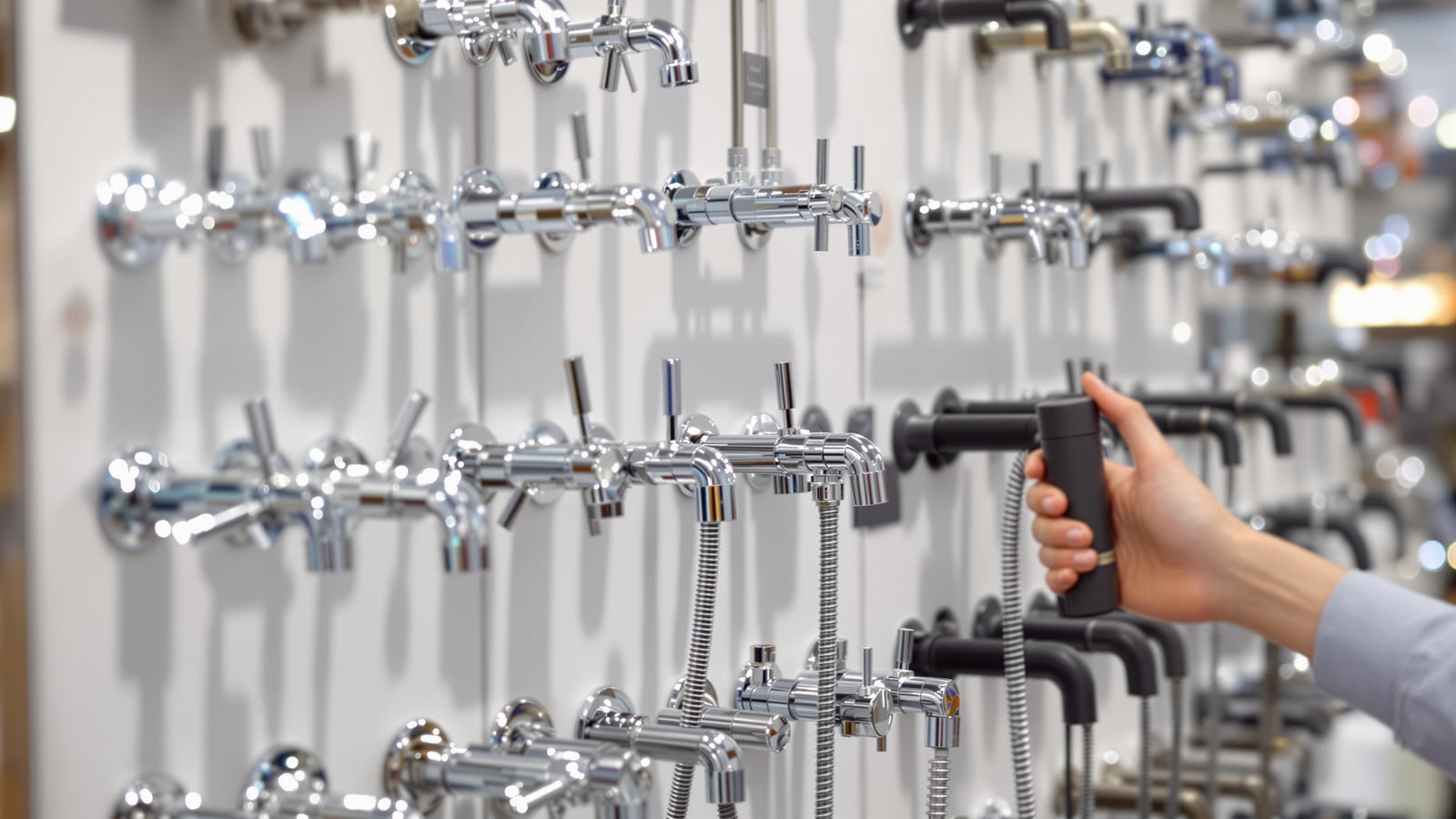
Walk into any sanitaryware showroom in India and you face a glittering wall of near-identical chrome taps, priced anywhere from ₹700 to ₹40,000. The salesperson points at the shiniest one in your budget and you nod. That is exactly how most people end up with a faucet that drips within a year, stains white with scale, or worse — a convincing fake sold at a genuine-brand price. This guide is not about what a faucet is; for the full technical breakdown of every type read the bathroom faucets guide. This is about the decision: the four things that actually decide whether your money is well spent, and how to walk out with the real thing.
The prettiest faucet with a poor cartridge fails first. In Indian hard water, you are buying a mechanism, not a shape — spend where the water actually touches metal.
The 4 things that decide the choice
Ignore the colour and the brochure adjectives for a moment. Only four properties separate a ten-year faucet from a one-year one, roughly in order of importance:
1. The cartridge — the valve inside that controls flow and temperature. It fails first, so it matters most.
2. The body material — genuine brass or cheap zinc alloy. Decides corrosion life.
3. The finish — chrome, PVD, or matte black — and how it is applied. Decides how it looks in year five.
4. The fit to your basin and pressure — spout height, reach, and aerator flow.
Get these four right and the brand name almost takes care of itself. Get them wrong and no logo saves you.
1. The cartridge — the one part hard water attacks
Inside almost every modern mixer is a cartridge: a small replaceable valve. In a single-lever tap it controls both flow and temperature. It is the part that wears, and in India it faces an enemy most brochures never name — hard water. Dissolved calcium and magnesium leave scale that chews through rubber washers and jams cheap valves within months.
- Rubber-washer / compression valves are the old two-handle design. Cheap, but the washer wears and the tap starts to drip. Fine for a garden bib tap, poor for a daily basin.
- Ceramic-disc cartridges use two polished ceramic discs sliding over each other. Nothing wears the way rubber does, and good ceramic resists scaling far better — so a genuine one gives a crisp quarter-turn shut-off with no drip for years.
When buying, ask one question: "Is this a ceramic-disc cartridge, and is it rated for how many cycles?" Good brands quote 200,000+ open-close cycles and will name the cartridge maker. If the salesperson cannot answer, treat the tap as a gamble. This matters most for a concealed faucet whose cartridge is buried in the wall — replacing it means breaking tile, so never economise there. In very hard water, budget for a softener to protect every tap in the house.
2. Body material — the brass-vs-zinc weight test
The biggest hidden difference between a ₹900 tap and a ₹4,000 one is the metal you cannot see.
- Forged or cast brass with high copper content resists corrosion and gives real heft. This is what you want.
- Zinc alloy (ZAMAK) is a cheap die-cast metal that corrodes, cracks at threads, and fails around the aerator — common in fakes and bottom-tier taps.
You can tell them apart in the showroom without any tools:
- The weight test. Pick up two taps of the same size. Genuine brass feels noticeably heavier and denser; zinc feels hollow and light. Heft is the single fastest field check.
- The thread test. Look at the exposed connection threads under the spout. Brass threads are a warm yellow-gold under the plating; zinc often looks grey or silvery where machined.
- The temperature test. Brass feels cool and stays cool to the touch; zinc warms quickly in the hand.
- Ask directly. A reputable seller will confirm "forged brass body" in writing. Vague answers ("it's metal, sir") are a red flag.
3. Finish — what still looks good in year five
The plating decides how the tap ages in humid, monsoon-heavy, hard-water India.
| Finish | Look | Hard-water durability | Price premium |
|---|---|---|---|
| Chrome (CP) | Bright mirror | Proven, easy to wipe; water spots show | Baseline |
| Matte black | Modern matte | Hides spots; scratches show as shiny marks | +30 to 60% |
| Brushed / satin nickel | Warm grey | Very forgiving on spots and fingerprints | +40 to 80% |
| PVD-coated (any colour) | As chosen | Hardest, most scratch- and tarnish-resistant | +40 to 90% |
The one word worth insisting on is PVD (physical vapour deposition) — a vacuum-bonded coating far tougher than ordinary electroplating. If you want black or gold that survives years of wiping, demand PVD rather than a painted or thinly plated finish, which flakes within a year or two. For plain chrome, quality is about plating thickness: good CP fittings are nickel-plated then chrome-plated to a controlled depth, which is exactly what a long finish warranty is really promising.
4. Fit — basin type, spout and flow
Choose the faucet and basin together. Two numbers decide fit: spout height must clear the basin rim enough to get hands under, and spout reach should land the stream near the drain, not the front lip. Tall counter-top bowls need a tall deck mixer or a wall-mounted mixer; standard under-counter basins take an ordinary deck mixer. Match the basin mixer taps guide for spout dimensions. Finally, the aerator caps water use: a good aerated tap gives a full stream at 4–6 LPM versus 8–12 LPM unaerated. On low overhead-tank pressure, choose a pressure-compensating aerator so the flow does not feel weak.
The huge fake-faucet problem — and how to spot it
Counterfeit CP fittings are one of the biggest scams in the Indian bathroom market. Fakes copy the logo, box and finish of brands like Jaquar, Grohe, Cera and Hindware, sell a zinc-alloy body with a rubber-washer valve at a genuine-brass price, and fail within a year. Here is how to avoid them:
- Buy from authorised dealers. Ask for the brand's dealer list; a genuine dealer gives a GST invoice with the brand name and model number, not a hand-written slip.
- Check the box and the tap for the IS/ISI mark. Genuine fittings carry a hologram and a printed model code; verify the hologram or QR against the brand's official app or site.
- Apply the weight test. A "Grohe" mixer that feels light is not a Grohe.
- Distrust the pitch. "Original stock, no bill, half MRP" is the classic fake sale. A real brand's flagship product is rarely 50% off from a roadside counter.
- Register the warranty. Genuine products let you register the serial number online; a fake will fail this step.
- Match the finish quality. Fakes often have visible orange-peel texture, sharp casting seams, or a lever that wobbles.
Good / better / best — the budget table
| Tier | Basin mixer (₹) | What you get | Warranty to expect |
|---|---|---|---|
| Good | 1,500–2,800 | Brass body, ceramic cartridge, chrome | 5–7 years |
| Better | 3,500–7,000 | Forged brass, 200k-cycle cartridge, PVD option | 10 years+ |
| Best | 9,000–20,000+ | Premium brass, branded cartridge, PVD colour | 15 years / lifetime |
The sensible rule: buy in the Better tier for daily bathrooms — it is the value sweet spot where cartridge and finish are genuinely good without paying for a badge. Reserve Best for concealed applications and statement pieces where failure is expensive to fix, and use Good for guest or utility basins.
What to check before you pay — the checklist
- IS 8931 stamp for single-lever fittings (or IS 1701 for pillar/bib taps) on the box or body.
- Written warranty on both cartridge and finish — brands like Jaquar and Grohe advertise long warranties precisely because their cartridge and plating back it up.
- GST invoice with brand name and model number for warranty claims.
- What's in the box: waste coupling, connection pipes, wall flanges — confirm, as some are sold separately.
- Is installation included or extra? A concealed faucet especially needs a skilled plumber.
- Cartridge availability: can you buy a replacement cartridge locally in five years?
Questions to ask the showroom
- Is the body forged brass, and is that stated on the invoice?
- Is the cartridge ceramic-disc, and rated for how many cycles?
- Is the finish PVD or standard electroplating?
- What exactly does the warranty cover, and for how long — cartridge, finish, or both?
- Are you an authorised dealer for this brand, and will the invoice carry the model number?
Online can be cheaper, but a showroom lets you apply the weight test and see the finish in person — and gives you a local face for warranty service. For the deep technical detail on every faucet type, cartridge and finish, read the companion bathroom faucets guide; to see how tapware fits your whole purchase plan, start from the bathroom shopping guide for India.
References
- Bureau of Indian Standards — IS 8931: Copper alloy single-control sanitary fittings (single-lever mixers).
- Bureau of Indian Standards — IS 1701: Copper alloy pillar taps, bib taps and stop valves for water supply.
- National Building Code of India (NBC) 2016, Part 9: Plumbing services and water supply.
- BIS ISI mark and hologram verification: Bureau of Indian Standards guidance on genuine product marking.
- CPHEEO Manual on Water Supply and Treatment, Ministry of Housing and Urban Affairs — water-efficiency and fixture guidance.
Export this guide
Related Guides — Deep-dive reading
Bathroom Faucets India: The Complete Guide to Taps, Cartridges, Finishes & Flow (2026)
Every faucet type explained for Indian bathrooms — pillar taps, basin mixers, single-lever vs two-handle, wall vs deck vs concealed, sensor and thermostatic — plus the ceramic-disc cartridge that survives hard water, CP-fitting quality to IS standards, finishes, aerators and honest rupee ranges.
BathroomsBasin Mixer Tap India: Single-Lever Buying Guide, Spout Height, Cartridge & Cost (2026)
How a single-lever basin mixer blends hot and cold on one control — what supplies it needs, the spout height that matches your basin, the ceramic cartridge that decides its life, pop-up waste, tall vessel mixers, finishes, flow rate, and rupee tiers versus separate pillar taps.
BathroomsHow to Choose a Shower System in India: A Buyer's Guide by Water Pressure, Type & Budget
A buyer's decision guide to picking a shower system for an Indian bathroom — start by measuring your water pressure, then choose overhead, hand, combo or jets, pick concealed versus exposed, and buy the right finish, warranty and ₹ tier without getting sold a fake.
BathroomsRelated Tools — Try Free
Stamp Duty Calculator — All Indian States
Stamp duty + registration charges for all 28 states and 8 UTs — gender concessions, urban/rural variants, metro cess built in.
Stamp DutyHome Colour Studio
Colour every room — living, bedroom, dining, kitchen, bathroom — surface by surface in any HEX/RGB/CMYK colour, or from 80+ curated Indian shades.
Colour StudioMaterial Quality Evaluation Checklist
20-point checklist to evaluate interior materials before signing off at delivery.
Quality Checklist