
Bathroom Safety Accessories India: The Fall-Safe Kit (Grab Bars, Anti-Slip, Seats & SOS) (2026)
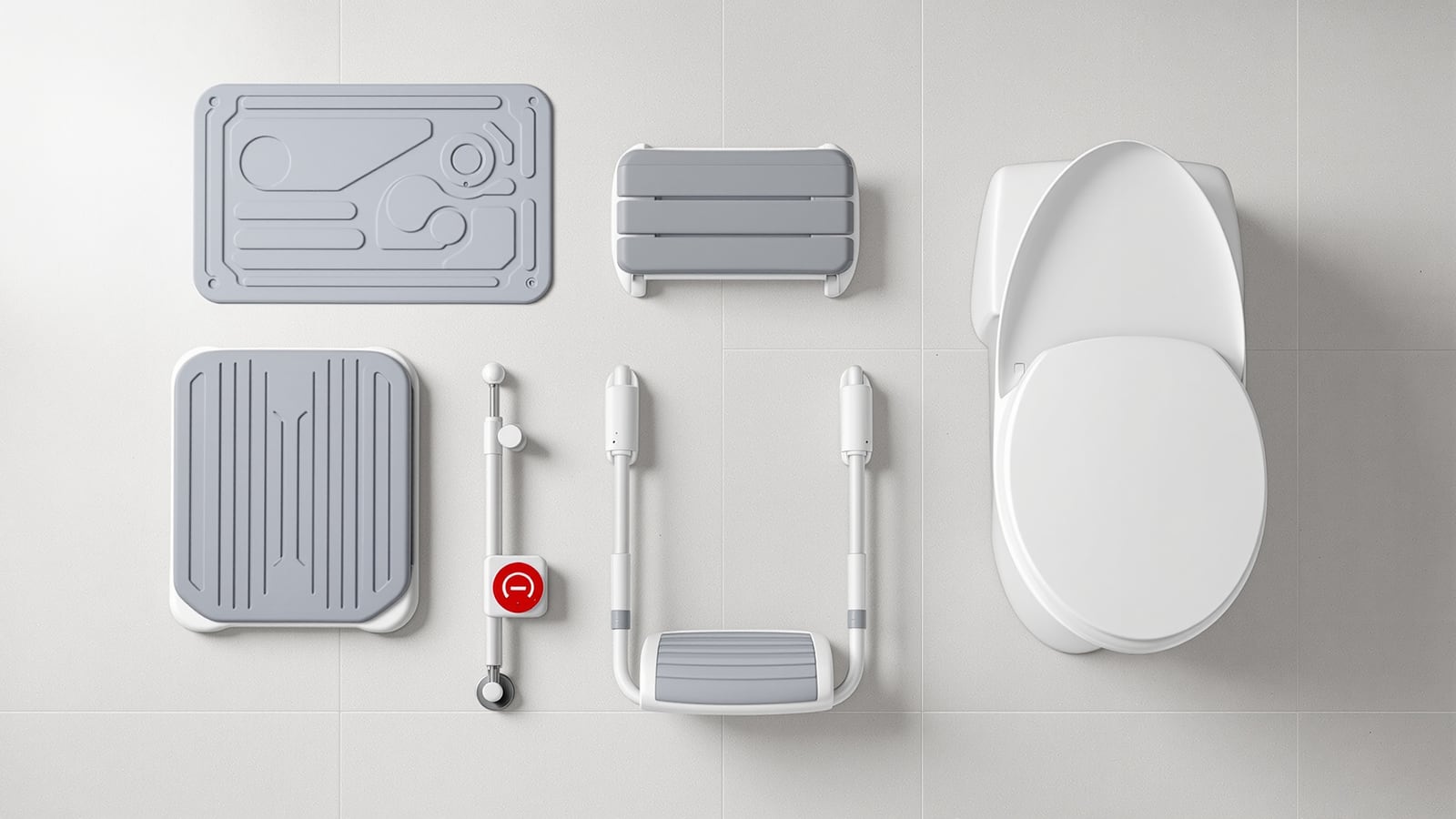
The full retrofit kit that turns a slippery Indian bathroom into a fall-safe one — anti-slip mats and strips, a shower stool, grab bars, an anti-scald thermostatic control, a raised toilet seat, an SOS button, corner guards, non-slip footwear and night lighting — with mm sizes, rupee costs and a room-by-room checklist.
Most bathrooms in Indian homes are built dry and used wet. A tile that looks fine in the showroom turns into a skating rink the moment a health faucet, a bucket bath or a shower puts a film of soapy water on it. Add hard fittings at knee and skull height, a threshold to step over and often a single dim bulb, and the bathroom quietly becomes the most dangerous room in the house — the place where most falls at home happen. You do not always get to rebuild it. What you can almost always do is retrofit a kit of safety accessories that catches the person before the floor does.
This guide is the shopping list and fitting plan for that kit. It is India-first: rupee costs, hard-water and monsoon-humidity realities, the wet-bathroom-with-health-faucet layout, and the apartment-society constraint that you often cannot move a drain or drill a shared wall without permission. Read it as the accessories companion to the elderly friendly bathroom guide, which covers the room-level design, and reach for the deeper single-topic guides where they exist: bathroom grab bars, accessible bathroom design and anti-skid bathroom tiles.
A safety accessory is only as good as the day the person actually needs it. Fit for the worst day — the stiff knee, the wet floor, the dim 2 a.m. trip — not the average one.
Start with the two failures you are preventing
Nearly every serious bathroom injury is one of two events. The slip-and-fall: a foot loses grip on a wet floor or in a slick tub, and the person goes down onto hard ceramic. The scald: a sudden slug of hot water — common in India when a geyser and a booster pump share a line and a tap elsewhere is opened — hits skin that cannot pull away fast enough. The kit below is organised around stopping both, then around getting help fast when something still goes wrong.
The fall-safe accessory kit
Here is the core kit, what each item does, and a realistic installed price. Treat it as a menu — most homes need the top half; households with a frail, disabled or very young user need most of it.
| Accessory | What it prevents | Typical size / spec | Cost (₹, supply + fit) |
|---|---|---|---|
| Anti-slip mat (suction base) | Slip in the wet zone / tub | 400×600 to 500×800 mm, PVC/rubber | 300–1,200 |
| Anti-slip adhesive strips/treads | Slip in tub, on steps, at threshold | 25–50 mm wide rolls/discs | 200–800 |
| Shower stool / fold-down seat | Fall while standing to bathe | Stool ~300 mm dia; wall seat 400×350 mm | 900–7,000 |
| Grab bar (stainless steel) | Loss of balance sitting/standing | 32 mm dia, 450/600 mm long | 700–3,000 each |
| Thermostatic anti-scald mixer | Scald from sudden hot surge | Caps outlet ~38–43 °C | 6,000–22,000 |
| Raised toilet seat / commode chair | Fall lowering onto/rising from WC | Raiser +50–120 mm; chair adjustable | 1,200–6,500 |
| Emergency SOS / call button | Being stranded after a fall | Wireless pager or pull cord | 1,500–6,000 |
| Corner guards / edge cushions | Head/limb injury on impact | Foam or silicone on counters, sills | 150–600 |
| Non-slip footwear (bath slippers) | Slip walking in/out wet | Rubber sole, drainage tread | 200–700 |
| Motion night light (IP-rated) | 2 a.m. trip in the dark | 0.5–3 W LED, warm 2700 K | 300–1,500 |
Anti-slip mats and strips — the cheapest big win
The floor is where the money should go first because it is the cheapest thing to fix. A suction-base anti-slip mat in the shower or bucket-bath zone gives instant grip on any tile; check that the suction cups actually hold on your tile texture (they grip glossy tiles better than rough anti-skid tiles) and lift and dry it weekly so black mildew and pink slime do not grow underneath in the humidity. For bathtubs and for the threshold lip, adhesive anti-slip strips or treads are better — they do not shift and they do not trap water. If you are re-tiling anyway, do the job properly at the surface with genuinely anti-skid bathroom tiles rated R10–R11 and a wet-barefoot rating of at least Class B (PTV/ramp); a mat is a patch, the tile is the cure.
A place to sit — stool or fold-down seat
Standing on one leg to wash the other, on a wet floor, is how a lot of falls start. A plastic shower stool with rubber feet (₹900–2,500) is the no-drilling answer and doubles as a bucket rest. Better, where the wall can take it, is a fold-down wall seat (400×350 mm, rated 100–130 kg) mounted with the top 450–480 mm above the finished floor — the same height as a chair, so sitting and rising is natural. It folds flat when a family member wants to stand. For a wheelchair user planning transfers, size and place it per the accessible bathroom design guide.
Grab bars — where the hand actually reaches
A grab bar is the single most load-bearing accessory in the room, and the one people fit wrong most often. It must be 32 mm diameter (the size a weak hand can wrap and pull on), stainless steel 304 so it survives Indian humidity without weeping rust, and — this is the part that fails — anchored into something solid. A bar screwed into a hollow tile-over-plaster wall will rip out under the exact load it exists to take. Fix into concrete, a masonry wall, or a marine-ply/steel backing plate; use chemical anchors or through-bolts, never plastic wall plugs alone. The full mounting detail, lengths and layouts are in the dedicated bathroom grab bars guide.
Anti-scald control — the invisible danger
Scald injuries do not announce themselves the way a wet floor does, which is why they are missed. A child or a senior with slow reactions cannot get out of the way of water that jumps from warm to 55 °C in a second. The fix is a thermostatic mixer or thermostatic shower valve that senses outlet temperature and caps it — typically to a safe 38–43 °C — and shuts off instantly if the cold supply fails. In Indian plumbing, where a shared line means someone opening a kitchen tap can rob your shower of cold water, this is not a luxury item. See the thermostatic mixer and thermostatic shower guides for selection. If a full valve is out of budget, set the geyser thermostat to 50 °C or below and fit an anti-scald in-line limiter; it is a fraction of the cost and removes the worst of the risk.
Toilet transfers, night trips and getting help
Lowering onto and rising from a floor-mounted WC is one of the hardest movements a weak knee makes. A raised toilet seat (adds 50–120 mm) or a commode chair over the WC brings the seat to a height the legs can manage, and pairs with a grab bar alongside. For the 2 a.m. trip — a huge share of elderly falls — fit a motion-sensor night light in warm 2700 K at skirting height so the person never crosses a dark wet floor; keep it IP-rated for the splash zone. And for the fall that still happens, an emergency SOS button — a wireless pager pressed to alert someone in the house, or a pull cord that reaches the floor — is the difference between a scare and hours stranded on cold tiles. Mount at least one control reachable from the floor, because that is where the person will be.
Who needs what
- Elderly (ambulant): the full core kit — grippy floor, grab bars, a seat, a raised WC, night lighting and an SOS. This is the household to spend the most on.
- Disabled / wheelchair users: transfer-grade bars, a fold-down seat, roll-in access, and controls reachable from a seated position; plan the whole room with the accessible bathroom design guide.
- Children: the danger is scald and impact more than falls — set the anti-scald cap, add corner guards to sharp counters and window sills, a safe step stool to reach the basin, and a door lock a child cannot lock themselves behind.
- Pregnancy: shifting centre of gravity and swollen feet make wet floors risky — a shower seat, one grab bar by the WC, a good anti-slip mat and proper non-slip bath footwear cover most of it, and all of it stays useful afterwards.
The retrofit checklist and what it costs
Fit in this order — cheapest and highest-impact first, so even a small budget removes the biggest risks:
- [ ] Floor grip: anti-slip mat in the wet zone, adhesive strips on tub/threshold
- [ ] Anti-scald: geyser set ≤50 °C now; thermostatic mixer when budget allows
- [ ] Somewhere to sit: shower stool (no drilling) or fold-down wall seat
- [ ] Grab bars: WC and shower, 32 mm SS 304, anchored to solid backing
- [ ] Toilet height: raised seat or commode chair if rising is hard
- [ ] Light the night trip: motion night light, warm, IP-rated, at low level
- [ ] Call for help: wireless SOS button or pull cord reachable from the floor
- [ ] Soften impacts: corner guards on counters and sills; non-slip footwear
A basic kit — mats, strips, a stool, one grab bar, a night light and geyser setting — lands around ₹4,000–8,000 and removes most of the risk in a weekend with a drill. A comprehensive kit with a thermostatic mixer, transfer-grade bars, a fold seat, a raised WC and an SOS system runs ₹25,000–55,000. Against the cost and life-change of a fractured hip, it is among the best money a household with a vulnerable member can spend. If you are renovating anyway, fold these into the works — see the bathroom renovation guide and, for a new build, the planning guide for new homes so the backing plates and level access are built in from day one.
References
- National Building Code of India (NBC 2016), Part 3 — Universal/barrier-free design provisions for grab bars, clear space and accessible sanitary facilities.
- CPWD Handbook / Harmonised Guidelines and Standards for Universal Accessibility in India — accessory heights, reach ranges and WC transfer clearances.
- IS 2556 — Vitreous sanitary appliances (water closets), for fixture dimensions and quality.
- IS 15622 — Pressed ceramic tiles, and slip-resistance testing referenced for wet-floor safety.
- Rights of Persons with Disabilities Act, 2016 and its accessibility rules — statutory basis for accessible bathroom provisions in India.
Export this guide
Related Guides — Deep-dive reading
Elderly Friendly Bathroom India: Grab Bars, Anti-Slip & Comfort Height (2026)
How to design a senior-safe bathroom in an Indian home — grab bars, anti-slip flooring, a shower seat, a comfort-height WC, lever taps, level access and good lighting — with dimensions in mm, rupee cost ranges and NBC 2016 / CPWD guidance.
BathroomsDesigning Adaptable & Universal-Design Homes
Accessibility, Aging-in-Place, and the Multi-Stage Family — Code, Anthropometrics, and Plan-Stage Discipline for Indian Residential Architects
Room PlanningKids Bathroom Design India: Child-Safe, Fun & Future-Proof
How to design a children's bathroom in India that is genuinely safe — anti-scald water, anti-slip floors, reachable fixtures and rounded edges — while staying playful today and easy to grow up tomorrow.
BathroomsRelated Tools — Try Free
Child & Elder Home-Safety Audit
Room-by-room safety audit for households with children or seniors — 10 categories, 70+ checkpoints tagged by audience.
Safety AuditCross-Ventilation Analyzer
Estimate airflow and air changes per hour (ACH) from room size, window areas, layout, and local wind — with NBC 2016 Part 8 compliance check.
Ventilation CalculatorApartment Video Door System Planner
Enter flats, entrances, floors and guard desk for a first-pass building intercom plan — door stations, indoor monitors, guard station, the right architecture and an indicative cost band.
Building Planner