
Bathroom Water Supply India: Cold & Hot Feed, Pipe Sizing, Pressure & Booster Pumps (2026)
How water actually reaches your fixtures in an Indian home — gravity-fed cold from the overhead tank, hot from the geyser, the pipe sizes that decide whether your shower gushes or dribbles, isolation valves at every fixture, booster pumps and hard-water protection, all mapped to IS 1172.
Turn a tap and water arrives — so most homeowners never think about the invisible system that puts it there. Then the new shower dribbles, the geyser takes forever, or two taps running at once starve each other, and suddenly the water-supply design matters very much. Almost every "low pressure" complaint in an Indian bathroom traces back to a decision made before the tiles went on: how high the tank sits, how thick the pipe is, and where the valves are. Get those right and an ordinary gravity system delivers a genuinely good shower for decades with no electricity at all.
This guide explains how water actually reaches your fixtures — the cold feed falling from the overhead tank, the hot feed from the geyser, the pipe sizes that decide flow, the valves that let you isolate one fixture without shutting the flat, and what to do when gravity alone is not enough. It sits under the bathroom plumbing guide for India; read that pillar for the drainage and waste side, and this one for everything that brings clean water in.
Pressure is set by tank height; flow is set by pipe diameter. A tall tank on a thin pipe still gives a weak shower — you need both. Undersizing the supply pipe to save a few hundred rupees is the single most common, and most expensive to fix, bathroom mistake.
Where the water comes from: the Indian two-tank reality
Most Indian homes run a two-tank system. Municipal or borewell water is pumped up into an overhead tank (OHT) on the roof or terrace, and the whole house is then fed by gravity from that tank. There is no mains pressure doing the work — the weight of the water column in the down-pipe is your pressure. This is why the height of the tank above your fixtures is the most important number in the entire system.
Every 1 metre of vertical drop from the tank water level to the outlet gives roughly 0.1 bar (about 1.0 metre head, or ~1.4 psi) of static pressure. So a tank whose base sits 3 m above a top-floor bathroom gives that bathroom only ~0.3 bar — barely enough for a rain shower — while the same tank gives a ground-floor bathroom two floors down perhaps 0.8–0.9 bar, which feels strong. The top floor always suffers most; the ground floor rarely complains.
- Cold feed runs straight from the overhead tank, branching to every cold fixture and to the geyser inlet.
- Hot feed runs from the geyser outlet to the taps and shower that need hot water. It is also gravity-fed — the geyser is just an inline tank, so hot-water pressure depends on the same OHT height. A common myth is that the geyser "pushes" hot water; it does not, it only heats what gravity delivers. Learn the appliance side in the geyser and water heater guide.
Pipe sizing: the number that makes or breaks your shower
Pressure gets water moving; pipe diameter decides how much can flow before friction eats the pressure up. Halve the diameter and you do not halve the flow — you cut it far more, because friction loss climbs steeply as the bore narrows. A thin pipe with a long run and a couple of bends can throw away most of your precious gravity head before the water ever reaches the shower rose.
Indian bathroom supply uses CPVC or PPR pipe (sometimes GI in older buildings) sized in nominal millimetres. The working rule for a residential bathroom:
| Pipe size (nominal) | Where it belongs | Typical role |
|---|---|---|
| 15 mm (1/2") | Final connection to a single tap, basin, WC cistern, health faucet | One fixture only — never a shared branch |
| 20 mm (3/4") | Branch feeding a bathroom, geyser inlet/outlet, shower feed | The workhorse size for a bathroom |
| 25 mm (1") | Riser/main feeding a whole bathroom or several fixtures, high-flow rain showers | Trunk line, long runs, multiple simultaneous outlets |
The classic mistake is running a whole bathroom — geyser, overhead shower, basin and health faucet — off a single 15 mm line. It works when one outlet is open and collapses the moment two run together, because a 15 mm pipe simply cannot carry the combined flow without a big pressure drop. Feed the bathroom with 20 mm minimum (25 mm if you have a rain shower or a long run), then drop to 15 mm only at the last leg to each fixture. Choose the material to suit your water in the bathroom pipe materials guide.
- A rain/overhead shower wants 8–12 litres/min to feel good; a hand shower ~6–8 L/min. A 15 mm run on modest gravity head often delivers only 3–4 L/min — hence the dribble.
- Keep hot and cold runs to the same diameter so a single-lever mixer blends evenly; mismatched sizes make the mixer favour whichever side has more pressure.
- Every elbow adds friction. Sweeping bends and fewer joints beat a maze of tight elbows.
Valves: isolate the fixture, not the flat
Good supply design lets you shut off one fixture for a repair without killing water to the whole home. That is the job of the small valves you should insist on:
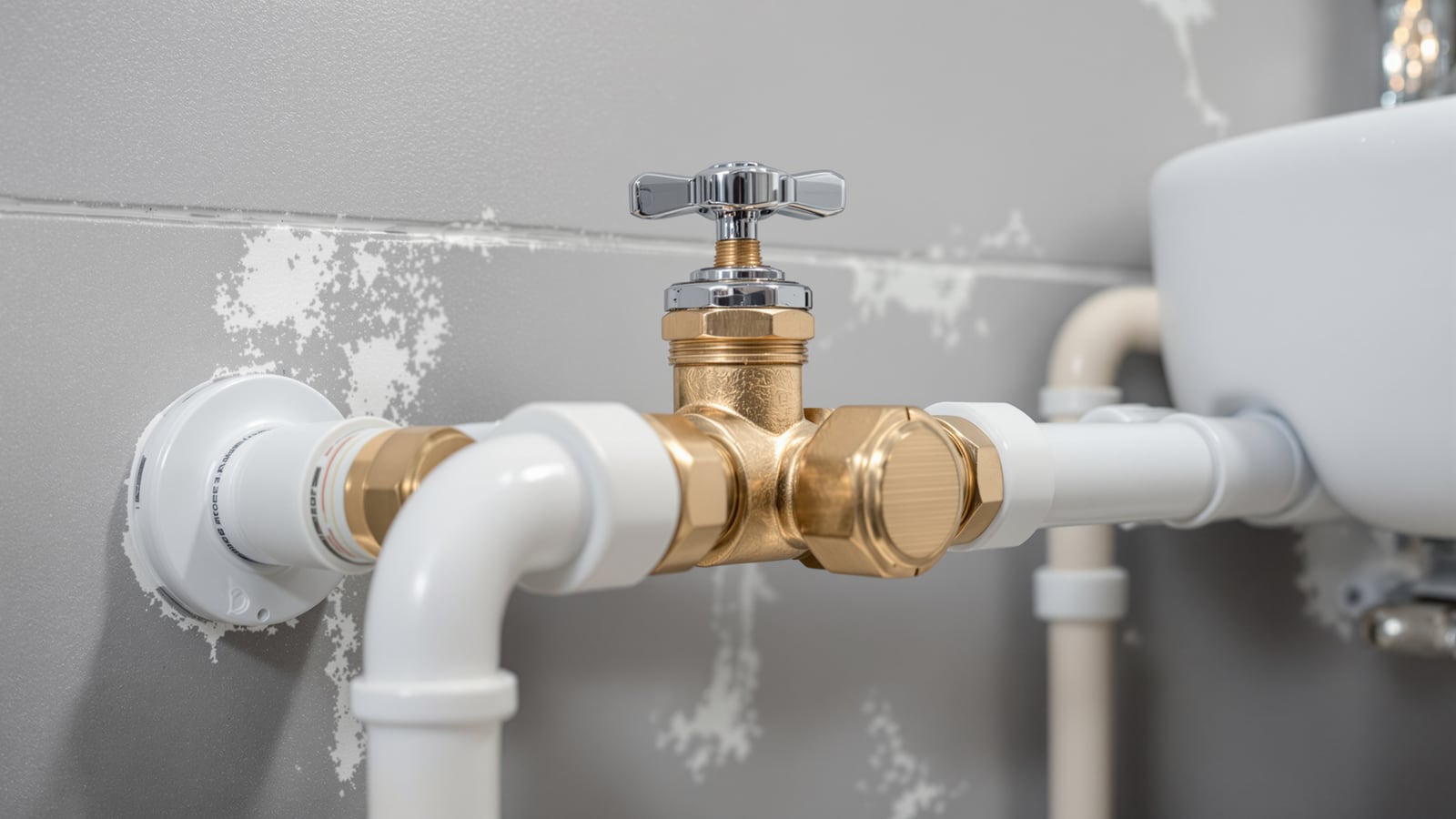
- Angle (angular stop) valve — the quarter-turn valve under every basin, WC cistern and often at the geyser. It isolates that single fixture and lets you change a tap or cartridge without draining the tank. Skipping these to save money means every minor repair becomes a building-wide shutdown.
- Isolation/gate valve — a larger valve on the bathroom's incoming branch, so the whole bathroom can be isolated from the riser.
- Non-return (check) valve — stops hot and cold cross-flow and protects a pump.
- Water-hammer arrestor — a small air cushion near fast-closing valves (solenoid, single-lever, washing machine) that absorbs the shock which otherwise bangs the pipes.
When gravity is not enough: pumps
If the tank is too low, the top floor too high, or you want a strong multi-jet shower, gravity alone will not deliver. Options, from crude to refined:
| Solution | What it does | Good for | Rough cost (₹) |
|---|---|---|---|
| Monoblock / "Tullu" pump | Boosts a single line on demand, noisy, no pressure control | Cheap fix for one weak tap | 1,500–4,000 |
| Pressure booster pump | Constant-pressure pump on the bathroom feed, quieter, auto cut-in | Whole-bathroom low pressure, rain showers | 8,000–25,000 |
| Pressure vessel + pump set | Pump with a bladder tank for smooth, on-demand pressure | Villas, high-end multi-outlet baths | 25,000–60,000+ |
A properly sized pressure booster pump lifts a weak 0.3 bar top-floor feed to a comfortable 1.5–2.0 bar and transforms the shower — this is the right answer for most flats, covered in depth in the water pressure booster pump guide. Fit it on the outlet side of the tank feeding the bathroom, with a non-return valve, and never let it run dry.
Hard water: the silent flow-killer
Much of India runs on hard water, and it attacks the supply system from the inside. Calcium and magnesium scale builds up in aerators, shower roses, geyser tanks and eventually inside the pipe bore itself, slowly choking flow until a shower that was fine at handover feels weak two years on. It also shortens geyser element life and blocks the fine passages in single-lever cartridges.
- Keep aerators and shower roses removable and cleanable — a monthly soak in mild acid or citric solution restores flow. Many premium roses now have rub-clean silicone nozzles for exactly this.
- On genuinely hard supply (hardness above ~200 ppm), a whole-house or point-of-entry softener protects the whole system, geyser included, and pays for itself in fewer replacements.
- Prefer CPVC/PPR over GI — plastic pipes do not corrode and scale grips them far less than rough galvanised bore.
- Set the geyser thermostat to a sensible 55–60 °C; scandingly hot settings accelerate scaling.
Getting it right at the planning stage
Water supply is buried in the wall, so mistakes are painful to fix later. Before the plumber begins:
- Confirm tank height. Measure the drop from tank water level to the highest fixture; below ~4 m to a top-floor shower, plan for a booster from day one.
- Insist on 20 mm bathroom branches and 15 mm only at the fixture tail.
- One angle valve per fixture, plus a bathroom isolation valve — non-negotiable for future repairs.
- Pressure-test the lines before tiling. A hydrostatic test to IS practice catches a leaking joint while the wall is still open.
- Keep a simple as-built sketch of pipe routes so a future drill does not puncture a live line.
Design the supply properly and the rest of the bathroom simply works — every faucet, shower and geyser you later choose performs to its rating instead of fighting a starved, scaled, valveless system.
References
- National Building Code of India (NBC) 2016, Part 9 — Plumbing Services (water supply, drainage, sanitation).
- IS 1172 — Code of Basic Requirements for Water Supply, Drainage and Sanitation, Bureau of Indian Standards.
- IS 15778 / IS 15801 — CPVC and PPR pipes and fittings for hot and cold water supply.
- CPHEEO Manual on Water Supply and Treatment, Ministry of Housing and Urban Affairs — design flows and system practice.
- IS 2065 — Code of Practice for Water Supply in Buildings.
Export this guide
Related Guides — Deep-dive reading
Low-Rise Plumbing Systems in India: Houses, Villas & Buildings up to 4 Storeys
How plumbing is organised for independent houses, villas and low-rise buildings up to about four storeys — the simple overhead-tank gravity model, when a small booster is still worth adding, single- versus multi-floor distribution, and the simpler stack and venting a low building can get away with.
PlumbingBathroom Planning for New Homes in India: Get It Right Before You Build
The bathroom decisions you cannot undo once the slab is cast — location and stacking, sunken vs non-sunken slabs, waterproofing, and the plumbing, electrical and ventilation you must coordinate with the civil work, stage by stage.
BathroomsGravity-Fed Plumbing System in India: How Overhead Tanks Push Water to Every Tap
The overhead-tank-to-fixture model that most Indian homes run on — how head height creates pressure, why the tank sits on the roof, how much pressure each floor really gets, how to size pipes for gravity flow, and exactly where gravity struggles and how to fix it.
PlumbingRelated Tools — Try Free
Shower Pump Calculator
Check whether your shower needs a pressure-boost pump and what size — available vs required pressure from your tank height or supply.
Bathroom CalculatorPlumbing Pressure-Test & Leak Checklist
Pre-closure pressure and leak test — 9 categories, 60+ checkpoints across water supply, drainage, fixtures, waterproofing, hot water, tanks.
Pre-Closure TestShower Water Flow Calculator
Shower water use per shower, day and month by head type, plus a pressure-adequacy check for your tank height or pump and low-flow savings.
Bathroom Calculator