

Solar Panel Maintenance and Cleaning in India: Keep Your Rooftop Generating (2026)
A homeowner guide to keeping a rooftop solar system producing at its best - why dust, droppings and pollution cut output, how often and how to clean panels safely, what to check on the inverter and wiring, degradation and warranty, and when to call a professional or take an AMC.
A rooftop solar system has almost no moving parts, so people assume it needs no care at all. That assumption quietly costs money. Panels sit flat to the sky in one of the dustiest, most polluted operating environments on earth, and a thin film of grime you can barely see can trim generation by a tenth or more. Maintenance is not about repairing solar - a good system rarely breaks - it is about protecting the output you already paid for, and catching the small fault before it becomes an expensive one.
This is the upkeep companion to the Studio Matrx rooftop coverage. If you are still planning or sizing a system, start with the rooftop solar guide; if roof and panels are one integrated surface, see the solar roof guide; and if you run batteries, the hybrid solar system guide covers that side.
Scope and safety. This is a design, specify and safe-homeowner-upkeep guide. Ground-level panel cleaning and reading your monitoring app are things you can do yourself. Anything else is not DIY. Do not walk on panels, do not clean wet panels near live wiring, and do not go onto a roof you cannot reach safely - a fall or an electric shock is a life-safety risk. All electrical work, roof access beyond easy safe reach, connector, inverter and wiring service must go to a licensed solar installer or electrician. Any grid, metering or DISCOM matter stays with the installer and the DISCOM. Figures here are indicative and vary by site, season and product - confirm against your own datasheets and warranty.
Why cleaning matters: soiling loss
The single biggest recoverable loss on an Indian rooftop is soiling - the polite word for everything that settles on the glass. Fine dust, industrial particulates, vehicle soot, pollen, tree sap and bird droppings build a layer that scatters and blocks sunlight before it reaches the cells. Uniform dust simply dims the whole panel. Worse are the concentrated blockages: a dropping or a leaf shades a group of cells completely, and because cells are wired in series, that one shaded patch drags down the output of the string around it and can even create a warm patch (a hot spot) over time.
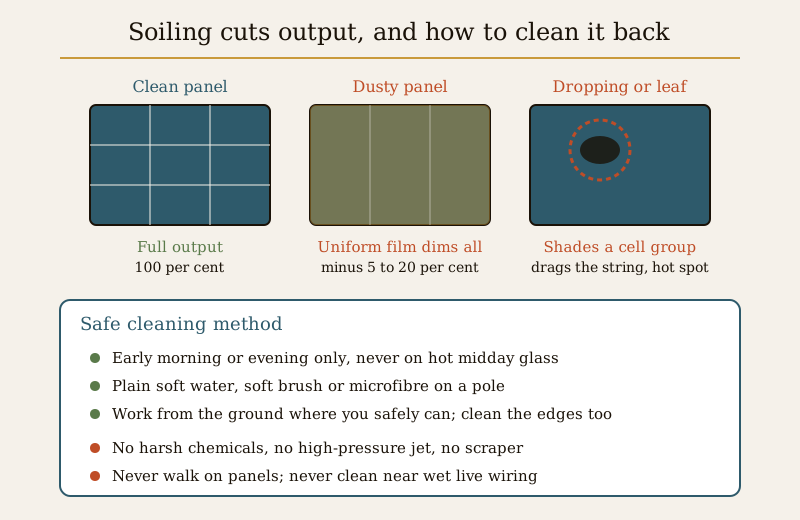
How much do you lose? It depends entirely on where you are. A clean-air hillside home in the monsoon belt may lose only a few per cent between showers. A house near a highway, a cement plant, a quarry, an unpaved road or heavy crop-burning can lose well into double digits between cleanings - some dry, dusty sites shed a fifth of their output within weeks. Rain helps, but it is not a wash: it can leave muddy streaks and mineral deposits worse than the dust was. The point is not the exact number, which changes by site and season, but the direction - dirty glass is lost generation every single day, and it compounds.
The good news is that soiling loss is almost fully recoverable. Unlike degradation, which is permanent, dirt comes straight off and the output comes straight back. That is why cleaning is the highest-return maintenance you can do.
How often to clean
There is no universal interval - cleaning frequency follows your dust, season and location. Use the schedule below as a starting point, then let monitoring tell you the truth: if generation on clear days drifts down week on week, the glass is telling you it is time.
Broad guidance for Indian rooftops:
- Low-dust, good-rain sites (coastal, hill, well-watered green suburbs): a proper clean every 4 to 8 weeks, more or less on rain.
- Typical urban and semi-urban rooftops: roughly every 2 to 4 weeks in dry months.
- High-dust sites (near highways, construction, quarries, cement or brick works, farmland, crop-burning season): as often as weekly, and always after a dust storm.
- After any event: clean after a dust storm, after nearby construction, after a spell of bird activity, and after the first monsoon showers dry into streaks.
Tilt matters too. Steeper panels self-clean better in rain; near-flat panels hold water, dust and droppings and need more attention. A small tilt correction at install time pays back for years.
How to clean safely
Cleaning solar glass is simple, and the safe method is also the gentlest one. The tempered glass has an anti-reflective coating you do not want to scratch, so the rule is soft tools and plain water.
- Clean in the cool of the day - early morning or evening. Never pour cool water on hot midday glass: the thermal shock can crack a panel, and water evaporates instantly into spots.
- Use plain water - soft or filtered water is best because hard water leaves mineral scale. For ordinary dust, water alone is enough. For sticky grime, a little mild soap well rinsed off is fine.
- Use a soft brush, sponge or microfibre on a pole, worked gently from the ground or from safe roof access. A telescopic solar brush lets many single-storey homeowners clean without climbing at all.
- Do not use harsh chemicals, detergents, abrasive pads, scrapers or high-pressure jets. These strip the coating, scratch the glass and can force water into the sealed junction box and connectors.
- Do the frame edges too - dirt collects at the lower edge and can shade the bottom cells.
What to avoid matters as much as what to do. Never walk or kneel on panels - the micro-cracks you cannot see permanently lower output and void warranties. Never clean panels wet around live cabling, and never touch DC connectors, the junction box or inverter with water. If any of this needs someone on the roof or beyond easy safe reach, that is a job for a professional.
DIY versus professional, and safety at height
Simple ground-level or single-storey cleaning with a pole brush is reasonable homeowner upkeep. Beyond that, hand it over. Going onto a sloped, high or fragile roof, moving among the array, or being near the DC wiring while wet is a fall-and-shock hazard not worth risking to save a service fee. Professionals arrive with harnesses, anchor points, deionised-water systems that dry spot-free, and the training to spot a failing connector or a hot module. If your roof is anything other than easy and safe to reach, budget for professional cleaning rather than improvising.
What else to check
Cleaning is the visible job; a good routine checks the rest too. Most of this is looking and reading, not touching.
- Inverter status. The inverter is the brain and the most likely thing to flag a problem. A green light and normal output are good; any fault code, red light or alarm gets noted and sent to your installer - read the solar inverter buying guide to understand what your inverter is telling you.
- The monitoring app. Compare today's generation with clear days last month. A steady slide points to soiling; a sudden drop or a dead string points to a fault. Monitoring is your early-warning system - check it weekly, it takes a minute.
- Shading from new growth. A branch that was clear in year one can shade the array by year three. Trim it, or accept the loss.
- Hot spots and discolouration. From the ground, look for browning, bubbling, cracks or a panel that looks different from its neighbours. These go to the installer.
- Mounting and clamps. After strong wind or monsoon, look for loose or lifted clamps, movement or rust at the roof fixings. A licensed installer tightens or re-seals these.
- Wiring and connectors. Look for chewed, sagging, sun-perished or exposed cable and any scorch marks. Do not touch or fix DC wiring - flag it and let the installer service it live-safe.
Degradation and warranty
Even a spotless, faultless panel slowly makes a little less power each year - normal, permanent degradation as the cells age under UV and heat. Modern panels typically lose a fraction of a per cent to about half a per cent per year, and a performance warranty usually guarantees a high share of rated output at 25 years - often the mid-to-high 80s of per cent. That is separate from the product warranty on the panel (commonly 10 to 15 years or more) and the shorter inverter warranty (often 5 to 12 years, extendable). Keep every invoice, datasheet and warranty document in one file, and insist on BIS and MNRE-approved panels at purchase, because warranty claims and any subsidy depend on it.
An annual schedule and the AMC option
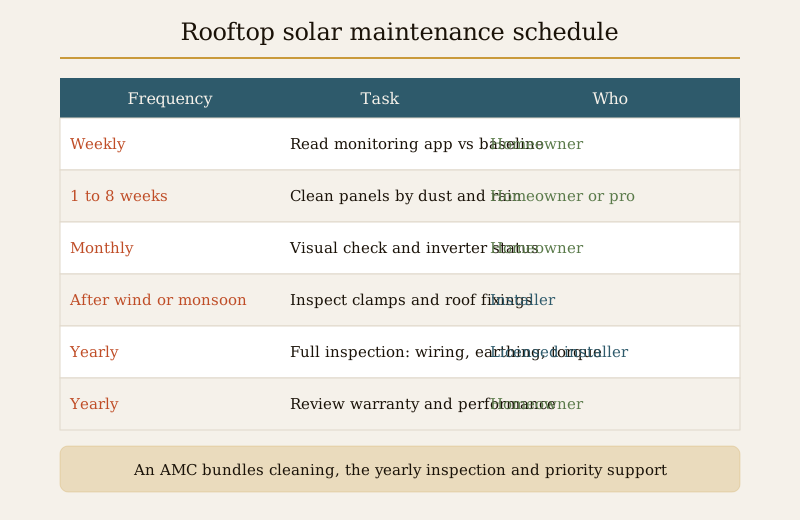
Put upkeep on a calendar so it actually happens. A workable rhythm is: read the monitoring app weekly, do a hands-on clean on your dust-driven interval, do a visual check monthly, and book a professional inspection once a year before or after monsoon. That yearly visit is where a trained technician checks connectors, torque, earthing, hot spots and inverter health properly.
Many installers offer an Annual Maintenance Contract (AMC) that bundles scheduled cleaning, an annual inspection and priority breakdown support for a fixed fee. For a hard-to-reach roof or a high-dust location, an AMC is often cheaper than the output you would lose to neglected soiling - and it keeps a professional, not you, on the roof.
Maintenance and cleaning schedule
| Task | Frequency | Who | Notes |
|---|---|---|---|
| Read monitoring app, compare to clear-day baseline | Weekly | Homeowner | Early warning for soiling and faults |
| Panel clean (plain water, soft brush, cool hours) | Every 1 to 8 weeks by dust and rain | Homeowner or pro | More often at high-dust sites and after dust storms |
| Visual check: shading, discolouration, debris | Monthly | Homeowner | From the ground; note anything odd |
| Check inverter status and fault log | Monthly | Homeowner | Report any fault code to installer |
| Inspect clamps, mounting, roof fixings | After strong wind or monsoon | Installer | Do not tighten array hardware yourself |
| Full professional inspection (wiring, earthing, torque, hot spots) | Yearly | Licensed installer | Ideal as an AMC visit |
| Review warranty and performance vs baseline | Yearly | Homeowner | Raise claims while in warranty |
Troubleshooting
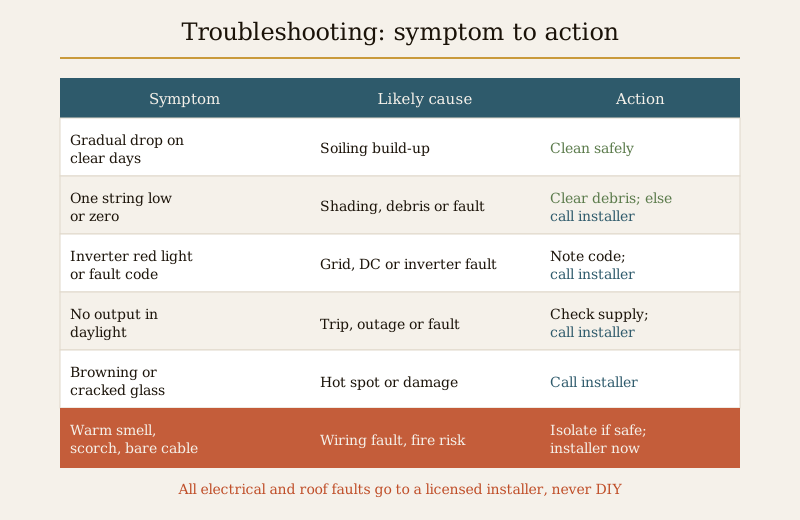
| Symptom | Likely cause | Action |
|---|---|---|
| Gradual week-on-week drop on clear days | Soiling build-up | Clean panels safely; recheck output |
| One panel or string reads low or zero | Shading, debris, or a module or string fault | Remove obvious debris from ground; if it persists, call installer |
| Inverter red light or fault code | Grid, DC or inverter fault | Note the code, do not reset repeatedly; call installer |
| No generation at all in daylight | Tripped protection, grid outage or inverter fault | Check house supply, then call installer; do not open the inverter |
| Visible browning, bubbling or cracked glass | Hot spot or panel damage | Stop relying on that panel; call installer for assessment |
| Water pooling and streaks after rain | Too-flat tilt or hard-water residue | Clean with soft water; discuss tilt correction with installer |
| Warm smell, scorch marks or exposed cable | Wiring or connector fault (fire risk) | Shut down at the isolator if safe, keep clear, call installer immediately |
Key takeaways
- Soiling is the biggest recoverable loss on an Indian rooftop; dirty glass is lost generation every day, and it fully returns when you clean.
- Cleaning frequency follows your dust, season and location - let monitoring tell you when.
- Clean gently: plain soft water, a soft brush, cool hours only; never harsh chemicals, high-pressure jets, hot-panel cleaning, or walking on panels.
- Ground-level cleaning and the app are homeowner jobs; anything at height, near wet live wiring, or on the inverter goes to a licensed installer.
- Degradation is normal and permanent; keep BIS and MNRE-approved panels and warranty papers, and book a yearly inspection or an AMC.
References
- Ministry of New and Renewable Energy (MNRE) - rooftop solar guidance and approved-model lists.
- Bureau of Indian Standards (BIS) - panel and inverter standards referenced in product datasheets.
- Panel and inverter manufacturer performance and product warranty documents (site-specific - read your own).
- Studio Matrx: rooftop solar guide, solar inverter buying guide, solar roof guide, hybrid solar system guide, and the electrical hub.
Export this guide
Related Guides — Deep-dive reading
Roof Access & Walkways
Someone will need to get onto your roof several times a year — to clear a drain, service the tank, wash the solar panels, check the waterproofing. Access designed into the house is far safer and cheaper than a ladder propped against a wall. This guide covers the ways up (mumty stairs, fixed ladders, hatches, loft ladders), the ways around (walkways and duckboards over fragile or waterproofed surfaces), and the guardrails and anchor points that make maintenance safe.
RoofingSolar System Fire Safety in India (2026): Rooftop PV, DC Arcs and Firefighter Access
Rooftop solar stays live in daylight even with the grid off. This guide explains the real PV fire risks, the protections that matter, and how to keep firefighters and your escape route safe.
SecurityRoof Safety Guide
Falls from height are among the deadliest accidents in Indian construction and home maintenance. This guide is a plain, safety-first look at why roof work is so dangerous, the hazards to respect, the protections professionals use, monsoon and heat precautions, and the small list of things a homeowner can safely do versus what to always hand to a trained pro.
RoofingRelated Tools — Try Free
Window Cleaning Cost Calculator
Estimate professional window cleaning cost per visit and per year by access and frequency.
Window CalculatorElectrical Safety & Load Audit
Home electrical audit — 10 categories, 65+ checkpoints across earthing, RCCB, MCB, wiring, switchboards, appliance circuits, DG/inverter backup.
Safety AuditRainwater Tank Sizer
How big should your rainwater tank be? Computes annual harvest, recommended tank capacity in litres, water-bill savings, and payback — for 10 Indian cities.
RWH Calculator