
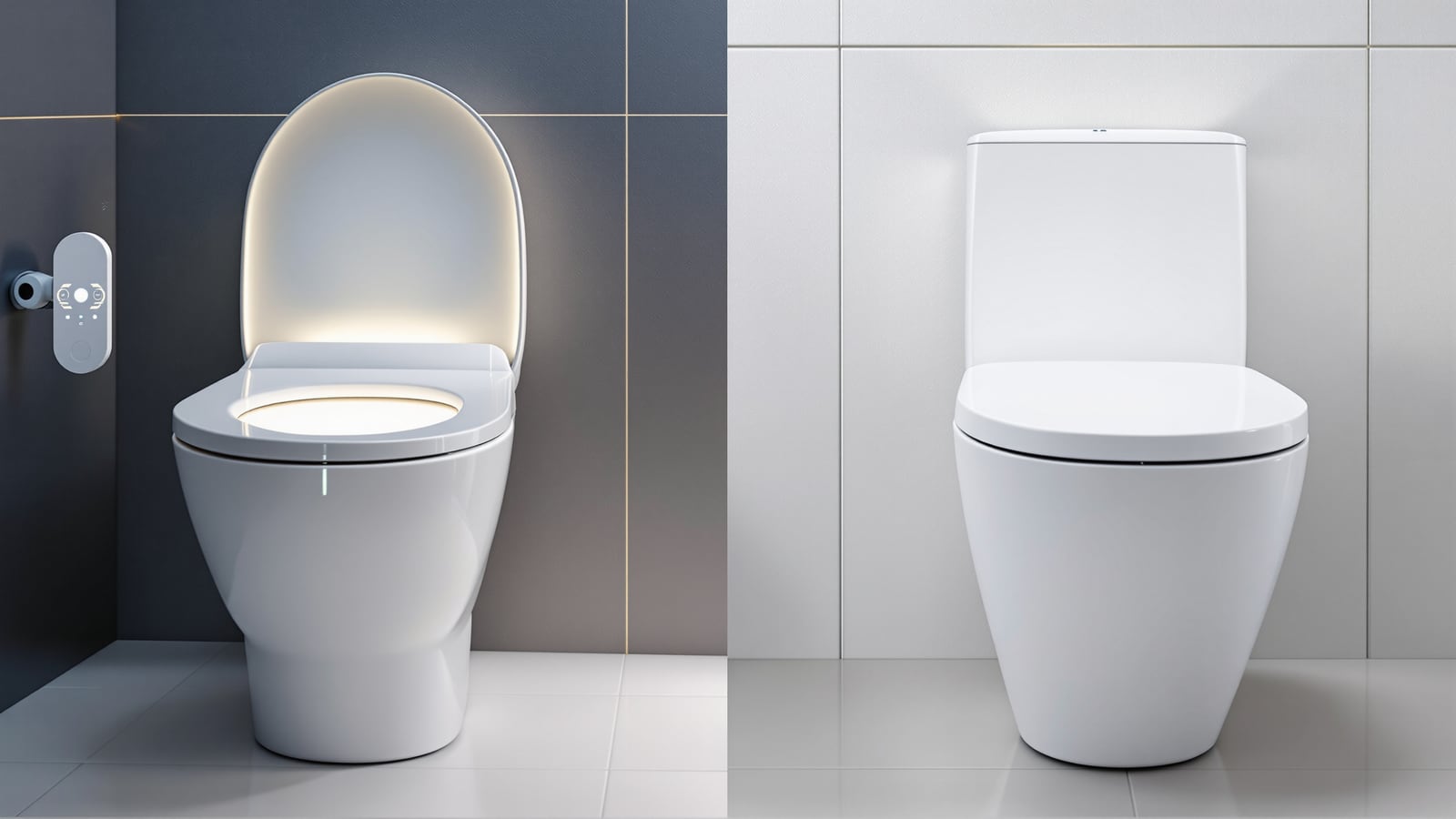
Smart Toilet vs Normal Toilet: Which Is Better for India? (2026)
An honest head-to-head between an electronic smart toilet / washlet and a conventional WC with a health faucet — hygiene and comfort, the power point and water tapping each needs, hard-water and voltage reliability, running cost, the huge price gap, repairs, and whether it is actually worth it in an Indian home.
Two toilets, both of which wash you with water. One is a ₹40,000-plus electronic appliance with a warm-water nozzle, heated seat and warm-air dryer. The other is the ordinary WC you already own with a ₹400 health faucet clipped beside it. Both do the essential Indian job — clean with water, not paper — so the real question is not which is "better" in the abstract, but which is better for your bathroom, your budget and your city's water and power.
This is an honest head-to-head. A smart toilet (an integrated washlet or a retrofit electronic bidet seat) versus a normal toilet with a health faucet, judged on hygiene, comfort, the services each needs, reliability against India's hard water and voltage swings, running cost, the price gap and repairs. It sits inside the Studio Matrx bathroom hub. For the fixtures themselves read the smart toilet guide for India and the bathroom and toilet guide for India; the bidet and health faucet guide is the companion to this page; and for the wider budget picture see smart bathroom cost in India.
A normal WC with a health faucet already cleans with water for a few hundred rupees, needs no power and never breaks down in a way that matters. A smart toilet layers warm water, a heated seat, a dryer and hands-free operation on top of that — real comfort, at a real cost in money, planning and upkeep. Buy the comfort where it earns its place; keep the faucet everywhere else.
The core difference
A normal toilet in India is a vitreous-china WC pan (floor-mounted or wall-hung) with a cistern or flush valve, and a health faucet — the hand-held jet spray — on a hose beside it. It is purely mechanical: water in, waste out, no electricity anywhere near it.
A smart toilet is that same washing job automated and warmed. A retractable nozzle delivers an adjustable warm jet, a blower dries you, the seat is heated, the lid opens and closes on a sensor, and a filter deodorises the bowl. You get it either as a retrofit electronic bidet seat that clips onto your existing pan (₹12,000-60,000) or a full integrated smart WC where pan and electronics are engineered as one (₹80,000-4,00,000+). Either way, it is an electrical appliance sitting in the wettest corner of the house — which changes everything about how you plan and maintain it.
The verdict table — attribute by attribute
| Attribute | Smart toilet | Normal WC + health faucet | Winner |
|---|---|---|---|
| Washing quality | Warm, aerated, adjustable, targeted jet + dryer | Cold jet, you aim it manually | Smart toilet |
| Comfort | Heated seat, warm air, night light, auto lid | Basic, cold, hands-on | Smart toilet |
| Services needed | Power point + water tapping + RCCB beside WC | Water line only | Normal WC |
| Reliability in India | Vulnerable to hard water and voltage swings | Almost nothing to go wrong | Normal WC |
| Upfront cost | ₹12,000-4,00,000+ | ₹400-700 for the faucet | Normal WC |
| Running cost | Electricity, filters, descaling, repairs | Effectively nil | Normal WC |
| Maintenance | Descale nozzle, change filter, service board | Wipe clean, occasional washer | Normal WC |
| Elderly / low mobility | Excellent — dignity and independence | Needs reach, grip and aim | Smart toilet |
| Resale / premium feel | Strong "wow" in a luxury bathroom | Standard, expected | Smart toilet |
The pattern is clear and fair: the smart toilet wins every row about experience, the normal WC wins every row about simplicity, cost and durability. Neither is a strawman — they are optimised for different things.
Hygiene and comfort — where the smart toilet earns its price
Both wash with water, so both beat paper on cleanliness. But the smart toilet adds things the faucet cannot: warm water instead of a cold shock, a nozzle that positions itself so you do not have to aim, a warm-air dryer that cuts paper use, a self-rinsing nozzle and a touch-free lid that reduce hand contact, and a heated seat on a cold morning. For elderly parents, anyone with limited mobility, arthritis or post-surgery recovery, the hands-free warm wash and dryer restore genuine independence — which is why smart seats appear so often in elderly-friendly bathrooms. The health faucet does the essential job well; the smart toilet does it more comfortably and more accessibly.
Services, reliability and running cost — where the normal WC wins
Here the ledger flips hard, and it is entirely Indian.
- Services. A smart toilet needs an IP44-rated, RCCB-protected power point and a 15 mm water tapping within about 300-400 mm of the pan, roughed in before tiling — retrofitting them later is the expensive part. A normal WC needs only its flush water line. Plan the smart-toilet point as part of your wet and dry zones, never as a bolt-on.
- Reliability. India's hard water scales the fine nozzle, solenoid valve and on-demand heater; India's voltage spikes and sags fry the control board. A seat that lasts a decade in Tokyo can fail in two years in Chennai or Delhi without defences. A normal WC and faucet have almost nothing to go wrong.
- Running cost. The smart toilet draws electricity, wants an inline filter and periodic descaling, and will eventually need a board or nozzle repair from a brand with a real Indian service network. The faucet's running cost rounds to zero.
The price gap — putting numbers on it
This is the single biggest reason most Indian homes keep the normal toilet. Treat brand names (Jaquar, Hindware, Cera, Kohler, TOTO, Roca) as examples, not endorsements.
| Item | Smart toilet | Normal WC + faucet |
|---|---|---|
| The fixture | ₹12,000-60,000 seat, or ₹80,000-4,00,000+ integrated WC | ₹3,500-15,000 pan + ₹400-700 faucet |
| Extra services | ₹3,000-8,000 power point + water rough-in | Included in normal plumbing |
| Protection | ₹2,500-6,000 stabiliser + inline filter | None needed |
| Running cost / year | Electricity + filters + descaling + eventual repair | Effectively nil |
Even the cheapest electronic bidet seat, fully installed and protected, costs roughly 20-40 times a WC-plus-faucet setup, and the gap widens to a hundredfold for a luxury integrated WC — the kind of spec that belongs in a luxury bathroom. The comfort is real, but so is the number.
Pick A if / Pick B if
| Pick the smart toilet if… | Pick the normal WC + faucet if… |
|---|---|
| You want warm-water washing, a dryer and a heated seat | The health faucet already does the job for you |
| An elderly or less-mobile person uses the bathroom | Budget is tight or it is a secondary / guest bath |
| It is a master or premium bath and you can rough in power | You cannot bring a safe power point to the WC |
| You will maintain a filter, stabiliser and descaling routine | You want zero maintenance and total reliability |
| You value the premium feel and resale appeal | You are in a rental or planning to move soon |
The honest verdict
For most Indian homes this is not really a fight — it is a division of labour. The normal WC with a health faucet is the right default for the majority of bathrooms: cheap, reliable, no power, no upkeep, and it already washes with water. The smart toilet is a deliberate upgrade for the one or two bathrooms where comfort, elderly accessibility or a premium experience genuinely earn the price and the planning.
So the sensible Indian answer is usually both: keep the normal WC and faucet through the house, and put a smart toilet — most cheaply, a retrofit bidet seat on a good existing pan, backed by an inline filter and a voltage stabiliser — in the master or elders' bathroom. Do not buy a smart toilet if you cannot safely rough in an RCCB-protected power point, and do not spend on a full integrated WC unless you are already renovating. Read the bidet and health faucet guide and the smart toilet guide alongside this page, and budget the whole thing against smart bathroom cost in India before you commit.
References
- NBC 2016 (National Building Code of India), Part 8 & Part 9 — building services, electrical installations and plumbing for wet areas.
- IS 732 — Code of practice for electrical wiring installations; earthing and 30 mA RCCB / earth-leakage protection in wet zones.
- IS 2556 — Sanitary appliances (vitreous china) specifications, relevant to the WC pan the seat mounts on.
- IS 1172 — Basic requirements for water supply, drainage and sanitation.
- CPHEEO Manual on Water Supply and Sanitation — Government of India guidance on domestic plumbing practice.
- BIS product certification — check for IS-marked electrical safety and IP ratings on any imported bidet seat.
Export this guide
Related Guides — Deep-dive reading
Smart Toilet India: Electronic Bidet Seats, Washlets, Cost & The Point Beside the WC
A practical India-first guide to smart toilets and electronic bidet seats — warm-water wash, warm-air dryer, heated seat, auto lid, deodoriser and night light — plus the electrical point, water tapping and IP protection you must plan beside the WC, and how hard water and voltage swings decide whether yours lasts.
BathroomsSmart Bathroom Mirror India: Touch Display, Voice, Defogger, Cost & Is It Worth It
A practical India-first guide to smart bathroom mirrors — the embedded touch display showing time, weather and news, the Bluetooth speaker, voice assistant, mood-lighting scenes and defogger — plus the power and optional data point behind the glass, the IP and electrical safety it demands, how hard water and monsoon humidity decide whether it lasts, and whether it is really worth the money over a good LED mirror.
BathroomsVoice Controlled Bathroom India: Waterproof Smart Speaker, Hands-Free Lights, Shower & Geyser, Privacy & Cost
A practical India-first guide to voice control in the bathroom — a splash-rated smart speaker or voice-enabled mirror that turns lights, music, exhaust fan, geyser and even the shower on and off hands-free — plus the microphone and privacy questions, the humidity and IP durability the device must survive, whether your Wi-Fi even reaches the wet corner of the house, which tasks genuinely benefit, the real accessibility win for elderly and disabled users, and what it all costs.
BathroomsRelated Tools — Try Free
Electrical Safety & Load Audit
Home electrical audit — 10 categories, 65+ checkpoints across earthing, RCCB, MCB, wiring, switchboards, appliance circuits, DG/inverter backup.
Safety AuditMonsoon-Readiness Checklist
Pre-rain home audit across 9 categories — terrace, drains, waterproofing, electrical, HVAC, pest, vehicles, documents.
Seasonal AuditSmart Bathroom Cost Calculator
Budget the smart fittings for a bathroom — smart WC, sensor faucet, LED mirror, digital shower, leak detector and more — with a per-item breakdown.
Bathroom Calculator