
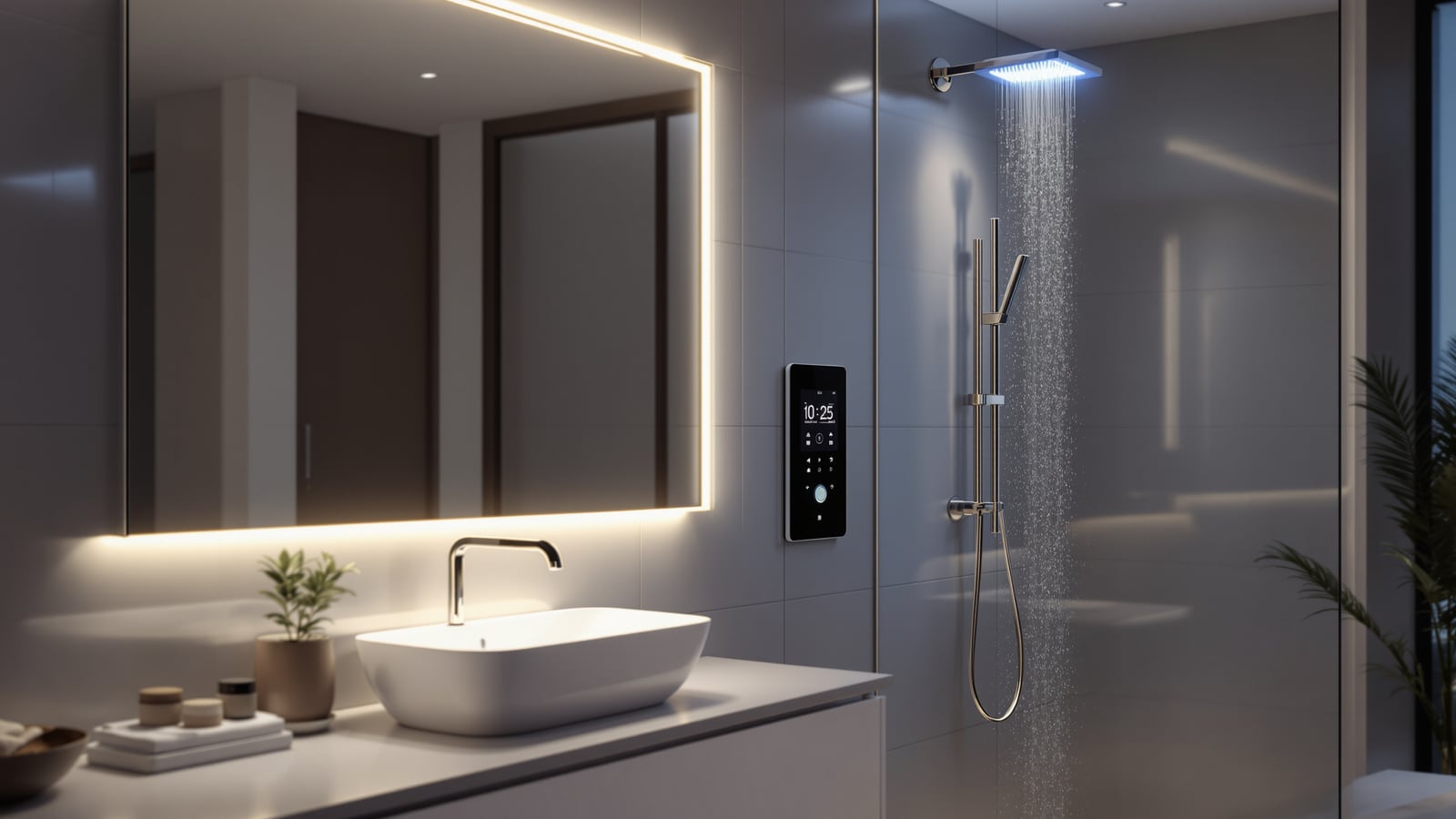
Smart Bathroom Cost in India (2026): Price Per Feature, Points to Rough In & Budget Tiers
What a smart bathroom actually costs in India — the rupee price of each smart feature, the extra electrical, water and data points they quietly need, a 'few smart touches' versus 'fully smart' budget, budget/standard/luxury tiers, running cost, and an honest split of what is worth it versus gimmick.
"How much does a smart bathroom cost in India?" has no single answer, because a smart bathroom is not one product — it is a basket of independent features, each with its own price tag and its own hidden requirement for a power point, a water tapping or a data connection. You can spend ₹30,000 adding two sensible smart touches to an ordinary bathroom, or ₹6,00,000 turning a luxury bathroom fully connected. This guide prices each feature, tells you what it quietly demands behind the wall, and builds a few-touches, standard and fully-smart budget so you can decide where the money is worth it.
This sits inside the Studio Matrx bathroom hub. For the overall build number read the bathroom construction cost guide for India; for what the technology does and how to plan it, the smart bathroom guide for India is the companion component page; and for the single most-wanted upgrade, see the smart toilet guide for India.
Every smart feature costs twice: once for the device, once for the point it needs. Budget the concealed power, water and data first, because roughing them in during construction is cheap and retrofitting them into a finished bathroom is where the real money leaks away.
Why a smart bathroom costs what it does
Three things drive the number. First, how many features you add — this is a menu, not a fixed thali. Second, the brand tier of each device: an entry Chinese-import smart seat and a Japanese integrated washlet are both "smart toilets" a decade apart in price. Third, and most missed, the points to rough in — a smart bathroom needs more IP-rated 16A sockets, an extra water tapping beside the WC, a fused spur for a digital shower and sometimes a data or LAN drop. Rough these in during the shell and they cost a few thousand; chase them into finished tiles later and you pay for demolition, re-waterproofing and re-tiling on top.
Price per smart feature (device + the point it needs)
The table below is the heart of this guide: each smart feature, its 2026 device price band in rupees, and the extra service point you must budget alongside it. Points are the rough-in cost of one IP-rated socket, water tapping or data drop done during construction.
| Smart feature | Device price (₹) | Extra point it needs | Point cost (₹) |
|---|---|---|---|
| Smart WC / electronic bidet seat | 18,000 – 2,50,000 | IP44 16A socket + water tapping beside WC | 2,500 – 4,500 |
| Smart / backlit LED mirror | 8,000 – 60,000 | Concealed 6A point behind mirror | 1,200 – 2,000 |
| Digital / smart shower (thermostatic + control) | 35,000 – 2,20,000 | Fused spur / 16A point + concealed valve | 4,000 – 7,000 |
| Sensor (touchless) faucet | 4,500 – 35,000 | Mains adaptor point or battery (no mains) | 0 – 1,500 |
| Smart / motion-sensor lighting | 3,000 – 30,000 | Driver point + neutral at switch for smart switch | 1,000 – 2,500 |
| Leak detection + auto shut-off valve | 6,000 – 45,000 | Point at valve on inlet main + sensor spots | 1,500 – 3,000 |
| Exhaust / humidity automation | 2,500 – 14,000 | Switched fan point + humidity sensor wiring | 800 – 1,800 |
A few notes on the ranges. The smart WC band is the widest in the bathroom: a retrofit bidet seat starts near ₹18,000, a mid integrated smart WC lands around ₹90,000–1,40,000, and a top-tier washlet-plus-pan crosses ₹2,00,000. Sensor faucets are the cheapest genuine smart upgrade and many run on batteries, needing no point at all. Digital showers carry the highest install complexity because the control talks to a concealed diverter and often a recirculation pump.
The points nobody quotes for
A conventional Indian bathroom is roughed in with one or two 6A light points, a geyser point and maybe one 16A socket. A smart bathroom needs more, and this rough-in is where DIY budgets break. Plan for:
- Extra IP-rated sockets — an IP44/IP55 16A point beside the WC for a smart seat, and a 6A point behind the mirror. Each finished point is roughly ₹1,200–4,500 with concealed conduit, the RCCB-protected circuit and the weatherproof faceplate.
- A water tapping at the WC — the bidet seat or smart WC taps the cistern supply, so you need a tee and an angle valve positioned before tiling.
- A fused spur or dedicated circuit for a digital shower, kept on an RCCB per IS 732 and NBC 2016 wet-area rules.
- A data or Wi-Fi consideration — most devices use Wi-Fi, but a thick RCC bathroom can kill signal, so budget a mesh node or a LAN drop (₹1,500–4,000) if the router is far.
Add these up and the "points" layer alone is typically ₹12,000–30,000 for a fully smart bathroom — small against the devices, ruinous if retrofitted.
Few smart touches vs fully smart
Most Indian homeowners do not want a fully connected bathroom; they want two or three touches that earn their keep. Here is the split.
| Package | What it includes | Device + points (₹) |
|---|---|---|
| A few smart touches | Sensor faucet + backlit smart mirror + motion-sensor light | 25,000 – 70,000 |
| Sensible smart | Above + retrofit bidet seat + leak sensor pucks | 70,000 – 1,50,000 |
| Fully smart | Integrated smart WC + digital shower + smart mirror + sensor faucet + smart lighting scenes + leak auto shut-off + exhaust automation | 2,80,000 – 6,50,000 |
The jump from "a few touches" to "fully smart" is roughly ten-fold, and almost all of it is the integrated smart WC and the digital shower. If budget is tight, those two are exactly where you can stay conventional without anyone noticing.
Budget, standard and luxury tiers
The same feature exists at three price levels. This is the range table to scale your own plan.
| Feature | Budget (₹) | Standard (₹) | Luxury (₹) |
|---|---|---|---|
| Smart WC / bidet seat | 18,000 | 90,000 | 2,50,000 |
| Smart mirror | 8,000 | 28,000 | 60,000 |
| Digital shower | 35,000 | 90,000 | 2,20,000 |
| Sensor faucet | 4,500 | 12,000 | 35,000 |
| Smart lighting | 3,000 | 14,000 | 30,000 |
| Leak detection | 6,000 | 22,000 | 45,000 |
| Exhaust automation | 2,500 | 8,000 | 14,000 |
| Points + labour | 12,000 | 22,000 | 35,000 |
| Fully-smart total | 89,000 | 2,86,000 | 6,89,000 |
City and tier variation
The devices cost the same everywhere — they are branded, GST-invoiced products — so material cost barely varies by city. What varies is labour and specialist availability. In metros (Mumbai, Delhi, Bengaluru, Hyderabad) a smart-fixture installer or AV integrator charges more per day but is easy to find and warranties are honoured. In tier-2 and tier-3 towns labour is 25–35% cheaper, but you may pay to bring in a specialist and after-sales service on an imported washlet can be slow. Budget slightly more, not less, for a fully smart bathroom outside a metro because of service logistics.
Running cost
A smart bathroom sips power and adds a little to the bill, but the figures are modest:
- Smart WC — the seat heater and water heater dominate; an always-on unit adds roughly ₹150–350 a month, less if you use eco or timer modes.
- Digital shower and pump — negligible standby, real cost is the water heating you would have paid anyway.
- Smart mirror, lighting, sensors — a few rupees a month; LED and low-draw electronics.
- Batteries — sensor faucets and some leak pucks use batteries; budget ₹300–800 a year to replace them.
- Filters and descaling — a bidet seat in hard water needs periodic descaling; a service visit is ₹800–1,500.
Call it ₹2,500–5,500 a year to run a fully smart bathroom, plus one service visit.
Worth it vs gimmick
Honestly, after years of Indian installs:
- Worth it: a sensor faucet (hygiene and water saving, cheap), a good bidet seat or smart WC (genuine comfort and paper saving), leak detection with auto shut-off (pays for itself the first time it saves a flooded flat below you), and a demist smart mirror in a humid bathroom.
- Borderline: smart lighting scenes and voice control — pleasant, rarely essential; worth it only if the rest of your home is already automated.
- Gimmick for most: built-in Bluetooth speakers, colour-changing mood LEDs, and app-controlled everything that a switch did fine. These add cost and failure points, not daily value.
A worked sample: a standard smart bathroom
For a typical 40 sq ft (5x8 ft) family bathroom done "sensible smart," not fully smart: a retrofit bidet seat ₹35,000, a backlit demist smart mirror ₹22,000, one sensor faucet ₹12,000, motion-sensor lighting ₹9,000, leak sensor pucks plus a basic shut-off ₹18,000, and points-plus-labour ₹18,000. Total: about ₹1,14,000 on top of a conventional bathroom — the two-thirds of the comfort of a fully smart bathroom at a sixth of the cost.
How to save without cutting corners
- Rough in the points now, buy the devices later. Concealed sockets and a WC water tapping cost little during construction and let you upgrade any time without breaking tiles.
- Start with a retrofit bidet seat, not an integrated smart WC. You keep your pan and get 90% of the function at a fraction of the price.
- Choose battery sensor faucets where a mains point is awkward — you skip a point entirely.
- Buy the smart WC and digital shower from one brand for warranty and service simplicity; mix cheaply on mirror, lighting and sensors where brand matters less.
- Skip the gimmicks. Speakers and mood LEDs are the easiest ₹20,000 to not spend.
Prices here are indicative for 2026 and move with brand, import duty, GST and the dollar. Treat every figure as a planning anchor, not a quote — get at least two local quotes for the devices and the points before you commit.
References
- National Building Code of India (NBC 2016) — wet-area electrical safety and socket placement guidance.
- IS 732 — Code of Practice for Electrical Wiring Installations, RCCB and earthing for bathrooms.
- CPWD Delhi Schedule of Rates (DSR) — reference basis for electrical point and plumbing labour rates.
- Bureau of Energy Efficiency (BEE) — appliance standby and running-cost context.
- Manufacturer 2026 price lists and India retail — Kohler, TOTO, Jaquar, Hindware, Grohe, Roca and smart-fixture importers, cited by name for indicative device bands.
Export this guide
Related Guides — Deep-dive reading
Smart Bathroom Mirror India: Touch Display, Voice, Defogger, Cost & Is It Worth It
A practical India-first guide to smart bathroom mirrors — the embedded touch display showing time, weather and news, the Bluetooth speaker, voice assistant, mood-lighting scenes and defogger — plus the power and optional data point behind the glass, the IP and electrical safety it demands, how hard water and monsoon humidity decide whether it lasts, and whether it is really worth the money over a good LED mirror.
BathroomsSmart Toilet India: Electronic Bidet Seats, Washlets, Cost & The Point Beside the WC
A practical India-first guide to smart toilets and electronic bidet seats — warm-water wash, warm-air dryer, heated seat, auto lid, deodoriser and night light — plus the electrical point, water tapping and IP protection you must plan beside the WC, and how hard water and voltage swings decide whether yours lasts.
BathroomsSmart Bathroom Guide for Indian Homes: Mirrors, Geysers, Toilets & More
The device-by-device honest guide to a smart bathroom in India — defogging mirrors, scheduled geysers that are the single biggest energy saver, bidet seats, humidity-driven exhaust fans, leak detection and the waterproofing and electrical safety rules you must not skip.
Smart HomeRelated Tools — Try Free
Electrical Safety & Load Audit
Home electrical audit — 10 categories, 65+ checkpoints across earthing, RCCB, MCB, wiring, switchboards, appliance circuits, DG/inverter backup.
Safety AuditSmart Bathroom Cost Calculator
Budget the smart fittings for a bathroom — smart WC, sensor faucet, LED mirror, digital shower, leak detector and more — with a per-item breakdown.
Bathroom CalculatorShower Water Flow Calculator
Shower water use per shower, day and month by head type, plus a pressure-adequacy check for your tank height or pump and low-flow savings.
Bathroom Calculator