
Bathroom Toilet India: The Complete Guide to WCs, Commodes & Water Closets (2026)
Indian squat vs Western commode, floor-mounted vs wall-hung with concealed cistern, the S-trap and P-trap outlet and its rough-in distance, dual-flush water norms, rimless and comfort-height trends, the health-faucet rule, and a rupee cost comparison — everything that decides which toilet is right for an Indian home.
The toilet is the one fixture in an Indian bathroom you cannot get wrong. Choose the wrong trap and the pan will not connect to your existing drain. Choose the wrong rough-in and the commode sits a hand's width off the wall. Pick a rimless bowl and cleaning gets easier for a decade; pick a cheap glaze and hard water stains it in a season. This is the pillar guide to WCs — water closets — for Indian homes: the honest differences between an Indian squat pan and a Western commode, the floor-mounted versus wall-hung decision, the trap and rough-in numbers that actually govern what you can install, flush water norms, the current rimless and comfort-height trends, and what all of it costs in rupees.
Read this alongside the bathroom design guide for India for the room around the fixture, and then go deep with the sibling guides on the wall-hung toilet, the floor-mounted toilet, the smart toilet, and the bidet and health faucet. Everything here is India-first: rupee ranges, the sizes you actually get in local showrooms, and the standards — IS 2556 for vitreous china sanitaryware and NBC 2016 Part 9 for plumbing and sanitation — that sit behind the numbers.
The single most common toilet mistake in India is buying the pan before checking the drain. Confirm your trap (S or P) and your rough-in distance first; the style, colour and brand are the easy part.
Indian (squat) versus Western (commode)
Two families of WC still share the Indian market, and many homes keep one of each.
- Indian pan (squat / orissa pattern). You squat over a floor-set pan. It is cheap, uses less water to flush, needs no seat to clean, and the squat posture is genuinely good for the colon — which is why many households retain one, especially for elderly relatives who prefer it or for a servant/utility toilet. The downsides: it is hard on knees and hips, splashes more, and reads as dated in a sale.
- Western commode (WC). You sit on a raised bowl with a seat. It is comfortable for all ages, essential for anyone with knee, hip or mobility issues, and now the default in almost every new Indian home. It costs more, uses more water and floor space, and the seat and rim need regular cleaning.
For most new bathrooms the Western commode wins on comfort and resale. Keep an Indian pan only where a specific user prefers it or in a strictly utility toilet. If accessibility matters, the Western commode is not optional — see the accessible bathroom design guide and the elderly friendly bathroom guide.
Types of Western commode
Once you have chosen a Western WC, the real decision is how it mounts and how the cistern relates to it.
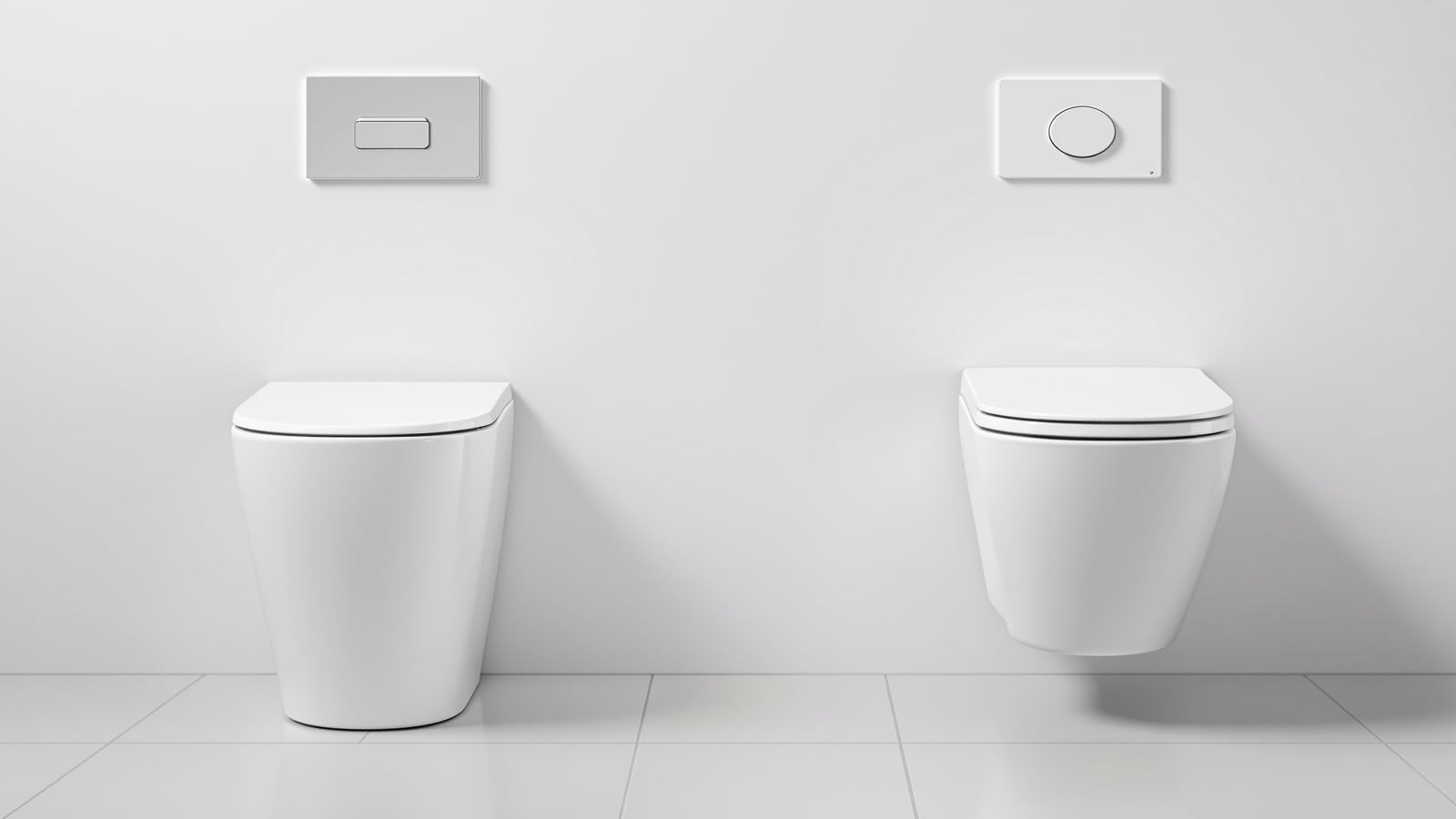
- Floor-mounted, close-coupled (two-piece). The classic: a floor-fixed bowl with a separate cistern bolted on top. Cheapest, easiest to service, understood by every plumber in India. The joint between tank and bowl and the floor bolts collect grime.
- Floor-mounted, one-piece. Bowl and cistern moulded as a single seamless unit. Cleaner lines, no tank-to-bowl joint to leak, easier to wipe — but pricier and heavier.
- Wall-hung, with concealed cistern. The bowl cantilevers off the wall on a hidden steel frame (an in-wall carrier), and the cistern is buried inside a stud or brick wall behind a flush plate. The floor is clear underneath, so mopping is effortless and the look is premium. It costs the most, demands a load-bearing frame installed during civil work, and any future repair means opening the wall panel. This is the fastest-growing category in urban India — the full trade-offs are in the wall-hung toilet guide, with the traditional option covered in the floor-mounted toilet guide.
The trap and the rough-in: the two numbers that govern everything
More installations go wrong here than anywhere else. Two hidden measurements decide whether a commode even fits your bathroom.
S-trap versus P-trap outlet
The trap is the S- or P-shaped bend built into the pan that holds a water seal and stops sewer gas rising into the room. What matters for buying is which way the waste leaves the pan:
- S-trap exits downward, through the floor into a drain in the slab. This is the traditional and still most common outlet in Indian construction, because our waste stacks usually run below the floor.
- P-trap exits horizontally, out through the wall behind the pan. Common with wall-hung units and in modern apartments where the drain is in the wall. Wall-hung frames are almost always P-trap.
You must match the pan's trap to your existing drain outlet. An S-trap pan cannot connect to a wall drain, and a P-trap pan cannot connect to a floor drain, without ugly adaptors that invite leaks. Check the drain before you buy — this is the check the blockquote above insists on.
Rough-in distance (the S-trap number)
For an S-trap floor commode, the rough-in (also called the trap distance or set-out) is the distance from the finished wall to the centre of the floor drain. If your pan's rough-in does not match the drain, the commode will sit too far from or too close to the wall.
| Trap type | Waste exits | Key measurement | Typical India value |
|---|---|---|---|
| S-trap | Down, through floor | Rough-in: wall to drain centre | 220 mm (common); also 250 / 300 / 400 mm |
| P-trap | Back, through wall | Height: floor to outlet centre | 180 mm (wall-hung frames) |
The commonest Indian S-trap rough-in is 220 mm, but 250, 300 and even 400 mm exist — always measure yours and buy a pan that matches. Buying "S-trap 220" when your drain is at 300 is the classic showroom error.
Flush systems and water norms
The flush is where water bills, resale value and green ratings meet.
- Single-flush delivers one fixed volume every time — wasteful and now largely obsolete for new work.
- Dual-flush gives you two buttons: a full flush around 6 litres for solids and a half flush around 3 litres for liquids. This 6/3 (some 4.5/3) split is the sensible default and is what water-efficiency schemes expect. Over a family's year it saves thousands of litres.
- Concealed dual-flush uses a large flush plate on the wall for wall-hung and some floor units; close-coupled dual-flush uses two buttons on the tank lid.
Green-building programmes — IGBC Green Homes and GRIHA — award points for low-flow WCs, and CPHEEO guidance and water-conservation norms push the 6/3-litre dual-flush as the baseline for new construction. If you are chasing a rating or simply a lower water bill, dual-flush is non-negotiable. Pair it with the water-saving fittings covered in the eco-friendly bathroom guide.
Rimless, comfort height and the seat that suits you
Three product trends are worth understanding before you shop.
- Rimless bowls. A conventional bowl hides a hollow rim where bacteria and hard-water scale collect out of sight. A rimless design does away with it — water sweeps the whole bowl in an open channel, so it is far easier to clean and more hygienic. In Indian hard water this is a real, lasting benefit and now available across price bands. It is the single upgrade most worth the extra rupees.
- Comfort / chair height. Standard bowl rim height is about 380–400 mm; comfort-height (chair-height) bowls sit around 430–480 mm so you stand up with less strain — kinder to tall users, elderly relatives and anyone with knee trouble. For a family bathroom, standard height suits children better; for an ensuite used by older adults, comfort height wins.
- Seat and glaze. A slow-close (soft-close) seat is worth the small premium — no slamming, longer life. A good dirt-resistant glaze (branded as EasyClean, Hygienicglaze and the like) keeps hard-water film from bonding to the surface. Insist on IS 2556 vitreous china; thin, cheap glaze stains within a season under Indian water.
The health-faucet / jet spray norm
In India, water cleansing is the norm, and every WC — squat or Western — is expected to have a health faucet (jet spray, bum gun) plumbed beside it. It runs off a T-connection from the angle valve feeding the cistern and mounts on a wall hook within easy reach on the user's dominant side, typically left of the pan at about 200–250 mm off the finished floor when hooked. For a genuinely dry, splash-controlled bathroom, plan its position when you set the WC, not after tiling. Some homes add a bidet function via a smart seat instead — the spray, bidet-seat and combined-unit options are compared in the bidet and health faucet guide and the smart toilet guide.
Cost comparison (India, 2026)
Indicative supply-only rupee ranges for the WC and its cistern/frame — excluding seat upgrades, tiling and plumbing labour. Wall-hung totals include the concealed frame and flush plate, which add substantially over the bowl alone.
| Toilet type | Typical price (₹) | Notes |
|---|---|---|
| Indian squat pan | 800 – 3,000 | Pan only; add trap and health faucet |
| Floor-mounted, two-piece (close-coupled) | 5,000 – 15,000 | Most common; easiest to service |
| Floor-mounted, one-piece | 12,000 – 35,000 | Seamless, easier to clean |
| Wall-hung bowl + concealed frame + plate | 22,000 – 70,000+ | Frame ₹8,000–25,000 of this; premium look |
| Rimless upgrade (on any Western bowl) | +1,500 – 6,000 | Worth it in hard water |
| Health faucet (jet spray) | 400 – 2,500 | Expected on every WC in India |
| Smart / integrated bidet WC | 45,000 – 3,00,000+ | See the smart toilet guide |
A practical rule of thumb. For a value-first bathroom, a two-piece dual-flush with a rimless bowl and a slow-close seat gives you almost all the hygiene benefit for a fraction of a wall-hung cost. Spend on wall-hung only when you have decided during civil work, want the clear-floor look, and accept the buried-cistern service trade-off. Whatever you choose, get the trap and rough-in right first — everything else can be changed later, but the drain cannot.
References
- NBC 2016 (National Building Code of India), Part 9 — Plumbing Services, water supply, drainage and sanitation requirements.
- IS 2556 — Vitreous sanitary appliances (vitreous china): specifications for WC pans, cisterns and squat pans.
- IS 1172 — Basic requirements for water supply, drainage and sanitation.
- CPHEEO Manual on Water Supply / Sewerage (Ministry of Housing & Urban Affairs) — water-use and low-flow fixture guidance.
- IGBC Green Homes and GRIHA rating manuals — water-efficiency credits for dual-flush and low-flow WCs.
- Bureau of Indian Standards (BIS) — current sanitaryware and plumbing standards.
Export this guide
Related Guides — Deep-dive reading
How to Choose a Toilet in India: A Buyer's Guide to WCs, Traps, Flush & Budget (2026)
The make-or-break trap and rough-in check, floor-mounted vs wall-hung, one-piece vs two-piece, flush type and water use, seat and rimless upgrades, good/better/best rupee tiers, what's actually in the box, and how to spot a fake before you pay.
BathroomsFloor Mounted Toilet India: S-Trap vs P-Trap, Rough-In & Cost (2026)
The practical default WC for most Indian homes — one-piece vs two-piece close-coupled, why the S-trap vs P-trap and trap-distance decision is the number one replacement mistake, floor fixing and sealing, cistern types, rupee costs, and an honest comparison with wall-hung.
BathroomsWall Hung Toilet India: Concealed Cistern, Carrier Frame & Real Costs (2026)
How a floating WC actually works — the in-wall carrier frame rated to ~400 kg, the concealed cistern behind the flush plate, the wall thickness and duct you must plan for, rough-in heights, and an honest pros-cons-cost comparison with floor-mounted pans.
BathroomsRelated Tools — Try Free
Before vs After — Cost Reality Check
Compare what you expected to pay vs what you actually paid, category by category.
Reality CheckApartment Video Door System Planner
Enter flats, entrances, floors and guard desk for a first-pass building intercom plan — door stations, indoor monitors, guard station, the right architecture and an indicative cost band.
Building PlannerBathroom Cost Calculator
Estimate the all-in cost of building or renovating a bathroom — by size, quality tier and city, with a category-wise breakdown.
Bathroom Calculator