
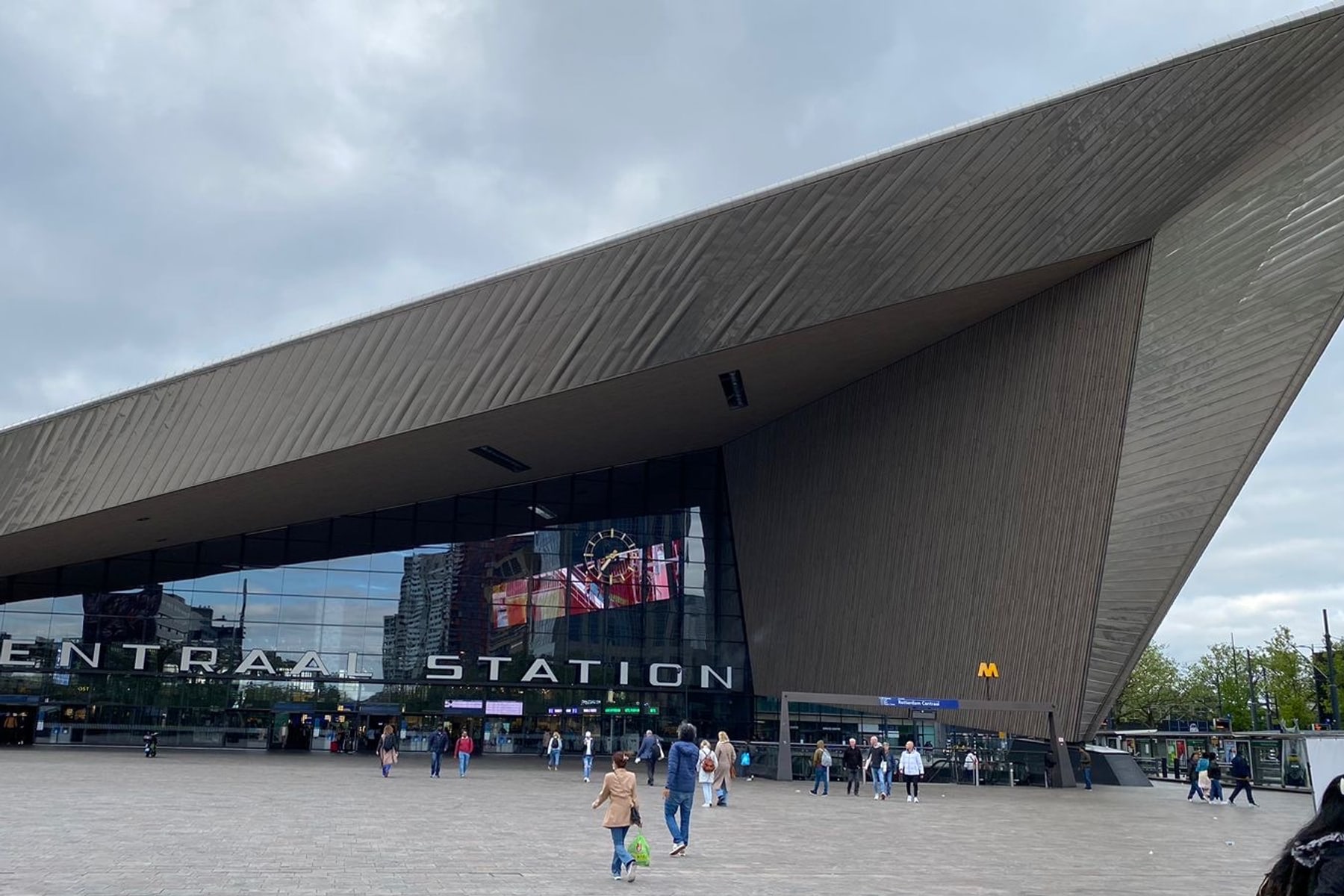
Rotterdam Centraal: The Station That Points at the City
How Team CS gave a rebuilt station a great pointed roof of stainless steel that gestures at the skyline, a second face of humble timber for the little houses behind it, a warm wooden hall, and one of Europe's largest solar roofs stretched over the platforms.
Come back one last time to Rotterdam — because if you arrived in this city by train, this is the building that met you at the door. Rotterdam Centraal, the central station, rebuilt and reopened in 2014, is the front entrance to everything else in this cluster: the Erasmus Bridge, the Cube Houses, the Markthal, the Euromast. And like the best front doors, it does two things at once — it makes a grand gesture to the city in front of you, and a quiet, courteous one to the neighbourhood behind you.
It is the work of "Team CS," a trio of Dutch firms: Benthem Crouwel, MVSA — the same practice that shaped the interiors of the nhow — and the landscape architects West 8. Its most famous feature is a roof: a huge, pointed, gleaming wedge of stainless steel that seems to lunge toward the city centre like the prow of a ship. But the cleverest thing about this station is not that dramatic face. It is the modest one hiding on the other side.
This is the twenty-seventh article in our Architectural Wonders series.
1. The roof that points
Walk out of the trains and into the great hall on the city side, and the building is doing something almost no station bothers to do: it is gesturing. The roof does not just shelter you — it aims you.
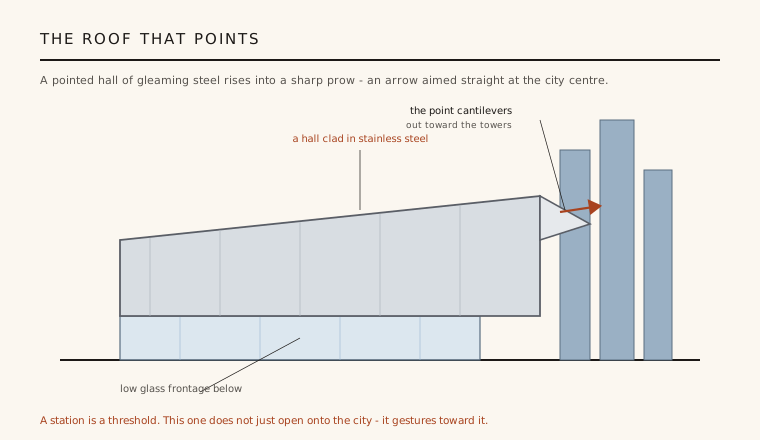
The entrance hall is a vast pointed wedge, its whole roof clad in bright stainless steel, rising to a sharp cantilevered point that soars out toward the city's high-rise spine, the Weena. The architects say the gleaming metal is a deliberate echo of the glittering River Maas that made Rotterdam a port; the sharp geometry turns the building into a kind of arrow, pointing the arriving traveller straight into the heart of the city. Structurally it is a bravura piece of work — a roof of immense span carried on essentially two supports, founded on the walls of the metro box buried below. A station is, at its core, a threshold — the hinge between arriving and belonging. Most stations merely open onto the city. This one points at it, and says: that way.
2. Two faces, two cities
Now walk straight through the hall and out the other side, and you will think you have left by a completely different building. You have not. This is the real genius of Rotterdam Centraal: it has two faces, and they could not be less alike.
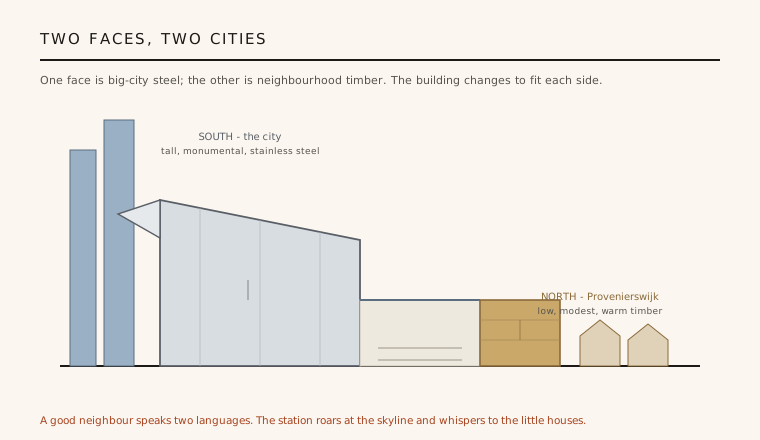
On the south, toward the Stationsplein and the towers of the modern city, the station is all majesty — the tall, shiny, pointed steel prow, a gateway scaled to the skyline. But on the north, the station backs onto the Provenierswijk, a modest nineteenth-century neighbourhood of small brick houses. And there the building changes its voice entirely: it drops low, turns transparent, and clads itself in warm timber, deferring politely to the scale of the little streets behind. One continuous hall runs all the way through, knitting the two together. This is a genuinely mature idea about how a big building should behave in a city. A monument does not owe every neighbour the same gesture. It can be grand where grandeur belongs and gentle where gentleness is kinder — a good neighbour who speaks two languages, roaring at the skyline and whispering to the houses.
3. A roof that makes power
There is a third face to this station that you cannot see from the street at all — it is on top, over the platforms, and it is quietly one of the most forward-looking things about the whole building.
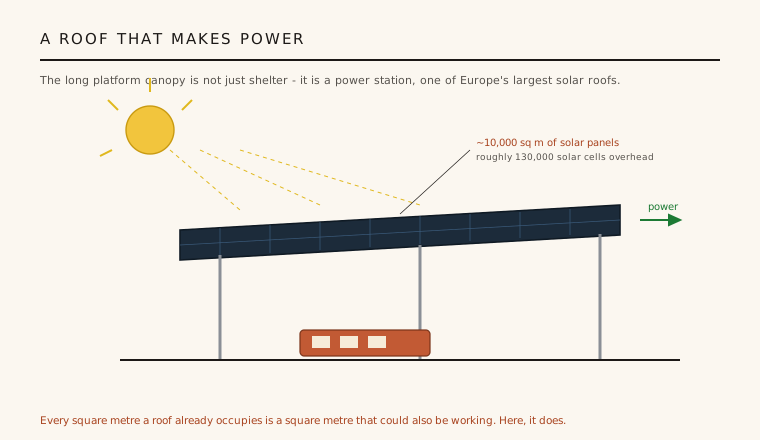
The long glazed canopy that covers the tracks is not only shelter — it is a power station. Roughly ten thousand square metres of it are filled with solar cells — some 130,000 cells set into around three thousand glass-in-glass panels — making it, at the time it opened, among the largest solar roofs in Europe on a public building. It is woven directly into the glazed roof itself, part of the surface that lets daylight down onto the platforms, not a rack of panels bolted on as an afterthought. It generates enough to trim the station's carbon emissions by about eight per cent. There is something deeply fitting in this. The Netherlands has, for centuries, made its power out of the sky — we watched it do so with the wind at Kinderdijk. Here the same instinct simply turns to the sun: a roof that has to exist anyway is quietly put to work.
4. Steel outside, timber within
Step back inside the great hall and look up, and you meet the tenderest decision in the whole design — the one that turns a monument into a place you might actually enjoy waiting in.
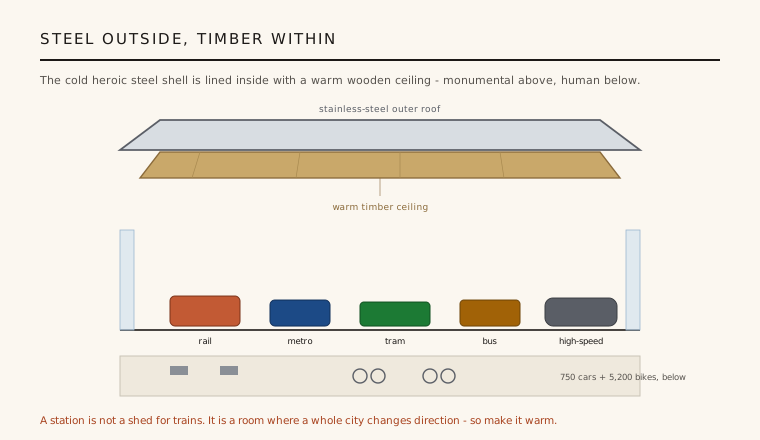
The outside of that dramatic roof is cold, heroic steel. But the inside — the surface you actually stand beneath — is lined entirely in warm timber, a soft wooden ceiling glowing over a bright, daylit concourse (the great spans use plain glued-timber beams, the sort meant for barns). The same building is monumental outside and intimate overhead. And the hall it shelters is not a shed for trains; it is a genuine piece of public space — one room where heavy rail, metro, tram, bus and the high-speed international trains all meet, with 750 cars and 5,200 bicycles tucked underground so the square out front can stay traffic-free and human. It is the lesson we keep meeting in the best of these buildings, from the Markthal to the nhow: pair a loud civic material with a soft human one, and give people a warm room, not just a route.
5. From 1957 to 2014
Finally, it helps to know what stood here before — because this station is the third act of a much longer Rotterdam story, and it was built with an unusually long view of the future.
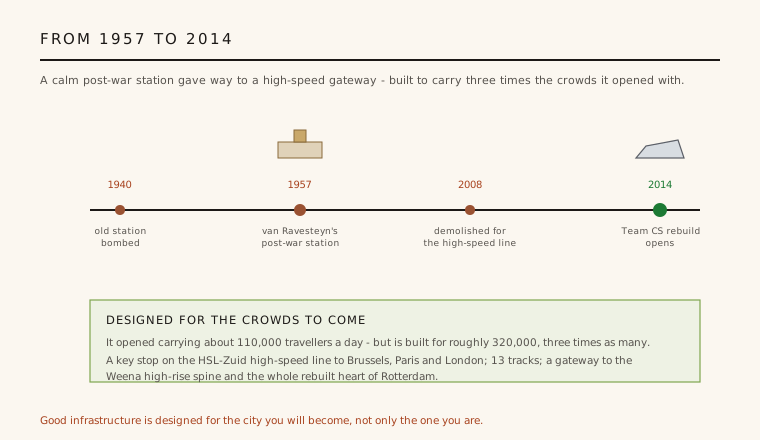
After the bombs of 1940 flattened the old station along with the rest of the centre, the architect Sybold van Ravesteyn gave the rebuilt city a calm, optimistic station in 1957. But half a century on it could no longer cope — and the arrival of the high-speed line was the final push. Van Ravesteyn's building came down in 2008, and Team CS's replacement opened in 2014. Crucially, they did not build it for the crowds of that day. It opened carrying about 110,000 travellers a day and was engineered to swell to roughly 320,000 — nearly three times as many — as it took its place as a key stop on the HSL-Zuid, the high-speed line running on to Brussels, Paris and London. That is the last, quiet lesson of Rotterdam Centraal, and a fitting one to end this Dutch chapter on: the best infrastructure is built not for the city you are, but for the city you intend to become.
6. What a modern architect can learn from Rotterdam Centraal
- A building may have two honest faces. A monumental steel prow addresses the city; a low timber face defers to the neighbourhood. Contextual response can be asymmetric within one building — you don't owe every neighbour the same gesture.
- Make infrastructure gesture. The arrow-shaped roof points at the city and mirrors the river. A transport hall can carry civic identity and wayfinding, not just shelter — architecture as a legible sign.
- Build renewable energy into the surface, not onto it. Ten thousand square metres of solar cells are part of the glazed platform roof itself. Integrated power reads as architecture; bolted-on hardware reads as apology.
- Warm the monument. The heroic steel shell is lined in soft timber exactly where people stand and wait. Pair a loud civic material with a gentle human one at the surfaces people actually touch.
- A station is public space. Cars and 5,200 bikes go underground so the forecourt can be a civic square, and one continuous hall becomes a public route between two neighbourhoods. Design the connective tissue, not just the shed.
- Design for the city you will become. It opened at 110,000 a day and was built for 320,000. Good infrastructure plans for the future's crowds, not only today's.
In Amogh's frame
Rotterdam Centraal is a place Amogh passed through himself. Here he is with his family on the Stationsplein, the great pointed steel roof and the "Centraal Station" lettering rising behind them — the very prow this whole article is about, seen not as a diagram but as an ordinary grey-bright afternoon at the front door of a city he loved to explore.
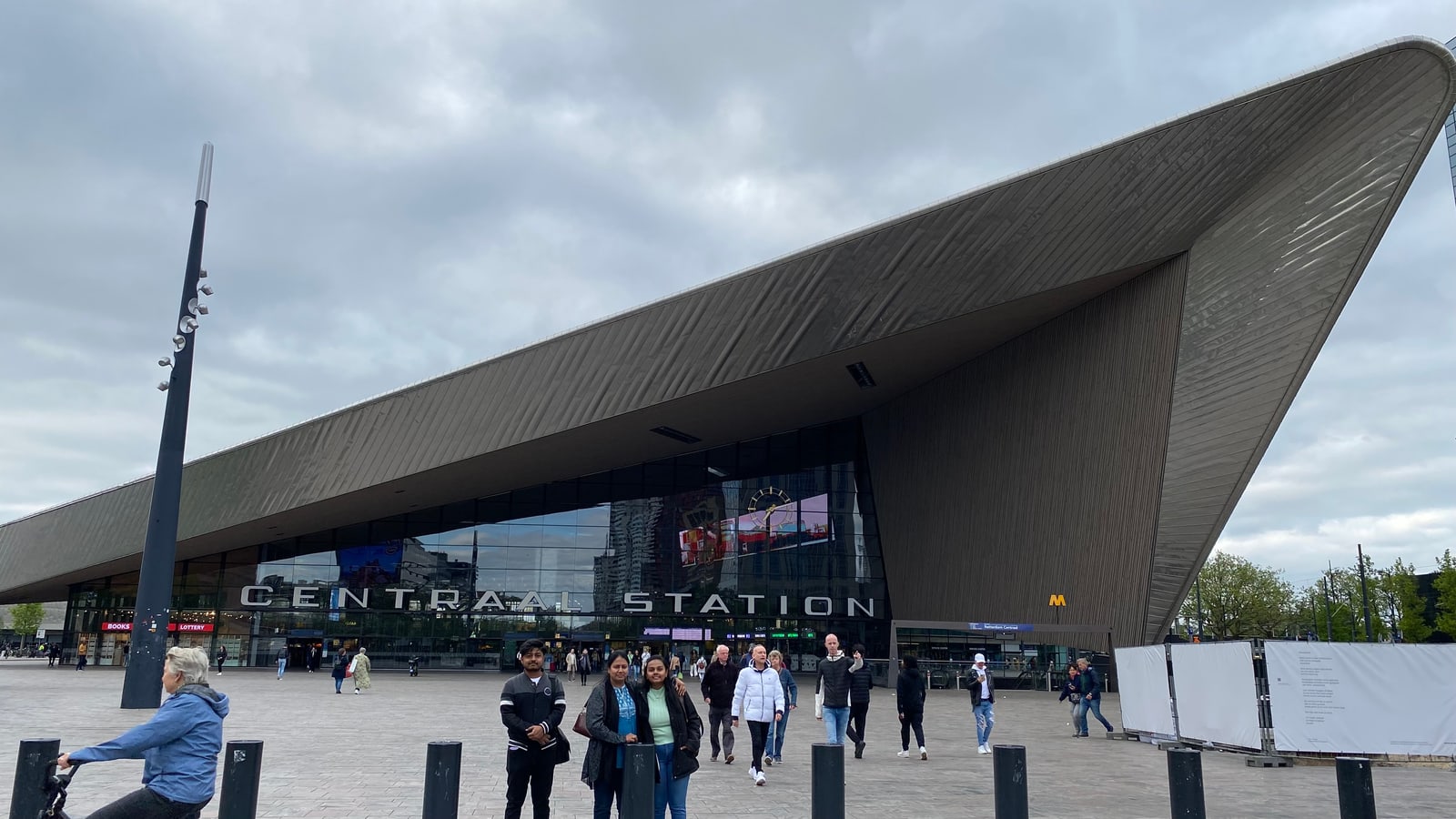
Studio Matrx is built in his memory. Some of these wonders he walked through himself; this is one of them.
References & further reading
1. West 8 — Rotterdam Centraal. https://www.west8.com/projects/rotterdam-centraal/
2. MVSA Architects — Rotterdam Central Station. https://mvsa-architects.com/en/projects/rotterdam-central-station/
3. ArchDaily — Rotterdam Central Station / Benthem Crouwel + MVSA + West 8 (Team CS). https://www.archdaily.com/588218/
4. Wikipedia — Rotterdam Centraal station. https://en.wikipedia.org/wiki/Rotterdam_Centraal_station
5. The Architect's Newspaper — Two-Sided Railway Station by Team CS. https://www.archpaper.com/2014/04/two-sided-railway-station-by-team-cs/
6. rotterdamcentrum.nl — The extraordinary architecture of the Central Station in Rotterdam. https://www.rotterdamcentrum.nl/en/discover/design-and-architecture/de-buitengewone-architectuur-van-het-centraal-station-in-rotterdam
Last verified 2026-07-03. Figures vary between sources and are given as widely cited approximations — the station reopened in 2014 (Team CS: Benthem Crouwel, MVSA and West 8), replacing Sybold van Ravesteyn's 1957 station; the stainless-steel entrance hall faces the city (Stationsplein) to the south while the modest timber face addresses the Provenierswijk to the north; the platform roof carries roughly 9,000–10,000 m² of solar cells (about 130,000 cells in some 3,000 glass panels, cutting the station's CO₂ by about 8%); it opened at ~110,000 passengers a day and is designed for roughly 320,000. The 250 m glazed platform canopy, the warm timber hall, the multimodal hub and the HSL-Zuid high-speed role follow the established record.
Export this guide
Related Guides — Deep-dive reading
Blaak 31: The Tower That Steps Aside
How KCAP built a twelve-storey office in the heart of Rotterdam that politely steps and turns away from its neighbours — shifting 2.70 metres every three floors to hand the Markthal next door its light and privacy — all balanced on a great steel truss above the city's live metro tunnel.
Architectural WondersOodi Helsinki Central Library: The Inhabited Bridge That Rebuilt the Public Library
ALA Architects spanned a 100-metre steel bridge over an open ground floor, wrapped it in Finnish spruce, and pointed its terrace straight at Parliament — a case study in the library reinvented as civic living room, in the engineering that makes a column-free public square possible, and in what a nation says when it builds knowledge opposite power.
The Future of ArchitectureFővám tér and Szent Gellért tér: How Budapest Turned a Transit Box into Underground Architecture
Sporaarchitects' twin M4 stations refuse to hide their engineering. By exposing the raw concrete beam-cage that holds back the Danube's earth and cutting skylights down thirty metres, they reinvent the deep metro station as a piece of public architecture — a nineteenth-century Pest street excavated back into the ground.
The Future of ArchitectureRelated Tools — Try Free
Before & After Studio
Generate AI before-and-after renders to preview how your redesign could look.
DesignAIFalse Ceiling Cost Estimator
Live ₹/sqft across 8 ceiling types — POP, gypsum, designer, metal, PVC, wooden — with cove and spot lighting for 20 Indian cities.
Cost CalculatorSun Path Analyzer
See the sun's exact path across your home or plot in AR — sunrise, sunset, solar noon, solstices.
AR Analyzer