
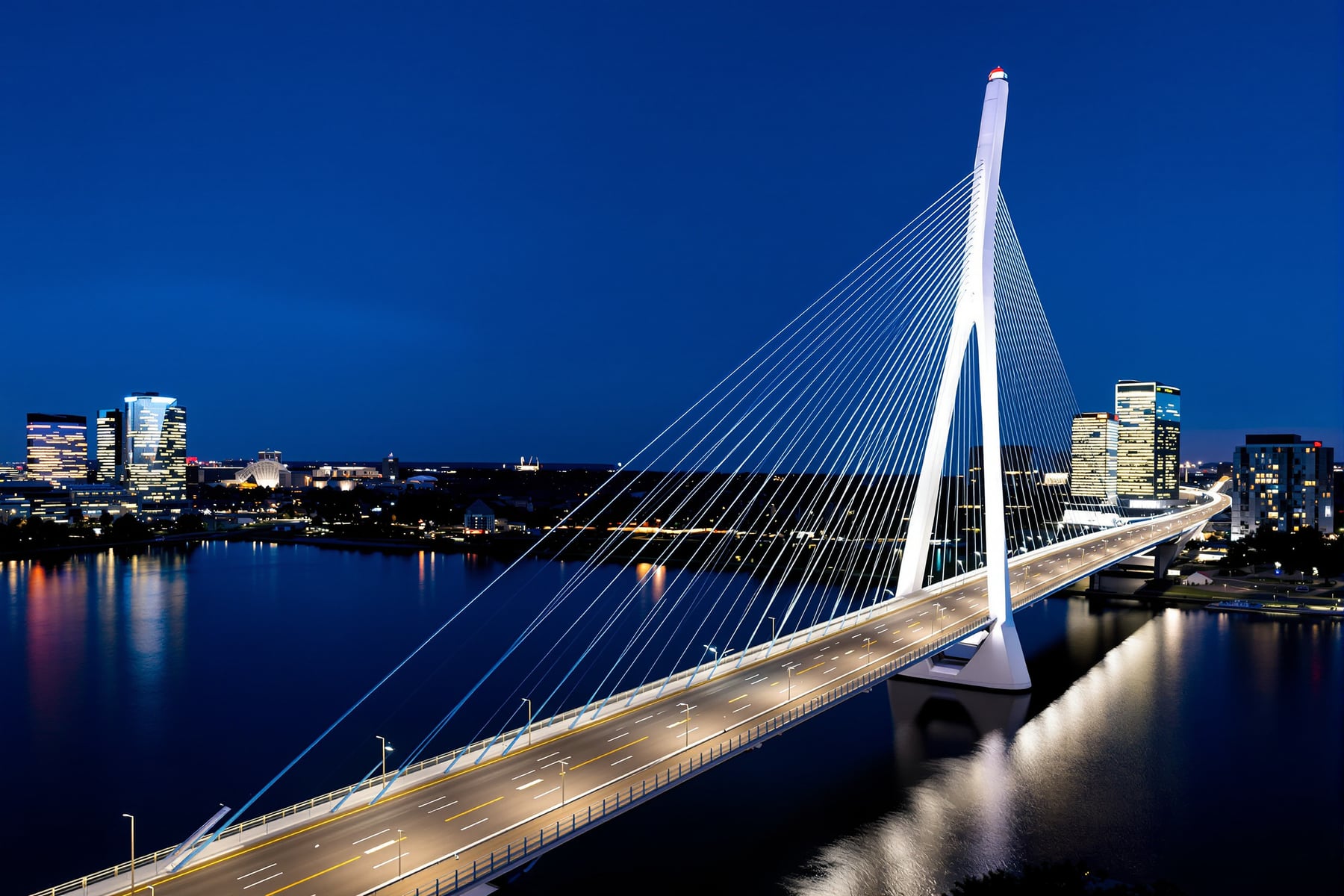
The Erasmus Bridge: Rotterdam's Swan
How a single leaning pylon and a fan of steel cables became the emblem of a city that had to reinvent itself — Ben van Berkel's cable-stayed swan across the Nieuwe Maas, the largest bascule in Western Europe, and the modern proof that a bridge can be a verb: it did not merely span Rotterdam, it changed it.
Stay in the Netherlands, but leave the quiet polder of Kinderdijk and come into the heart of Rotterdam — a city that does the opposite of almost everything this series has celebrated. Nearly every wonder we have visited is ancient. Rotterdam has hardly any old centre at all: on the 14th of May 1940 German bombers flattened it in a single afternoon, and in rebuilding, the city chose to become the boldest showcase of modern architecture in Europe. Its emblem — the silhouette on the city's own logo — is not a cathedral or a tower. It is a bridge: the Erasmusbrug, which everyone in Rotterdam simply calls the Swan.
It is a single white pylon, 139 metres tall, bent near the top like a swan's neck, from which a fan of steel cables carries a road deck across the wide Nieuwe Maas. It is beautiful; it is structurally daring; part of it lifts to let ships through; and — most importantly — it was built to do something no bridge had quite been asked to do before: to pull a divided city back together.
This is the twenty-second article in our Architectural Wonders series, and only the second — after the Bibliotheca Alexandrina — to be built in our own lifetime.
1. The Swan
The whole design turns on one bold decision: a single, asymmetric pylon. Instead of the balanced pair of towers most big bridges use, Ben van Berkel — the architect, then of Van Berkel & Bos, later UNStudio — set one tall mast to the side and bent it near the top, so it rakes back and then kinks forward over the river.
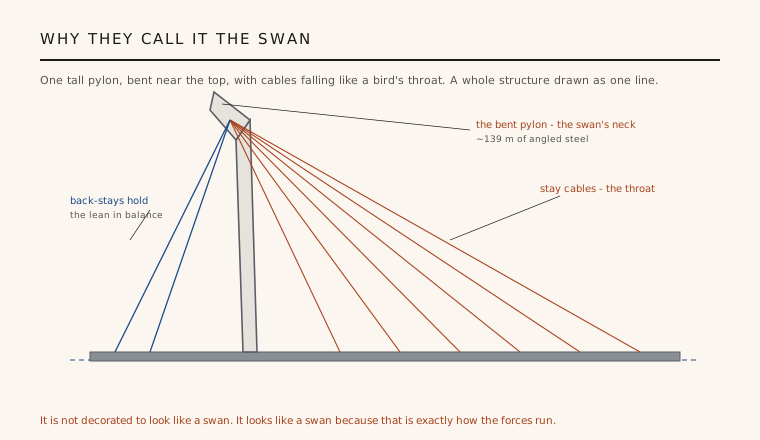
From that bend a fan of forty stay cables sweeps down to the deck, and the whole thing — pale sky-toned steel, taut lines, one elegant angular gesture — reads instantly as a swan's neck and throat. The nickname was not designed in; it is simply what the shape looks like once the structure is honest about how it works. And the city fell for it completely. A bridge conceived as infrastructure became, within a few years, the image of Rotterdam itself — the shape on its tourist posters and its civic logo. That is a rare thing for a piece of engineering to achieve, and it is the first clue that the Erasmus Bridge is doing more than carrying traffic.
2. A leaning tower held by cables
Look again at that single leaning mast and you should feel a little disbelief — because it looks like it should fall over. Understanding why it does not is the key to the whole bridge, and it is a lovely piece of structural logic.
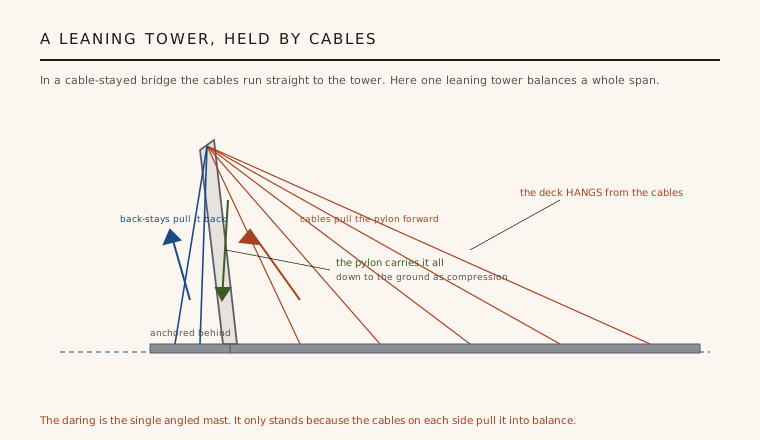
This is a cable-stayed bridge: the stay cables run straight from the tower down to the deck, carrying the roadway's weight directly up to the pylon, which passes it down to the ground in compression. (That is different from a suspension bridge, where the deck hangs from a great draped cable slung between two towers.) The danger of a single, inclined pylon is that the weight of the main span, pulling on all those cables, would drag the tower over. The answer is the group of steep back-stay cables on the shorter landward side: they pull in the opposite direction and hold the leaning mast in balance. The engineers were blunt about how essential this is — they found the bridge simply could not stand without the back-stays. That is the honest lesson hiding inside the elegance: the daring lean is not a trick of shape, it is earned, cable by cable, by a rigorous balancing act. Van Berkel took the inclined-pylon idea partly from Santiago Calatrava's Alamillo Bridge in Seville — and the reason it works here is that architect and city engineers, unusually, worked as equals, so the sculpture and the structure are the same object.
3. The swan opens its wing
There is a second surprise. This graceful sculpture is also a working machine — because the Nieuwe Maas is a busy shipping river, and tall ships must pass. So the southern end of the bridge is a bascule: a section of the roadway that tilts up to open a gap.
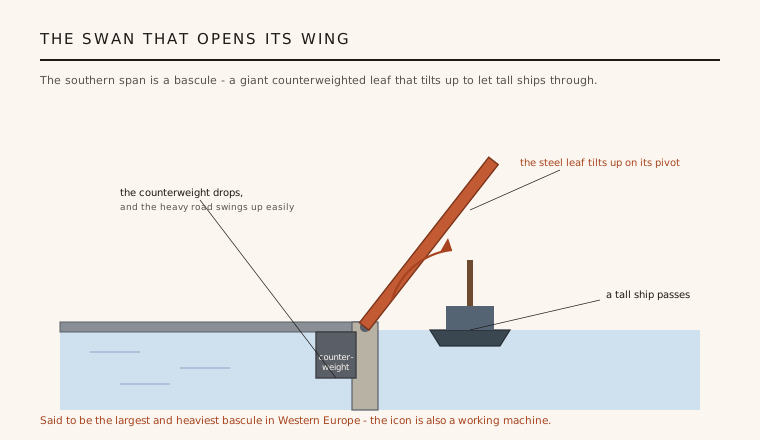
The bascule span is 89 metres long, and it is reckoned the largest and heaviest bascule bridge in Western Europe — the tilting leaf alone is a steel plate over fifty metres long weighing well over a thousand tonnes. It swings up on great pivot bearings, helped by a counterweight that drops behind the pivot so the hydraulic rams need only a fraction of the force they otherwise would, and it clears roughly fifty metres for a ship to slip through. There is something very Dutch in this detail: even the city's proudest icon must bow to the water. In a country that has spent eight centuries negotiating with the sea — the same negotiation we watched at Kinderdijk — the river still has the right of way, and the bridge is built to yield to it.
4. A bridge that rebuilt a city
Now the real reason the Erasmus Bridge exists — and the reason it belongs among wonders. It was never only a way to get across the river. It was commissioned as a deliberate act of city-building.
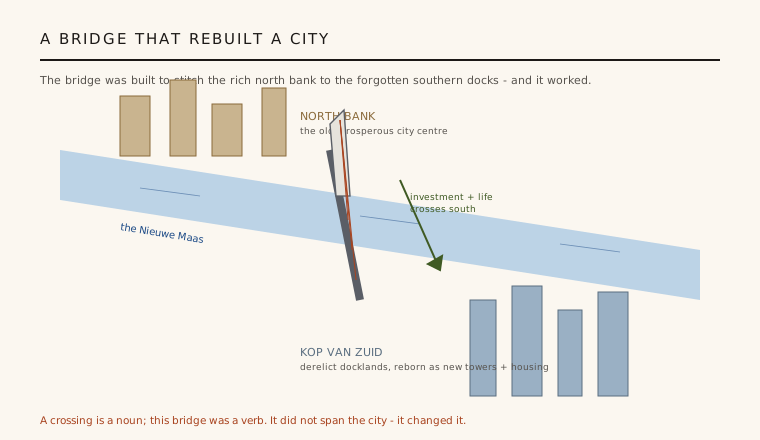
On the north bank stood the prosperous, rebuilt city centre. On the south bank lay Kop van Zuid — a peninsula of derelict former docklands, cut off, poor, forgotten. The bridge was built to stitch the two together, and van Berkel described the pylon's whole job as literally "pulling the north to the south." It worked, spectacularly: the crossing detonated one of Europe's great waterfront regenerations, and the empty docks became a district of towers, housing, culture and life. This is the idea that turns a bridge from a noun into a verb. A crossing that merely spans a gap is engineering; a crossing that changes the economy and the self-image of a whole city is something more. As the Bibliotheca Alexandrina carried the ambition of a city on the Mediterranean, the Swan carried the ambition of a city on the Maas. Van Berkel said the thing he could never have predicted was that it would be "embraced by so many people … that this bridge became the bridge of others." That is the highest thing public architecture can hope for: to be given away to the people who use it.
5. The wobble, and the honest lesson
No account of this bridge would be honest without the wobble — and it is, in fact, the most useful part of the whole story for anyone who builds. Within weeks of the grand opening, in the autumn of 1996, the slender stay cables began to swing in alarming arcs whenever wind met rain, and the bridge had to be closed while engineers worked out why.
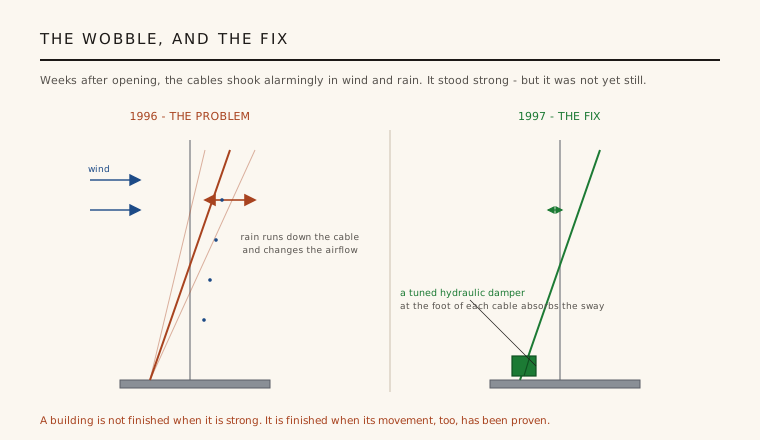
The cause was a subtle one, now a textbook case: rain–wind-induced vibration. Thin rivulets of rainwater running down the cables changed the way the wind flowed around them, and in the right conditions this drove the cables into large, self-feeding oscillations. The bridge was perfectly strong — it could carry every load asked of it — but it had not been proven still. The permanent cure, fitted in 1997, was quiet and clever: small tuned hydraulic dampers at the foot of each cable, which soak up the sway and all but eliminated it. Here is the lesson, and it is a humbling one for every designer: a structure is not finished when it can bear its loads. It is finished when its movement, too, has been verified — its resonances, its response to wind, its dynamics. (London's Millennium Bridge would learn the identical lesson, swaying under footfall, four years later.) The elegance of the Swan is real; so is the reminder that beauty and strength are not enough on their own, and that the honest engineer tests for the trembling as well as the standing.
6. What a modern architect can learn from the Erasmus Bridge
- Make the structure the sculpture. The Swan's beauty is not applied — the leaning pylon, the fan of stays and the back-stays are the load path, made visible. The most honest ornament is a structure that shows how it works.
- An icon can be a catalyst. The bridge was built to pull a poor south bank into the life of a rich north, and it triggered a whole district's rebirth. A single, well-placed piece of infrastructure can reset a city's economy and its self-image.
- Daring must be earned, not faked. The single inclined pylon looks impossible and nearly was — it cannot stand without its back-stays. Expressive imbalance is only legitimate when a rigorous, honest system pays for it.
- Infrastructure can be public art with a civic contract. That Rotterdam took the bridge to its heart — that it "became the bridge of others" — shows a crossing can carry identity, memory and pride, not only traffic. Design for that adoption.
- Verify the dynamics, not only the statics. The wobble proved a structure can be entirely strong and still fail to be still. A design is complete only when its movement — wind, rain, resonance, damping — has been tested, not assumed.
- Sometimes you must design the relationship, not the object. The real brief was the relationship between two halves of a city, and between a bridge and its river. The best answer was not a bigger span but a wiser connection.
In Amogh's frame
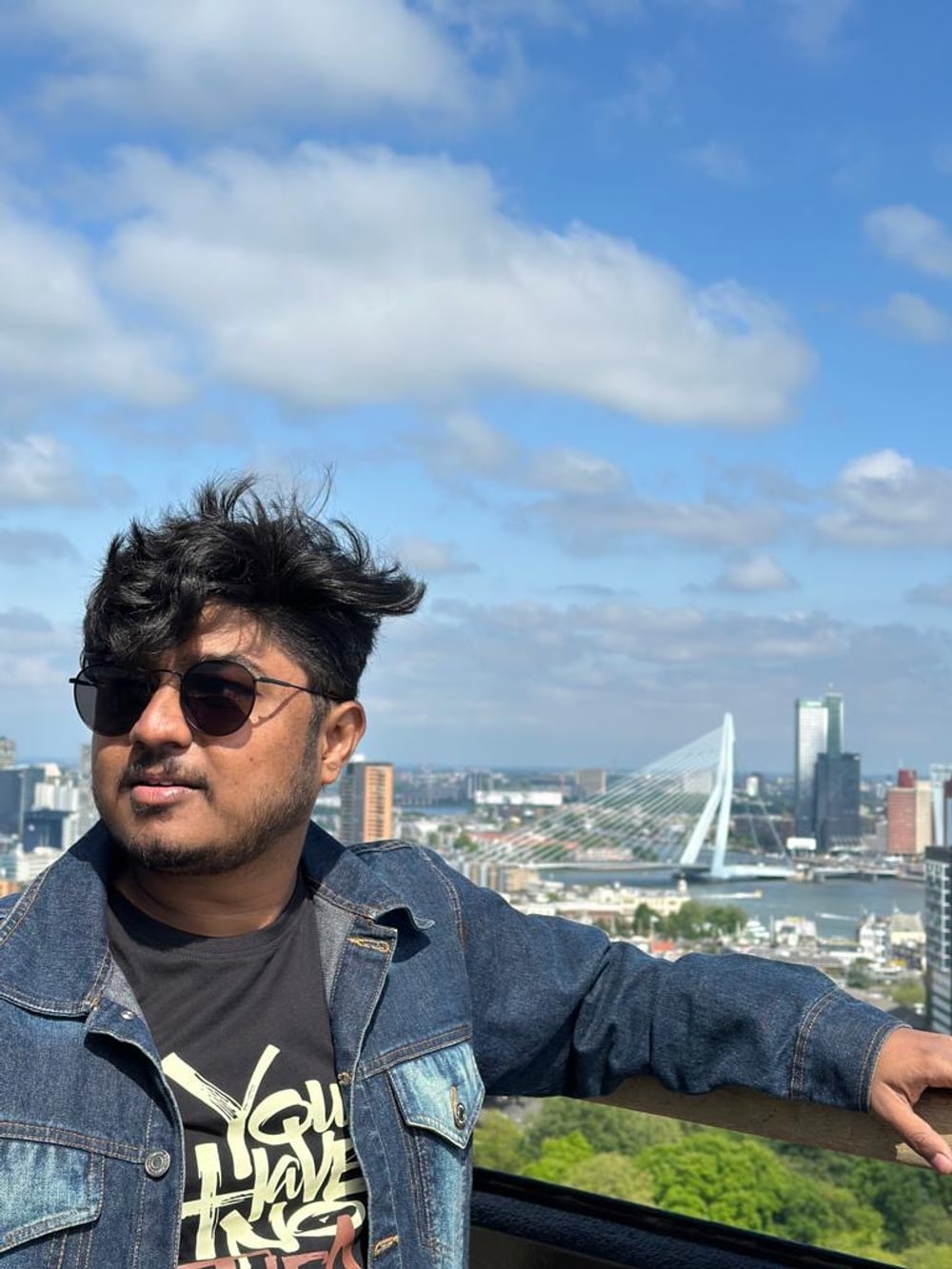
The Erasmus Bridge is one of the wonders Amogh saw with his own eyes. Here he is, high above Rotterdam, the white "Swan" spread across the Nieuwe Maas behind him and the towers of the reborn city crowding the far bank — the very bridge, and the very view, this whole article is about.
And here he is again at the same railing high above the river — this time with his family beside him, his parents and his sister, the ones who are now building Studio Matrx in his memory, the Swan and the city they all looked out on together stretching away below.
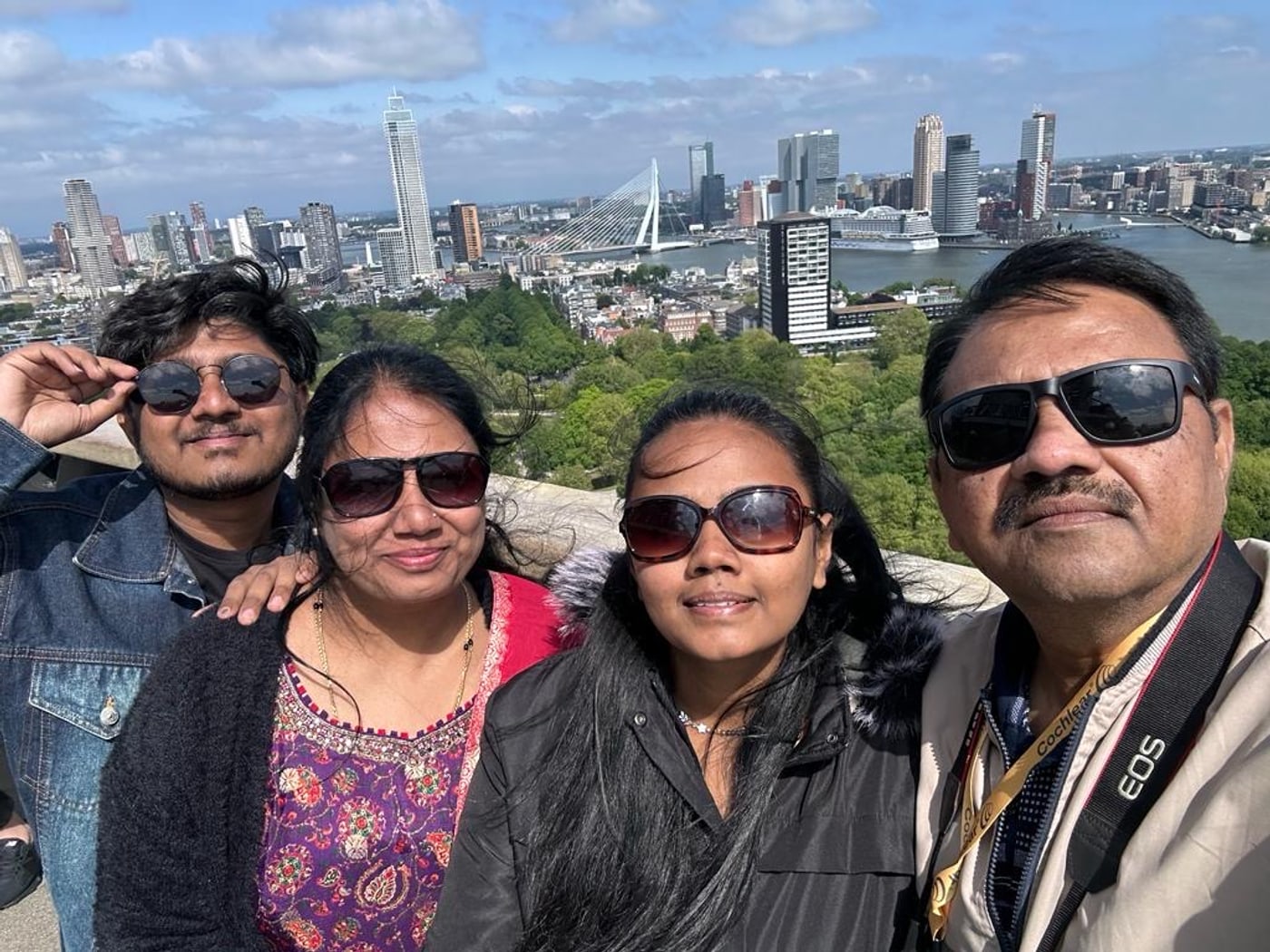
Studio Matrx is built in his memory. Some of these wonders he walked through himself; this is one of them.
References & further reading
1. UNStudio — Erasmus Bridge. https://www.unstudio.com/projects/erasmus-bridge/
2. UNStudio — Q&A: Ben van Berkel on Designing the Erasmus Bridge. https://www.unstudio.com/news/articles/q-a-ben-van-berkel-on-designing-the-erasmus-bridge/
3. Wikipedia — Erasmusbrug. https://en.wikipedia.org/wiki/Erasmusbrug
4. SKF — Bearing the biggest bascule. https://www.skf.com/group/newsroom/news-and-stories/bearing-the-biggest-bascule
5. The Happy Pontist — Rotterdam Bridges: 1. Erasmus Bridge. http://happypontist.blogspot.com/2013/10/rotterdam-bridges-1-erasmus-bridge.html
6. ASCE, Journal of Bridge Engineering — Full-Scale Measurements to Investigate Rain–Wind Induced Cable-Stay Vibration and Its Mitigation (2006). https://ascelibrary.org/doi/10.1061/(ASCE)1084-0702(2006)11:3(293)
Last verified 2026-07-03. Dimensions and dates vary slightly between sources and are given as widely cited figures — the bridge is about 802 m long with a 139 m steel pylon and a main cable-stayed span of roughly 284 m (sources give 280–285 m); the bascule section is 89 m and is described as the largest and heaviest in Western Europe. The 1996 opening by Queen Beatrix, the rain–wind-induced cable vibration and its 1997 tuned-damper retrofit, Ben van Berkel's authorship with the City of Rotterdam's engineers, and the Kop van Zuid regeneration follow the established record.
Export this guide
Related Guides — Deep-dive reading
Kop van Zuid: A New City on the Old Docks
How Rotterdam turned a mile of derelict Holland America Line docklands — the pier from which close to a million emigrants sailed for the New World — into a waterfront district of star-architect towers, stitched to the city by a single bridge and built patiently across thirty years.
Architectural WondersCahokia and Monks Mound: The Great City America Forgot
A thousand years ago, across the river from where St Louis now stands, Native Americans built a city of perhaps twenty thousand people — larger than London at the time — with a hundred and twenty earthen mounds, a plaza the size of dozens of football fields, and a solar calendar of cedar posts. At its heart rose Monks Mound, the largest earthwork in the Americas, with a footprint to rival the Great Pyramid. Then, before Europeans ever arrived, it vanished — and almost no one remembers it.
Architectural WondersThe Pantheon: The Dome That Has Never Been Beaten
Nearly nineteen centuries ago the Romans poured a hemisphere of concrete 43 metres across, left a single round hole open to the sky at its summit, and walked away — and it is still, today, the largest unreinforced concrete dome on Earth. A temple to all the gods that became a church, the best-preserved building of ancient Rome, and the ancestor of every great dome from Florence to the United States Capitol.
Architectural WondersRelated Tools — Try Free
Design Brief Generator
Answer 10 questions and generate a professional interior design brief PDF for your designer or architect.
Brief GeneratorAI Measurement Tool
Measure your room using voice, photos, or video sweep — no tape measure needed.
DesignAIBefore & After Studio
Generate AI before-and-after renders to preview how your redesign could look.
DesignAI