
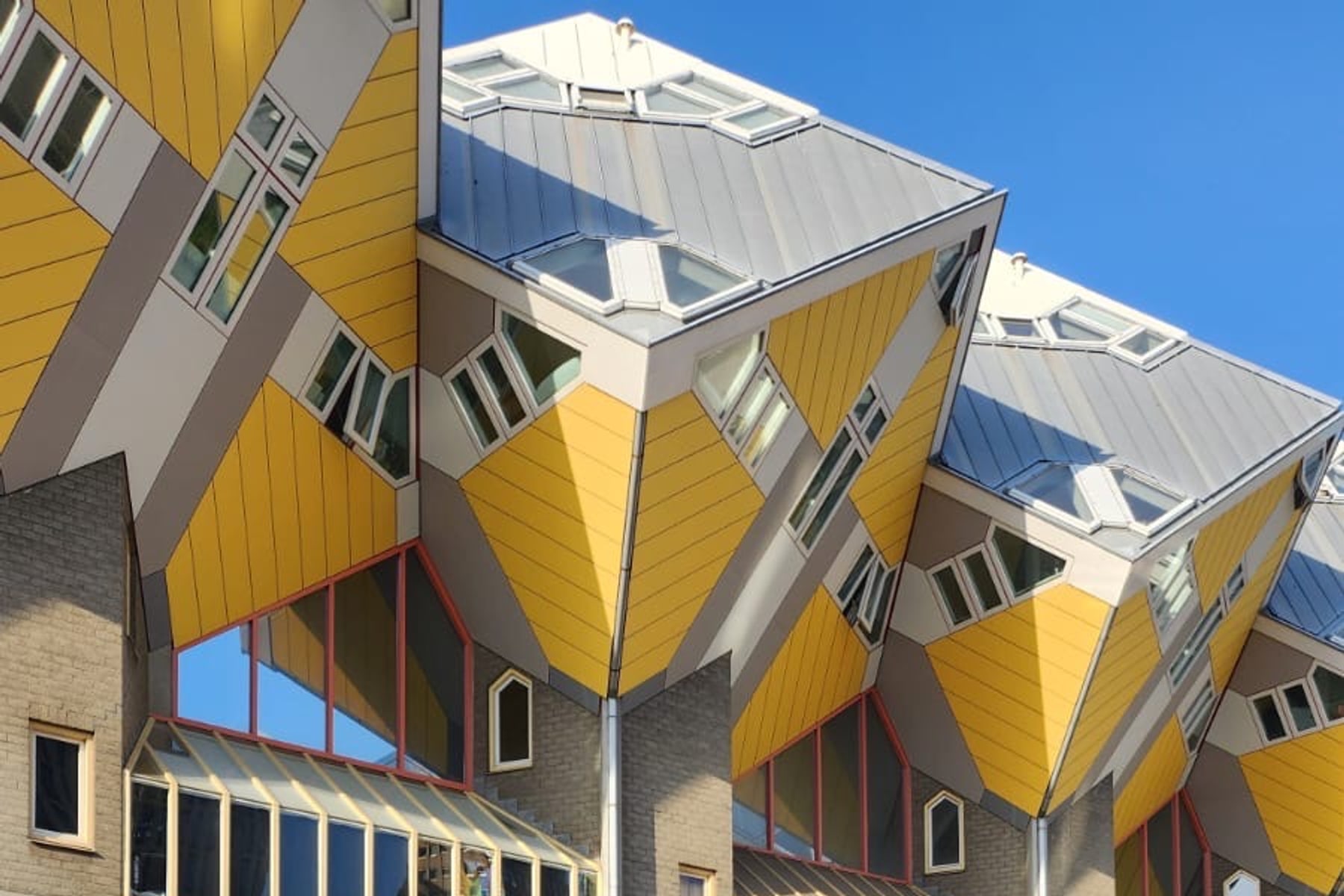
The Cube Houses: A Forest of Tilted Homes
How Piet Blom tilted an ordinary cube onto its corner, stood it on a concrete trunk, and grew a whole village of them above a Rotterdam road — the boldest housing experiment in this series, and an honest lesson in what an unforgettable idea costs the people who live inside it.
Walk a few minutes from the Erasmus Bridge, past the old harbour, and you arrive at the strangest housing estate you will ever see: a cluster of bright yellow cubes, each one tilted up onto its corner and balanced on a concrete stalk, leaning over the street like a crowd of tipsy dice. This is the Kubuswoningen — the Cube Houses — and it is the boldest, most stubborn and most argued-over building in this entire series.
It is the work of one idealistic Dutch architect, Piet Blom, who did not think he was designing houses at all. He thought he was planting trees. Each cube is a tree; the whole cluster is a forest; and the idea underneath it — "living as an urban roof" — is one of the most generous ideas about the city that modern architecture ever produced. It is also, if you actually have to live in one, a bit of a nightmare. Both of those things are true at once, and that is exactly why it belongs among the wonders.
This is the twenty-third article in our Architectural Wonders series.
1. One cube, tipped on its corner
The whole building grows from a single, almost childlike move. Take an ordinary cube — a plain house-shaped box — tilt it 45 degrees so it balances on one corner, and stand it on top of a tall hexagonal concrete pylon. That is it. That one rotation generates the plan, the section, the roof, the windows and the unmistakable silhouette, all at once.
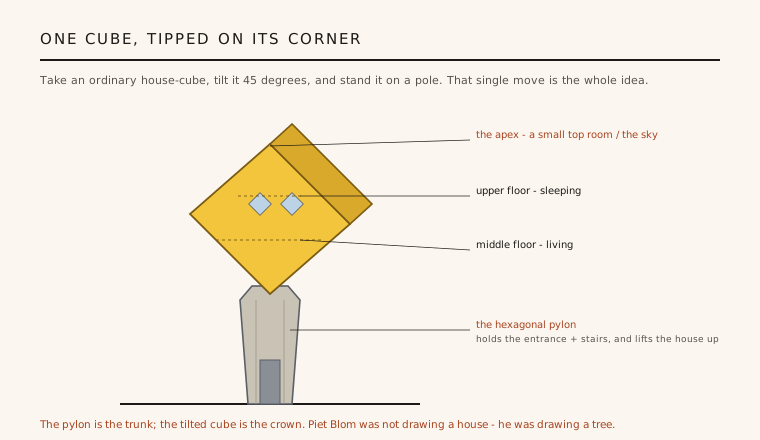
Inside, you climb up through the pylon — which holds the front door and the staircase, the "trunk" of the tree — and emerge into the tilted cube above. It stacks into three usable levels: a living floor (kitchen and living room), a sleeping floor (bedrooms and bathroom), and a small apex at the top, a pyramid of a room lit by as many as eighteen little windows, used as a study, a child's room or a tiny greenhouse. There are 38 of these cubes in Rotterdam, plus two larger "super-cubes," each home about 100 square metres. It is a remarkable piece of design economy: nearly everything about the architecture follows from one decision, taken once.
2. A tree, and a forest
Blom was not interested in a clever shape for its own sake. The tilt served an idea he had been chasing his whole career, and it is a beautiful one. He called it "wonen als stedelijk dak" — "living as an urban roof."
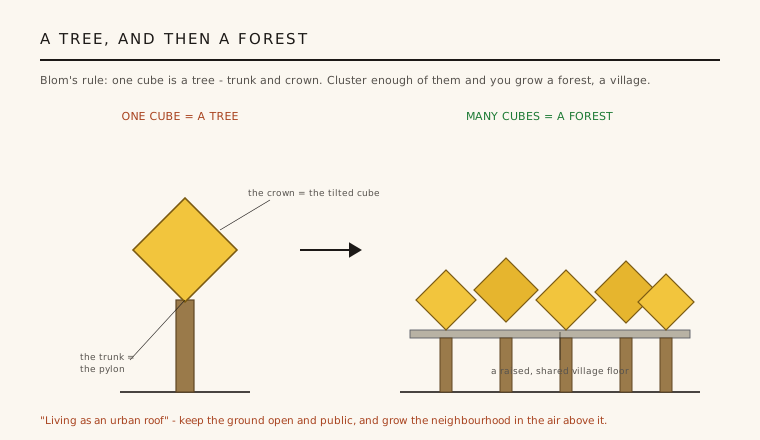
The logic runs like this. A single cube on its pylon is a tree — trunk and leafy crown. Cluster enough of them together and you have a forest; the residents nicknamed the complex the "Blaakse Bos," the Blaak Forest. And a forest of houses raised up on stalks does something a normal apartment block cannot: it keeps the ground beneath it open and public, while growing the whole neighbourhood in the air above. You build the private dwellings as a roof over the city, and hand the valuable ground level back to everyone. This is the humane, community-minded thinking of Dutch Structuralism, the movement Blom belonged to — a village of individual, quirky, non-identical homes gathered together, set deliberately against the faceless repetition of the ordinary housing slab. The metaphor is not decoration. It is the organising principle of the entire design.
3. The trouble with living in a diamond
And now the honest part — because a wonder should be told truthfully. The tilted cube is unforgettable to look at and genuinely hard to live in. When you rotate a cube onto its corner, you also rotate every wall, and suddenly no surface is vertical.
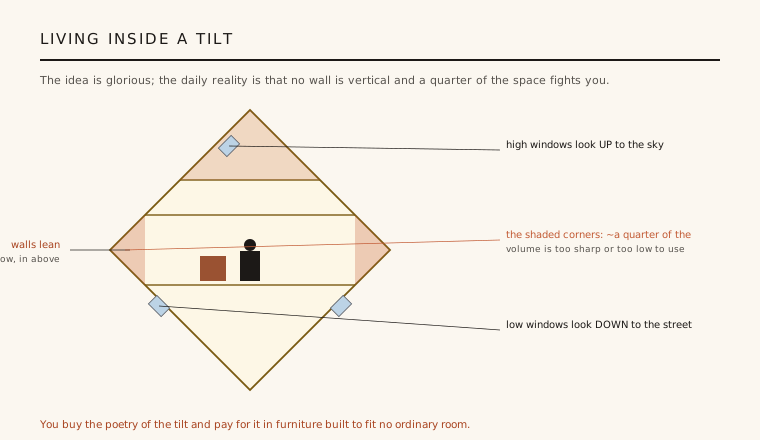
The walls splay outward low down and lean in overhead, so roughly a quarter of the floor area is effectively unusable — too sharp, too low, or too awkward for any normal furniture. Residents commission bespoke, angled furniture built to fit no ordinary room; the stairs are steep; the windows tilt to face down to the street and up to the sky rather than straight out. The houses suit energetic young owners far better than the elderly, and living in one demands, as the show-house museum politely puts it, "adaptability and creativity." That show-house — the Kijk-Kubus, one cube fitted out and opened to visitors — exists precisely because everyone's first question is the same: but how on earth do you live in it? (Two of the super-cubes, tellingly, were long ago turned into a hostel.) This is the permanent lesson of the Cube Houses: an iconic gesture is never free, and here the bill is paid, quietly, in lost space and custom cupboards, by the people who call it home.
4. A village over a road
Step back, though, and the estate is doing something cleverer than any single cube reveals — because the whole cluster is really a bridge. The Cube Houses sit astride the Blaak, a wide, busy, multi-lane road with the metro running beneath it, and they turn that piece of hostile infrastructure into an asset.
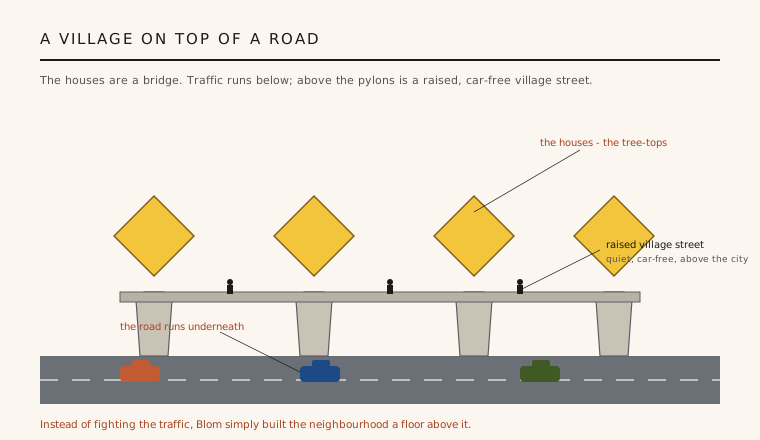
Between the pylons runs a raised pedestrian deck — a quiet, car-free village street in the air — while the traffic roars past underneath. Blom took the idea from Florence's Ponte Vecchio, the inhabited bridge lined with shops, and used it to stitch the city back together: a person can now walk from Blaak square across to the old harbour on a calm elevated path, floating over the road entirely. This is "living as an urban roof" made real — instead of fighting the traffic, Blom simply built the neighbourhood a floor above it. It is the same Rotterdam instinct we keep meeting in this cluster: a few steps away, the Markthal would later pile a whole market, a car park and hundreds of homes into one arch, and the Erasmus Bridge would knit two riverbanks together. This is a city that answers its problems by building boldly over and across them.
5. Rehearsed in Helmond first
One last thing, and it is the most reassuring lesson of all for anyone with a wild idea. The Rotterdam forest, for all its daring, was not a first attempt. Blom had built the whole concept before, smaller, years earlier.
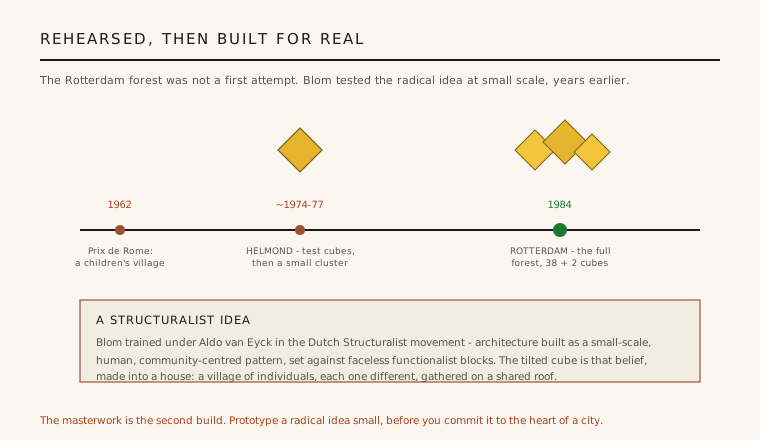
Trained under the great Aldo van Eyck and steeped in the human, small-scale ideals of Structuralism, Blom won the Prix de Rome in 1962 for a design about communal living, and spent the next two decades working the idea out. He built a few test cubes and then a small cluster of them in the town of Helmond through the mid-1970s — a genuine prototype at low stakes — and only then, in 1984, committed the fully developed forest to the heart of Rotterdam. Forty years on it is a global icon, a magnet for tourists, and a piece of shorthand for the city's post-war reinvention; it has needed repeated renovation (its timber-and-panel cubes are less durable than they look), which is its own honest footnote about the lifetime cost of boldness. But the deepest lesson is the sequence itself: Blom rehearsed his most radical idea at small scale before he built it for real. The masterwork was the second attempt.
6. What a modern architect can learn from the Cube Houses
- Price livability into the gesture. The tilted cube is unforgettable and forfeits a quarter of its floor to dead space. Iconic form has a human cost — design it in from the start, rather than discover it after people move in.
- Treat the roof of the city as buildable land. "Living as an urban roof" lifts homes over a road and hands the ground back to the public. In dense cities, the air above infrastructure is a real, transferable site.
- A social metaphor can be a structural principle. "Tree, forest, village" is not styling — it physically produces a raised, shared, intimate community. Let the idea organise the plan, not just name it.
- One generative move can carry a whole design. A single 45-degree rotation yields plan, section, façade and identity together — elegant proof of how much a disciplined idea can do, and how completely it then governs the life inside.
- Conviction outlasts fashion — and carries a maintenance bill. Forty years on the Cubes are a beloved icon, but their timber-and-panel envelope has needed repeated repair. Boldness earns durable cultural value and a lifecycle cost; budget for both.
- Prototype the radical idea small, first. Blom tested the cubes in Helmond before committing them to a city centre. Rehearse an unproven typology at low stakes before you build the set-piece.
In Amogh's frame
The Cube Houses are one of the places Amogh explored himself. Here he is — the one holding the camera — with his family beneath Piet Blom's tilted yellow cubes, the tree-house forest this whole article is about rising over their shoulders on an ordinary sunlit afternoon in Rotterdam.
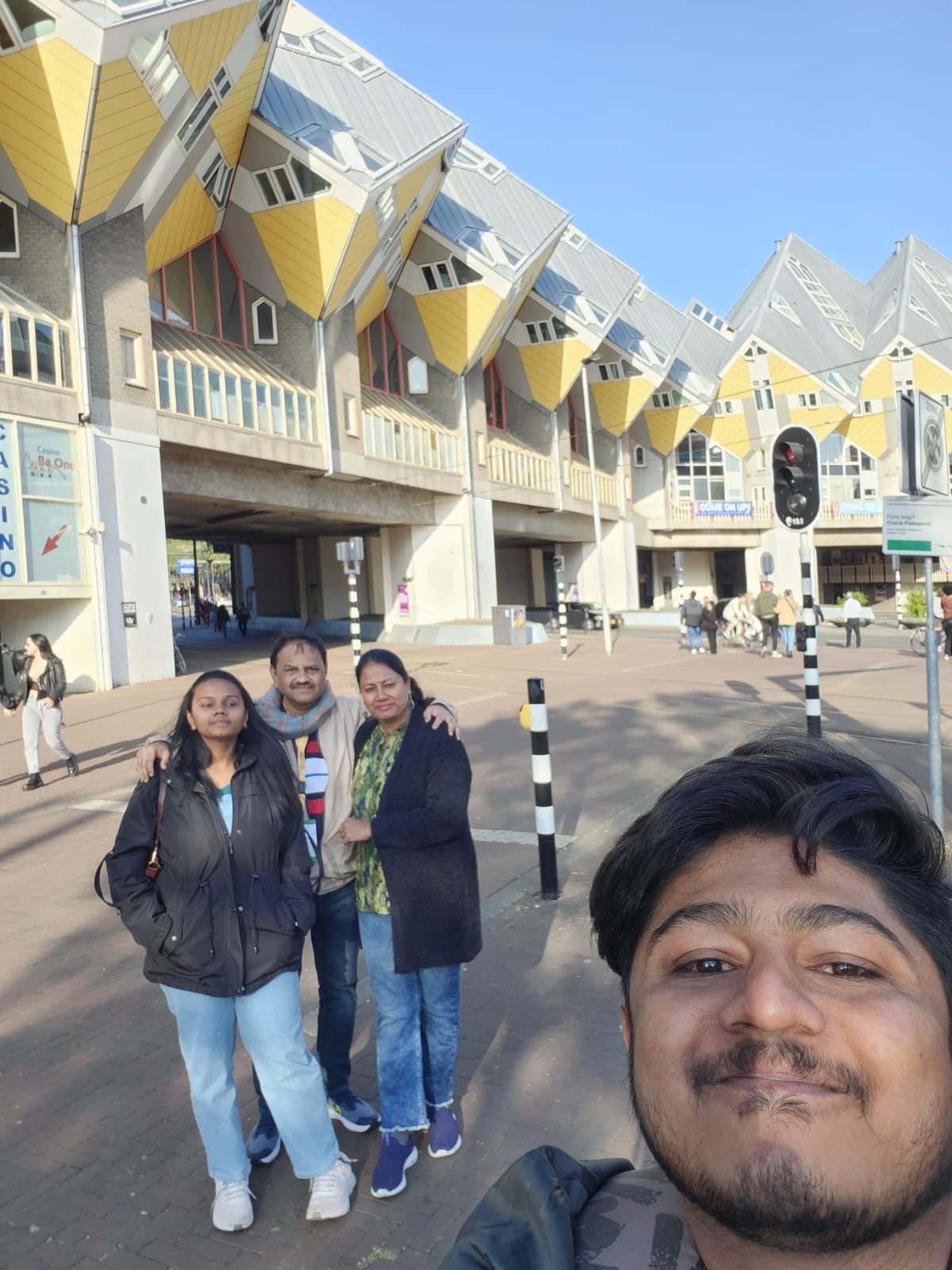
Studio Matrx is built in his memory. Some of these wonders he walked through himself; this is one of them.
References & further reading
1. ArchDaily — AD Classics: Kubuswoningen / Piet Blom. https://www.archdaily.com/482339/ad-classics-kubuswoningen-piet-blom
2. Wikipedia — Cube house. https://en.wikipedia.org/wiki/Cube_house
3. Kijk-Kubus — the Cube House museum (Show Cube), Rotterdam. https://www.kubuswoning.nl/en/
4. Metalocus — Residential urban forest in the heart of Rotterdam: Kubuswoningen by Piet Blom. https://www.metalocus.es/en/news/residential-urban-forest-heart-rotterdam-kubuswoningen-piet-blom
5. Encyclopaedia Britannica — 6 Buildings You'll Want to Visit in the Netherlands. https://www.britannica.com/list/6-buildings-youll-want-to-visit-in-the-netherlands
6. Rijksdienst voor het Cultureel Erfgoed — Piet Blom (1934–1999). https://kennis.cultureelerfgoed.nl/index.php/Piet_Blom_(1934-1999)
Last verified 2026-07-03. Dates and figures vary between sources and are given as widely cited approximations — the complex has 38 small cubes plus 2 larger "super-cubes," each home about 100 m² with roughly a quarter of the space hard to use; the cube is tilted onto its corner (usually described as ~45°, which gives wall inclinations of about 54.7°) on a hexagonal reinforced-concrete pylon, and was completed in 1984 (designed 1977–78, built 1982–84). Piet Blom's earlier Helmond cube houses, the "living as an urban roof" concept, the tree/forest metaphor, the pedestrian deck over the Blaak, and the Dutch Structuralist context follow the established record.
Export this guide
Related Guides — Deep-dive reading
Blaak 31: The Tower That Steps Aside
How KCAP built a twelve-storey office in the heart of Rotterdam that politely steps and turns away from its neighbours — shifting 2.70 metres every three floors to hand the Markthal next door its light and privacy — all balanced on a great steel truss above the city's live metro tunnel.
Architectural WondersHouse for Trees: How Vo Trong Nghia Turned a House into Five Flowerpots
In one of the densest districts of Ho Chi Minh City, VTN Architects built a family home as five concrete boxes whose real purpose is to carry big tropical trees on their roofs — a low-cost prototype that treats a private house as public green infrastructure, and asks whether architecture's future job is to grow the city back.
The Future of ArchitectureACROS Fukuoka: Emilio Ambasz and the Building That Gave Its Park Back
Two decades before the vertical forest, Emilio Ambasz hid a million square feet of concert hall and offices under a fifteen-storey climbing garden — turning the oldest argument in cities, land value versus open space, into a single terraced hill in the heart of Fukuoka.
The Future of ArchitectureRelated Tools — Try Free
Full-Room BOQ — Living, Bedroom, Kitchen, Bath
Room-wise BOQ across living, bedrooms, kitchen, utility, and bathrooms with line-item pricing.
Full-Room BOQBefore vs After — Cost Reality Check
Compare what you expected to pay vs what you actually paid, category by category.
Reality CheckCross-Ventilation Analyzer
Estimate airflow and air changes per hour (ACH) from room size, window areas, layout, and local wind — with NBC 2016 Part 8 compliance check.
Ventilation Calculator