
The Markthal: A Cathedral for Groceries
How MVRDV bent 228 apartments into a giant arch over a public food market, painted its 11,000-square-metre ceiling with a cornucopia of fruit, and turned a European hygiene rule into the most-visited building in Rotterdam — the everyday market raised to a civic monument.
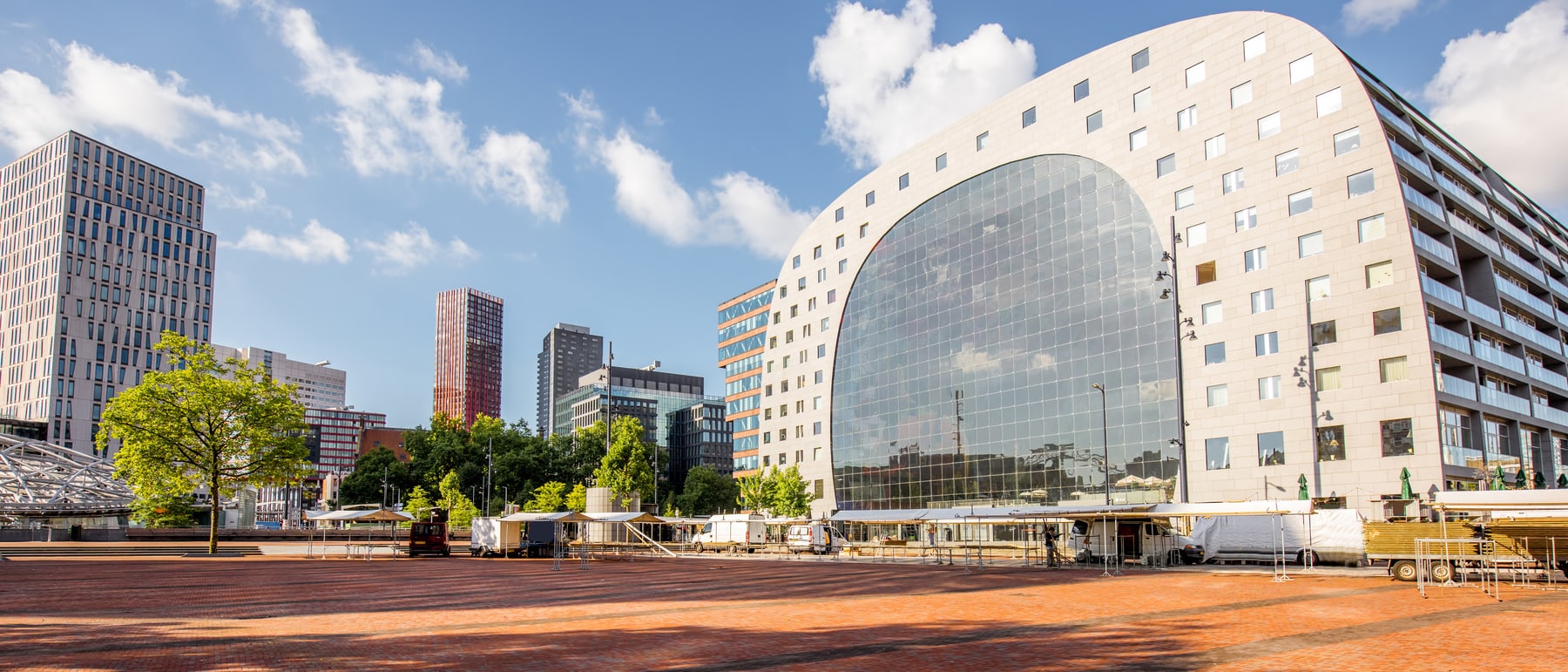
Cross the square from the Cube Houses and you meet their opposite twin. Where Piet Blom scattered a village of little tilted cubes, the architects MVRDV did precisely the reverse: they took 228 apartments and bent them all into a single colossal arch — a grey horseshoe some forty metres high — and slid a public food market into the tunnel underneath. This is the Markthal, the youngest wonder in our whole series, opened in 2014. And it is quietly one of the most radical: it takes the most ordinary thing a city ever does — sell fruit and fish — and builds it a cathedral.
Underneath that vault of homes is an all-weather market square, roofed by an 11,000-square-metre painting of giant produce, closed at each end by a wall of glass that bends in the wind, and visited by around eight million people a year. It is housing, market, artwork, shop, restaurant and car park folded into one gesture — and it began, of all things, as the answer to a hygiene regulation.
This is the twenty-fourth article in our Architectural Wonders series.
1. A horseshoe of homes
Start with the one idea that makes everything else follow. A market hall is normally a shed — a big roof on columns. MVRDV, led by Winy Maas, asked a stranger question: what if the housing itself were the roof?
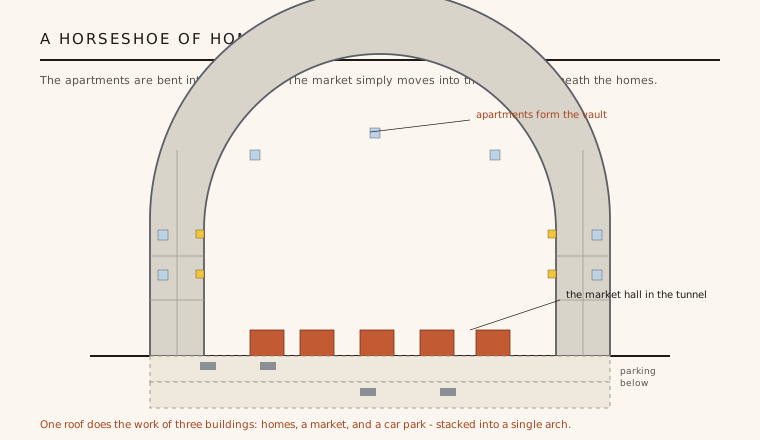
So they bent an entire apartment building into a giant arch — a horseshoe that springs from the ground on both sides and curves up and over — and set the market inside the tunnel. The residents' flats form the thick, inhabited vault; the covered public square lives in the space beneath them. It is a genuinely new hybrid: a single building that is at once a block of homes and a public room, the private dwellings paying, quite literally, to hold up the roof over a shared civic space. Where the Cube Houses next door lifted a village onto stilts to keep the ground open, the Markthal does something related but bolder — it wraps the housing right around the public life it shelters.
2. A market under a painted sky
Walk in underneath, look up, and you understand why locals call it the "Sistine Chapel of Rotterdam." The entire curved inner surface of the arch — all 11,000 square metres of it — is a single, overwhelming artwork.
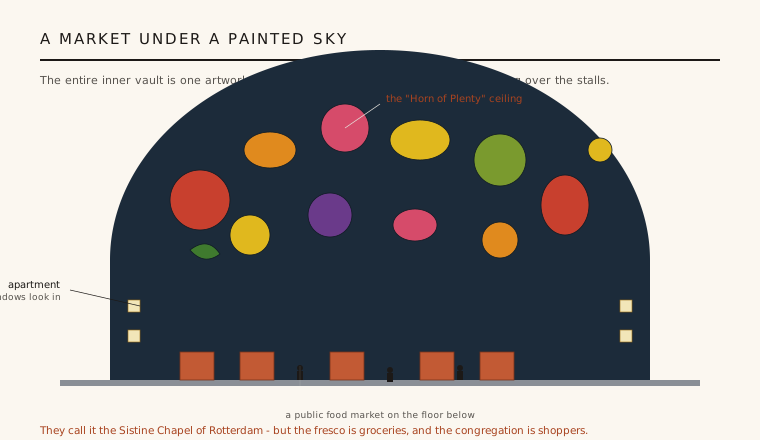
It is called the "Hoorn des Overvloeds" — the Horn of Plenty — by the Dutch artist Arno Coenen with Iris Roskam: a surreal, joyous still-life of vastly enlarged fruit, vegetables, grain, fish, flowers and insects, echoing the great Dutch still-life paintings of the seventeenth century. What makes it modern is how it was made and mounted: it was digitally rendered with animation-studio software (the master file ran to over a terabyte) and printed onto some four thousand perforated aluminium panels fixed to the vault — panels whose tiny holes let the ceiling do acoustic and ventilation work while it dazzles. This is the crucial architectural point: the art is not decoration applied afterward. It is the interior — art and building fused at the scale of the whole room. For a platform built in memory of an architect who was also an artist, there is something moving in a market whose roof is a painting, and whose subject is simply the abundance of ordinary food.
3. A glass wall that bends
The arch is open at both ends — otherwise it would be a dark tunnel — and closing those two huge openings posed a beautiful engineering problem. The answer is a pair of glass walls counted among the largest suspended glass façades in Europe, and their trick is that they are built to move.
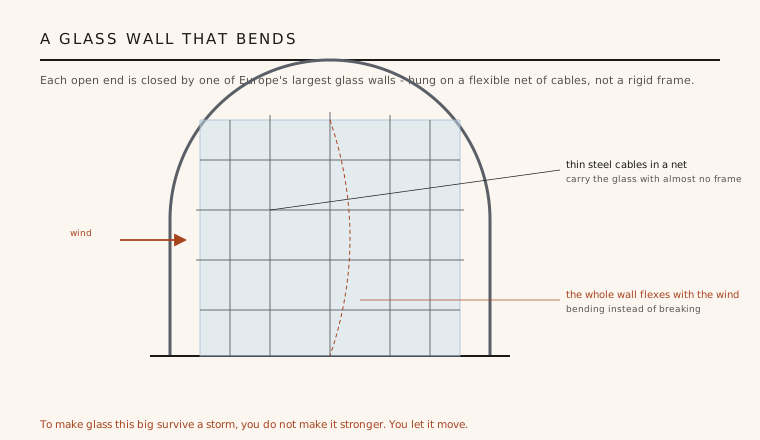
Each wall — roughly 42 metres wide and 35 metres tall — hangs not from a heavy frame but from a fine net of thin steel cables, strung taut across the opening like a tennis racket, with the glass panes clipped to the grid. In a storm, the whole wall can flex inward and out by as much as seventy centimetres in the middle, and simply springs back — bending instead of breaking. It is the same deep lesson we have met twice already in the Netherlands: at the Erasmus Bridge the cables had to be taught to move so they would not shake apart, and at Kinderdijk the whole country survives by yielding to water rather than resisting it. To make something this large and this fragile survive the weather, you do not make it stronger. You let it give. And through that near-invisible glass, the apartments in the arch look down into the market, so residents live with the life of the hall spread out beneath their windows.
4. One building, four lives
Step back and count what is actually stacked inside this single form, because the density of it is the real marvel — and a serious answer to how crowded cities might grow.
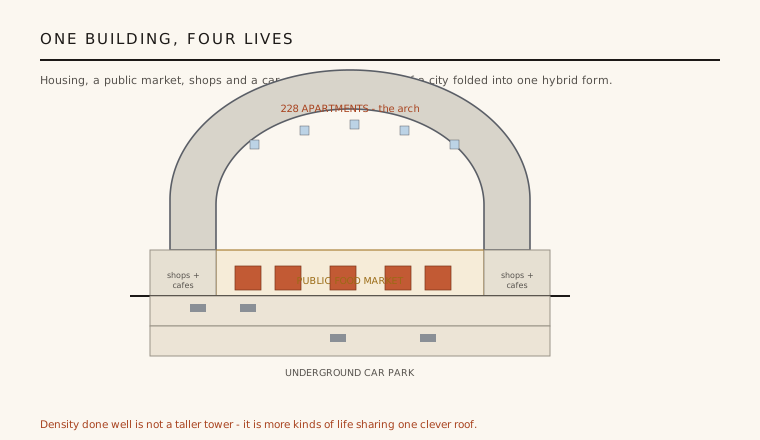
Below ground sit roughly 1,200 parking spaces on several levels. On the ground floor, inside the tunnel, is the market — around a hundred fresh-food stalls, plus restaurants, cafés and a supermarket. Wrapped over the top, forming the arch, are the 228 apartments, a real vertical neighbourhood of rentals, owner-occupied flats and penthouses. Shops and eating-places line the edges. Four quite different kinds of life — sleeping, shopping, eating, parking — share one clever roof. This is what genuine density looks like when it is done well: not a taller and taller tower, but more kinds of use folded into a single generous form, where the paying private homes cross-subsidise a public square that everyone gets to enjoy for free.
5. A rule became a monument
Here is the detail that turns the Markthal from a clever building into a small parable — and it is the best lesson of all. The whole extraordinary thing exists because of a piece of paperwork. New European food-hygiene rules meant Rotterdam's beloved open-air market could no longer legally sell fish, meat and cheese in the open air. The market had to be covered.
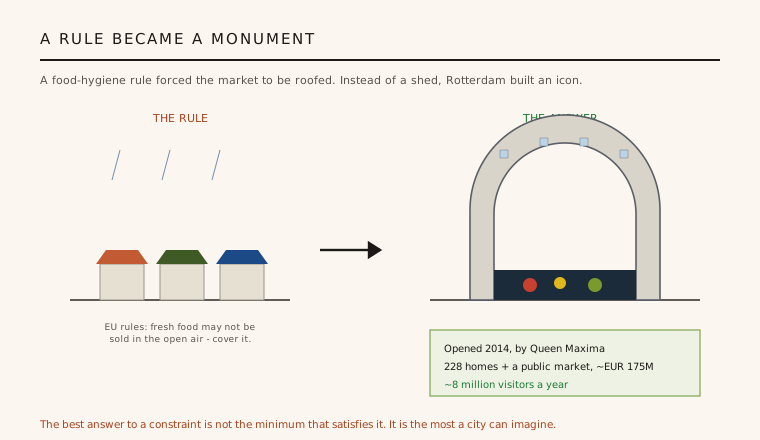
A timid city would have built a shed. Rotterdam — the city we have watched reinvent itself all through this cluster, from the Erasmus Bridge to the Cube Houses — built an icon instead, opened by Queen Máxima in 2014, and it worked beyond anyone's projection: the Markthal now draws about eight million visitors a year, an economic engine the size of a whole town centre. That is the parable. A constraint is not the enemy of ambition — it is often its starting point. The rule said only "cover the market." The architects heard a question about what a market could be, and answered it at the scale of a monument. The everyday act of buying dinner was given the dignity of great civic architecture — which, in the end, is one of the kindest things a building can do.
6. What a modern architect can learn from the Markthal
- Fold programs together instead of spreading them out. Homes, a market, shops and a car park in one arch — real density is more kinds of life sharing a form, not a taller tower. Hybrid, not sprawl.
- Dignify the everyday. A food market is the most ordinary of programs; the Markthal gives it a forty-metre painted hall. Infrastructure and commerce deserve the same ambition we lavish on museums.
- Fuse art into the fabric, not onto it. The Horn of Plenty is the interior, printed on the working acoustic ceiling — art integrated into structure and budget from the start, not applied at the end.
- Turn the constraint into the concept. A hygiene rule to "cover the market" generated the arch, the covered square and the icon. Treat the binding limit as the design engine, not the obstacle.
- Let big, fragile things move. The suspended glass survives storms by flexing up to seventy centimetres. "Closing" a building need not mean rigidity or opacity — a façade can be weather-tight, near-invisible and deliberately compliant all at once.
- Let private value pay for public space. Saleable apartments and paid parking cross-subsidised a genuinely public covered square — a repeatable way to deliver civic generosity through private development.
In Amogh's frame
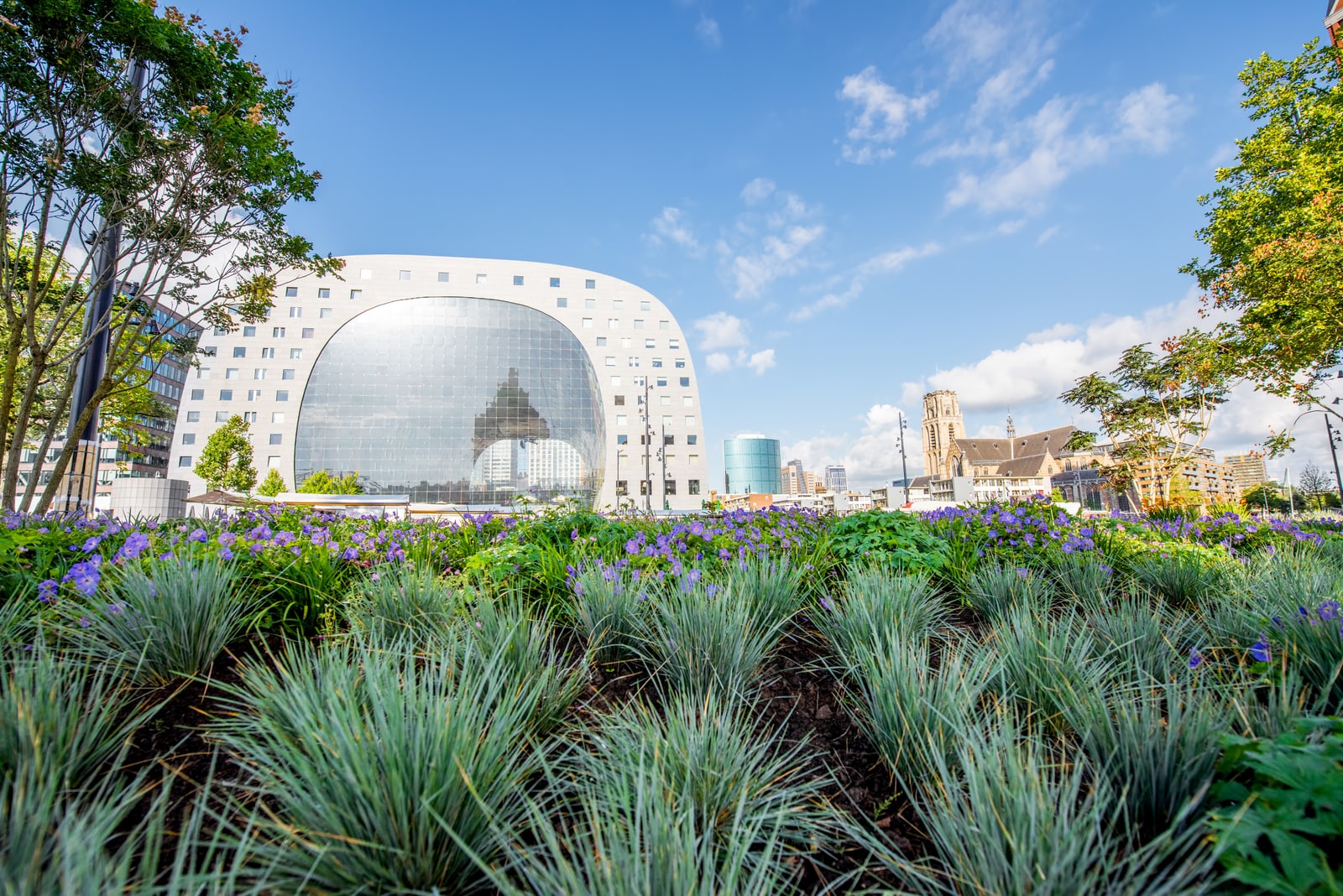
Amogh did not step into this frame — he is behind it. He photographed the Markthal from across a bed of ornamental grasses and flowers, the great grey arch and its curved glass wall rising beyond, the old Laurenskerk tower keeping watch to the side. It is his eye we are looking through — the traveller's eye for light that this whole platform was built to honour.
Studio Matrx is built in his memory. Some of these wonders he walked through himself; this is one of them.
References & further reading
1. MVRDV — Markthal (project page). https://www.mvrdv.com/projects/115/markthal
2. ArchDaily — Markthal Rotterdam / MVRDV. https://www.archdaily.com/553933/markthal-rotterdam-mvrdv
3. Octatube — Cablenet façades, Market Hall Rotterdam. https://www.octatube.nl/en_GB/project-item/projectitem/6-market-hall.html
4. BKOR (Rotterdam public-art foundation) — Horn of Plenty (2014), Arno Coenen & Iris Roskam. https://www.bkor.nl/en/beeld/hoorn-des-overvloeds/
5. Wikipedia — Market Hall (Rotterdam). https://en.wikipedia.org/wiki/Market_Hall_(Rotterdam)
6. Markthal (official) — The building. https://markthal.nl/en/visit-markthal/the-building/
Last verified 2026-07-03. Figures vary between sources and are given as widely cited approximations — the arch stands about 40 m high over a hall roughly 120 by 70 m, holds 228 apartments and around 96 fresh-food stalls above some 1,200 underground parking spaces, and cost about €175–178 million; the Horn of Plenty ceiling by Arno Coenen and Iris Roskam covers about 11,000 m² on perforated aluminium panels; the suspended cable-net glass end walls (about 42 by 35 m) are among Europe's largest and can flex up to roughly 70 cm in high wind. The 2014 opening by Queen Máxima, the MVRDV authorship, and the EU food-hygiene rule that drove enclosing the market follow the established record.
Export this guide
Related Guides — Deep-dive reading
The Cube Houses: A Forest of Tilted Homes
How Piet Blom tilted an ordinary cube onto its corner, stood it on a concrete trunk, and grew a whole village of them above a Rotterdam road — the boldest housing experiment in this series, and an honest lesson in what an unforgettable idea costs the people who live inside it.
Architectural WondersKalkbreite Co-op: How Zurich Built a Neighbourhood on Top of a Tram Depot
Müller Sigrist's cooperative in Zurich stacks 97 homes, a cinema, shops and 200 jobs on the roof of a working tram shed, capping the whole thing with a public garden — a working blueprint for dense, low-carbon, socially mixed city living, and the questions it still leaves open about who gets in.
The Future of ArchitectureBlaak 31: The Tower That Steps Aside
How KCAP built a twelve-storey office in the heart of Rotterdam that politely steps and turns away from its neighbours — shifting 2.70 metres every three floors to hand the Markthal next door its light and privacy — all balanced on a great steel truss above the city's live metro tunnel.
Architectural WondersRelated Tools — Try Free
Cross-Ventilation Analyzer
Estimate airflow and air changes per hour (ACH) from room size, window areas, layout, and local wind — with NBC 2016 Part 8 compliance check.
Ventilation CalculatorHome Building & Interior Cost Calculator — 20 Cities
Construction + interior costs for 20 Indian cities across kitchen, wardrobes, flooring, painting, ceiling.
Cost CalculatorRainwater Tank Sizer
How big should your rainwater tank be? Computes annual harvest, recommended tank capacity in litres, water-bill savings, and payback — for 10 Indian cities.
RWH Calculator