
The Euromast: Rotterdam's Ship's Mast in the Sky
How Hugh Maaskant balanced a slender 185-metre tower on a buried block of concrete — stable like a flower in a heavy pot — styled it as a ship's mast for a port city risen from ruins, and gave it a rotating glass lift: a landmark that has kept reinventing itself for over sixty years.
One more Rotterdam wonder, and it is the one you can see from all the others. Stand on the Erasmus Bridge, or on the roof-deck of the Cube Houses, and a slender pale finger of concrete rises above the whole city: the Euromast. It is not the newest of Rotterdam's icons, but it is the tallest and the oldest of them — built in 1960, for decades the highest structure in the entire Netherlands — and it holds a lovely engineering secret and an even lovelier lesson about how a landmark stays alive.
It was designed by Hugh Maaskant, the architect who did more than anyone to shape post-war Rotterdam, and it was built for a flower show. But do not let that fool you. Underneath its elegance is one of the cleverest, simplest ideas about how to stand a tall thing up that this whole series will show you — and above it is a glass lift that spins as it climbs.
This is the twenty-fifth article in our Architectural Wonders series.
1. A mast for a reborn city
To understand why Rotterdam wanted this tower, you have to remember what had happened to Rotterdam. In May 1940, German bombers erased its medieval heart in a single afternoon — the same wound we met at the Erasmus Bridge. The post-war city rebuilt itself, deliberately and defiantly, as the most modern city in the country, and it wanted a symbol to prove it.
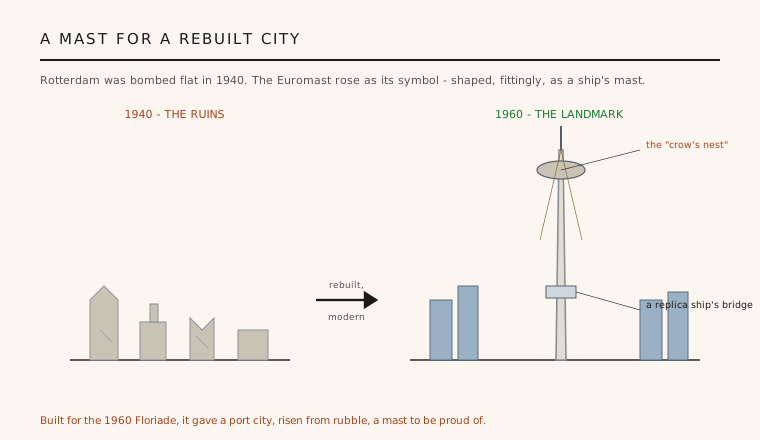
The occasion was the 1960 Floriade, the great international garden exhibition, and Maaskant gave the reborn port city a form drawn straight from the harbour that made it: a ship's mast. The tower carries a "crow's nest" — the lookout at the top of a mast — and lower down a replica ship's bridge, so the whole structure reads as a vessel standing on its end, a monument to a city that lives by the sea. Maaskant even fixed its height with a very human argument: he wanted the main deck at about a hundred metres, because, he said, a hundred metres "is the boundary where one still has contact with the ground, can still recognise people and cars." It is a small, beautiful piece of reasoning — a skyscraper-height tower designed, above all, to keep you connected to the people below.
2. A flower in a pot
Now the secret. A tower this slender and this tall ought to need an enormous, deep, expensive foundation to stop the wind from tipping it over. The Euromast does something far simpler and far cleverer.
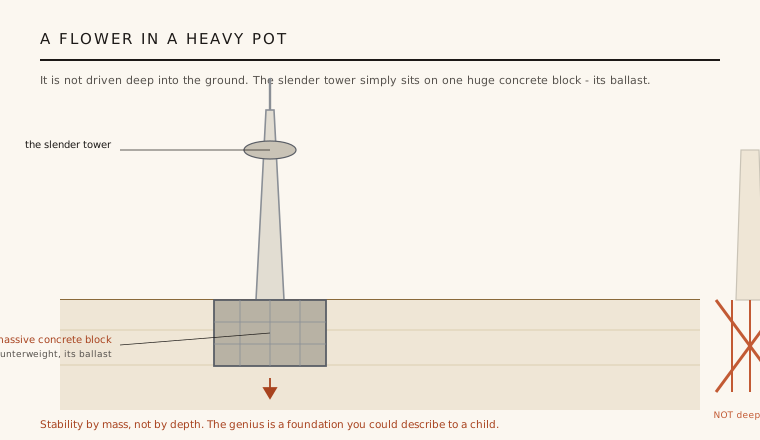
It stands on a single massive block of reinforced concrete, set just below the ground — a counterweight so heavy that it pulls the centre of gravity of the whole tower below ground level. And an object whose centre of gravity is underground simply cannot topple; it behaves like a flower in a heavy pot, or one of those toys that always rights itself. The slender shaft above — a hollow tube of slip-formed concrete, just thirty centimetres thick and nine metres across, cast continuously as it climbed — needs no deep forest of piles to stay upright, because the weight at its foot does the work. (How heavy is that block? Here the sources genuinely disagree: it is quoted as 1.9 million kilograms — about nineteen hundred tonnes — by some, and as 1.9 million pounds, less than half that, by others; the same number, tangled in a units mix-up. Either way, it is a great deal of concrete, buried, doing one job.) It is the same lesson we keep meeting in the Netherlands — from the swaying Pashupatinath pagoda far away to the flexing Erasmus Bridge: stability is not always about being rigid or deep. Sometimes it is about where you put the weight.
3. Two towers in one
For its first decade the Euromast was a hundred-metre tower, and it was enough to top the whole country's skyline. Then, in 1970, it grew a second tower on top of the first.
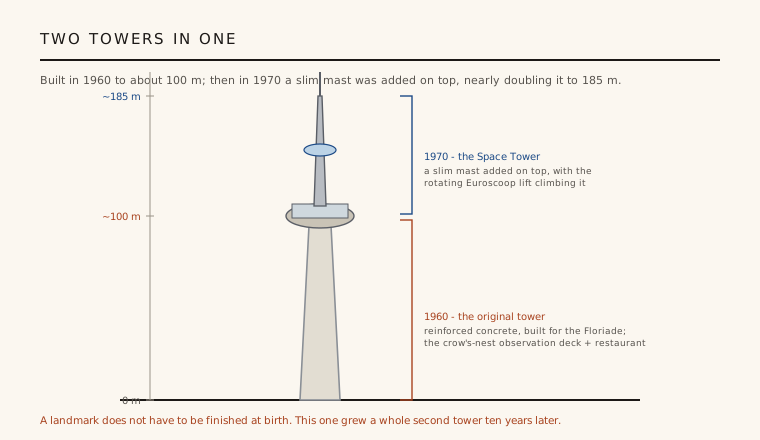
For a second Rotterdam garden exhibition, the C '70, engineers bolted a slim steel mast — a "Space Tower" system from the Swiss firm Willy Bühler — onto the crown of the concrete shaft, adding some eighty-five metres and lifting the total to about 185 metres. In a matter of days, using a crane perched on the existing tower, Rotterdam nearly doubled its landmark. There is a quiet lesson even in that: a great structure does not have to be finished at birth. The Euromast was designed well enough, and built strong enough, that a whole second tower could later be stood on its head — proof that generosity in the original engineering buys freedom for the future.
4. The Euroscoop
The new mast was not just for height. It carried the tower's most delightful invention — a lift that turned the journey up into the main event.
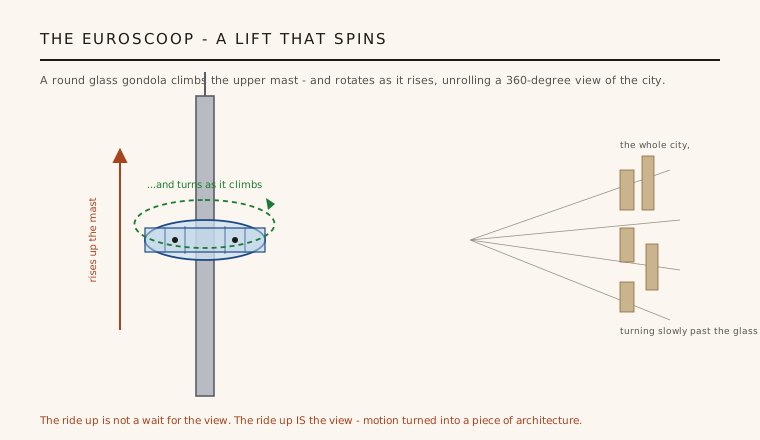
The "Euroscoop" is a round glass gondola, holding about thirty people, that clamps around the steel mast and spirals slowly upward while rotating — so as you rise the last stretch to the top, the entire city wheels past the glass around you, a continuous 360-degree panorama unrolling as you climb. It is a small stroke of genius. Most towers make you wait in a plain box for the view; the Euromast makes the ride itself the view, turning simple vertical travel into a piece of choreographed architecture. It is the same instinct we saw at the Cube Houses and the Markthal — the very Rotterdam habit of taking an ordinary thing (a lift, a market, a road) and making it an experience worth having.
5. Sixty years of reinvention
And here is why the Euromast, more than almost any building in this series, deserves to be studied by anyone who wants their work to last. It has survived not by staying the same, but by continually becoming something new — all on the very same shaft of 1960 concrete.
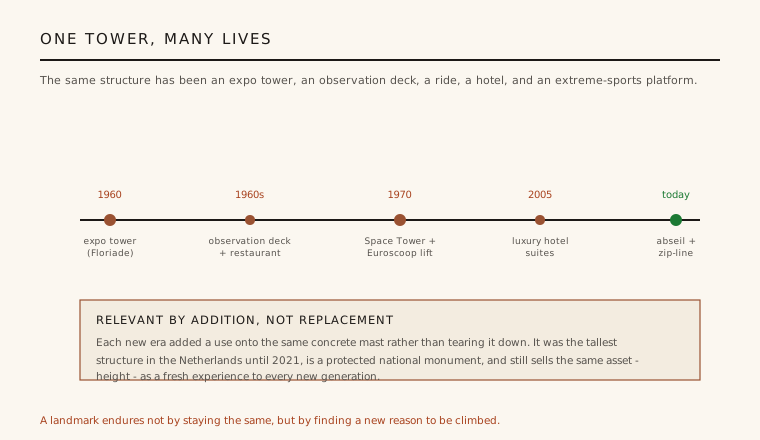
It began as an exhibition tower; became an observation deck and restaurant; grew the Space Tower and its spinning lift in 1970; gained two luxury hotel suites a hundred metres up in 2005; and today you can abseil off its platform on a rope in open air, or zip-line to the ground at nearly a hundred kilometres an hour. Each new era simply added a use to the same structure rather than tearing it down. It was the tallest thing in the Netherlands until 2021, it is now a protected national monument, and it goes on selling the one asset it has always had — height — as a fresh thrill to every new generation. That is the deepest lesson of the Euromast: a landmark endures not by being frozen, but by finding, again and again, a new reason to be climbed.
6. What a modern architect can learn from the Euromast
- Stability can come from weight, not depth. The tower stands because a buried counterweight drops its centre of gravity below ground — a "flower in a pot." The elegant structural answer is often the simplest one, not the most massive.
- Design the vantage, not just the object. From the crow's nest to the rotating Euroscoop, the whole tower is organised around the public view, and even the ride up is made part of the experience. Height is a civic amenity — stage it.
- Build generously enough to grow. Because the 1960 shaft was well engineered, a whole second tower could be added in 1970. Over-provision in the bones of a structure buys decades of future freedom.
- Stay relevant by addition, not replacement. Expo tower, observation deck, hotel, extreme-sports platform — one armature, many lives. A building lasts when it can absorb new uses instead of being demolished for them.
- A landmark carries a city's story. Styled as a ship's mast for a bombed-and-rebuilt port, the Euromast turned form into civic memory and morale. What a tower means can matter as much as how tall it is.
- Keep human scale in mind, even at height. Maaskant set the deck at ~100 m so people could "still recognise people and cars" below. Ambition and a connection to ordinary life are not opposites.
In Amogh's frame
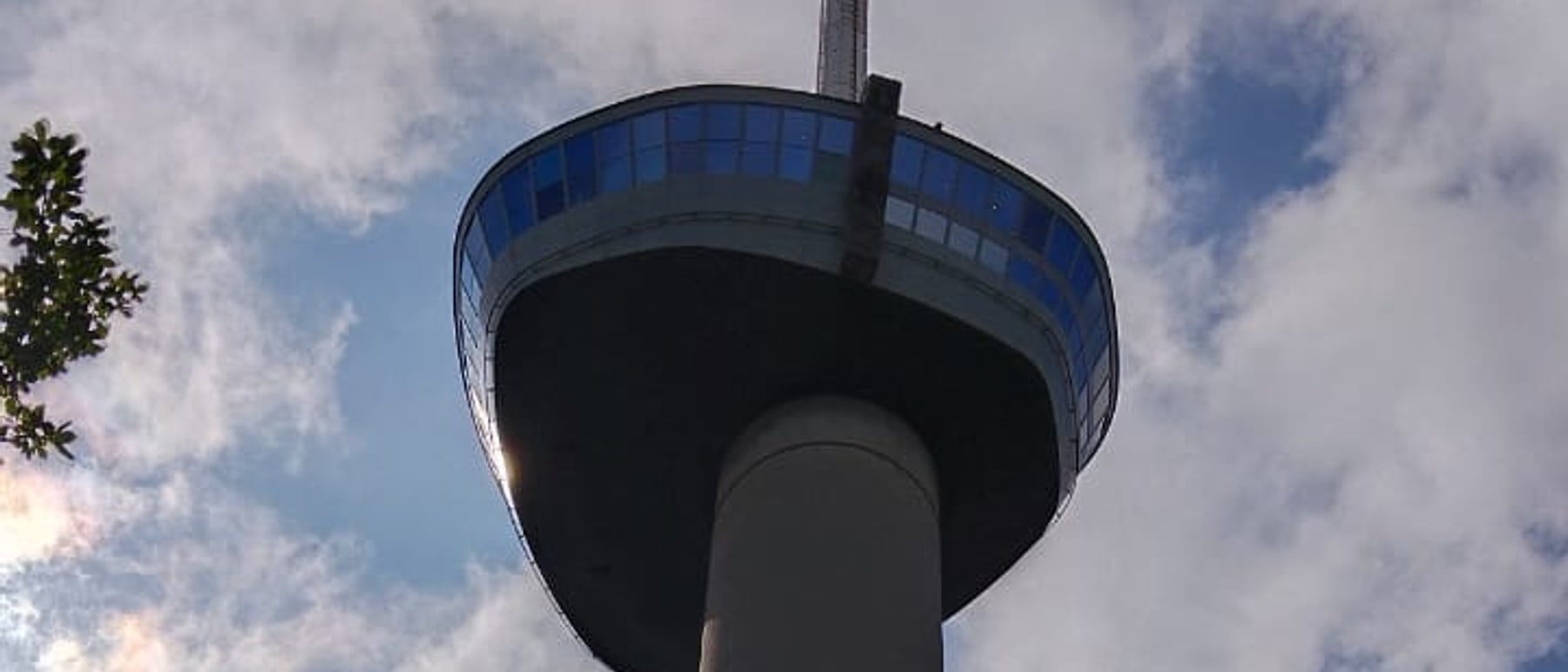
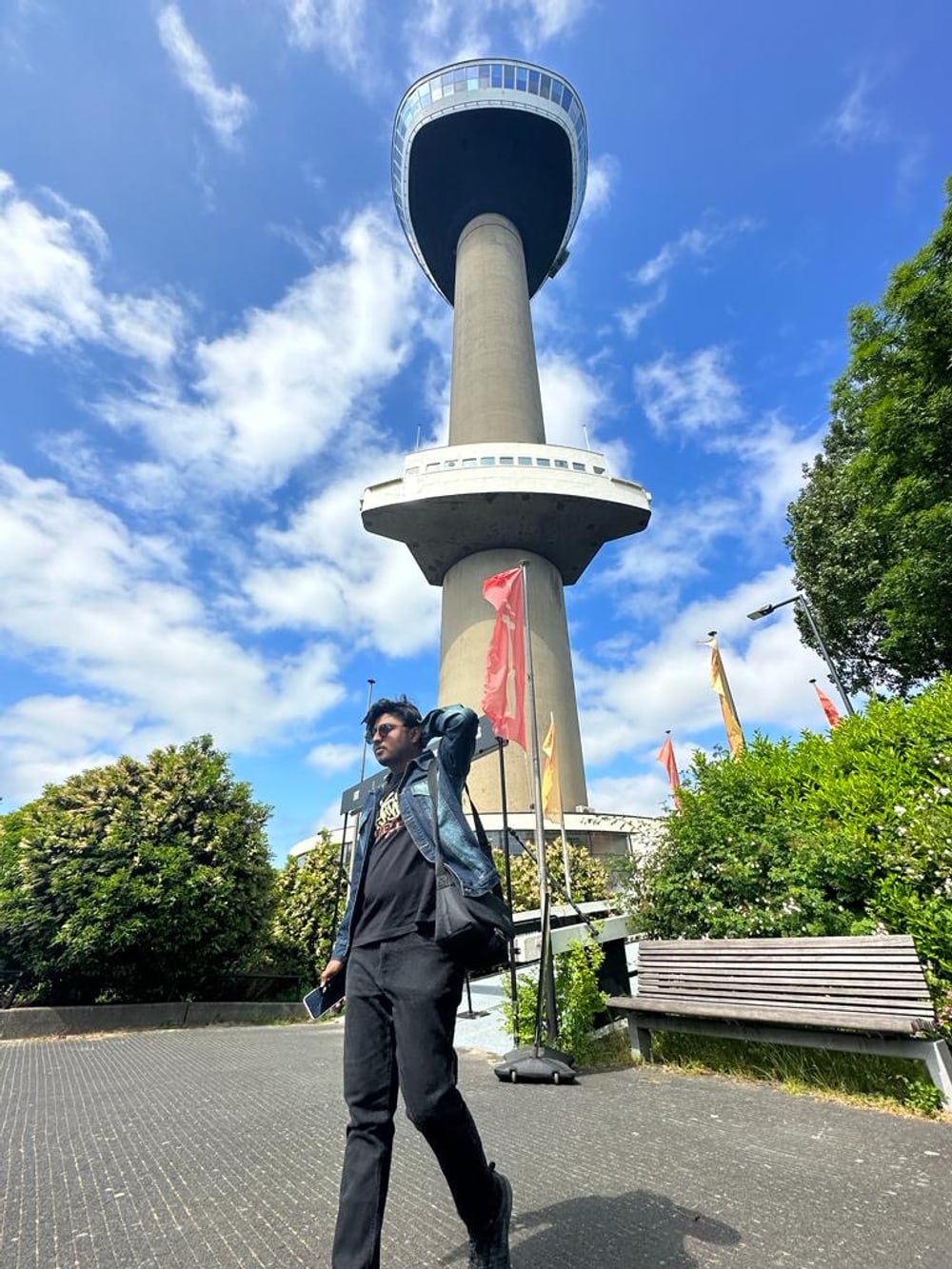
The Euromast is a place Amogh climbed himself. Here he is at its foot, the great concrete tower and its crow's-nest deck rising into a bright blue Rotterdam sky behind him — the tower whose "flower in a pot" foundation and spinning Euroscoop this article is about, seen on an ordinary sunny afternoon in the park.
Studio Matrx is built in his memory. Some of these wonders he walked through himself; this is one of them.
References & further reading
1. Wikipedia — Euromast. https://en.wikipedia.org/wiki/Euromast
2. Euromast (official) — History. https://euromast.nl/en/history/
3. Post-war Reconstruction Community Rotterdam — Euromast. https://wederopbouwrotterdam.nl/en/articles/euromast
4. World Federation of Great Towers — Euromast. https://www.great-towers.com/tower/euromast
5. Euromast (official) — Abseiling & Zipline. https://euromast.nl/en/abseiling/
6. RotterdamStyle — Euromast unveils renovated suites with panoramic views. https://rotterdamstyle.com/where-to-sleep/euromast-unveils-renovated-suites-with-panoramic-views
Last verified 2026-07-03. Dates and figures vary between sources and are given as widely cited approximations — the tower opened in 1960 for the Floriade at about 100 m and was raised to roughly 185 m (184.6 m) by the 1970 Space Tower extension; the shaft is a slip-formed concrete tube about 9 m across with 30 cm walls, and the stabilising foundation counterweight is reported as 1.9 million kg (~1,900 t) by some sources and 1.9 million lb (~860 t) by others — a units discrepancy left as a range. Hugh Maaskant's authorship, the ship's-mast styling, the rotating Euroscoop lift, the 100 m hotel suites, and the abseil/zip-line activities follow the established record.
Export this guide
Related Guides — Deep-dive reading
Quay Quarter Tower: How 3XN Kept a Skyscraper Alive Instead of Killing It
In Sydney, 3XN and BG&E chose not to demolish the 1976 AMP Centre but to grow a new tower out of its bones — keeping around two-thirds of the old columns, beams and slabs and almost all of its core. This deep study reads the world's first 'upcycled' skyscraper as a manifesto for what tall buildings become when carbon, not the wrecking ball, sets the terms.
The Future of ArchitectureStatue of Unity: The Architecture of the Approach, the Museum, and the World's Tallest Figure
Michael Graves Architecture wrapped a 182-metre bronze colossus of Sardar Patel around two concrete cores, then choreographed a kilometres-long arrival sequence — road, bridge, visitor centre, museum, and a chest-height viewing gallery — into a single national monument on the Narmada. This is a deep study of the building behind the statue: its structure, its staged approach, and the contested ground it stands on.
The Future of ArchitectureACROS Fukuoka: Emilio Ambasz and the Building That Gave Its Park Back
Two decades before the vertical forest, Emilio Ambasz hid a million square feet of concert hall and offices under a fifteen-storey climbing garden — turning the oldest argument in cities, land value versus open space, into a single terraced hill in the heart of Fukuoka.
The Future of ArchitectureRelated Tools — Try Free
Circadian Light Meter
Patient-centric circadian lighting visualizer for Indian healthcare design — time-of-day × intensity → CCT, melanopic lux (EML / mEDI), melatonin suppression, and an alertness curve. Calibrated against WELL v2 L03 Circadian Lighting Design, CIE S 026:2018, Brainard 2001, and Lucas et al. 2014.
Circadian ToolCross-Ventilation Analyzer
Estimate airflow and air changes per hour (ACH) from room size, window areas, layout, and local wind — with NBC 2016 Part 8 compliance check.
Ventilation CalculatorScale & Proportion Calculator
Check whether a room's shape or a window's proportion feels right, using the golden mean (1:1.618).
Design Tool