
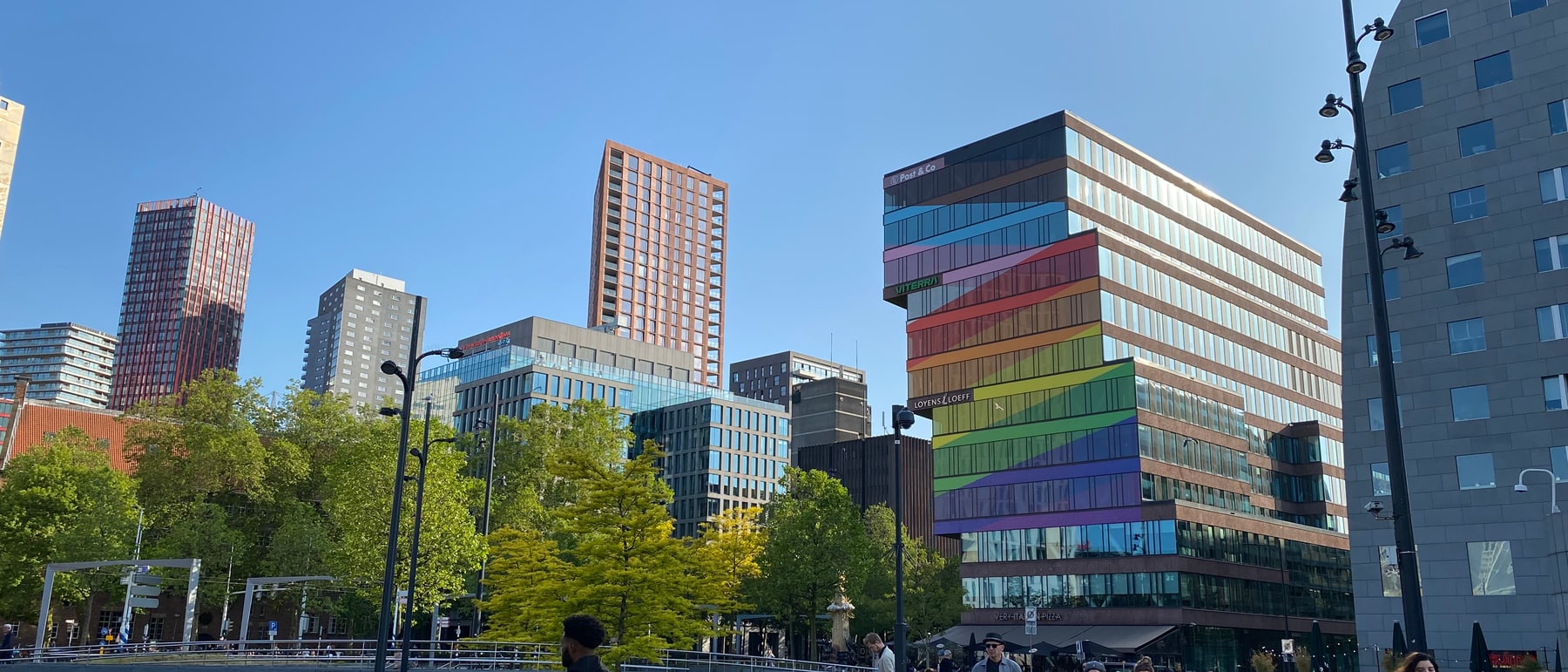
Blaak 31: The Tower That Steps Aside
How KCAP built a twelve-storey office in the heart of Rotterdam that politely steps and turns away from its neighbours — shifting 2.70 metres every three floors to hand the Markthal next door its light and privacy — all balanced on a great steel truss above the city's live metro tunnel.
We stay in Rotterdam, and step from the water back into the dense, rebuilt heart of the city — to a single street corner beside Blaak station where three of the wonders we have already visited stand almost within touching distance: Piet Blom's Cube Houses, MVRDV's great Markthal, and, a short walk away, the swan-necked Erasmus Bridge. On that crowded corner stands an office building most visitors walk straight past on their way to the more famous neighbours. It deserves a longer look, because it is quietly one of the best-mannered buildings in the city.
It is Blaak 31, completed in 2010 by the Rotterdam practice KCAP (Kees Christiaanse Architects & Planners). Where so many towers arrive on a site by planting themselves square and demanding the light, this one does the opposite: it steps and turns aside to share it. That single idea — a large building being courteous to its neighbours — is why a plain-sounding office deserves a place in this series.
This is the thirtieth article in our Architectural Wonders series.
1. A tower that steps aside
Look at Blaak 31 for a moment and you notice it is not one clean block. It is a stack, and the stack is restless.
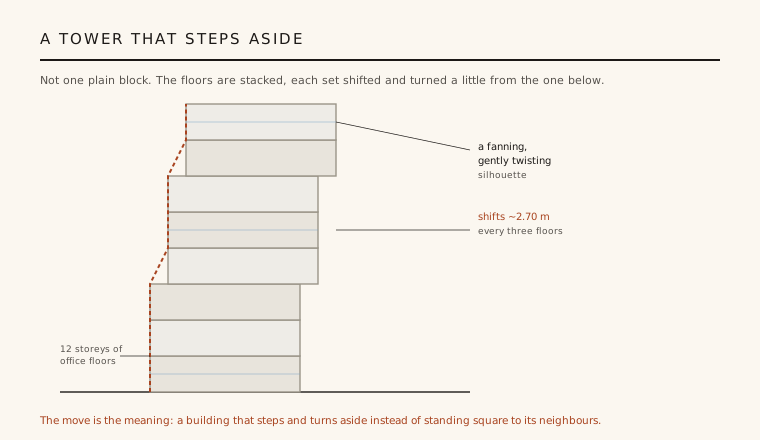
The building rises through twelve storeys above ground (some leasing sources count eleven), and instead of stacking those floors dead-straight, KCAP set them slightly rotated and shifted relative to one another — the massing steps by about 2.70 metres every three floors. The result is a silhouette that seems to fan open and gently twist as it climbs, catching the light differently at every level. It is a small, precise, repeated move, and from it comes the whole character of the building. The stepping is not decoration added to a box; it is the box rearranging itself out of politeness — and to understand why, you have to look next door.
2. Giving the neighbour its light
The direction and depth of that stepping were not chosen for looks. They were, in the architects' own account, "partly determined by the distance to the Market Hall," the vast Markthal that was rising on the very next plot.
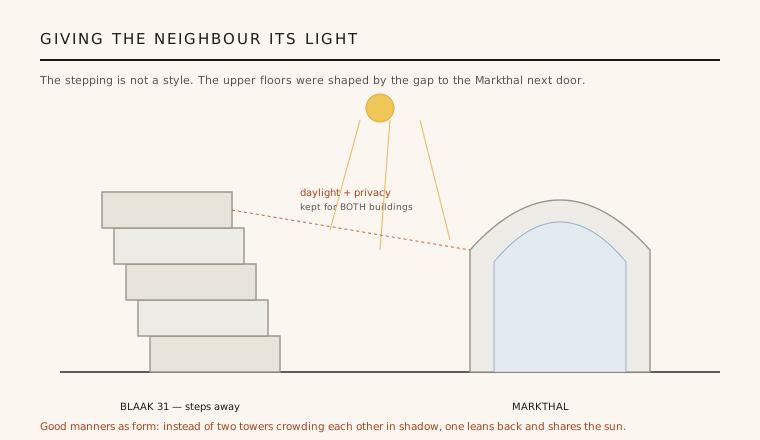
Two large buildings on adjacent plots can easily ruin each other — each one throwing the other into permanent shadow, each one staring into the other's windows. KCAP's answer was to make Blaak 31 lean away as it rose, stepping its bulk back from the shared boundary so that both buildings keep the maximum daylight and privacy. The office gives up a little of its own floor area near the top precisely so its neighbour can breathe. It is the same civic instinct we admired at Kop van Zuid, where towers were placed to frame views rather than block them — architecture that understands a building is never alone, but a member of a street. Good manners, here, are not a footnote to the design. They are the design.
3. Built over a moving tunnel
There is a second, invisible reason the building behaves the way it does — and it lies directly beneath your feet.
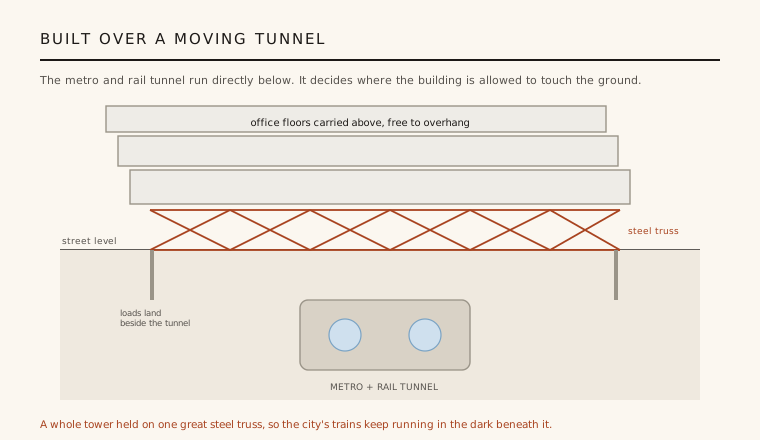
Blaak 31 sits squarely over the underground metro and rail tunnel that serves Blaak station — the trains run in the dark right under the lobby. That tunnel cannot take the weight of a tower, and it dictates exactly where the building is allowed to touch the ground. KCAP's engineers answered with a spectacular steel truss that bridges over the tunnel and gathers the loads down to the few points where the earth can carry them, letting the office floors overhang above the void. The developer, not given to understatement, described the mass as "dramatically cantilevered over the metro tunnel." Strip away the marketing and the feat is still real: a whole twelve-storey building held on one great lattice of steel, so the city's trains keep running undisturbed beneath it. It is the quiet, unglamorous cousin of the engineering we met at Rotterdam Centraal — structure solving an impossible site so that ordinary life can go on.
4. A skin of stone and glass, a lively base
If the massing is the building's argument, its surface is its manners made visible.
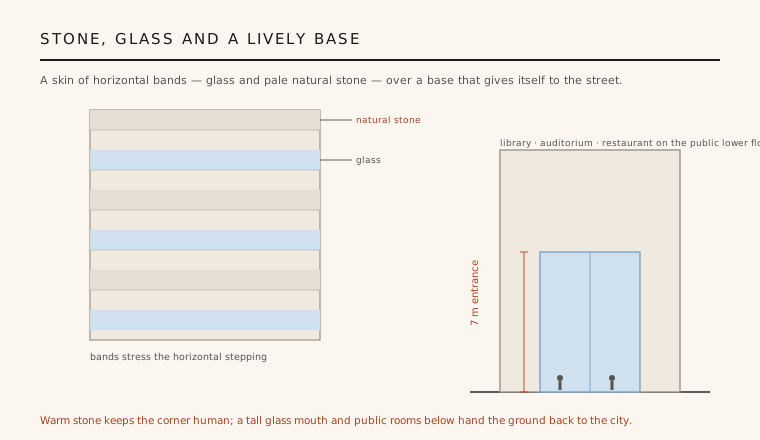
Rather than a single sheet of mirror-glass, KCAP wrapped the building in clean horizontal bands of glass and pale natural stone. The stone keeps the corner warm and human against Rotterdam's grey sky; the horizontal lines stress the stepping, so the eye reads the fanning stack clearly. (In the photograph at the top of this page the building is caught in a rare mood — its glass dressed for a moment in a full spectrum of colour, a temporary art wrap of the kind Rotterdam's buildings sometimes wear to mark Pride; its everyday face is the quiet stone-and-glass facade described here.) And crucially, the building does not sit on the pavement like a sealed safe. Its lower floors are public: behind a seven-metre-high glazed entrance lie a library, an auditorium and a restaurant, with atriums and cascading "waterfall" stairs drawing daylight down inside — one staircase, delightfully, inspired by the impossible geometries of M.C. Escher. As at the Markthal, the ground floor is treated as a gift to the street: a base full of life rather than a blank wall, so the building adds to the corner instead of merely occupying it.
5. The corner that finished the quarter
Step back across the open Binnenrotte and you see what Blaak 31 really is: the last, quiet piece that completed a corner of the city.
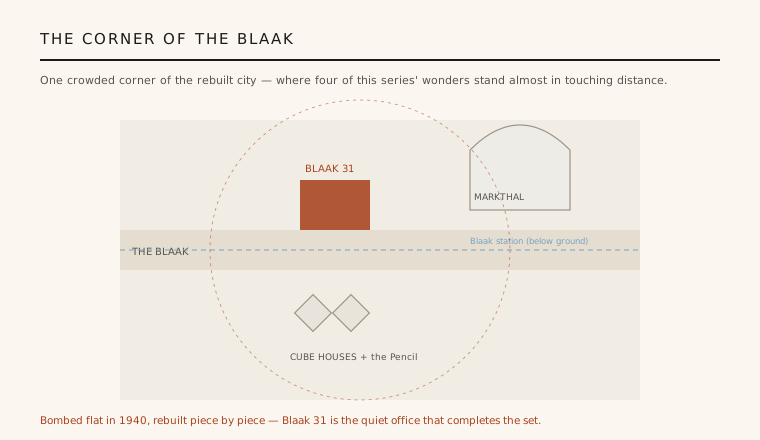
This whole quarter — the Laurenskwartier — was flattened in the May 1940 bombardment that erased Rotterdam's medieval centre, and it has been rebuilt slowly, piece by piece, for eighty years. Blaak 31 rose on the plot of the derelict Cebeco building, demolished in 2008, and slotted in among an extraordinary set of neighbours: the Cube Houses and Piet Blom's "Pencil" tower, the sunken Blaak station, and the soon-to-open Markthal. It was built in just 21 months, and it was designed to be a good citizen in every sense — even underfoot. It scored more than 200 points on GreenCalc+, the Dutch sustainability yardstick of its day, through green roofs, combined heat-and-power and light steel construction. Shortlisted for the Rotterdam Architecture Prize in 2011, it never became a postcard. It did something rarer: it took a hard, tunnel-crossed corner between three celebrities and made it whole, without stealing anyone's light. In a city that loves the loud gesture, Blaak 31 is the wonder of the considerate one.
6. What a modern architect can learn from Blaak 31
- Shape the building around its neighbours. Blaak 31's whole form — the 2.70 m step every three floors — exists to give the Markthal daylight and privacy. Ask not only "how big can it be?" but "what does my building owe the ones beside it?"
- Let good manners become the form. The courteous move — leaning back, sharing the sun — is exactly what makes the building memorable. Civic generosity and striking architecture are not opposites; here they are the same gesture.
- Turn a brutal constraint into the concept. A live metro tunnel that forbids columns became a heroic steel truss and a cantilever. The hardest site fact, met honestly, often produces the boldest idea.
- Give the ground floor back to the street. A seven-metre glazed entrance and public rooms — library, auditorium, restaurant — make the base a gift, not a barrier. A building earns its place by what it offers pedestrians at eye level.
- Use warm, banded materials to stay human at scale. Stone-and-glass bands keep a large office approachable and legible. Material and rhythm can soften bulk without hiding it.
- The quiet building can be the great one. Set among famous neighbours, Blaak 31 wins by completing the corner rather than shouting over it. Knowing when not to be the loudest object is its own kind of mastery.
References & further reading
1. KCAP Architects & Planners (official) — Blaak 31, Rotterdam. https://www.kcap.eu/en/projects/v/blaak_31/
2. designboom — KCAP architects: Blaak 31, Rotterdam. https://www.designboom.com/architecture/kcap-architects-blaak-31-rotterdam/
3. Provast (developer) — Blaak 31 Rotterdam. https://www.provast.nl/en/project/blaak-31-rotterdam/
4. e-architect — Blaak 31 Rotterdam, KCAP Architects & Planners. https://www.e-architect.com/rotterdam/blaak-31-office-building
5. Architectenweb — KCAP's Blaak 31 opgeleverd. https://architectenweb.nl/nieuws/artikel.aspx?ID=23774
6. MIMOA — Blaak 31, KCAP / Fokkema & Partners. https://www.mimoa.eu/projects/Netherlands/Rotterdam/Blaak%2031
7. Bouwwereld — Kantoorgebouw Blaak 31, Rotterdam. https://www.bouwwereld.nl/bouwtechniek/kantoorgebouw-blaak-31-rotterdam/
Last verified 2026-07-04. Figures vary between sources and are given as widely cited approximations — Blaak 31 was designed by KCAP Architects & Planners (project architects Han van den Born and Kees Christiaanse; interiors by Fokkema & Partners for anchor tenant Loyens & Loeff), developed by Provast, and delivered in 2010 after a 21-month build. Sources differ on size: roughly twelve storeys above ground (some leasing listings say eleven) plus an underground parking level, and about 23,000–26,000 m² of floor area. The stepped, rotated massing (~2.70 m every three floors, shaped by the gap to the Markthal), the steel truss over the metro/rail tunnel, the banded glass-and-natural-stone facade, the seven-metre entrance and public lower floors, and the GreenCalc+ score above 200 follow the architect's and Dutch trade-press record. No verified metre height or named structural engineer is published, so none is stated.
Export this guide
Related Guides — Deep-dive reading
nhow Amsterdam RAI: Three Towers That Twist
How OMA took three plain triangular prisms, stacked them and turned each one sixty degrees, and built a 91-metre hotel that cantilevers into the air, aims each of its three blocks at a different view of Amsterdam, and gives a faceless business district a totem to steer by.
Architectural WondersOodi Helsinki Central Library: The Inhabited Bridge That Rebuilt the Public Library
ALA Architects spanned a 100-metre steel bridge over an open ground floor, wrapped it in Finnish spruce, and pointed its terrace straight at Parliament — a case study in the library reinvented as civic living room, in the engineering that makes a column-free public square possible, and in what a nation says when it builds knowledge opposite power.
The Future of ArchitectureThe Greenwich by Rafael Viñoly: The Supertall That Refused to Be a Pencil
125 Greenwich Street stands two monumental I-beams on end and rotates them into the sky — a nearly column-free Financial District tower that argues, against Manhattan's needle-thin luxury towers, that a shorter, wider, wind-braced building is the more humane and durable answer. A study of its structure, its long troubled construction, and the late architect's quiet self-critique.
The Future of ArchitectureRelated Tools — Try Free
Cross-Ventilation Analyzer
Estimate airflow and air changes per hour (ACH) from room size, window areas, layout, and local wind — with NBC 2016 Part 8 compliance check.
Ventilation CalculatorBrise-Soleil Visualizer
Interactive horizontal-louvre cut-off angle calculator — sun altitude, louvre depth, and spacing inputs with a live shadow preview. Computes θ = arctan(spacing/depth) for façade shading, ECBC envelope compliance, hospital daylight design, and tropical sun-control detailing.
Sun Shading ToolConcept Generator
Get 3 AI-generated design concepts for any room with style, materials, and cost estimate.
DesignAI