
Kinderdijk: Nineteen Windmills Against the Sea
How the Dutch turned a drowned delta into farmland — a network of nineteen wind-powered pumps that has kept a whole region from returning to the sea for nearly three centuries, and the clearest lesson in this series on living with water instead of walling it out.
Leave the mountains behind entirely. After the Himalayan valley of Boudhanath and the stone temples of India, come to the flattest, wettest ground in this whole series — the grey-green river delta of Holland. There is no mountain here, no marble, no dome. The wonder at Kinderdijk is a row of nineteen windmills along a canal, and what they do is quietly astonishing: they keep an entire region from drowning.
Almost every wonder we have visited has been a single great object — a temple, a tomb, a tower. Kinderdijk is a different kind of marvel. It is not one building but a system; not a monument but a working machine the size of a landscape; and it carries the most useful lesson of all for an age of rising seas — how to live with water rather than wall it out.
This is the twenty-first article in our Architectural Wonders series.
1. A country below the sea
To understand these windmills you must first understand the ground they stand on — because that ground should not, by rights, be dry land at all. Roughly a quarter of the Netherlands lies at or below sea level, and the Alblasserwaard, the polder Kinderdijk drains, is among the lowest of it: old peat bog that, once drained for farming, oxidises and sinks, settling year by year further below the rivers that surround it.
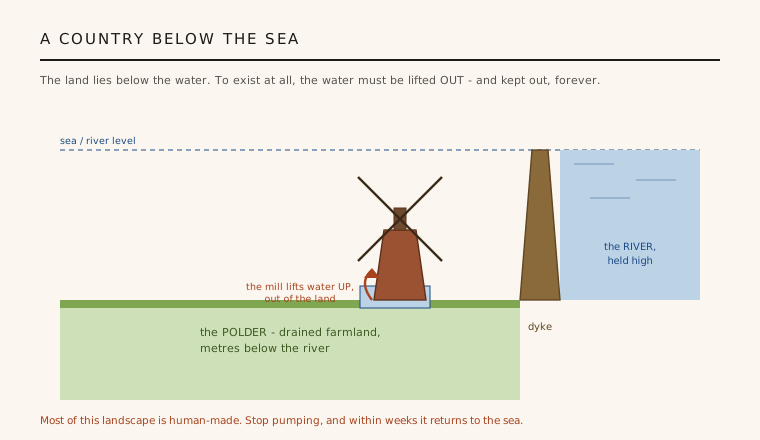
That single fact changes everything. Because the polder floor sits lower than the rivers, rain and seepage cannot simply run away downhill — there is no downhill. The water has to be lifted up and out, mechanically, forever. Stop pumping for a few weeks and the fields return to marsh; stop for a season and they return to the sea. There is a Dutch saying — "God made the world, but the Dutch made the Netherlands" — and it is barely an exaggeration: almost everything you see at Kinderdijk is a human-made hydrological machine pretending to be a peaceful countryside. At Lukla the lesson was that when you cannot change the site, you change the design. Here is that lesson at its most extreme: the site is a land that wants to be sea, and the design is a machine that politely, endlessly, refuses to let it.
2. A building that is a pump
So the whole purpose of a Kinderdijk windmill is not to grind grain — it is to move water uphill. Each mill is, quite literally, a building-sized pump, and the elegance is that every visible part of it is doing mechanical work.
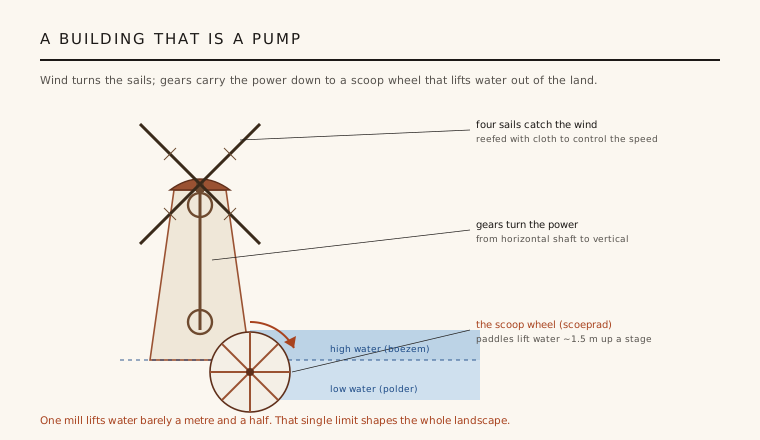
The chain of action is beautifully direct. The wind fills the four great lattice sails; the sails turn a shaft; gearing carries that power down and round to a scoop wheel (the Dutch _scheprad_) — a big paddle wheel turning in a close-fitting channel that scoops water at the bottom and carries it up to spill over into a higher canal. In some mills the scoop wheel is replaced by an Archimedes screw, a giant helix in an inclined trough that traps a pocket of water on every turn and walks it up the slope. The cap at the top rotates so the sails can always be pointed into the wind, and the miller reefs the sailcloth — spreading more in a light breeze, less in a gale — to control the speed. There are no services hidden in a basement, no machine concealed behind a façade. The architecture is the mechanism: this is a building you could not draw without drawing how it works. At Petra a desert people conjured water out of nothing; here a water-people labour to be rid of too much. Opposite problems, one and the same genius for hydrology as architecture.
3. A machine you live inside
Here is the detail that makes Kinderdijk unexpectedly human. These pumps were also homes. The miller and his family lived inside the working mill — slept, cooked and raised children in the cramped, dark, ceaselessly turning body of the machine.
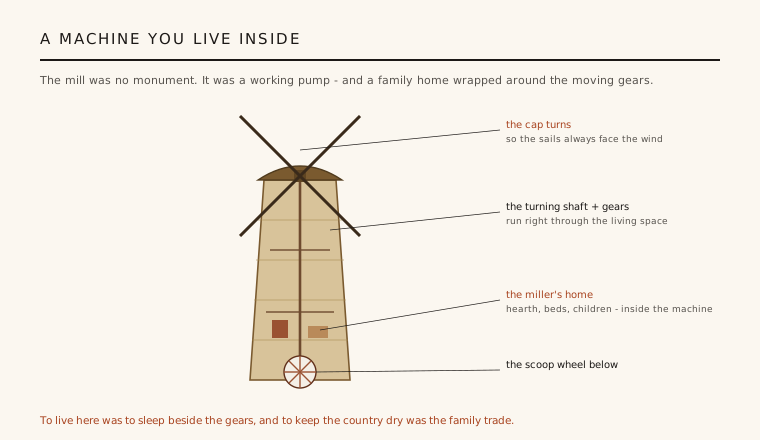
Life in a mill was hard and genuinely dangerous. The sails of a ground-sailer sweep down almost to the earth, so a moment's carelessness near the turning cross could be fatal; the machinery ran through the middle of the living space; the noise never stopped. And it demanded a permanent human presence — a miller had to keep a round-the-clock watch on wind and water, ready to turn the cap, set or reef the sails, and start pumping the instant the polder rose. The craft passed down through mill dynasties, families who inherited the feel of it. That intimacy never really ended: most of the nineteen mills are still inhabited today, many by resident millers who hold a formal diploma and can run the mill if called upon. It is a rare and moving idea — a house that is also a piece of national infrastructure, tended by a family who live inside the thing that keeps their whole country dry.
4. A staircase for water
Now the question that turns nineteen windmills from a picturesque row into a piece of genius. Why nineteen? Because one mill is nearly useless on its own. A scoop wheel can lift water only about a metre to a metre and a half — nowhere near enough to raise it the full height out of the deep polder and over the river dyke.
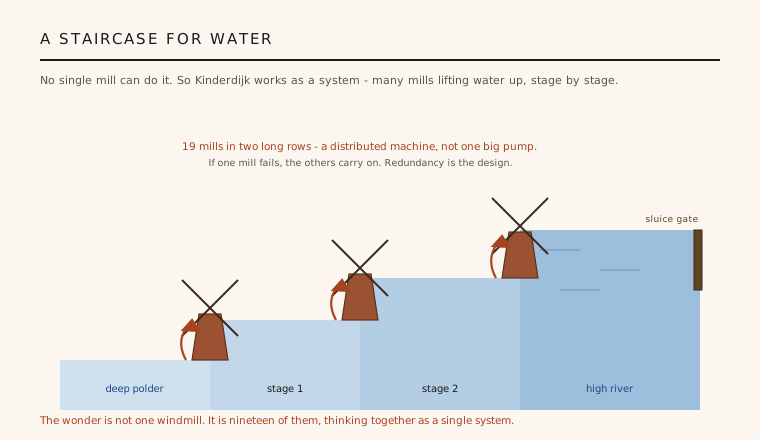
The solution is to raise the water in stages, like a staircase. The mills are arranged in a row — a _molengang_ — so each one lifts the water a single step higher, into a slightly higher canal, where the next mill picks it up and lifts it again. At Kinderdijk two long rows do this in parallel: the eight brick Nederwaard mills of 1738 draining the lower ground, the eight thatched Overwaard mills of 1740 the higher, each row serving its own water board. The water climbs step by step into a raised storage basin, the boezem, and waits there until the river Lek drops low enough — at low tide — for sluice gates to open and let it drain away by gravity. What makes this a wonder is that it is a distributed machine. There is no single great pump to fail; the load is shared across nineteen. If one mill is down for repair, the others carry on and the polder stays dry. At Trakai water was a wall — a moat to keep enemies out. Here water is neither wall nor enemy but a permanent condition to be managed, and the management is shared, redundant, and quietly unbreakable.
5. Six centuries of keeping dry
The windmills, astonishing as they are, are only one chapter in a much longer story — and that story is the real lesson. Draining the Alblasserwaard began back in the 1200s, and by 1277 the local lords were compelled to cooperate and elect water boards (_waterschappen_) to manage it — institutions that survive today and count among the oldest continuously functioning democracies on earth.
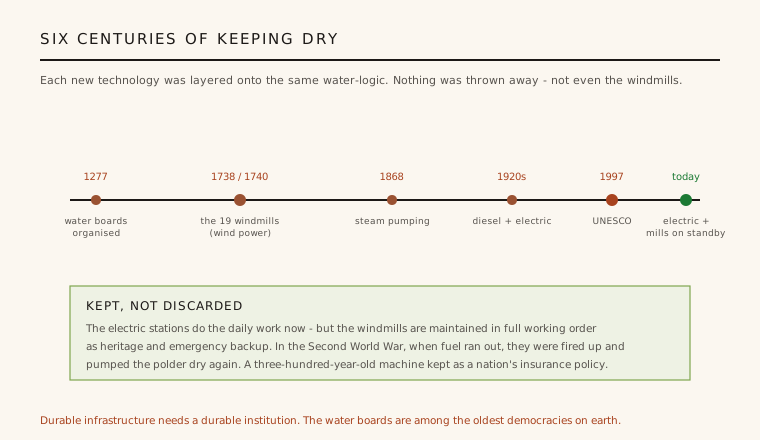
On top of that unbroken institution, one technology was layered after another — never ripping out the last. The windmills of 1738 and 1740 were joined by steam pumping stations from 1868, then diesel and electric ones in the 1920s, and today quiet electric stations do the daily work. But the mills were never scrapped. They are kept in full working order as heritage and as emergency backup — and that is not sentiment: during the Second World War, when fuel ran out, the "obsolete" windmills were fired up again and pumped the polder dry. UNESCO inscribed the whole ensemble — mills, dykes, boezems, sluices and pumping stations together — in 1997, recognising not a set of pretty objects but a single designed landscape. The deepest lesson at Kinderdijk is therefore not mechanical but institutional: durable infrastructure needs a durable institution to tend it. For a country like India, facing harder monsoons and sinking coastal cities, the Dutch answer is worth hearing — the reply to too much water is rarely a taller wall. It is a patient, maintained, cooperative system, and the will to keep it running for eight hundred years.
6. What a modern architect can learn from Kinderdijk
- The building can be the machine. A Kinderdijk mill is pump, power plant and house in one honest object — no "services" bolted onto "architecture." Let structure, mechanism and shelter be a single design, not separate trades.
- Work with water, not against it. The Dutch do not merely wall the water out; they accept a ground plane below the waterline and manage the surplus — store it, lift it, release it on the river's schedule. Design the whole water cycle, not just a barrier.
- Distributed and redundant beats big and singular. Nineteen modest mills in two independent rows fail gracefully; a single great pump does not. Resilience often lives in multiplicity and humble backup, not in one heroic machine.
- Let the working process give the form. The unobstructed sail-sweep, the wind-tracking cap, the reefable cloth, the choice of scoop wheel or screw — every feature is the visible trace of an operating constraint. Honest engineering, left legible, becomes the beauty.
- The unit of design can be a landscape. Kinderdijk is a wonder as an ensemble — mills, dykes, canals and sluices reading as one territory. Sometimes the thing you are really designing is not a building but a whole working ground.
- Durable infrastructure needs a durable institution. The mills have run because the water boards have endured for eight centuries. The most resilient thing about a piece of infrastructure may be the community and governance committed to maintaining it.
In Amogh's frame
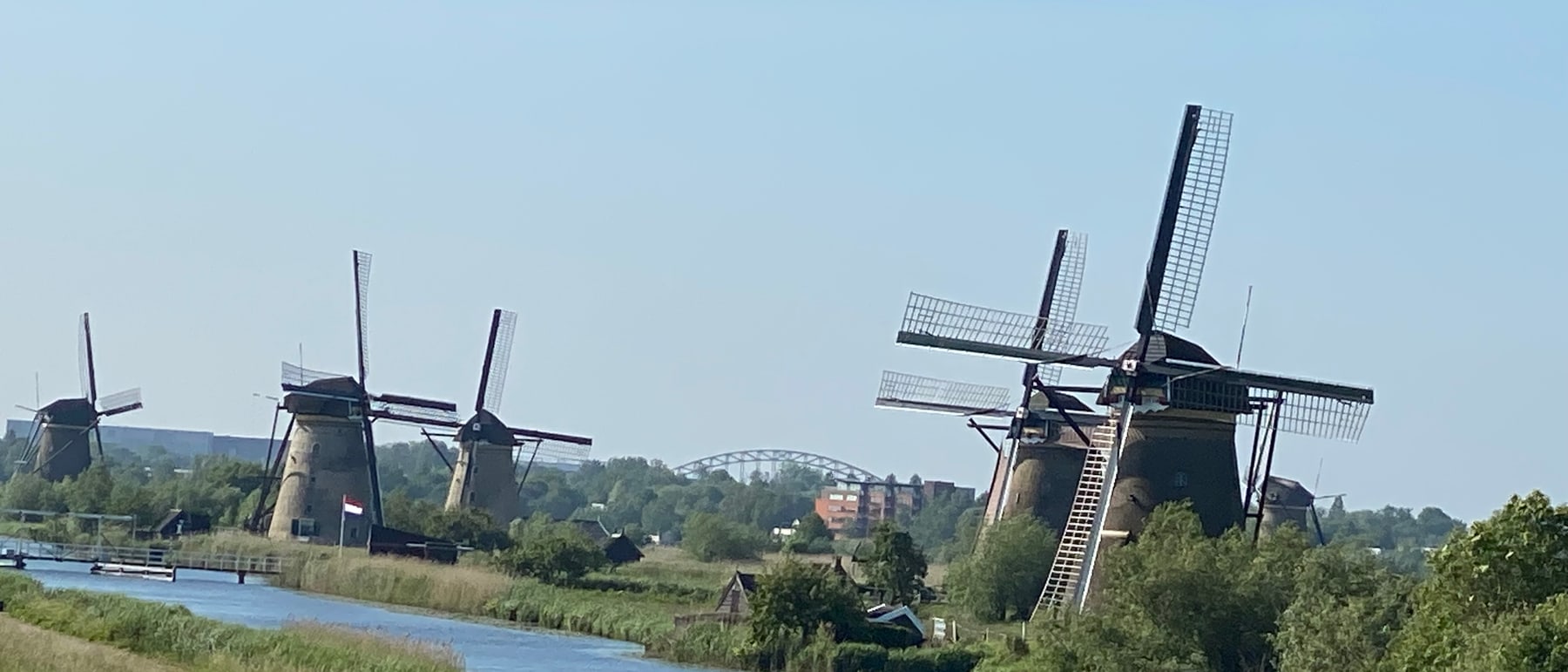
Kinderdijk is one of the places Amogh visited himself. Here he is with his family beside the canal, the great drainage windmills of the polder standing across the water behind them in the bright Dutch sunshine — the working landscape this whole article is about, seen not as a diagram but on a clear blue-sky afternoon.
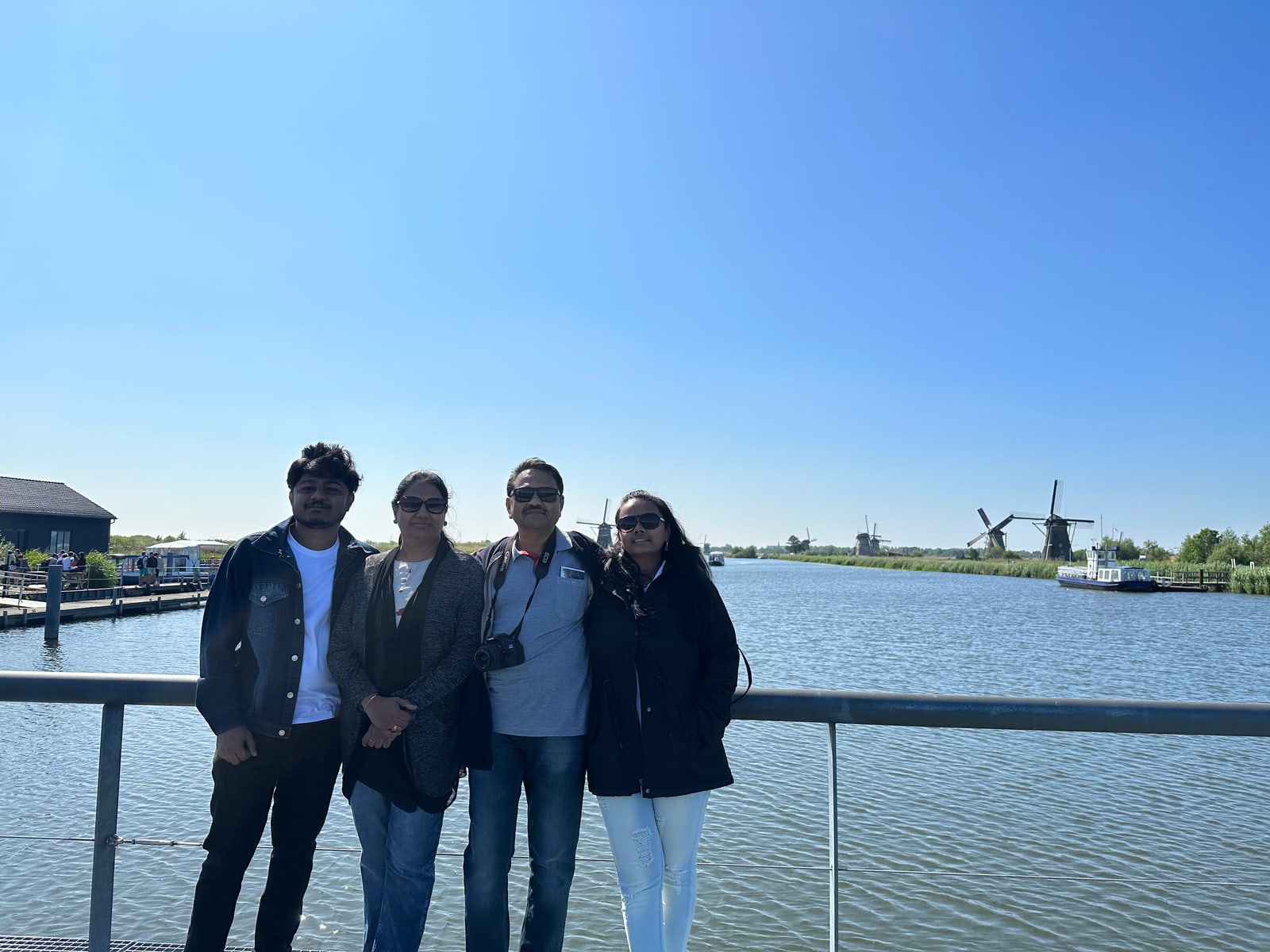
Studio Matrx is built in his memory. Some of these wonders he walked through himself; this is one of them.
References & further reading
1. UNESCO World Heritage Centre — Mill Network at Kinderdijk-Elshout (inscribed 1997; ref 818). https://whc.unesco.org/en/list/818/
2. Wikipedia — Kinderdijk. https://en.wikipedia.org/wiki/Kinderdijk
3. Wikipedia — Kinderdijk windmills. https://en.wikipedia.org/wiki/Kinderdijk_windmills
4. Kinderdijk (official) — Blokweer Museum Mill; windmills & pumping stations. https://kinderdijk.com/
5. Exploring the Netherlands — The Windmills at Kinderdijk (UNESCO World Heritage Site). https://exploringthenetherlands.com/windmills-at-kinderdijk-unesco/
6. Wikipedia — Water board (Netherlands). https://en.wikipedia.org/wiki/Water_board_(Netherlands)
Last verified 2026-07-03. Dates and dimensions vary between sources and are given as widely cited approximations — the mills stand roughly 25–30 m tall and each lifts water only about 1 to 1.5 m per stage; the Nederwaard group (8 brick mills, 1738) and the Overwaard group (8 thatched mills, 1740), with three further mills, make up the nineteen; UNESCO inscribed the mill network in 1997 (ref 818). The polder drainage, the staged pumping, the wind-to-steam-to-electric transition, and the mills' retention in working order as emergency backup follow the established record.
Export this guide
Related Guides — Deep-dive reading
Stonehenge: The Stone Circle That Was Built Like Carpentry
How Neolithic Britons, over fifteen centuries and with nothing but antler picks and rope, dragged twenty-five-tonne sarsens and Welsh bluestones across an island to raise the only stone circle on Earth joined like woodwork — mortise, tenon, tongue and groove in solid stone — aligned it on the turning sun, filled it with the cremated dead, and left us a temple whose purpose we still cannot fully name.
Architectural WondersThe Pantheon: The Dome That Has Never Been Beaten
Nearly nineteen centuries ago the Romans poured a hemisphere of concrete 43 metres across, left a single round hole open to the sky at its summit, and walked away — and it is still, today, the largest unreinforced concrete dome on Earth. A temple to all the gods that became a church, the best-preserved building of ancient Rome, and the ancestor of every great dome from Florence to the United States Capitol.
Architectural WondersEncuentro Guadalupe (Endémico): The Cabin That Refuses to Touch the Ground
In Mexico's wine country, Jorge Gracia's graciastudio raised twenty tiny weathering-steel rooms onto slender stilts so the desert could keep running underneath them — a lesson in building lightly on fragile land, and a quiet argument that the most radical thing a hotel can do is barely be there at all.
The Future of ArchitectureRelated Tools — Try Free
Lift Installation Timeline Calculator
Phase-wise timeline in weeks for installing a home lift — new build or retrofit.
Lift CalculatorMonsoon-Readiness Checklist
Pre-rain home audit across 9 categories — terrace, drains, waterproofing, electrical, HVAC, pest, vehicles, documents.
Seasonal AuditAI BOQ Generator
AI generates detailed Bill of Quantities with city-specific rates and labour breakdown.
ArchitectAI