
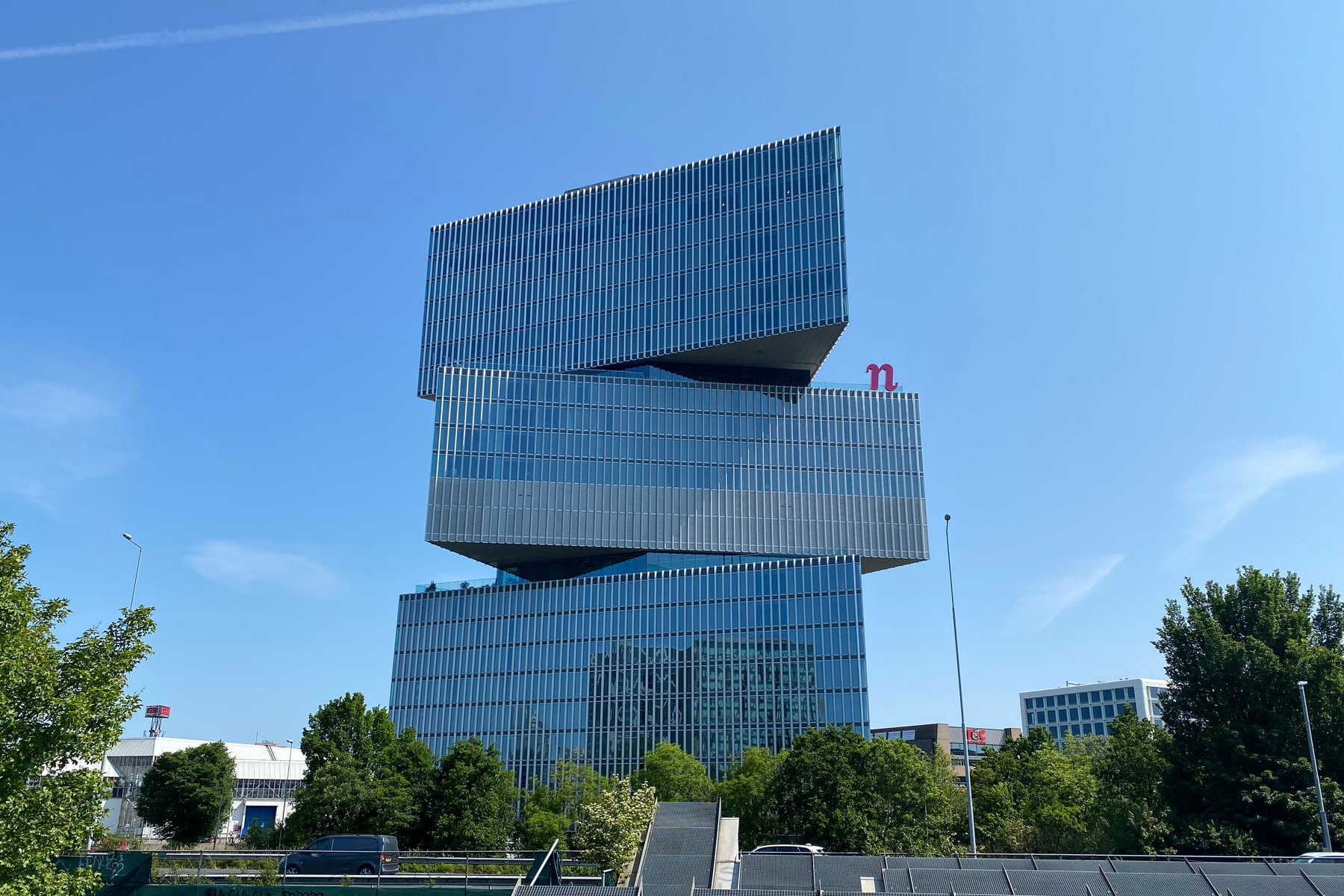
nhow Amsterdam RAI: Three Towers That Twist
How OMA took three plain triangular prisms, stacked them and turned each one sixty degrees, and built a 91-metre hotel that cantilevers into the air, aims each of its three blocks at a different view of Amsterdam, and gives a faceless business district a totem to steer by.
Leave Rotterdam at last and take the train north to Amsterdam — but not to the canals and the gabled houses. Go instead to the Zuidas, the glassy business district on the city's southern edge, and to the great RAI convention centre, and look up. Beside it stands a building that looks as though a giant has taken three enormous triangular blocks and casually stacked them, turning each one as it went, so the whole tower seems caught mid-twist. This is the nhow Amsterdam RAI hotel, finished in 2020, and it is the work of OMA — the office of Rem Koolhaas — with Reinier de Graaf as the partner in charge.
It is the newest kind of wonder in our series and, in one sense, the simplest. There is no ancient legend here, no centuries of weathering. There is just one very good idea, executed with nerve: take a plain shape, repeat it, rotate it, and let the drama fall out. It is worth studying precisely because you can see the whole thought at a glance — and then spend the rest of the article discovering how much cleverness it took to stand it up.
This is the twenty-sixth article in our Architectural Wonders series.
1. Three prisms, stacked and turned
Most spectacular buildings are sculpted — shaped by hand into a swoop or a blob. The nhow is the opposite. Its dramatic form comes not from sculpting but from a single, almost mathematical rule, applied three times.
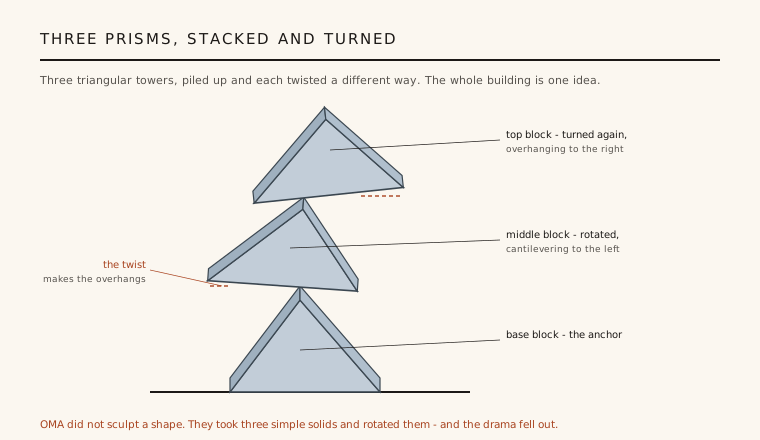
The rule is this: take a triangular tower, stack a second on top of it but turn it sixty degrees, then stack a third and turn it sixty degrees again. That is the entire design. Because each triangle is rotated relative to the one below, its points now jut out past the block beneath — and suddenly you have a tower that appears to twist as it climbs, with great cantilevers hanging over the plaza. Nothing here is a whim of the pencil; the whole silhouette is the by-product of rotating a simple solid. This is a very OMA way to think — trust a clear geometric operation to generate the architecture, rather than reaching for ornament. It is the same instinct we admired at Boudhanath, where a stack of pure shapes carried the whole meaning; here the shapes are plain glass prisms, and the meaning is pure modern nerve.
2. A triangle that looks three ways
But why a triangle? A tower could twist using any shape. The triangle is chosen for a reason, and it is a lovely one — it is the tool that lets a single building look in three directions at once.
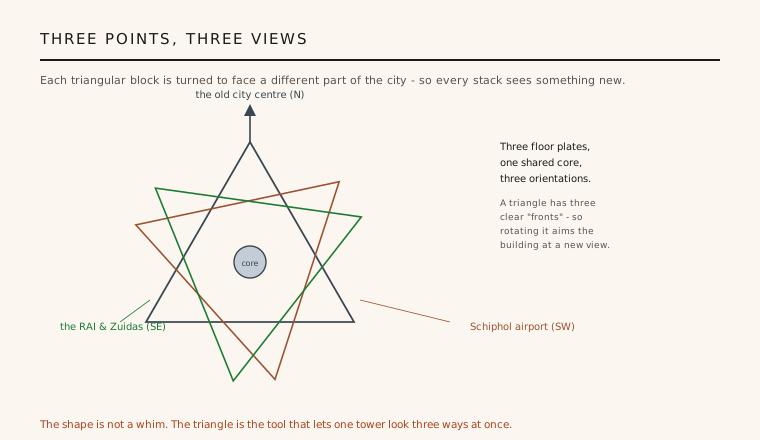
A triangle has three distinct faces, each looking a different way. So by rotating each of the three stacked volumes, OMA aimed each block at a different panorama: one toward Amsterdam's old city centre to the north, one toward Schiphol airport to the southwest, one toward the modern Zuidas to the southeast. Guests in different parts of the hotel therefore wake to completely different cities. The idea runs right into the interior: the rooms are themed to the six compass directions the building's corners point to, each with its own cultural character, a nod to Amsterdam's mix of peoples. And the triangle itself is not arbitrary either — it is a quiet tribute. A slender triangular advertising column once marked this very square, until the surrounding offices swallowed it; OMA brought that lost triangular landmark back, at giant scale. The shape, in other words, is doing three jobs at once: framing the views, organising the rooms, and remembering the place.
3. Holding up the overhang
Now the hard part — because that beautiful twist is, structurally, a nightmare, and the honesty of this building is in how much hidden work the elegance costs.
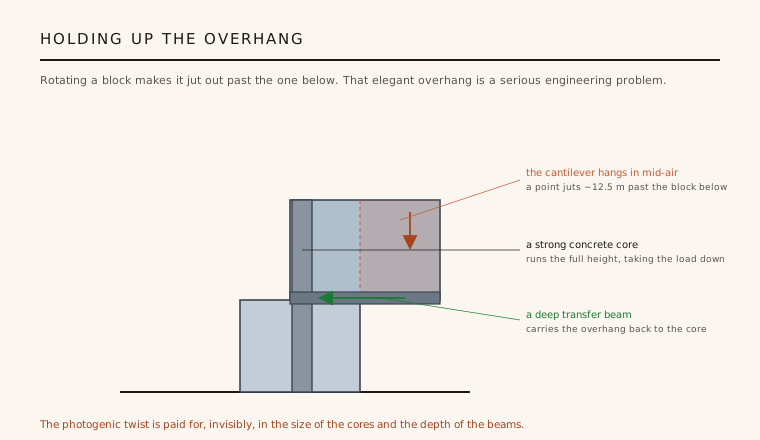
When you rotate a block, its floors reach out into empty air — at the nhow, a triangle's point projects some twelve and a half metres beyond the block below it, and the floors cantilever as much as twenty-three metres out from the building's core. All that overhanging weight has to be caught and carried back down. The engineers (Van Rossum) ran a strong concrete core and a ring of columns up the full height, and at the two biggest overhangs — around the tenth and seventeenth floors — they did something remarkable: they borrowed a heavy truss girder from bridge-building and used it in a high-rise, reportedly for the first time ever, to hold the cantilevers up. This is the lesson every young architect eventually learns the hard way, and it echoes right through this series — from the back-stays of the Erasmus Bridge to the counterweight of the Euromast: the photogenic gesture is always paid for, invisibly, in structure. The twist is free to look at and very expensive to build.
4. A tower with a crown that broadcasts
Look closer and the nhow is not really a stack of bedrooms at all. It is a vertical machine, programmed from bottom to top to keep working around the clock.
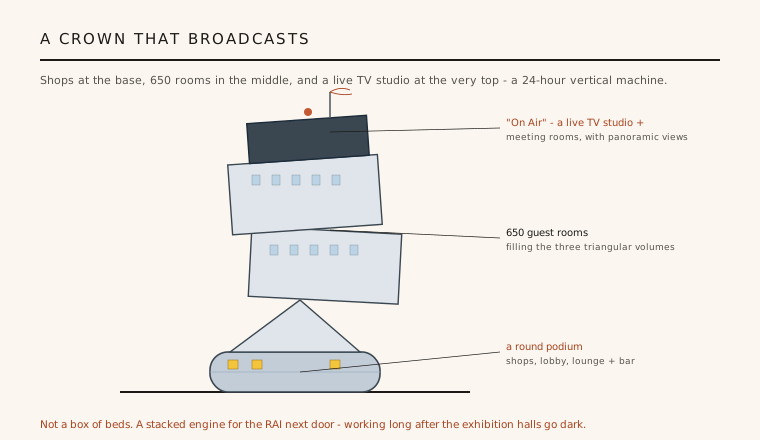
At the base, a two-storey circular podium holds shops, the lobby, a lounge and a bar — a public plinth open to the street. Above it, the three triangular volumes are filled with the 650 guest rooms that make this one of the largest hotels in the Benelux. And at the very top sits the most telling detail: a crown of meeting rooms and a genuine live television broadcasting studio, called "On Air," where a daily show is filmed against the panorama of the city. The whole building is conceived as an engine for the RAI convention centre beside it — a place that keeps humming with conferences, broadcasts, meetings and guests long after the exhibition halls have gone dark. It is the same Dutch instinct we met at the Markthal: don't build a single-use box; fold many kinds of life into one form and let it work all day and all night.
5. A totem for the Zuidas
Finally, step back across the plaza and ask what the building is really for — beyond its 650 rooms. Its deepest job is to be a landmark: to give an amorphous new business district a point to steer by.
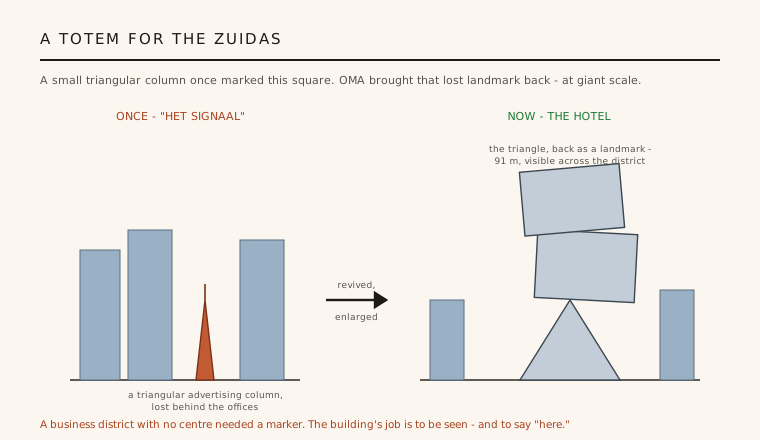
The Zuidas is a district of glass office slabs that can feel placeless — a business park without a heart. What such a place needs, more than another office block, is a totem: a single, memorable, visible-from-everywhere marker that says "here." That is what the nhow provides. By reviving the old triangular signpost at the scale of a 91-metre tower, OMA gave the district a legible centre, a thing that shows up on the skyline and in the memory. De Graaf argued that we should "learn to enjoy modernity again," and he took special pleasure in reporting that Amsterdam's taxi drivers liked the building — the surest sign a landmark has done its job. Because this, in the end, is one of architecture's oldest and most useful tasks, from a Himalayan stupa to a Dutch hotel: to plant something in the ground that a whole community can orient itself around.
6. What a modern architect can learn from the nhow Amsterdam
- Let a rule generate the form. Three triangles, each turned sixty degrees, produce the whole building — silhouette, floor plates and drama alike. A clear geometric operation can do the work of a thousand sketches, and reads instantly.
- Turn orientation into architecture. The twist is justified by the view: each block faces a different city. Massing driven by what a building looks at is richer, and more honest, than shape for shape's sake.
- Cantilevers are borrowed structure. A 12.5-metre overhang meant importing a bridge truss into a tower. Every dramatic projection is paid for in cores, transfer beams and cost — design the gesture knowing who carries it.
- Program a building as a machine, not a box. Podium, rooms and a rooftop broadcast studio make the hotel a 24-hour engine for the convention centre next door. Ask what a building does all day, not just what it contains.
- A landmark is a public service. By reviving a lost totem, the nhow gives a placeless district something to steer by. Legibility — being memorable and locatable — is a real gift a building can make to a city.
- Simplicity up front buys buildability. One repeated triangle let the team pour a floor roughly every eight days despite a twisting tower. Geometric discipline early is what makes a complex form actually constructable.
References & further reading
1. OMA — nhow Amsterdam RAI Hotel. https://www.oma.com/projects/rai-nhow-hotel
2. Dezeen — OMA completes nhow Amsterdam RAI Hotel. https://www.dezeen.com/2019/12/02/oma-nhow-amsterdam-rai-hotel-amsterdam/
3. ArchDaily — OMA/Reinier de Graaf Reveals the Completed nhow Amsterdam RAI Hotel. https://www.archdaily.com/929529/oma-reveals-latest-images-of-the-completed-nhow-amsterdam-rai-hotel
4. SCIA Engineer — nhow RAI Hotel Amsterdam (structural user story). https://www.scia.net/en/user-stories/nhow-rai-hotel-amsterdam
5. Designboom — OMA / Reinier de Graaf's nhow Amsterdam RAI hotel tops out. https://www.designboom.com/architecture/oma-reinier-de-graafs-nhow-amsterdam-rai-02-11-2019/
6. Hospitality Net / Minor Hotels — nhow Amsterdam RAI: First Impressions. https://www.hospitalitynet.org/announcement/41001592.html
Last verified 2026-07-03. Figures vary between sources and are given as widely cited approximations — the tower is about 91 m tall with roughly 24–25 storeys and 650 rooms (described as the largest newly built hotel in the Benelux); each of the three triangular volumes is rotated about 60°, with a triangle's point projecting some 12.5 m beyond the block below and floors cantilevering up to ~23 m from the core. OMA's authorship (partner Reinier de Graaf), the 2020 completion, the orientation of the blocks to the old city centre / Schiphol / Zuidas, the bridge-derived truss at the largest cantilevers, and the rooftop "On Air" studio follow the established record.
Export this guide
Related Guides — Deep-dive reading
Blaak 31: The Tower That Steps Aside
How KCAP built a twelve-storey office in the heart of Rotterdam that politely steps and turns away from its neighbours — shifting 2.70 metres every three floors to hand the Markthal next door its light and privacy — all balanced on a great steel truss above the city's live metro tunnel.
Architectural WondersThe 42, Kolkata: How a 1:10 Sliver of Concrete Rewrote an Indian Skyline
Hafeez Contractor's residential tower on Chowringhee is a perfect square in plan pushed to roughly 249 metres — a slenderness ratio of about 1 to 10 that turns a colonial-era plot in the heart of Kolkata into India's tallest completed building outside Mumbai. A case study in slender-tower engineering, the water damper that keeps it still, and what vertical luxury says about the Indian metropolis.
The Future of ArchitectureQuay Quarter Tower: How 3XN Kept a Skyscraper Alive Instead of Killing It
In Sydney, 3XN and BG&E chose not to demolish the 1976 AMP Centre but to grow a new tower out of its bones — keeping around two-thirds of the old columns, beams and slabs and almost all of its core. This deep study reads the world's first 'upcycled' skyscraper as a manifesto for what tall buildings become when carbon, not the wrecking ball, sets the terms.
The Future of ArchitectureRelated Tools — Try Free
Window Orientation Planner
Pick the best window type, glass and shading by wall direction — north, east, south and west.
Window ToolCross-Ventilation Analyzer
Estimate airflow and air changes per hour (ACH) from room size, window areas, layout, and local wind — with NBC 2016 Part 8 compliance check.
Ventilation CalculatorHome Building & Interior Cost Calculator — 20 Cities
Construction + interior costs for 20 Indian cities across kitchen, wardrobes, flooring, painting, ceiling.
Cost Calculator