
Rainwater Filtration & First-Flush in India: Cleaning Rain Before You Store or Recharge It
A homeowner's guide to the step that makes or breaks a rainwater harvesting system — diverting the dirty first flush, screening leaves, desilting, and choosing the right filter before the water reaches your tank or recharge pit.
Collecting rain is the easy part. What decides whether a rainwater harvesting (RWH) system works for years or silts up in one monsoon is what happens between the roof and the tank — the filtration train. This Studio Matrx guide, written for homeowners, walks through cleaning harvested rain before it ever reaches storage or a recharge structure: the first-flush diverter, leaf screens, the desilting chamber, and the filter that finishes the job.
Filtration is the make-or-break step. Skip it and your storage tank fills with silt and leaf litter, or your recharge pit clogs and stops soaking. This guide is the cleaning layer that sits underneath the whole system — for the big picture start at the rainwater harvesting guide, and for the roof-side collection see rooftop rainwater harvesting.
Why the first rain is the dirtiest
Between showers, a roof collects a surprising amount of grime — dust, pollen, bird and lizard droppings, dead leaves, soot from traffic, and whatever the wind has dumped. The first rain washes all of that off in one dirty slug. If you let it run straight into your tank, you have effectively rinsed the roof into your drinking or gardening water.
The fix is deliberately throwing the first few minutes of rain away. That is the job of the first-flush diverter, and it is the single most important — and most often skipped — component in an Indian RWH system.
The first-flush diverter
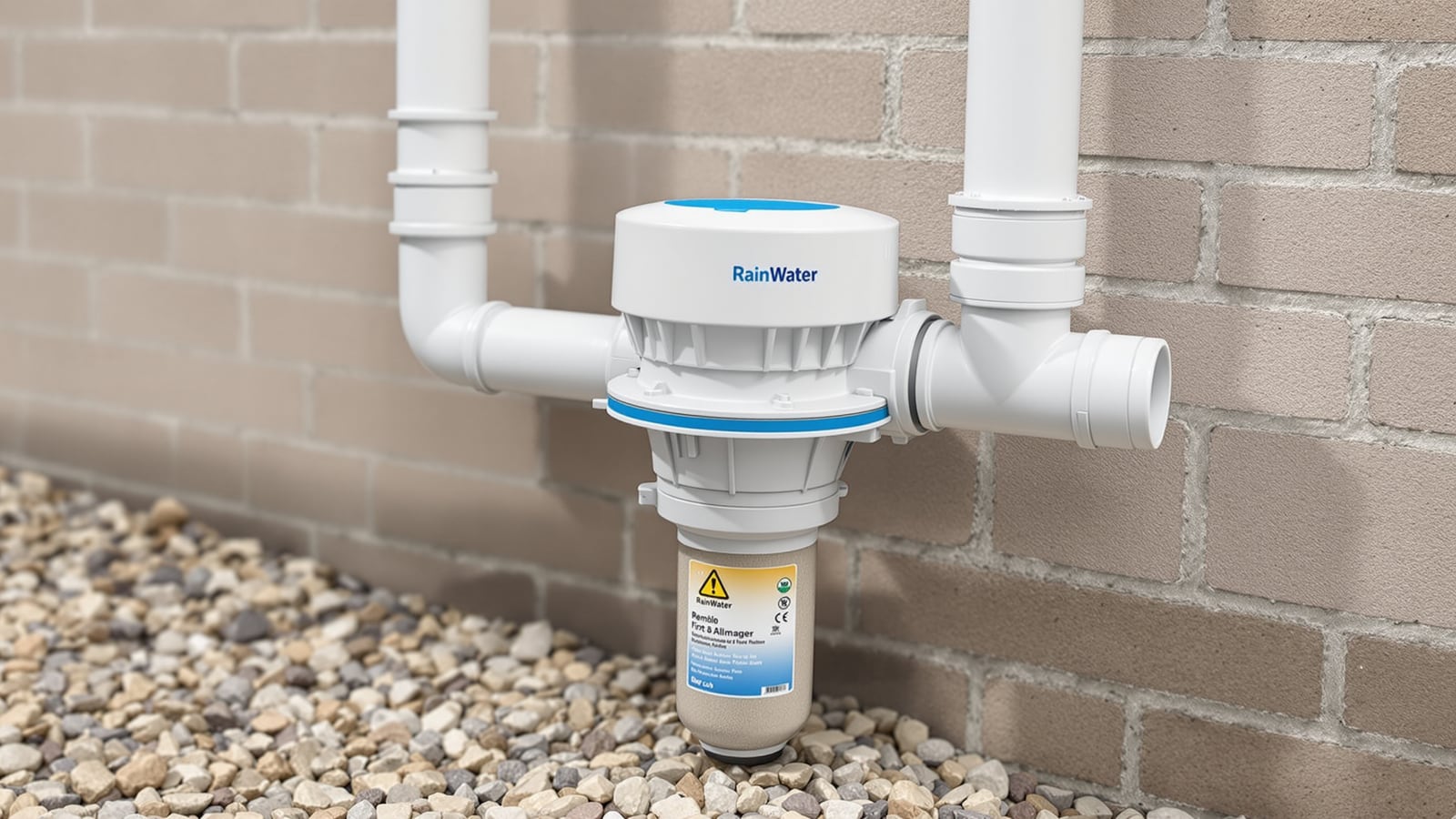
A first-flush diverter (also called a first-flush device, or FFD) is a chamber or a length of pipe that fills up with the dirty opening rain and holds it back, so only the cleaner rain that follows carries on to storage or recharge.
The commonest home design is a standpipe: a vertical pipe hanging off the downpipe. The first rain fills it from the bottom; once it is full, further water backs up and overflows into the filter and tank. A slow-release valve or a small pinhole at the base drains the trapped dirty water away over the next few hours, resetting the device for the next shower. A floating ball can seal the top of the standpipe once it is full, so the clean water diverting past does not disturb the settled dirt.
How much to divert? The usual homeowner rule of thumb is to dump the first 1–2 mm of rainfall off the roof. That translates to a diverter volume based on roof area:
| Roof area (plan) | First-flush at ~2 mm | Practical standpipe |
|---|---|---|
| 50 m² | ~100 litres | 150 mm pipe, ~5.5 m OR a small chamber |
| 100 m² | ~200 litres | Dedicated FFD chamber |
| 150 m² | ~300 litres | Chamber with slow-drain valve |
| 200 m² | ~400 litres | Chamber, sized on site |
These are indicative. Roofs that are dirty, tree-shaded or long-unwashed need a bigger first flush; a clean terrace washed by frequent rain needs less. Size generously — over-diverting only costs you a little yield, while under-diverting costs you a dirty tank.
The full filtration train
First-flush diverting is one stage of several. In order, from roof to storage or recharge:
- Leaf screen / gutter mesh. A coarse mesh or leaf guard over the gutter and at the downpipe mouth stops leaves, twigs and larger debris entering at all. Cheapest component, biggest nuisance-saver.
- Desilting / settlement chamber. A small silt trap where water slows down and heavier grit and sand settle out before filtration. It has a removable cover so you can scoop out the sludge.
- First-flush diverter. Dumps the dirty opening rain, as above.
- The filter. The finishing stage that removes fine suspended matter, before water enters the tank or the recharge pit.
Filter types you will actually meet
Once the coarse stuff is gone, a filter removes the remaining fine suspended matter. Three families cover almost every Indian home:
- Sand-gravel-charcoal media filter. The classic, build-it-yourself option: a masonry or drum chamber layered with coarse gravel at the bottom, then fine gravel, then coarse and fine sand, sometimes with a charcoal layer for odour and colour. Water percolates down through the layers and comes out clarified. Cheap, robust, and easy to rebuild — but it needs space and periodic media washing.
- Mesh / disc filters. A stainless-steel mesh screen or a stack of grooved plastic discs that strains the water as it passes. Compact, low-maintenance, self-cleaning designs exist. Good for recharge and for pre-filtering before a tank; the mesh rating decides how fine.
- Proprietary rainwater filters. Ready-made inline units (many popular Indian brands) that combine a fine mesh with a self-cleaning geometry inside a compact housing. They fit straight onto the downpipe, need little space and little maintenance, and are the easiest retrofit — at a higher cost per unit.
| Filter type | Cleans to | Space & effort | Indicative cost | Best for |
|---|---|---|---|---|
| Sand-gravel-charcoal media | Fine, plus some odour/colour | Needs a chamber; wash media | ₹8,000–₹25,000 built | Storage, DIY, larger roofs |
| Mesh / disc filter | Fine mesh rating | Compact; occasional rinse | ₹3,000–₹12,000 | Recharge, pre-filter to tank |
| Proprietary inline filter | Fine, self-cleaning | Very compact; low effort | ₹6,000–₹30,000+ | Easy retrofit, tidy installs |
Costs are indicative and vary with roof size, brand and mason rates. Match the filter to the use, not the brochure — a recharge pit does not need a polished-water filter, and a storage tank you will draw from does.
Recharge vs storage: how fine is fine enough?
The single decision that sets your filtration standard is what the water is for. The two RWH paths need very different levels of cleaning.
- Filtering for RECHARGE (basic). Here the water is going into the ground — a recharge pit, trench or bore. The soil itself is the final filter. You only need to keep out silt, leaves and grit so the pit does not clog. A leaf screen, a desilting chamber and a coarse media or mesh filter are enough. Over-filtering recharge water just wastes money.
- Filtering for STORAGE-and-USE (finer). Water you will store and draw on — flushing, washing, gardening, or drinking — must be clearer, because it will sit in a tank and be handled. Use a proper media or fine proprietary filter, and add a first-flush diverter sized generously. For potable use, filtration alone is never enough: stored rain still needs disinfection and treatment before anyone drinks it. That is a separate subject — see drinking water systems. For non-drinking reuse around the house, see rainwater reuse.
Placement: always before storage or recharge
Filtration belongs upstream of everything you care about. The first-flush diverter and filter sit on the downpipe or in a chamber before the water enters the tank or the recharge pit — never after. A filter downstream of the tank is cleaning water that has already dirtied your storage.
Keep the whole train accessible: chambers with removable covers, filters at a height you can reach, and the first-flush drain pointed at a soak-away or the stormwater drain (not back into the harvesting line). If you are also managing the discard side of rain, that is stormwater drainage.
Maintenance: the part everyone forgets
Filters do not clean themselves unless the design says so, and even then they need checking. A simple routine:
- Before the monsoon: clear the gutter mesh and leaf screens, scoop out the desilting chamber, and confirm the first-flush drain is not blocked.
- During the monsoon: rinse mesh and disc filters after the first heavy spells; wash or turn over media filter sand if flow slows.
- Yearly: rebuild or top up media filter layers, replace charcoal, and check that the first-flush slow-drain valve still empties between showers.
A clogged filter silently sends dirty water — or overflows and wastes the harvest. Ten minutes before each big rain is the cheapest maintenance you will ever do.
Sizing and the by-law reality
You do not need to size filtration by formula; size it to your roof and flow, using the first-flush table above and the filter's rated capacity. For sizing the tank and yield that sit downstream, use the rainwater tank sizer rather than guessing.
RWH — including a first-flush and filtration provision — is mandatory for many plots in Indian cities. Municipal building bye-laws in Bengaluru, Chennai, Delhi, Hyderabad and others require rainwater harvesting above a certain plot or built-up area, and completion or water-connection approval can depend on it. The exact threshold, structure and any rebate are set locally, so verify with your municipal corporation or water board — do not rely on a number quoted online.
References
- Central Ground Water Board (CGWB) — guidance on rooftop rainwater harvesting and artificial recharge.
- CPHEEO (Ministry of Housing & Urban Affairs) — Manual on Water Supply and Treatment.
- Relevant Bureau of Indian Standards codes on rainwater harvesting and water quality (confirm the current code by number with a qualified engineer).
- Your local municipal corporation / water board bye-laws for mandatory RWH thresholds and any rebates.
Export this guide
Related Guides — Deep-dive reading
Rainwater Harvesting Guide for India: Catchment, Storage, Recharge & Bye-laws
The section pillar for rainwater harvesting — why it matters for water security and groundwater, the full catchment-to-store-or-recharge chain, the two paths of using rain versus recharging aquifers, indicative yield and sizing, first-flush and filtration, maintenance, and the mandatory-RWH reality in Indian cities.
PlumbingRooftop Rainwater Harvesting in India: Catching Rain Off Your Roof for Storage or Recharge
A homeowner's guide to rooftop rainwater harvesting — using the roof as a catchment, sizing gutters and downpipes for your area and rainfall, first-flush and filtration, and where the water finally goes: a storage sump for use or a recharge structure for the ground.
PlumbingRooftop Rainwater Harvesting
The rain that lands on your roof is a free water supply and, in most Indian cities, a legal duty. What a rooftop rainwater harvesting system is, the two paths (store it for reuse or recharge the groundwater), the parts that make it work, how much a roof can actually collect, and the maintenance that keeps it honest. Plain language, India-grounded.
RoofingRelated Tools — Try Free
Rainwater Tank Sizer
How big should your rainwater tank be? Computes annual harvest, recommended tank capacity in litres, water-bill savings, and payback — for 10 Indian cities.
RWH CalculatorFirst Flush Diverter Calculator
Size a rainwater first-flush diverter — the initial dirty roof-wash to divert before storage — from roof area and divert depth.
Plumbing CalculatorMonsoon-Readiness Checklist
Pre-rain home audit across 9 categories — terrace, drains, waterproofing, electrical, HVAC, pest, vehicles, documents.
Seasonal Audit