
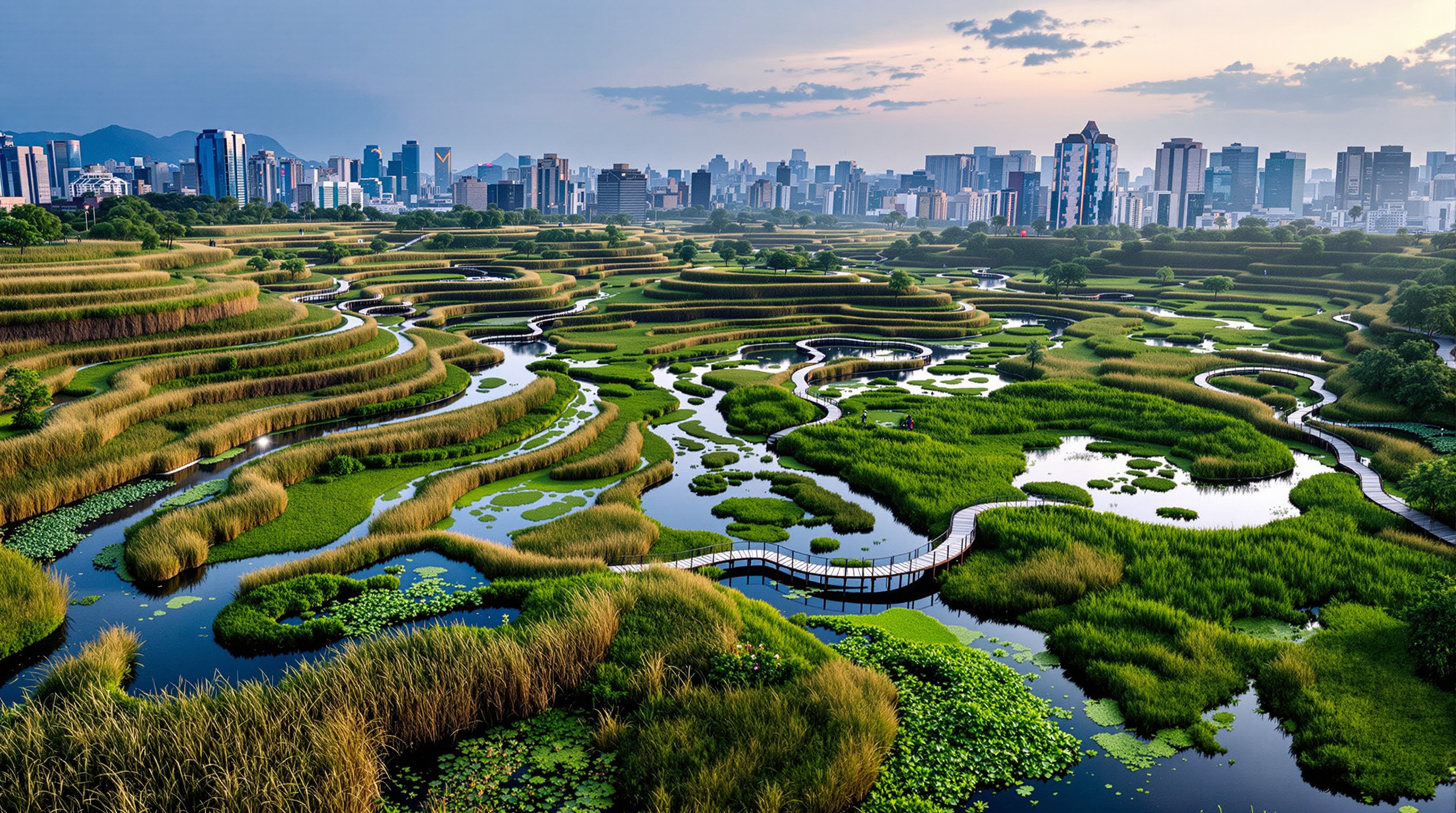
The Sponge City: How Kongjian Yu Taught China's Cities to Drink the Rain
Landscape architect Kongjian Yu and his firm Turenscape reframed the flood-prone city as a living sponge — a national programme, launched in 2013–14 across dozens of Chinese cities, that swaps concrete pipes for wetlands, rain gardens and terraces. A study of its ecological logic, its flagship parks, and the hard question of what a sponge can and cannot hold.
Most entries in this canon are a single building — an object you can walk around, photograph, date to a ribbon-cutting. The Sponge City is not that. It is an idea that became a national policy, then spread across dozens of Chinese cities as parks, streets, roofs and riverbanks. Yet it belongs here as firmly as any museum or tower, because it advances one of the most consequential architectural arguments of our century: that the ground itself — soft, planted, absorbent — can do the work we have spent a hundred years asking concrete pipes to do, and do it better.
The argument's author was Kongjian Yu (1963–2025), a Harvard-trained landscape architect who founded the Beijing firm Turenscape and taught at Peking University. Yu spent his career insisting that Chinese cities had made a civilisational mistake by importing the Western engineering habit of channelling water away as fast as possible — draining, piping, walling, paving. His counter-proposal was almost childishly simple, which is part of why it travelled: build the city like a sponge. Let it soak up rain where it falls, hold it, clean it through living systems, and release it slowly.
"We have to make friends with water, make friends with floods... The sponge city is a philosophy, not just a technology. It is about learning to let the water in rather than fighting to keep it out." — Kongjian Yu, in interviews across the 2010s
The question it poses
Kushner's canon asks of every building: what does it tell us about where architecture is going? The Sponge City answers that the discipline's next frontier may not be the object at all, but the surface between a city and its water — and that the person who designs it might be a landscape architect rather than an architect in the conventional sense.
That is a genuinely destabilising claim. For most of the modern era, water management was invisible infrastructure: the province of civil engineers, buried, unloved, measured only by whether the street flooded. Yu's move was to drag that hidden system up into the daylight and make it the primary public form of the city — a park that is also a filtration plant, a riverbank that is also a floodplain, a plaza that is also a reservoir. Architecture, in this reading, stops being a thing that sheds water and becomes a thing that keeps it.
The timing was not accidental. In July 2012 a catastrophic cloudburst drowned Beijing, killing seventy-nine people and exposing how helpless a modern Chinese megacity was against its own runoff. Yu, already an outspoken critic of what he called "grey" infrastructure, used the moment — and national television — to press his case. Within eighteen months the concept had reached the top of the state.
From theory to national policy
The intellectual groundwork long predated the slogan. Yu's doctoral and early academic work on Ecological Security Patterns (from the mid-1990s) and his polemic for "negative planning" and ecological infrastructure (around 2003) had already reframed the landscape as the load-bearing structure of the city rather than its decoration. Turenscape had been building demonstrations of the idea since roughly 2000, at projects such as the Zhongguancun Life Science Park in Beijing. The word "sponge" simply gave a decade of theory a handle the public and the Party could grip.
The political turn is usually dated to December 2013, when, at the Central Urbanization Work Conference, Xi Jinping called for cities built around "natural retention, natural infiltration, and natural purification." In 2014 the Ministry of Housing and Urban-Rural Development issued technical guidance, and the Sponge City Programme became formal national policy. A first batch of sixteen pilot cities was designated in 2015 and a second batch the following year, bringing the initial roster to around thirty — Wuhan, Chongqing, Xiamen, Shanghai, Beijing and others — each receiving central subsidies to retrofit districts as sponges.
The headline ambitions were quantified, and they are worth stating plainly because they set the bar the programme is judged against:
| Target | Metric | Deadline |
|---|---|---|
| Early pilot coverage | 20% of each city's built-up area meets sponge standards | 2020 |
| National rollout | 80% of urban built-up areas function as sponge | 2030 |
| Rainfall capture | Capture, reuse or infiltrate ~70% of annual rainfall on-site | 2030 |
These are not the usual metrics of architecture. Nobody asks a cathedral to absorb seventy percent of its rain. That the programme is measured in litres and percentages, not in beauty or symbolism, tells you how completely Yu shifted the terms.
How a sponge actually works
The technical core is the international toolkit of Low-Impact Development (LID) and nature-based solutions, assembled at city scale. Rather than one big pipe carrying water to one big outfall, the sponge city distributes thousands of small interventions that each slow, soak and store. The section below shows the logic: rain that once sheeted off tarmac into an overloaded drain is instead intercepted, step by step, by a chain of soft systems.
Read left to right, the section is a hierarchy of restraint. Permeable paving lets water pass through the surface instead of running off it. A rain garden — a shallow planted depression — catches what the paving cannot and lets it pool and percolate. A bioswale, a vegetated channel, conveys the surplus slowly, filtering it through roots and soil. Finally a constructed wetland and retention pond store the water, clean it biologically, and either return it to the aquifer below or hold it for reuse. The conventional storm drain does not vanish — it becomes the overflow of last resort, the terracotta line at the right, rather than the first and only defence.
Nothing here is technologically exotic. The radicalism is in the inversion of priority: soft systems first, hard pipe last. That reordering is Yu's real invention, and it is architectural in the deepest sense — it decides the form, the section and the public face of the city.
The flagships: proof you can walk through
Because the programme is abstract, its argument lives in Turenscape's built parks, each a demonstration that the sponge is buildable and beautiful.
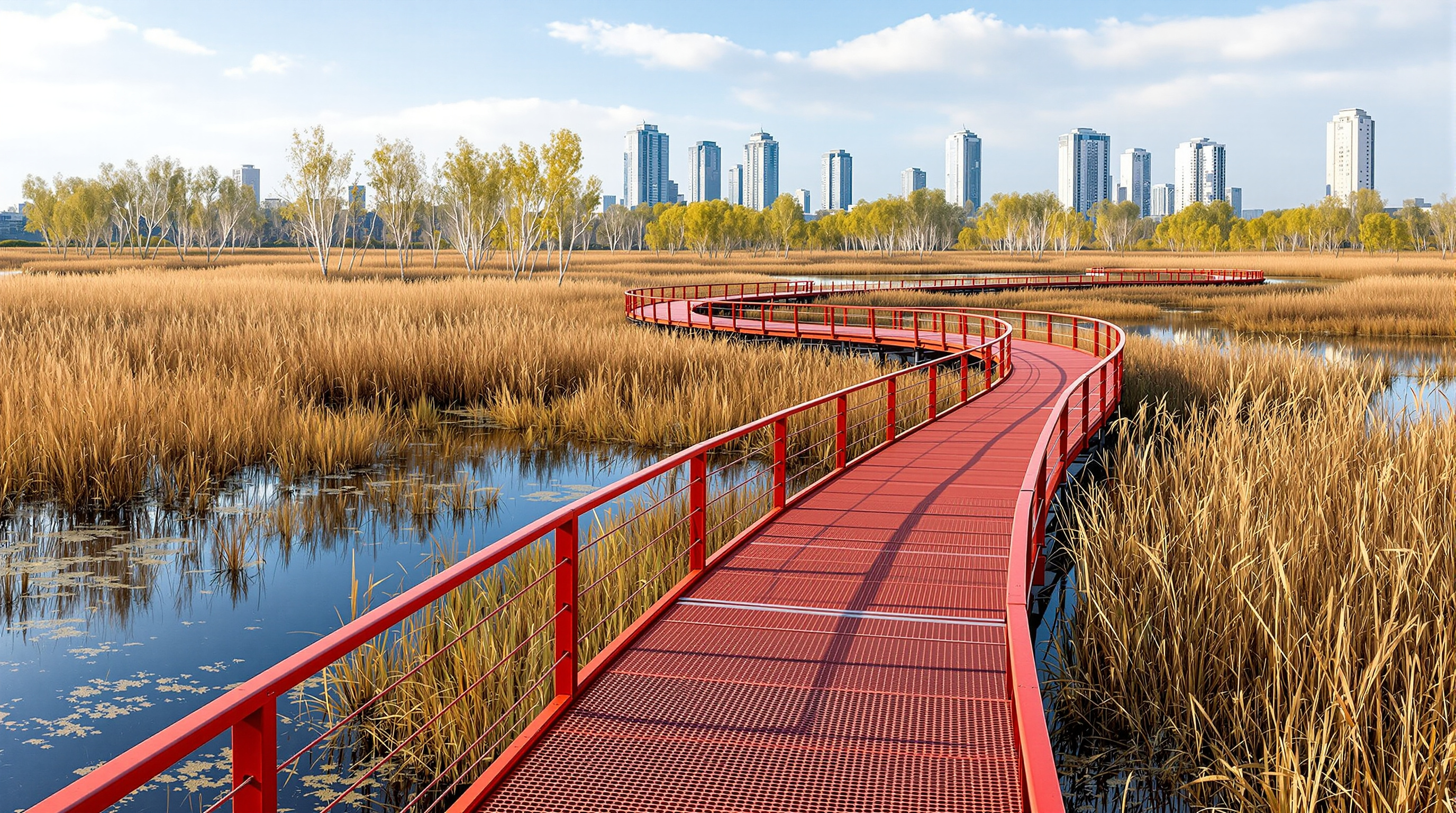
Qunli Stormwater Wetland Park in Harbin (built roughly 2009–2011, about 34 hectares) is perhaps the clearest. A dying wetland, marooned by a new district built up around it, was ringed with a "necklace" of ponds and mounds made by a simple cut-and-fill of the earth. Runoff from the surrounding city is collected at the perimeter, filtered through the pond ring, and delivered clean to the wetland core, which is left to evolve on its own. The result is at once a flood buffer, a water-treatment system, a biodiversity reserve and a beloved public park — four functions in one soft form.
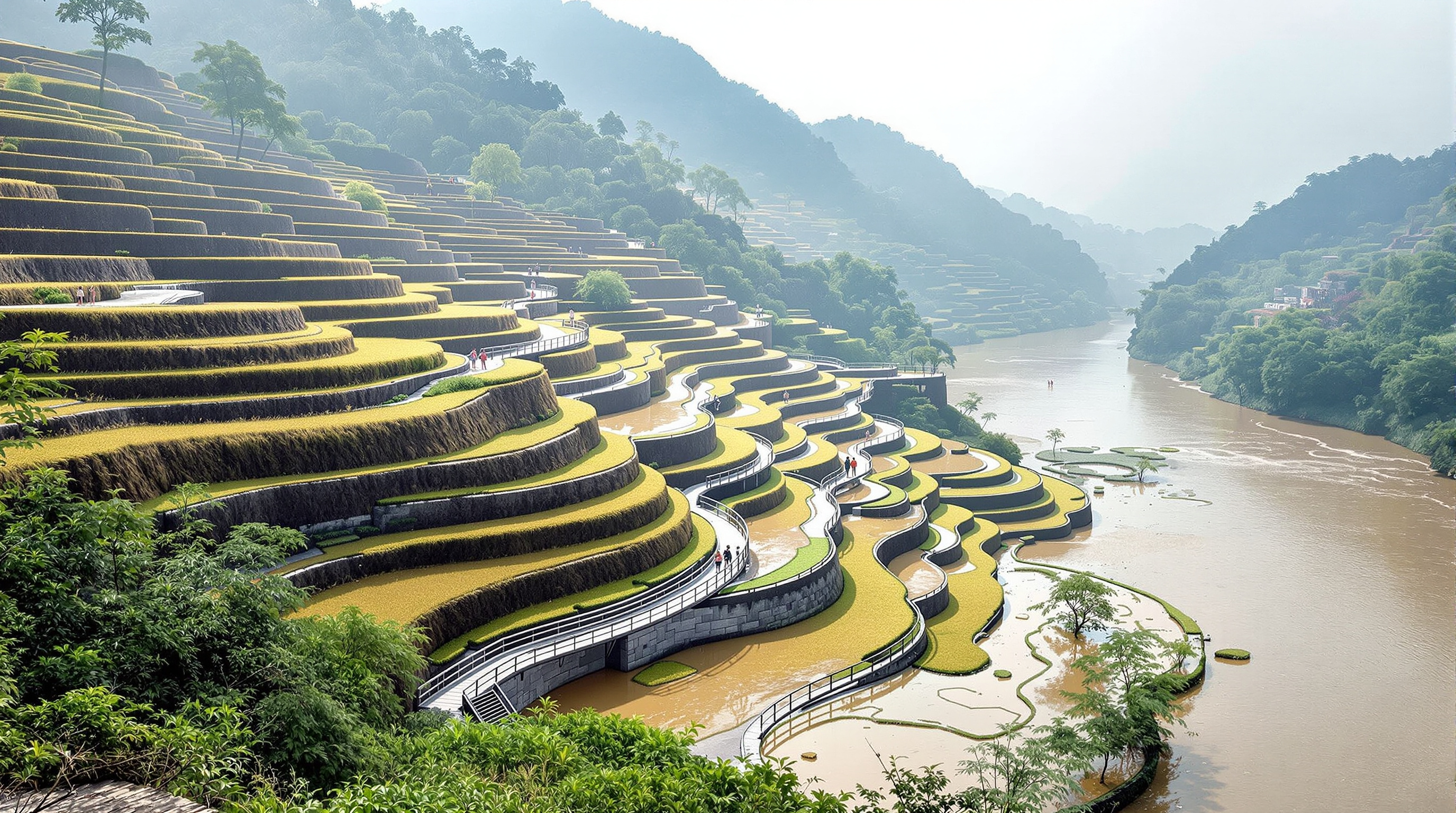
Houtan Park, built on a former industrial site for the 2010 Shanghai Expo, threaded a linear constructed wetland along the polluted Huangpu waterfront, demonstrating that a landscape could measurably improve water quality as people strolled through it. Yanweizhou Park in Jinhua (2014, about 26 hectares) is the sharpest polemic of all: Yu persuaded the city to stop building a concrete flood wall and instead lay down water-resilient terraces of native grass that are simply allowed to flood. When the river rises, the paths go under; when it falls, the silt left behind fertilises the planting. It is architecture designed to be submerged — a direct rebuke to the engineering instinct to wall water out.
The third position: what a sponge cannot hold
Studio Matrx's editorial habit is to resist both the brochure and the backlash, and the Sponge City demands it, because the honest verdict is genuinely mixed.
The critique arrived with brutal timing. In July 2021, Zhengzhou — a designated sponge pilot — was hit by rainfall of over 600 millimetres in three days, an event estimated at closer to a once-in-a-millennium intensity than the once-in-a-century standard its systems were built for. Nearly four hundred people died, many in a flooded subway and road tunnel. Critics asked, reasonably, what the sponge label had been worth. Peer-reviewed reviews have since documented that many of the first pilot cities continued to flood after their upgrades, that monitoring data remains thin, and that sponge interventions tend to be local and source-level — excellent at soaking up frequent, moderate rain, far less able to stop a catastrophic deluge that any system, grey or green, would struggle against.
The fair reading is that these critiques attack a straw man the concept never claimed to be. A sponge is not a dam. Yu's own position was always that green and grey must work together — the sponge handling the routine seventy or eighty percent of rain events, hard infrastructure reserved for the rare extreme. The programme's real failures are less about the idea than about implementation: uneven quality, contractors treating "sponge" as a branding checkbox, cities retrofitting isolated patches rather than the connected watershed the theory requires. A sponge only works if it is continuous; a patchwork of demonstration plots is not a sponge, it is a collection of gardens.
There is also the matter of legacy and loss. Yu died in September 2025 in a plane crash in Brazil's Pantanal, only two years after receiving the Cornelia Hahn Oberlander International Landscape Architecture Prize — the discipline's highest honour — for exactly this body of work. The concept now has to prove it can outlive its charismatic author.
Why it belongs in the canon
Set against a museum or a tower, the Sponge City can look like the softest thing in this book — no dramatic cantilever, no signature silhouette, sometimes barely a "building" at all. That is precisely its provocation. It proposes that the most future-facing architecture of the climate century may be the architecture you can least easily photograph: the reshaped ground, the deliberately floodable park, the city redesigned to be permeable in an age of intensifying rain.
For the rest of the flood-prone world — including India's monsoon-battered cities, where the same grey-infrastructure inheritance produces the same drowning streets — the lesson is portable and urgent. The Sponge City tells us architecture is going somewhere counter-intuitive: toward softness, toward absorption, toward making friends with the water it once spent all its ingenuity trying to expel.
References
- Yu, K. (Turenscape) — official project descriptions for Qunli Stormwater Wetland Park, Houtan Park and Yanweizhou Park. turenscape.com (primary source — the architect's firm)
- Chikhi, F., Li, C., Ji, Q. & Zhou, X. (2023). "Review of Sponge City implementation in China: performance and policy." Water Science & Technology, 88(10), 2499–2520. DOI: 10.2166/wst.2023.312. (peer-reviewed — implementation, targets and limitations)
- Zhang, Z. et al. (2021). "Exploring the Development of the Sponge City Programme (SCP): The Case of Gui'an New District, Southwest China." Frontiers in Water, 3, 676965. DOI: 10.3389/frwa.2021.676965. (peer-reviewed — policy rollout and pilot practice)
- Springer / Urban Lifeline (2025). "The Three-Point Sponge Policy approach for integrating Blue-Green-Grey Infrastructure by Design: Lessons from the 2021 Extreme Flood in Zhengzhou, China." Urban Lifeline. DOI: 10.1007/s44285-025-00057-0. (peer-reviewed — the extreme-event critique)
- "Landscape Architect Kongjian Yu, Pioneer of the 'Sponge City' Concept, Wins the 2023 Oberlander Prize." ArchDaily (2023). archdaily.com (architectural press — biography and honours)
- "Kongjian Yu, Creator of the Sponge City Concept, Passes Away in Brazil Plane Crash." ArchDaily (2025). archdaily.com (architectural press — records Yu's death, September 2025)
Part of The Future of Architecture in 300 Buildings — Studio Matrx's canon of the buildings asking where architecture goes next. Chapter 16: Concepts & Provocations.
Export this guide
Related Guides — Deep-dive reading
Hunter's Point South Park: The Waterfront That Was Designed to Flood
SWA/Balsley, Weiss/Manfredi and Arup turned an abandoned Queens shoreline into an 11-acre park that yields to the East River instead of walling it out — a working prototype for the 'soft', adaptive, resilient public realm that a warming, rising-water century now demands.
The Future of Architecture+POOL: The Floating Pool That Wants to Filter a River Clean
Family and PlayLab's plus-shaped pool for New York's East River proposes a radical idea — a piece of public leisure that is also a piece of water infrastructure, swimming its own river water clean through the walls that hold it up. After sixteen years of crowdfunding, testing and delay, it is the definitive case study in architecture as civic utility.
The Future of ArchitectureThe Big U: The Flood Wall That Refused to Be a Wall
BIG and One Architecture answered Hurricane Sandy not with a barrier but with a ten-mile ribbon of raised parkland around Lower Manhattan — a 'string of pearls' where storm defence doubles as public space. This deep study reads the Big U as concept and provocation, its bridging-berm and flip-down-wall logic, and the hard gap between the visionary drawing and the East River Park it became.
The Future of ArchitectureRelated Tools — Try Free
Cross-Ventilation Analyzer
Estimate airflow and air changes per hour (ACH) from room size, window areas, layout, and local wind — with NBC 2016 Part 8 compliance check.
Ventilation CalculatorGarden Planning Toolkit
Get a tailored garden plan — planting layers, Indian species, features and a checklist — from your climate, space, sun and goals.
PlannerRainwater Tank Sizer
How big should your rainwater tank be? Computes annual harvest, recommended tank capacity in litres, water-bill savings, and payback — for 10 Indian cities.
RWH Calculator