
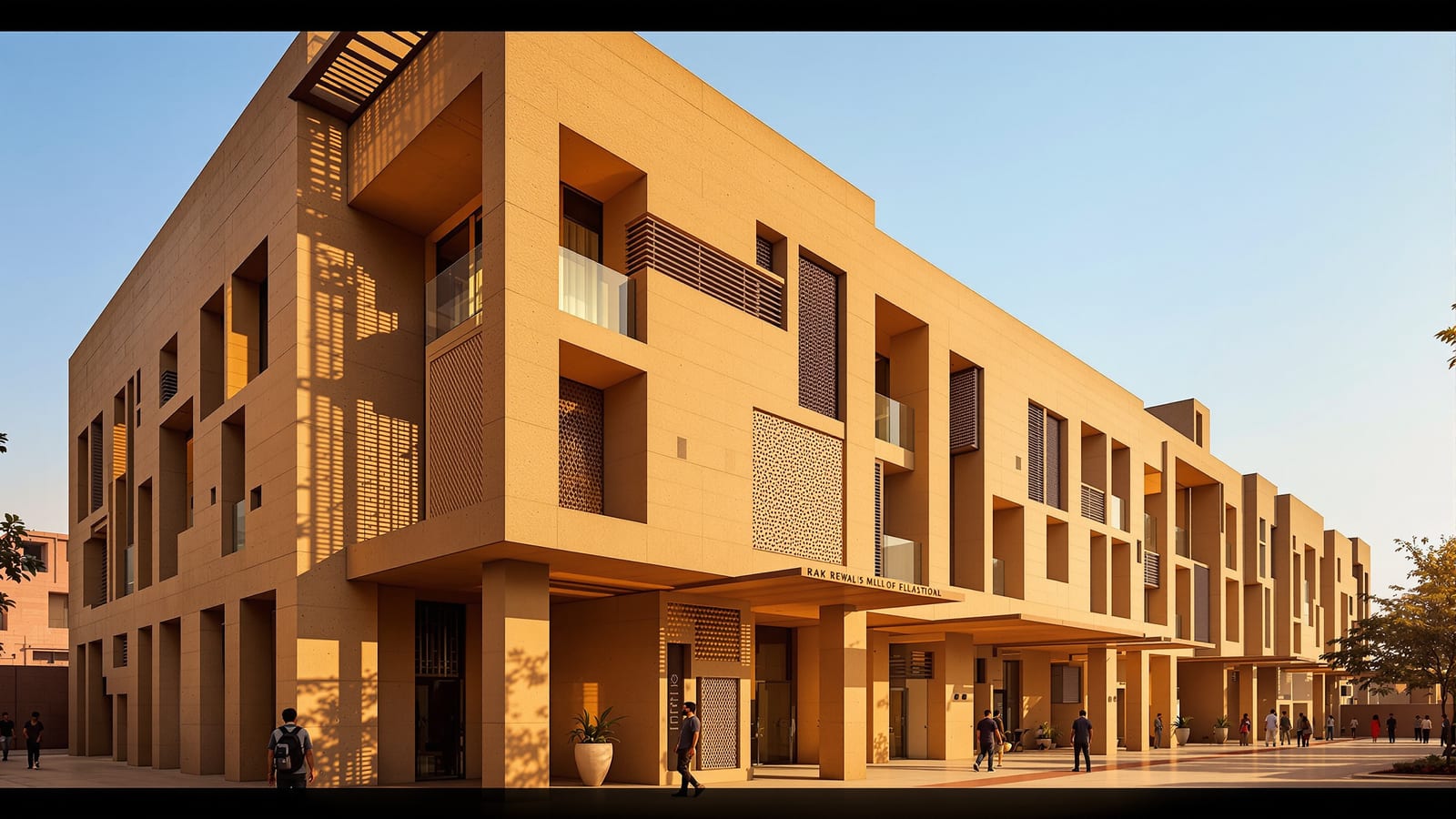
Raj Rewal's Façade Signature: Sandstone, Jaali and the Climate-Rooted Indian Wall
How India's master of the sandstone-clad, jaali-screened, deeply climate-responsive institutional façade translated Jaisalmer and Fatehpur Sikri into a modern Indian wall that is the opposite of the imported glass box.
Stand in the shade of an old wall in Jaisalmer at noon and something becomes obvious that no glossy render of a glass tower will ever teach you: the wall is doing work. The honey-coloured sandstone is warm to the touch but cool an inch inside; the window is sunk deep into the thickness of the stone so the sun never reaches the glass; a carved jaali screen turns a hard white sky into a soft fall of dappled light and a moving breath of air; and the street outside is narrow and shaded, a cool seam between buildings where people actually want to walk. The desert city is, in effect, a single enormous climate machine made of stone — and it is also beautiful, dense, and human.
Raj Rewal spent a career proving that a modern Indian building could be all of those things at once. Born in 1934 and working from New Delhi from 1962, he refused the post-independence reflex of importing the air-conditioned glass box and stood instead — alongside Charles Correa and B. V. Doshi — for a modernism that was authentically Indian: rooted in the climate of the subcontinent and in the deep intelligence of its traditional cities. His façades are buff and red sandstone, perforated with jaali, sunk into deep reveals, shaded by pergolas, and woven into courtyards and shaded streets. They look like nothing else, and they belong exactly where they stand.
This is part of our Building Façades series — specifically our Masters of the Façade set, where we study how one great architect designed the wall itself. We are not retelling his life here; for the full biography see Raj Rewal. This guide is about his façade language: the sandstone-clad, jaali-screened, deeply shaded Indian wall. We will cross-link our companion guides on stone & masonry façades, jaali / traditional Indian façades, climate-responsive façades and concrete façades, and his fellow masters Charles Correa and B. V. Doshi.
1. The wall as a climate machine, not a curtain
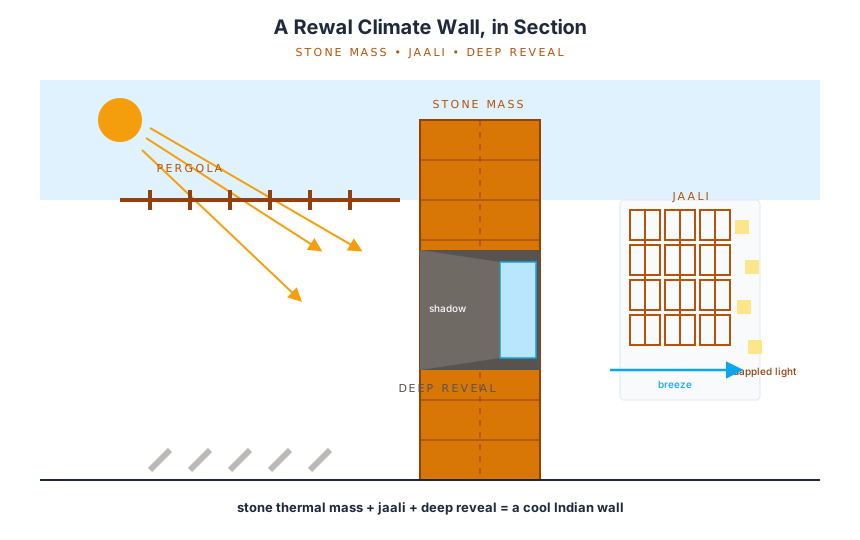
Most of the twentieth century's exported architecture treated the façade as a thin curtain wall — a sealed skin of glass hung off a frame, sun and weather kept out by mechanical cooling running day and night. In Delhi's climate that is a thermodynamic disaster: the glass admits heat all day, the building bakes, and the air-conditioning bill never stops. Rewal's starting point is the opposite. His façade is thick, massive and self-shading — a wall that manages heat, light and air by its own geometry before any machine is switched on.
The key idea is thermal mass: a heavy material such as sandstone or concrete absorbs the day's heat slowly and releases it slowly, so the interior never tracks the brutal swing of the outside air. Combine mass with deep reveals (windows pushed back into the wall's thickness so the wall itself shades the glass), jaali (a perforated screen that filters glare and admits breeze), and pergolas (open overhead frames that shade walls and courts), and you have a low-energy wall — what we would now call climate-responsive. That is the through-line of every façade Rewal built.
2. Sandstone cladding rooted in Indian tradition
Rewal's signature material is sandstone cladding — buff and red sandstone, the very stone of Rajasthan's forts, the havelis of Jaisalmer, the ramparts of Fatehpur Sikri and the walls of Delhi's own Red Fort and Humayun's Tomb. Cladding means the stone is a facing layer fixed to a structural frame or backing wall, rather than a solid load-bearing mass; it gives the warmth, weight and weathering of stone with a buildable modern wall behind it.
The choice is deliberate on three levels. Materially, sandstone is a high-mass, sun-tolerant material that ages gracefully in Indian heat and dust where painted render streaks and glass dazzles. Culturally, the colour and grain instantly read as Indian — the wall belongs to its place without resorting to applied ornament or pastiche domes. And texturally, sandstone takes the deep shadow of a reveal or a jaali beautifully: the same low Delhi sun that makes glass glare makes sandstone glow. You can see this logic at the State Trading Corporation building, the SCOPE office complex and the Parliament Library, all clad in the warm stone palette. For the technical detail of how such walls are fixed and detailed, see our stone & masonry façades guide.
3. The jaali, the deep reveal and the pergola: shade as architecture
If sandstone is Rewal's noun, the jaali is his favourite verb. A jaali is a perforated stone or concrete screen — a wall pierced by a geometric pattern of openings. It is one of the most intelligent climate devices ever invented: it cuts direct glare to a soft, dappled light; it admits and even accelerates breeze (small openings speed airflow by the venturi effect); it gives privacy without blackout; and it casts a constantly shifting pattern of shadow that makes the façade alive through the day. Rewal modernised the jaali — sometimes in precast concrete, sometimes in stone, in clean geometric grids rather than floral tracery — but its job is exactly the desert haveli's job.
Beside the jaali sit two more devices. The deep reveal is the simplest and most powerful: by recessing a window deep into the wall, the wall's own thickness shades the glass for most of the day, so the opening can be generous without admitting a furnace. The pergola — an open overhead lattice — extends the same logic to walls, terraces and courts, throwing a grid of shadow that cools the surface beneath. Together, jaali plus deep reveal plus pergola let a Rewal façade be solid and shaded where the sun hits and open and breathing where it does not. See our jaali / traditional Indian façades and climate-responsive façades guides for the building physics.
Learning from Jaisalmer: stone, jaali and the shaded street
Here is the technical heart of Rewal's method, and the thing that makes him a model rather than a stylist. He did not borrow Indian motifs; he reverse-engineered the Indian city. He looked hard at the traditional urban fabric — Jaisalmer, the desert fort-city, and Fatehpur Sikri, Akbar's red-sandstone capital — and asked why they work, then rebuilt the answer in modern terms.
What he found was cluster urbanism: dense, low-rise building packed tightly so that the buildings shade each other and the ground between them. The spaces between are not leftover; they are the design. Narrow, crooked shaded streets — the cool "bazaar street" — channel breeze and keep walkers out of the sun. Courtyards punched into the mass act as light wells, breathing chimneys and shared rooms open to the sky. Everything is built of high-mass sandstone, screened with jaali, sunk in deep reveal. The result is a settlement that is hot outside and bearable inside, and that puts people, not cars, at the centre.
Rewal translated that whole system — not one device but the town — most completely at the Asian Games Village in New Delhi (1982). Instead of slab blocks in open lawns, he built a low-rise, high-density modern Indian town: clusters of sandstone-toned houses around shared courts, threaded by shaded pedestrian streets and small squares, so that the housing both looked Indian and behaved like Jaisalmer in the Delhi heat. The façade is inseparable from the urbanism: the shaded street is made by the walls that face it. This is the single most important lesson Rewal offers India — that a climate-correct façade is part of a climate-correct place.
4. Signature façade devices at a glance
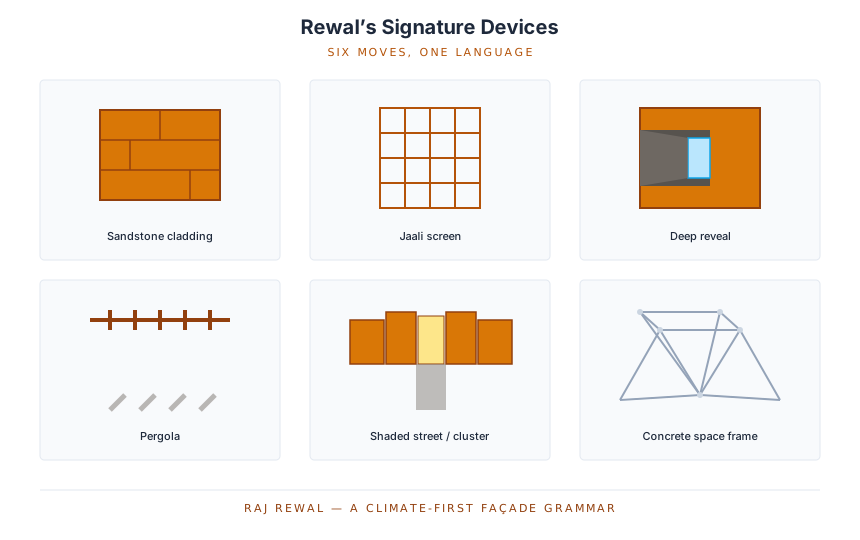
| Device | What it is | Why it works in India | Where to see it | The India lesson |
|---|---|---|---|---|
| Sandstone cladding | Buff/red sandstone facing on a structural backing | High thermal mass; sun- and dust-tolerant; reads instantly as Indian | STC building, SCOPE, Parliament Library | A dignified, low-glare wall that belongs to its place |
| Jaali / perforated screen | A wall pierced with a geometric pattern of openings | Cuts glare to dappled light, speeds breeze, gives privacy without blackout | Parliament Library, institutional façades | Shade and ventilation as ornament, not add-ons |
| Deep reveal | Window recessed into the wall's thickness | The wall self-shades the glass for most of the day | Across the institutional work | Big openings without the heat penalty of glass |
| Pergola | Open overhead lattice over wall, terrace or court | Throws a cooling grid of shadow on surfaces and paths | Asian Games Village courts and streets | Cheap, passive shading that scales to any budget |
| Shaded bazaar street / cluster | Narrow pedestrian streets between tightly packed low-rise blocks | Buildings shade each other and the ground; breeze is channelled | Asian Games Village | Climate is solved by urban form, not just by the wall |
| Concrete space frame | A deep triangulated reinforced-concrete lattice | One element is structure, façade and sun-shade together | Hall of Nations (1972, demolished 2017) | Honest structure that is also the shading |
5. Concrete, honesty and the space frame
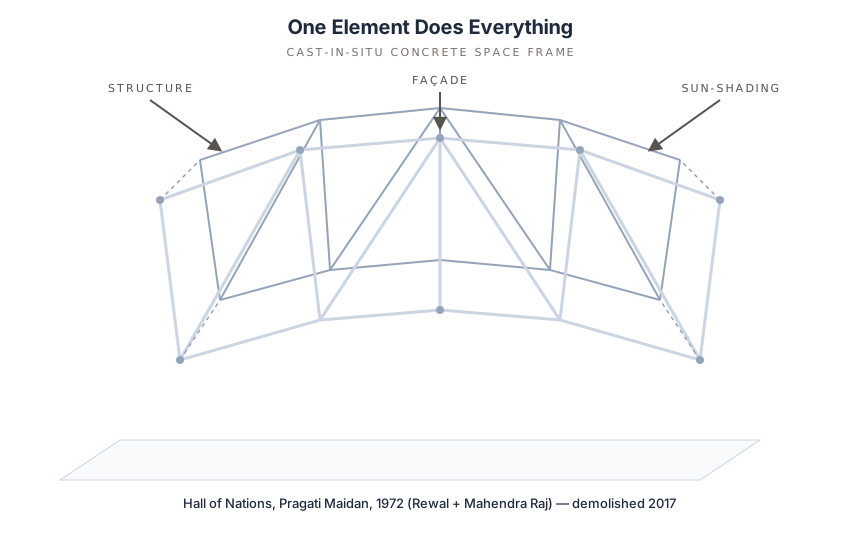
Rewal's other great material is concrete, and his other great façade idea is honest materiality — the principle that a building should show what it is made of and how it stands up, rather than hiding structure behind a decorative skin. Nowhere is that clearer than the space frame: a deep, triangulated three-dimensional lattice that spans large distances with little material. In most of the world space frames are made of steel tubes. Rewal and the great structural engineer Mahendra Raj made theirs in cast-in-situ reinforced concrete — concrete poured on site into the lattice itself.
The genius, for a façade guide, is that the concrete lattice was simultaneously the structure, the façade and the sun-shade. There was no separate cladding to add: the deep triangulated frame that held the building up was the same deep frame that cast the building into shadow and gave it its unforgettable face. This is the purest possible expression of the climate-responsive, honest wall — structure equals shade equals architecture. Our concrete façades guide unpacks the building science.
Real buildings, not renders
Hall of Nations & Hall of Industries, Pragati Maidan, New Delhi (1972). Designed by Rewal with engineer Mahendra Raj for the trade fair marking 25 years of independence and built in about 22 months, this group of interconnected halls was, by widely cited accounts, the world's first and largest-span space-frame structure built in reinforced concrete. Its deep concrete lattice was structure and façade and sun-shading in one — a brutalist masterpiece of honest Indian engineering. It was demolished in April 2017 despite legal challenges and international appeals (including from MoMA and the Centre Pompidou). The loss is real and is now widely treated as a turning point in how India thinks about conserving its modern heritage. We name it accurately and mourn it honestly. (Bharat Mandapam now stands on the site.)
Asian Games Village (Asiad Village), New Delhi (1982). Rewal's modern Indian town — low-rise, high-density clustered housing in a sandstone palette, organised around courtyards, shaded pedestrian streets and small squares in the manner of Jaisalmer and Fatehpur Sikri. The façades make the streets; the streets make the climate. It remains the clearest demonstration that a culturally-rooted, climate-correct Indian wall is also an urban idea.
Parliament Library (Sansad Bhawan Library), New Delhi. A major institutional commission sitting beside Herbert Baker's circular Parliament House. Rewal answered with a low, dignified composition in sandstone, using jaali, deep reveals and domed forms that reference Indian tradition while staying resolutely modern — a façade that defers to its monumental neighbour without copying it.
SCOPE Office Complex and State Trading Corporation (STC) Building, New Delhi. Two of Rewal's defining institutional façades: sandstone-clad, deeply modelled with recessed openings and self-shading geometry, proving the language works for large office buildings and not only for housing. The deep reveals do the heat-management work that a glass curtain wall could never do in Delhi.
Sheikh Sarai and CIDCO housing. Rewal applied the same cluster-urbanism and shaded-street logic to large public housing — evidence that the method is not a luxury gesture but a way to give ordinary Indian housing the climate and community of the traditional city.
6. Why his façades read as Indian without copying the past
It would have been easy to make an "Indian" building by gluing on domes and arches — and Rewal pointedly did not. His façades feel Indian for structural, not decorative, reasons. The Indian-ness lives in the behaviour of the wall: in the way deep reveals carve real shadow, in the way jaali turns sky into dappled light, in the warm grain of sandstone, in the human scale of a shaded court. These are abstractions of how Jaisalmer and Fatehpur Sikri actually work, translated into clean modern geometry. The lesson for anyone building in India today is that authenticity comes from climate and section, not from ornament — a rooted building is one that handles the sun and the breeze the way the old city did.
7. The Hall of Nations demolition: a cautionary tale
We have to dwell on the loss, because it is part of the lesson. The Hall of Nations was not merely a beautiful building; it was a world first in concrete engineering and a symbol of post-independence Indian confidence. Its 2017 demolition — pushed through despite court cases and global protest — showed that India had not yet built the legal and cultural machinery to protect modern heritage the way it protects Mughal and colonial monuments. For a façade audience the lesson is double-edged: it tells you these climate-honest concrete walls are precious, and it warns that even the most important of them can vanish overnight. Document, value and defend the good modern wall while it stands.
What this means for India
Rewal is a working model — arguably the working model — for the contemporary climate-correct, culturally-rooted Indian institutional façade. The formula is concrete and repeatable: sandstone cladding plus jaali plus deep reveals plus shaded courts and streets, rooted in the logic of the Indian city. That combination produces a low-energy, dignified, unmistakably Indian wall, and it is the direct opposite of the imported glass box that bakes its occupants and runs the meter all day.
Three takeaways matter most for India. First, his method — learn from the traditional Indian city, from Jaisalmer and Fatehpur Sikri, by asking why they stay cool and then rebuilding the answer — is exactly how to root a modern building in place and climate, and it works for a campus, an office or a single house. Second, the Hall of Nations stands as a permanent reminder to value and protect modern heritage, not only the old. Third, the building physics is real: mass, shade and screened ventilation cut cooling loads in precisely the climate most of India lives in.
Be honest about the caveats, too. Sandstone cladding is premium and heavyish: it needs proper fixing, backing and detailing to be safe and durable, and it costs more than render — so on a tight budget you may reserve real stone for key elevations and reach the same physics with a high-mass plastered wall, a precast-concrete jaali and a deep RCC reveal. And Rewal's built work is largely institutional and campus scale; you cannot literally copy a trade-fair hall onto a 30×40 plot. But the principles scale down beautifully. A deep reveal, a jaali screen, a pergola and a shaded court cost little and work on the smallest house. That is the gift: a master's climate logic that an ordinary Indian home can afford.
What this means for you
If you are building or commissioning in India, treat Rewal's wall as a checklist rather than a style to copy. Ask of every sunny elevation: where is the deep reveal that shades the glass? Where is the jaali or perforated screen that lets you open up without glare? Where is the pergola or shaded court that cools the spaces between? Could a high-mass wall — sandstone where the budget allows, plastered or precast where it does not — replace the heat-trapping glass? And is the building placed so that it shades itself and the ground around it, the way the old city does?
Do that, and you will have a wall that is cooler, cheaper to run, ages well in Indian dust and sun, and looks like it belongs to this land — a Rewal wall in spirit if not in stone. For the technical follow-through, read our stone & masonry façades, jaali / traditional Indian façades, climate-responsive façades and concrete façades guides, and see how his contemporaries solved the same problem in Charles Correa and B. V. Doshi.
Sources
- Raj Rewal — architect (born 1934, Hoshiarpur; practice in New Delhi from 1962; died 2024); biography and project list, including Asian Games Village, Parliament Library, SCOPE and the State Trading Corporation building; major Indian and international honours (Indian Institute of Architects Gold Medal, Robert Mathew Award, Great Master's Award, French Ordre des Arts et des Lettres).
- Hall of Nations & Hall of Industries, Pragati Maidan, New Delhi — architect Raj Rewal, structural engineer Mahendra Raj, 1972; built for the trade fair marking 25 years of independence; described as the world's first and largest reinforced-concrete space-frame structure; the concrete lattice served as structure, façade and sun-shading; demolished April 2017 despite legal and international protest (including MoMA and the Centre Pompidou); Bharat Mandapam now occupies the site.
- Asian Games Village Complex (Asiad Village), New Delhi — Raj Rewal, 1982; low-rise high-density cluster housing referencing Jaisalmer and Fatehpur Sikri.
- Studio Matrx in-house: Raj Rewal biography, stone & masonry façades, jaali / traditional Indian façades, climate-responsive façades, concrete façades.
Export this guide
Related Guides — Deep-dive reading
Charles Correa's Façade Signature: How India's Master Made the Climate-Correct Wall
How Charles Correa eroded the flat sealed wall into deep, shaded, porous layers — verandahs, terraces, pergolas and open-to-sky courts — so the Indian façade filters sun and drives air instead of sealing it out.
Building FacadesLouis Kahn's Façade Signature: Wrapping Ruins, Brick Arches, and Monumental Light
How Louis Kahn shaded the glass behind giant geometric screen walls, asked the brick to be an arch, and built monumental façades of fair-faced concrete and light — and what that hot-climate logic teaches Indian builders today.
Building FacadesJaali & Traditional Indian Façades: India's Original Climate-Smart Screen
Guide to the jaali and traditional Indian façades: history from Mughal and Rajasthani stone screens to Hawa Mahal and Sidi Saiyyed, the building physics of daylight, heat, privacy and breeze, materials from sandstone to GRC and metal, the parametric revival at Pearl Academy Jaipur, and how a homeowner can use a jaali.
Building FacadesRelated Tools — Try Free
Brise-Soleil Visualizer
Interactive horizontal-louvre cut-off angle calculator — sun altitude, louvre depth, and spacing inputs with a live shadow preview. Computes θ = arctan(spacing/depth) for façade shading, ECBC envelope compliance, hospital daylight design, and tropical sun-control detailing.
Sun Shading ToolCross-Ventilation Analyzer
Estimate airflow and air changes per hour (ACH) from room size, window areas, layout, and local wind — with NBC 2016 Part 8 compliance check.
Ventilation CalculatorBefore & After Studio
Generate AI before-and-after renders to preview how your redesign could look.
DesignAI