

The Principles of Landscape Architecture, Explained
Unity, balance, rhythm and the landscape-specific craft moves that make an Indian garden feel composed rather than collected.
Walk into a garden that works and you rarely think about why. You feel it before you analyse it: the eye settles somewhere, the body knows where to walk, the shade arrives exactly where you wanted to pause. Walk into one that does not work and the symptoms are just as physical — a lawn that feels like a leftover, a path that ends in a hedge, a row of identical palms that march past the house like traffic cones. The difference is almost never the plant list or the budget. It is whether the space was composed.
Landscape architecture is the discipline of that composition. It borrows a vocabulary of design principles that painters, architects and gardeners have refined over centuries, but it applies them to a medium that moves, grows, casts shadows, drains water and changes with every monsoon. A garden is not a picture you look at; it is a sequence you move through. That single fact reshapes every principle below.
The core claim of this guide is simple: a beautiful Indian garden is the product of a small set of organising principles — unity, balance, proportion, rhythm, transition, emphasis and simplicity — translated through the craft moves unique to landscape (grading, sight lines, planting layers, enclosure and the choreography of movement). Master the principles and the plant list almost chooses itself; ignore them and no amount of expensive material will rescue the result.
The principles are inherited; the craft is landscape's own
Most design-principle lists you will find online were written for two-dimensional or interior work. They are not wrong for gardens, but they are incomplete. An interior room is bounded, lit artificially, static and seen all at once. A landscape is unbounded at the edges, lit by a sun that swings 47 degrees between the December and June solstices in most of India, alive and slowly changing, and — crucially — experienced over time as you move.
So this guide splits the subject in two. First, the classical design principles that landscape shares with all visual composition. Then the landscape-specific craft moves — grading and levels, sight lines and framing, the layering of planting, enclosure and threshold — that have no real equivalent indoors. The Indian Society of Landscape Architects (ISOLA) and most COA-recognised programmes teach both halves together, because in practice you cannot separate them: you achieve balance through planting layers, you create rhythm through grading, you frame a focal point with a threshold.
If you want the bigger frame around this — what the profession actually is and how it differs from gardening — start with what landscape architecture is and the seven elements of landscape design. This guide is the next layer up: how those elements are organised into something coherent.
Unity and harmony: the garden reads as one idea
Unity is the sense that everything in the garden belongs to the same conversation. It is the first principle because it is the one most often broken in Indian homes, where a garden accretes over years — a few crotons here, a row of areca palms there, a sudden bed of marigolds for a festival, a fountain bought on impulse.
You create unity through dominance (one material, colour or plant repeated enough to set the key), interconnection (paths, edging and walls that physically tie areas together) and consistency (a limited palette of materials). A classic Indian device for unity is the single repeated paving — Kota stone or grey granite running from the gate through the entire garden — so the eye reads one floor, not five.
Indian example: The Mughal charbagh (the four-part paradise garden of the Taj Mahal or Humayun's Tomb) is the most unified landscape on the subcontinent. Water channels, symmetrical quadrants, a single species of tree repeated in avenues and one geometric logic make hundreds of metres read as a single idea. You can borrow the principle without the scale: one paving, one hedge species, one dominant flowering tree.
Balance: symmetry for grandeur, asymmetry for ease
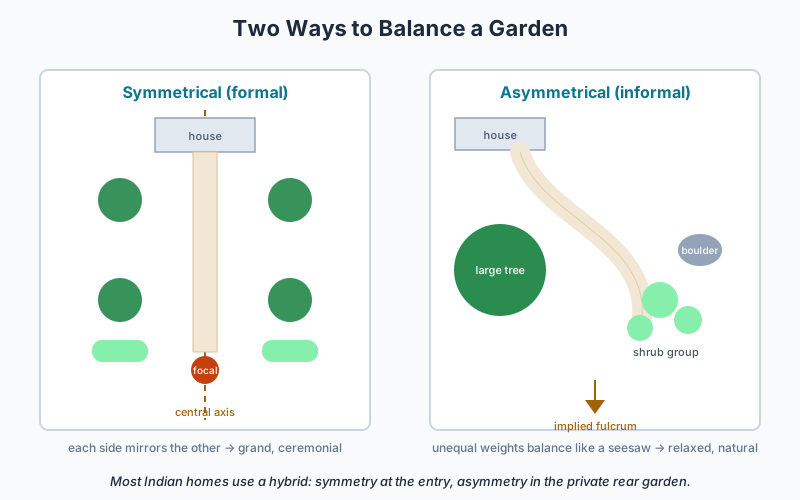
Balance is the visual equilibrium of a composition around a real or implied axis. There are two kinds, and choosing between them is one of the most consequential decisions in a garden.
Symmetrical (formal) balance mirrors one side against the other across an axis. It signals order, formality and arrival — which is why it suits an entrance forecourt, a temple garden or a Mughal-style layout. Asymmetrical (informal) balance places objects of different visual weight so they balance like a seesaw — a single large tree on one side offset by a cluster of shrubs and a boulder on the other. It feels natural, relaxed and is far more forgiving on irregular Indian plots.
| Aspect | Symmetrical balance | Asymmetrical balance |
|---|---|---|
| Feeling | Formal, grand, ceremonial | Relaxed, natural, contemporary |
| Best for | Entry forecourts, axial approaches, Mughal/Indo-Saracenic homes | Family gardens, sloping or irregular plots, courtyards |
| Plot suitability | Regular, rectangular sites | Awkward shapes, corner plots |
| Maintenance | Higher (clipped hedges, paired specimens must match) | Lower (groupings hide imperfection) |
| Risk if done badly | Stiff, sterile, "showroom" feel | Lopsided, accidental-looking |
Most Indian homes do well with a hybrid: a symmetrical, formal threshold at the gate or front door (a pair of matched trees, an axial path) that relaxes into asymmetry in the private rear garden where life actually happens.
Proportion and scale: sizing to the human and to the house
Proportion is the relationship of parts to each other and to the whole; scale is their relationship to the human body and to the building. Gardens fail on scale constantly in India because plant material grows. The neem sapling that looked right beside a single-storey house becomes a 15-metre canopy that swallows it in fifteen years.
The working rules: keep the largest tree's mature canopy in proportion to the building mass; size paths to how many people walk abreast (a comfortable two-person path is about 1.2 m, a generous one 1.5 m); and avoid the "lollipop" problem where small, isolated objects float in oversized lawns. A useful heuristic from design literature is that a feature reads as part of the composition when its dimension is roughly one-third to two-thirds of the space it sits in — a planter, a water body or a seating deck sized to that range rarely looks lost or overbearing.
Rhythm and repetition: how the garden moves your eye
Rhythm is repetition with intention — the same element recurring at intervals so the eye travels in a controlled way. An avenue of gulmohar at even spacing, a run of identical terracotta pots, a repeated cluster of three shrubs at each bend of a path: each sets up a beat. Repetition also reinforces unity, which is why the two principles are usually discussed together.
The craft is in the interval. Too regular and rhythm becomes monotony (the "traffic cone" row of palms). Vary the interval, or break the run with a single contrasting accent every fourth or fifth beat, and rhythm becomes music. In Indian gardens, gradation — plants stepping down in height from canopy to shrub to groundcover along a bed — is the most reliable rhythmic device and doubles as planting structure.
Transition and sequence: the experience of moving through
Here landscape parts ways decisively with interior and graphic design. A garden is revealed over time, in a sequence of views, as you walk. Transition is how one space hands you to the next without a jolt — through changes in level, in enclosure, in light and shade, in paving texture underfoot.
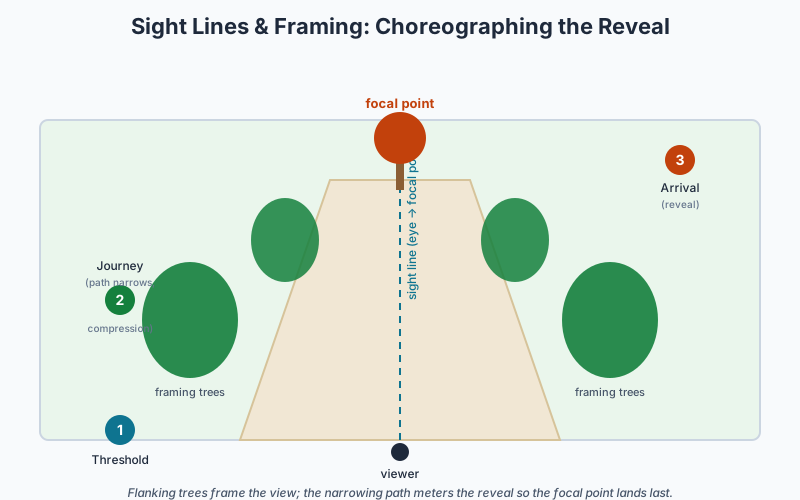
Good gardens are choreographed: compression then release (a narrow shaded passage that opens onto a sunlit lawn), concealment then reveal (a path that curves so the focal point appears only at the last moment), the deliberate sequence of threshold → journey → arrival. This is why a curving path almost always feels better than a straight one in an informal garden — not because curves are prettier, but because they meter out the reveal and lengthen the experience of a small plot.
Indian example: The traditional courtyard house (the Kerala nalukettu, the Chettinad and Rajasthani havelis) is a masterclass in sequence — a dim, low entrance compresses you, then releases you into a bright open aangan (courtyard). You can study this logic in our courtyard landscape design guide and feel why some gardens feel peaceful the moment you enter.
Emphasis and focalization: every garden needs somewhere for the eye to rest
Focalization is the deliberate creation of a focal point — the one thing the composition leads your eye toward. Without it, the eye wanders and the garden feels restless. With too many, they compete and cancel out. The discipline is to have one dominant focal point per view, supported by subordinate accents.
A focal point earns its role through contrast: a specimen tree against a plain hedge, a water feature against still planting, a sculpture or a brightly glazed pot against green. The craft move that makes focalization landscape's own is framing — using two flanking trees, an arch, or a narrowing path to direct the gaze and hold the focal point inside a "frame," exactly as a doorway frames a view.
Simplicity and restraint: the hardest principle to obey
Simplicity is the principle that says: do less, repeat more, resist the urge to collect. The most serene Indian gardens — the lawns of Lutyens' Delhi, the green simplicity of a well-kept temple tank, the restraint of a good modern villa garden — use remarkably few species and materials. ISOLA practitioners and landscape architects in the lineage of Mohammad Shaheer (who designed the Sanskriti and Garden of Five Senses landscapes in Delhi) consistently advise reducing the palette: three to five structural plant species, one or two paving materials, one water gesture.
Restraint is hard because plants are cheap and nurseries are seductive. But a garden of fifty species reads as a collection; a garden of seven, well repeated, reads as a design.
The landscape-specific craft moves
The principles above tell you what good composition looks like. The craft moves below are how landscape — and only landscape — achieves it.
Grading and levels
Grading is the shaping of the ground. It is invisible when done well and disastrous when ignored — the single most common cause of waterlogged gardens and flooded ground floors in Indian monsoons is a site that slopes back toward the house. The minimum working rule is a fall of about 1 in 50 (2%) on planted ground and paving away from the building for at least the first 1.5–2 metres. Beyond drainage, grading creates drama: a sunken seating court, a raised planting berm to screen a boundary wall, terraced beds on a slope. Level change is the most powerful (and most underused) tool in residential Indian landscaping.
Sight lines and framing
A sight line is the invisible axis from where a person stands to what they are meant to see. Designers draw them from the front door, from the living-room sofa, from the gate, and then arrange planting and focal points along them. Framing tightens the sight line; screening blocks the unwanted parts of it (the neighbour's water tank, the compound wall). Almost every "wow" view in a good garden is a sight line that was planned, not found.
Layering of planting: canopy, understory, shrub, ground
Nature does not plant in single rows; it stacks. A healthy forest has a canopy, an understory of smaller trees, a shrub layer and a ground layer, and the most resilient, lowest-maintenance and most biodiverse gardens copy this structure. Layering also delivers the visual principles for free: it creates depth, gradation (rhythm), enclosure and the textured background a focal point needs. This is the heart of biophilic landscape design, and it is what makes a layered Indian garden feel cool and alive rather than flat and hot.
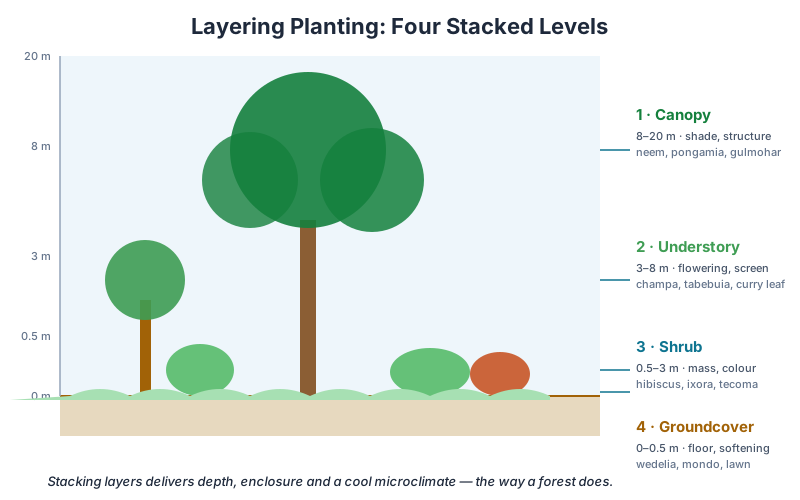
| Layer | Height range | Role | Indian examples (homeowner-friendly) |
|---|---|---|---|
| Canopy | 8–20 m | Shade, structure, climate control | Neem, Indian beech (Pongamia), gulmohar, rain tree (large plots) |
| Understory | 3–8 m | Mid-height interest, flowering, screening | Frangipani (champa), Tabebuia, curry leaf, drumstick |
| Shrub | 0.5–3 m | Mass, colour, enclosure, hedging | Hibiscus, ixora, tecoma, hamelia, bougainvillea |
| Groundcover & lawn | 0–0.5 m | Floor, weed suppression, softening edges | Wedelia, Mexican grass, mondo grass, dwarf jasmine, lawn |
For canopy choices matched to climate and soil, our guide to the best trees for Indian homes pairs with this layer table.
Enclosure and threshold
Enclosure is the sense of being held by a space — the psychological comfort of a room outdoors, with a "back" to your seating and a "wall" of green around the edges. Threshold is the marked moment of passing from one zone to another: a gate, an arch, a change in paving, a step up. Together they turn an open plot into a sequence of outdoor rooms. Research in environmental psychology — the "prospect and refuge" idea associated with Jay Appleton and tested widely since — explains why: humans relax in spaces that offer both an outlook (prospect) and a sense of shelter at their back (refuge). Layered planting and a defined threshold deliver exactly that.
The choreography of movement
Finally, all the craft moves serve one end: the experience of moving through the garden over time. The path is not just a route; it is a script. Where it narrows, you slow and notice; where it opens, you feel release; where it curves, you anticipate. Designing a garden is closer to directing a short film than to arranging a still life — and that is the deepest reason interior-design principles, however useful, can never fully cover landscape.
Putting it together: a checklist and the common mistakes
A composed garden satisfies a short test. Does it read as one idea (unity)? Is it balanced for the feeling you want (symmetry vs asymmetry)? Are the parts sized to the house and the body (proportion, scale)? Does the eye travel and rest somewhere on purpose (rhythm, emphasis)? Does moving through it feel like a sequence (transition)? Is the palette restrained (simplicity)? And do the craft moves — grading, sight lines, layers, enclosure — carry all of the above?
| Common mistake | Why it breaks a principle | The fix |
|---|---|---|
| Single-row planting | No layering; flat, hot, high-maintenance | Stack canopy → understory → shrub → ground |
| Garden slopes toward the house | Grading ignored; monsoon flooding | Fall of 1 in 50 away from building for 1.5–2 m |
| Fifty species, one of each | Destroys unity and simplicity | Three to five structural species, well repeated |
| Identical palms in an even row | Rhythm becomes monotony | Vary interval or add a contrasting accent |
| No focal point, or three competing ones | Emphasis lost; restless eye | One dominant focal point per view |
| Straight path to a blank wall | No sequence, no reveal | Curve the path; place a focal point at its end |
| Oversized lawn with floating shrubs | Scale and proportion failure | Group plants in masses; size features to one-third–two-thirds of the space |
| Symmetry forced onto an irregular plot | Looks stiff and lopsided | Use asymmetrical balance; reserve symmetry for the entry |
Where this leaves you
Principles are not a style — they are the grammar beneath every style, from a Mughal charbagh to a contemporary terrace garden. Learn them and you can read why a space works, brief a designer precisely, and avoid the expensive mistakes that no plant can hide. The plants, the paving and the budget all follow from the composition, not the other way round.
When you are ready to apply them to your own site, walk the rest of the landscape design library, and if you want to see these principles at the scale of public work, the profiles of India's landscape masters show the same grammar at play across decades of built work.
References
- Indian Society of Landscape Architects (ISOLA) — professional standards and educational framework for landscape design in India.
- Council of Architecture (COA) — recognition of landscape architecture programmes and professional scope in India.
- National Building Code of India (NBC) 2016 — site planning, drainage and external development provisions.
- Appleton, J. — "The Experience of Landscape" (prospect-refuge theory in environmental aesthetics).
- Shaheer, M. — built works and writings on Indian landscape design (Garden of Five Senses and Sanskriti, Delhi).
- Booth, N. K. — "Basic Elements of Landscape Architectural Design" (principles of unity, balance, rhythm and emphasis).
- Mughal garden scholarship on the charbagh (four-part paradise garden), as embodied at Humayun's Tomb and the Taj Mahal complex.
Export this guide
Related Guides — Deep-dive reading
Sequential Progressions: Why the Order of Spaces Matters
A home is experienced as a journey in time, not a plan seen all at once — and arranging that journey, with compression, release and thresholds from public street to private inner room, is what makes a house feel right.
Design PrinciplesThe Architectural Psychology of Comfortable Spaces
Why some rooms feel right and others never do — the science of space and the human mind
Design EducationThe Best Trees for Indian Homes
A research-grade guide to choosing and placing trees around an Indian home — the real cooling and clean-air numbers, the right species for shade, flowers, fragrance and fruit, and the placement science that keeps roots out of your walls and drains.
LandscapeRelated Tools — Try Free
Garden Planning Toolkit
Get a tailored garden plan — planting layers, Indian species, features and a checklist — from your climate, space, sun and goals.
PlannerCross-Ventilation Analyzer
Estimate airflow and air changes per hour (ACH) from room size, window areas, layout, and local wind — with NBC 2016 Part 8 compliance check.
Ventilation CalculatorMonsoon-Readiness Checklist
Pre-rain home audit across 9 categories — terrace, drains, waterproofing, electrical, HVAC, pest, vehicles, documents.
Seasonal Audit