
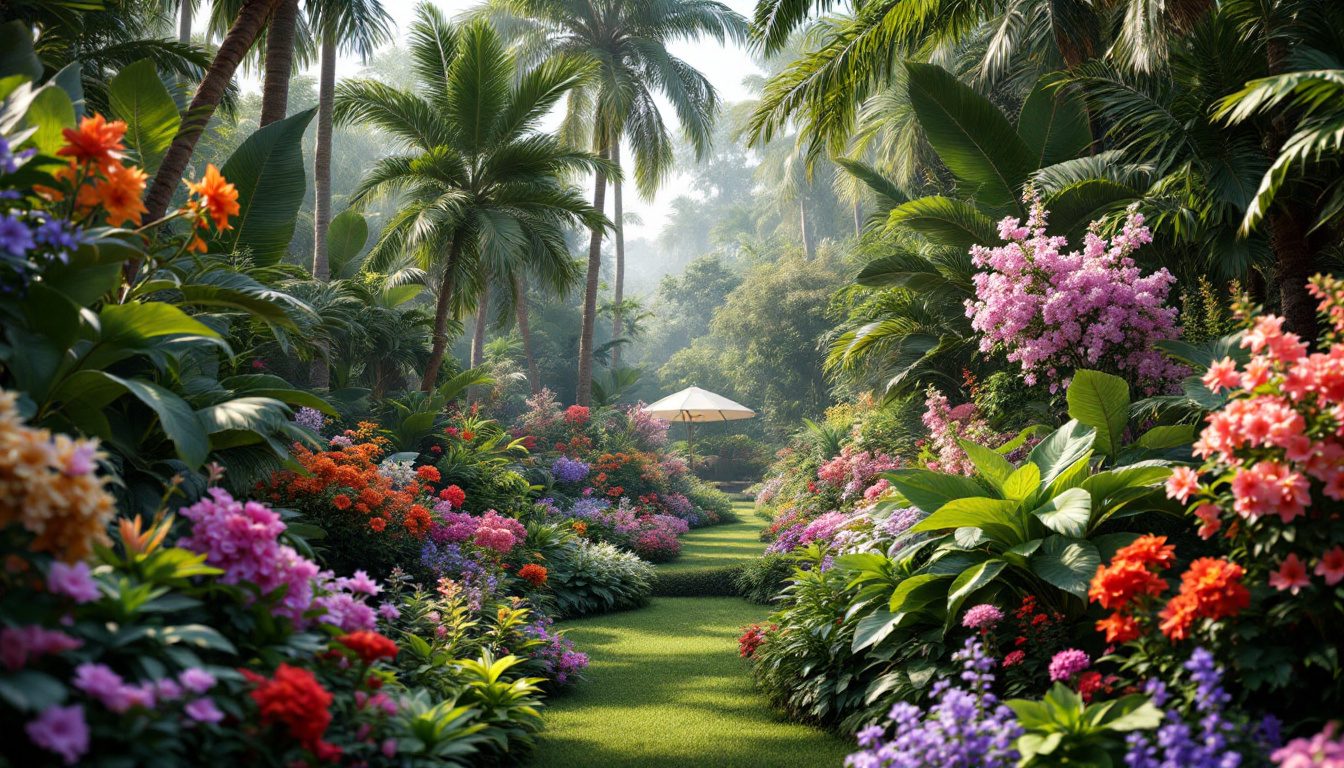
The Seven Elements of Landscape Design
Line, form, texture, colour, scale, space and visual weight — the visual alphabet of design, re-grounded in Indian plants, light and hardscape.
Stand at the edge of a garden you admire and try to say, precisely, what makes it good. Most people reach for the plants — "the gulmohar is gorgeous," "I love the bougainvillea." But the plants are only the raw material. What you are actually responding to is something more basic and portable: the lines the paths draw across the ground, the rounded mass of a frangipani against the sharp blades of a palm, coarse banana leaves beside fine ferns, the cool blue of plumbago calming a hot bed of cannas. You are reading the elements of design — the alphabet from which every garden, grand or modest, is composed.
These elements are the same seven that painters, sculptors and architects have used for centuries: line, form, texture, colour, scale, space and visual weight. What changes outdoors is how they behave. A line in a garden is walked, not just looked at. A colour shifts from dawn to dusk and flowers for six weeks then vanishes. A form grows two metres in three monsoons. To design with these elements is to design with living, changing, three-dimensional material under an Indian sun.
The core claim of this guide is this: a beautiful garden is not a lucky collection of nice plants but a deliberate arrangement of seven visual elements — line, form, texture, colour, scale, space and visual weight — each of which behaves differently outdoors than it does on a canvas or in a room. Learn how each works in the open air, with Indian plants and Indian light, and you can design a garden that feels composed at any budget; ignore them, and the most expensive nursery haul in the world will still read as clutter.
Why elements, and why outdoors is different
Almost every "elements of design" article online was written for interiors or graphics — built for a bounded, lit, static, all-at-once world: a room you see whole from the doorway. A landscape is the opposite. It is open at the edges, lit by a sun that swings roughly 47 degrees between the December and June positions across most of India, alive and slowly changing, and experienced over time as you move through it.
So this guide re-grounds each of the seven classical elements in the medium of soil, plants, water and stone. For every element you get four things: a plain definition, how it behaves outdoors, a concrete Indian garden example, and a practical "how to use it" tip. Then a closing section on combining them, because no element works alone.
If you want the bigger frame around this — the difference between a designer and a gardener, and what the profession is — start with what landscape architecture is. And once you know the elements, the next layer up is how they are organised: the principles of landscape design — unity, balance, rhythm and the rest — assemble these raw elements into a composition.
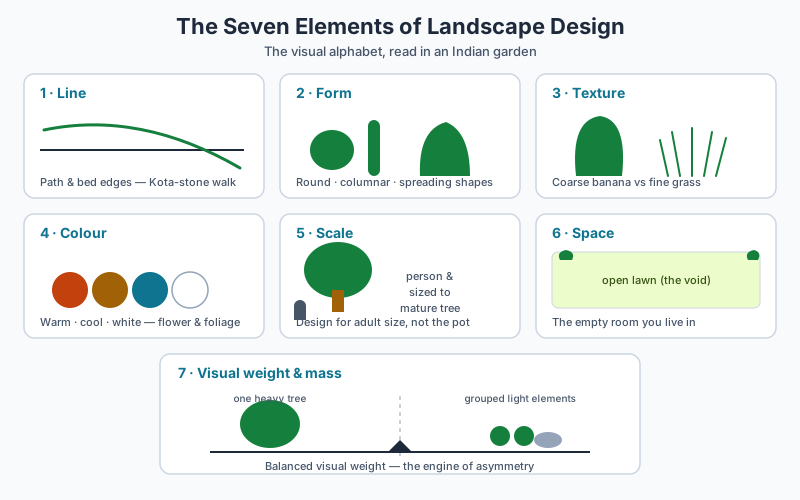
1. Line: the element you walk
Definition. Line is the one-dimensional edge that the eye follows — the rim of a bed, the run of a path, the silhouette where canopy meets sky.
Outdoors. A line on paper is only seen; a line in a garden is also walked. There are three kinds worth naming. Ground lines — bed edges, paving joints, the lawn-to-border boundary — set the plan of the garden. Vertical lines — a row of slender Ashoka (mast trees), the trunks of areca palms — draw the eye up and make a small space feel taller. Path lines control speed and direction: a straight axis is fast and formal; a curve slows you and meters out the reveal.
Indian example. The water channels of a Mughal charbagh — the long reflecting rills at Humayun's Tomb or the Taj — are pure line: dead-straight axes of light and water that pull the eye and the body to a focal monument. At the opposite pole, the meandering edge of a naturalistic pond in a Kerala resort garden uses curving line to feel relaxed and found rather than imposed.
How to use it. Decide the line of your main path first, before choosing a single plant. Straight if you want formality and a quick arrival at a focal point; gently curved (with a destination at each bend) if you want the small plot to feel longer and the walk to feel calm. Then make your bed edges deliberate — a crisp mowing edge of brick or Kota stone instantly makes an amateur garden look designed.
2. Form: the three-dimensional shape
Definition. Form is the overall three-dimensional shape of a plant or object — round, columnar, vase-shaped, weeping, spreading, irregular.
Outdoors. Form is the most enduring element because it persists when flowers have gone and is legible even in silhouette at dusk. A garden composed of strong, contrasting forms holds together in every season; a garden of one repeated form (the dreaded row of identical round shrubs) reads as monotonous. The skill is to build a small vocabulary of contrasting forms and repeat them: a few rounded masses, one or two strong verticals, a spreading canopy overhead.
Indian example. The classic Indian avenue pairs the broad, umbrella-spreading form of the rain tree (Albizia saman) with the upright columnar form of Ashoka along the drive — spreading shade above, vertical rhythm at eye level. In a courtyard, the sculptural irregular form of a multi-stemmed frangipani (champa) against a plain wall is a one-plant composition in itself.
How to use it. Choose three form "characters" for the garden and cast them deliberately: a spreading shade tree (canopy), a couple of rounded shrub masses (the body), and one vertical accent (the exclamation mark). Mature form, not nursery-pot size, is what you are designing with — a neem bought in a 2-litre bag becomes a 12–15 metre canopy, so place it for its adult shape.
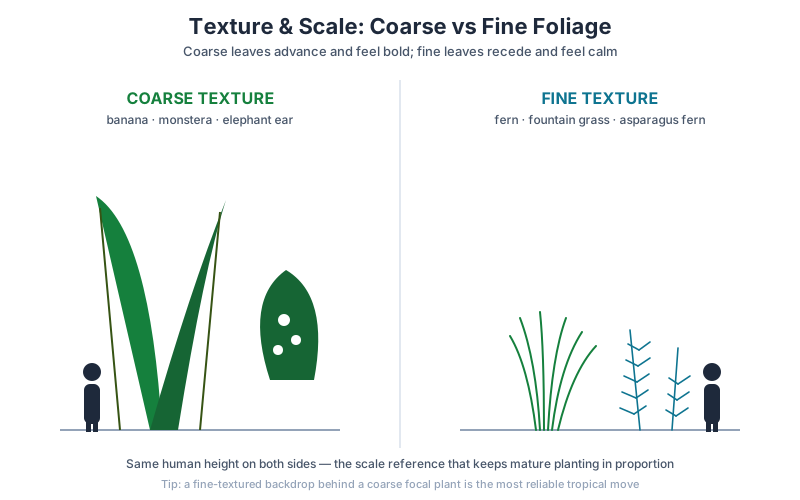
3. Texture: the element read by the foliage
Definition. Texture is the visual and tactile coarseness or fineness of a surface — here, mostly the size and density of leaves, but also the grain of bark, stone and paving.
Outdoors. Texture is the quietest element and the one amateurs most often miss, yet it does more for a garden than colour because it is present all year. Plants fall on a spectrum from coarse (large, bold leaves — banana, monstera, elephant ear, fishtail palm) to fine (small or feathery leaves — asparagus fern, fountain grass, ferns). Coarse texture advances and feels dramatic and tropical; fine texture recedes and feels calm and spacious. A fine-textured backdrop behind a coarse focal plant is one of the most reliable moves in tropical Indian planting. Texture also changes with distance — a hedge smooth from across the lawn is coarse up close.
Indian example. A monsoon-belt courtyard that pairs the huge, glossy paddles of banana and the deeply cut leaves of monstera (coarse) against a soft drift of ferns and ophiopogon grass (fine) achieves drama and depth with green alone — no flower required. This is the textural logic at the heart of tropical landscape design in India.
How to use it. Build the bed with texture first and treat colour as a bonus. A simple, foolproof recipe: one coarse-textured anchor, a medium-textured mass around it, and a fine-textured edge or backdrop. If a green-only bed already looks good, any flowering you add will only improve it.
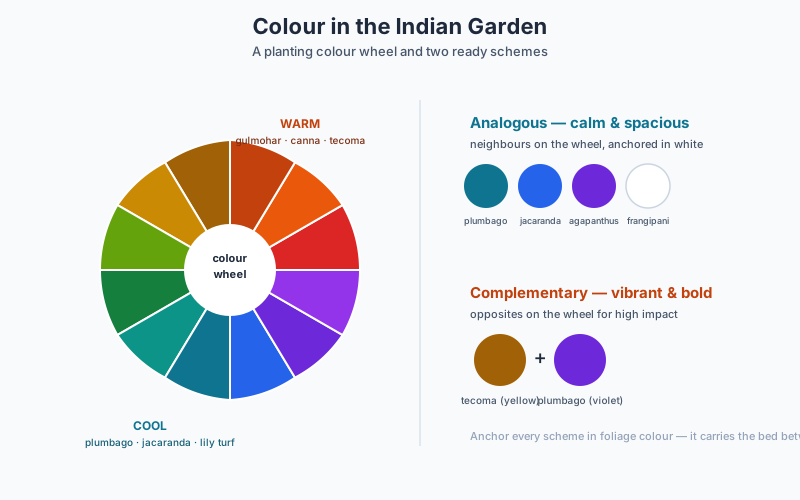
4. Colour: the loudest and most fleeting element
Definition. Colour is hue, value (light to dark) and intensity — in a garden it comes from flowers, foliage, bark, paving and even painted walls.
Outdoors. Colour is the element that shouts, and the one beginners over-rely on. Three things make garden colour behave unlike paint. First, it moves — hot colours (red, orange, yellow) read best in strong noon sun while cool colours (blue, violet, white) glow at dusk and in shade. Second, it is temporary — most flowering lasts weeks, so foliage colour (the burgundy of red shrub croton, the lime of golden duranta, the grey of agave) is the colour that stays. Third, it is seasonal — India's flowering calendar gives successive waves if you plan for them.
The colour wheel still applies. Warm hues advance and energise; cool hues recede, calm and make a small garden feel larger; white is the great unifier and the night-garden colour. An analogous scheme (neighbours on the wheel) reads as serene; a complementary scheme (opposites, like the violet-and-yellow of plumbago against tecoma) reads as vibrant.
Indian example. The grand bougainvillea cascades of Lutyens' Delhi and Jaipur use a single hot hue at mass scale for impact. For calm, a Bengaluru courtyard of white frangipani, blue plumbago and silver-grey foliage stays cool-looking even through the dry heat.
| Colour family | Behaviour in the garden | Best Indian plants | Where to use |
|---|---|---|---|
| Warm (red, orange, yellow) | Advance, energise, read in full sun | Gulmohar, canna, marigold, tecoma, hibiscus, golden duranta (foliage) | Sunny beds, festival/entry impact, distant focal points |
| Cool (blue, violet, white) | Recede, calm, glow at dusk and in shade | Plumbago, jacaranda, agapanthus, lily turf, white frangipani | Small gardens, shaded courts, evening-use spaces, near seating |
| Foliage (year-round) | The colour that never leaves | Red shrub croton, golden duranta, purple oxalis, silver agave, copper-pod | Structural backbone of every bed; carries the garden between bloom |
| White / silver | Unifies clashing colours; the night-garden palette | Frangipani, jasmine, tabernaemontana (chandni), dusty miller | Moon gardens, courtyards, to cool down a hot scheme |
| Flowering season | Months | Signature Indian bloomers |
|---|---|---|
| Spring | Feb–Apr | Tabebuia (pink/yellow trumpet), silk cotton, palash (flame of the forest) |
| Summer | Apr–Jun | Gulmohar, jacaranda, golden shower (amaltas), bougainvillea peak |
| Monsoon | Jul–Sep | Rain lily, hibiscus, ixora, plumbago, cassia |
| Post-monsoon / winter | Oct–Feb | Chrysanthemum, marigold, petunia and seasonal annuals, tabebuia (second flush) |
How to use it. Pick a scheme before you shop — two or three hues plus white, not a rainbow. Anchor it in foliage colour so the bed works in every month, and let flowers be the seasonal bonus. If you want calm and a sense of more space, lean cool; if you want energy and impact at the gate, lean warm.
5. Scale: sizing to the human and the house
Definition. Scale is the size of garden elements relative to the human body and to the building; proportion is their size relative to each other.
Outdoors. Scale is where gardens fail most often in India, for one reason: plants grow. The element bought at nursery size is not the element you design with — you design with its mature size. A neem sapling that looks right beside a single-storey house can swallow it in fifteen years. Two scales matter: human scale (paths sized to how many walk abreast, seating sized to bodies, a pergola at a sheltering height) and architectural scale (the largest tree's mature canopy in proportion to the building mass). A useful heuristic: a feature reads as part of the composition when its dimension is roughly one-third to two-thirds of the space it occupies.
Indian example. The "lollipop" garden — a few small, isolated shrubs floating in a vast lawn beside a large house — is a scale failure visible in countless Indian plots. The fix is grouping plants into masses large enough to hold their own against the building.
How to use it. Design with mature sizes, not pot sizes — look up the adult height and spread of every tree before you plant it. Size paths realistically: about 1.2 m for two people to pass comfortably, 1.5 m for a generous main route. And group, never dot: a single shrub looks lost; seven of the same shrub in a mass looks intentional.
6. Space: the void you actually live in
Definition. Space is the three-dimensional void between and around the solid elements — the lawn, the open court, the air beneath a canopy, the sky-room over a terrace.
Outdoors. This is the most counter-intuitive element, because beginners design the objects and forget the void. But you do not sit in a shrub; you sit in the space it helps enclose. Landscape works with two kinds: open space (lawn, paving, water — the floor you move across) and enclosed space (the outdoor "rooms" made by walls of planting, with the canopy as a ceiling). Their relationship — open then enclosed, compression then release — is the very experience of a garden. Environmental-psychology research on "prospect and refuge," associated with Jay Appleton, explains why we relax in spaces that give both an outlook and a sheltered back: the layered outdoor room delivers exactly that.
Indian example. The traditional courtyard house — the Kerala nalukettu, the Chettinad and Rajasthani havelis — is a masterclass in space: a dim, low, compressed entrance releases you into a bright open aangan. You can study this in our courtyard landscape design guide, and feel why some gardens feel peaceful the moment you step in.
How to use it. Draw the empty spaces first — sketch the lawn, the paved court, the seating void — and only then place the plants that shape them. Aim for a sequence of at least two contrasting spaces even on a small plot: one open and sunlit, one enclosed and shaded. The void is the room; the plants are the walls.
7. Visual weight and mass: the balancing element
Definition. Visual weight is how heavy an element feels to the eye — driven by size, density, darkness, texture and colour. Mass is the grouped bulk of solid planting as opposed to open space.
Outdoors. Every composition balances visual weight around an axis, like a seesaw. Dark, dense, coarse, warm-coloured and large elements feel "heavy"; light, airy, fine, cool and small ones feel "light." A single dark mango on one side can be balanced by a loose cluster of light-foliaged shrubs, a pale boulder and a bench on the other — equal weight, unequal objects. This is the engine of asymmetrical balance, which suits the irregular plots most Indian homes have far better than rigid symmetry. A garden that is all mass feels claustrophobic, all void feels barren; the art is the ratio.
Indian example. A contemporary villa garden that sets one heavy specimen — a spreading rain tree or a dark-canopied mango — on one side of the lawn, balanced by a long low drift of fine ornamental grasses and a pale stone bench on the other, achieves a relaxed, modern equilibrium without a mirror-image plan.
How to use it. Once your big "heavy" element is placed (usually the main tree), balance it not with an identical twin but with grouped lighter elements of equal visual pull on the opposite side of your main viewing axis. Keep a deliberate ratio of planted mass to open void — roughly a third to half open is a comfortable starting point for a family garden.
Combining the elements: how they work together
No element acts alone. Line carries the eye to a form; form is given depth by texture; texture is lit by colour; colour, form and texture together create the visual weight that scale and space then balance. Layer them in roughly this order: line and space first (the plan and the voids), then form and scale (structure and sizing), then texture (the year-round character), and finally colour (the seasonal bonus on top). Skip to colour first — as most beginners do — and you get a bright, weak garden that collapses the moment the flowers fade.
The elements are the alphabet; the principles of landscape design — unity, balance, rhythm, emphasis, simplicity — are the grammar that turns them into sentences. And the deeper payoff of getting the elements right is not merely aesthetic: a garden built on form, texture, space and layered mass is also cooler, more biodiverse and more restorative, which is the whole argument of biophilic landscape design.
Here is the full set in one view, and then a worked example of all seven applied to a real, modest Indian plot.
| # | Element | What it is | How it behaves outdoors | Use-it tip |
|---|---|---|---|---|
| 1 | Line | One-dimensional edge the eye and body follow | Walked as well as seen; straight = fast/formal, curved = slow/calm | Set the main path line and crisp bed edges first |
| 2 | Form | Three-dimensional shape of plants and objects | Persists in every season and in silhouette | Cast three contrasting forms; design for mature shape |
| 3 | Texture | Coarseness/fineness of foliage and surfaces | Year-round; coarse advances, fine recedes; changes with distance | Build beds with texture; coarse anchor + fine backdrop |
| 4 | Colour | Hue, value, intensity from flowers/foliage/stone | Shifts with light; fleeting from bloom, lasting from foliage | Choose a 2–3 hue scheme; anchor it in foliage colour |
| 5 | Scale | Size relative to body and building | Driven by mature plant size, not pot size | Design with adult sizes; group, never dot |
| 6 | Space | The void between solids — open and enclosed | Sequence of open and enclosed rooms = the experience | Draw the voids first; sequence open then enclosed |
| 7 | Visual weight / mass | How heavy an element feels; grouped bulk vs void | Balances around an axis; engine of asymmetry | Balance one heavy element with grouped light ones |
| Element | Applied to a typical 30 × 40 ft (≈110 m²) Indian front-and-side plot |
|---|---|
| Line | One gently curving 1.2 m Kota-stone path from gate to door; crisp brick mowing edge to the lawn |
| Form | One spreading shade tree (Indian beech / Pongamia), two rounded ixora masses, one vertical Ashoka accent at the corner |
| Texture | Coarse anchor of monstera by the door, medium hibiscus mass, fine fountain-grass edge along the path |
| Colour | Analogous cool scheme — blue plumbago, white frangipani, silver-grey foliage — with marigold pots for festival warmth |
| Scale | Path at 1.2 m; canopy chosen so mature spread suits a single-storey house; shrubs grouped in fives and sevens |
| Space | Open sunlit lawn at front; small enclosed shaded sit-out beside the house — two contrasting outdoor rooms |
| Visual weight / mass | The Pongamia (heavy) balanced across the lawn by grouped shrubs, a pale boulder and a bench; ~40% kept as open void |
Where this leaves you
The seven elements are not a style and not a one-time checklist — they are the materials of every garden, from a Mughal charbagh to a third-floor Mumbai balcony. Learn to name them and you change how you look: you stop seeing "nice plants" and start seeing line, form, texture, colour, scale, space and weight, arranged well or badly. That literacy is the most valuable thing a homeowner can carry into a nursery or a designer's meeting.
When you are ready to apply them to your own site, walk the rest of the landscape design library, pair this with the best trees for Indian homes for your canopy and form choices, and read the principles of landscape design to see how these seven raw elements are organised into a garden that feels, finally, like one composed idea.
References
- Booth, N. K. — "Basic Elements of Landscape Architectural Design" (the foundational treatment of line, form, texture, colour, scale and space in landscape).
- Indian Society of Landscape Architects (ISOLA) — professional standards and educational framework for landscape design in India.
- Council of Architecture (COA) — recognition of landscape architecture programmes and professional scope in India.
- Appleton, J. — "The Experience of Landscape" (prospect-refuge theory in environmental aesthetics).
- National Building Code of India (NBC) 2016 — site planning and external development provisions relevant to residential gardens.
- Mughal garden scholarship on the charbagh (four-part paradise garden), as embodied at Humayun's Tomb and the Taj Mahal complex.
- Shaheer, M. — built works and writings on Indian landscape design (Garden of Five Senses and Sanskriti, Delhi).
Export this guide
Related Guides — Deep-dive reading
Villa Landscape Design — Indian Villa Gardens, Hardscape & Vastu Landscape (2026)
8 landscape zones · Climate-zone tree palette · Vastu landscape · NBC 2016 Part 10 · 1.5 acre worked example
Design StylesThe Architectural Psychology of Comfortable Spaces
Why some rooms feel right and others never do — the science of space and the human mind
Design EducationThe Best Trees for Indian Homes
A research-grade guide to choosing and placing trees around an Indian home — the real cooling and clean-air numbers, the right species for shade, flowers, fragrance and fruit, and the placement science that keeps roots out of your walls and drains.
LandscapeRelated Tools — Try Free
Garden Planning Toolkit
Get a tailored garden plan — planting layers, Indian species, features and a checklist — from your climate, space, sun and goals.
PlannerCross-Ventilation Analyzer
Estimate airflow and air changes per hour (ACH) from room size, window areas, layout, and local wind — with NBC 2016 Part 8 compliance check.
Ventilation CalculatorMonsoon-Readiness Checklist
Pre-rain home audit across 9 categories — terrace, drains, waterproofing, electrical, HVAC, pest, vehicles, documents.
Seasonal Audit