
Sequential Progressions: Why the Order of Spaces Matters
A home is experienced as a journey in time, not a plan seen all at once — and arranging that journey, with compression, release and thresholds from public street to private inner room, is what makes a house feel right.
Think of the last home that moved you — a grandmother's house in a small town, a heritage hotel, a temple you visited as a child. You did not experience it as a floor plan seen from above. You experienced it as a journey: a gate, a few steps up, a shaded verandah where you slipped off your shoes, a cool dim passage, and then the sudden brightness of a courtyard open to the sky. The pleasure was not in any single room. It was in the order — the way one space prepared you for the next.
A house is never seen all at once. It is revealed to you over time, one footstep after another, the way a piece of music unfolds note by note or a film cuts from shot to shot. The plan on the architect's screen is a god's-eye view that no inhabitant will ever have. What we actually live inside is a sequence — and most modern Indian flats get that sequence catastrophically wrong, opening the front door straight into the middle of family life with no pause, no threshold, no choreography at all.
The order in which spaces are revealed is itself a design material — as real as brick or light — and arranging that order, from public street to private inner room, with deliberate compression and release along the way, is what separates a home you simply occupy from one you experience.
A home is a sequence in time, not a plan in space
The architect draws in plan because plans are how buildings get built — they are dimensioned, coordinated, sent to contractors. But the plan is a fiction of simultaneity. It shows every room at once, flattened, as if you could perceive the whole house in a single godlike glance. You cannot. You move through it. You turn a corner and a view appears; you pass through a doorway and the ceiling drops; you climb three steps and the light changes. The house is delivered to you serially, in time, and your felt impression of it is the sum of those moments in the order they arrive.
This is closer to cinema than to painting. A film director does not show you the whole story in one frame — they choose what you see and when, building anticipation, then revealing. Architects borrowed the word sequence from exactly this idea. Modernists from Le Corbusier (his promenade architecturale at Villa Savoye) to Frank Lloyd Wright deliberately compressed and released visitors as they moved. The lesson for a homeowner is freeing: you can have an ordinary plan and an extraordinary experience, or a clever plan and a flat one, depending entirely on what happens as you walk the path.
The Japanese tea ceremony makes the point most purely. The roji — the garden path to the tea house — is a designed sequence intended to slow you, cool your mind, and shed the noise of the street before you arrive. The path narrows, the stepping stones force you to look down and walk deliberately, the final doorway (the nijiriguchi) is so low that even a samurai must bow to enter. By the time you reach the tea room you are a different person than the one who left the road. The path made you ready. That is sequence doing psychological work.
Compression and release: the oldest trick in spatial design
The single most powerful move in spatial sequence is compression and release — squeezing the visitor through a low, narrow, dim space and then opening into a tall, wide, bright one. The contrast is the effect. A living room that is merely large feels large. A living room you enter from a low, tight foyer feels enormous, because your body just measured itself against the squeeze and now reads the openness as a release. Architecture, like comedy, runs on contrast and timing.
Frank Lloyd Wright was the master of this. His entrances are famously low, dark, almost uncomfortable — and then they burst open into the soaring main living space. He called it "compression and release" and used it relentlessly, knowing that the cramped prologue is what makes the great room sing. Christopher Alexander, in "A Pattern Language" (1977), names the same instinct in his pattern Entrance Transition (pattern 112): a building should make you pass through a definite transition — a change of light, of level, of sound, of view — between the public street and the private interior, so that you arrive rather than merely walk in.
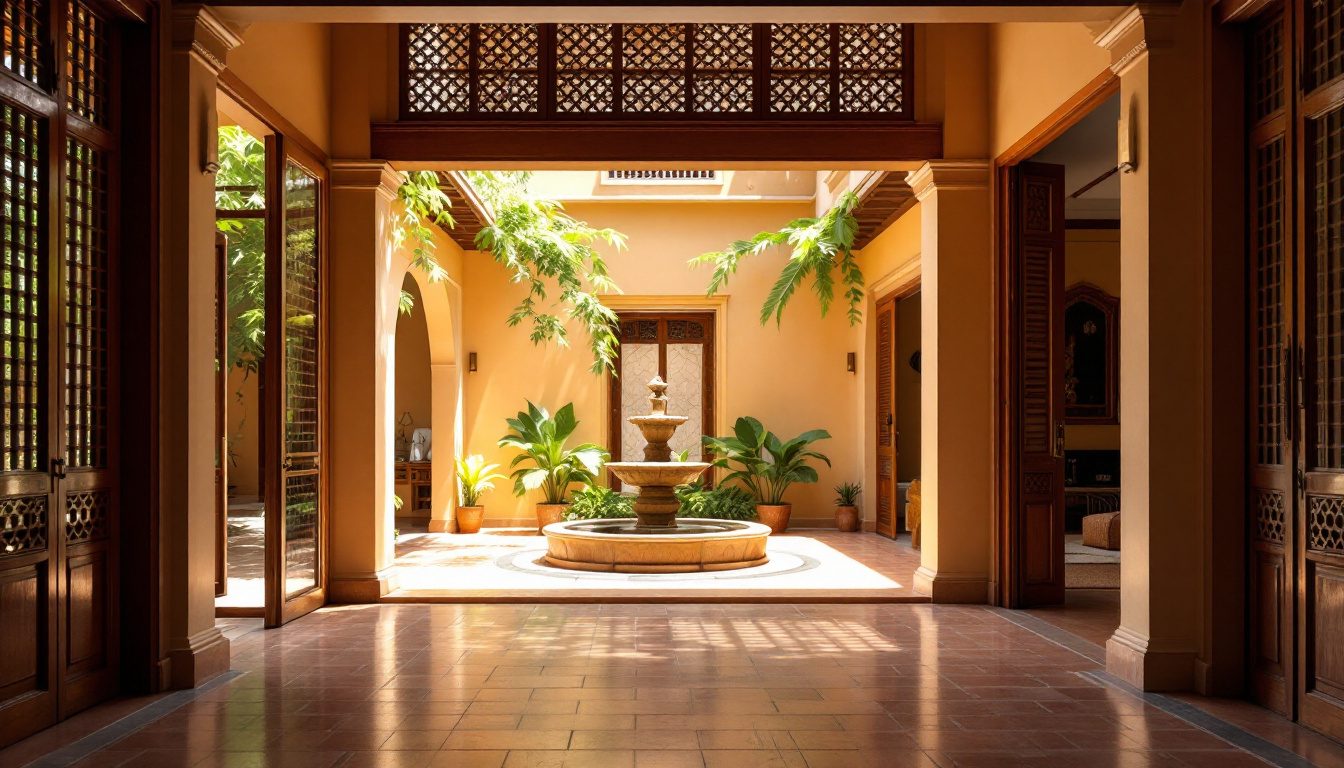
The traditional Indian home does this without a textbook. You approach off a hot, bright, noisy street. You step up onto the plinth — a level change that already signals "you are entering somewhere." You pass under the deep shade of the verandah or otla, low and cool. And then the house opens into the courtyard, the brahmasthan, flooded with sky. Hot to cool, bright to shaded to bright again, low to high, public to private — the whole sequence is a single sustained act of compression and release, and it is one reason these homes feel so deeply right even when they are modest. The pause before arrival is not wasted space. It is the part of the building that makes the arrival mean something.
| Sequence move | What the body does | The felt result |
|---|---|---|
| Low, narrow, dim entry | Folds inward, slows, focuses | Anticipation, a held breath |
| Sudden tall, wide, bright space | Expands, looks up, relaxes | Relief, drama, a sense of occasion |
| A pause or threshold between | Stops, reorients, sheds the street | Transition, arrival, readiness |
| Gradual brightening along a path | Eye adjusts, gaze pulled forward | Invitation, procession, reveal |
The intimacy gradient: public to private, in the right order
Beyond drama, a sequence has a job: it must sort spaces from public to private and arrange them so you move through them in a sensible order. Alexander calls this the Intimacy Gradient (pattern 127), and it is perhaps the most useful single idea for laying out an Indian home. Rooms, he argues, should be arranged so that a visitor moves from the most public spaces near the entrance to the most private spaces deep inside, encountering each in turn. You do not walk a guest past the bedrooms to reach the sofa. You do not put the puja room or the master bedroom where a courier rings the bell and sees straight in.
The gradient runs roughly: street, gate, entry transition, formal/guest sitting, family living, dining, kitchen, then the private zone of bedrooms, and finally the most retreat-like spaces — the master suite, the puja room, the reading corner. Each step is a little more intimate, a little more "ours," than the one before. Get the order right and the house manages social distance effortlessly: a delivery person stops at the threshold, a guest reaches the drawing room, close friends drift to the dining table, only family penetrates to the private rooms. Get it wrong — the bedroom door opening onto the living room, the kitchen visible from the entrance — and the house feels permanently exposed, with no way to control who sees what.
This is also where related spaces should be sequenced for use, not just for privacy. Alexander's Sequence of Sitting Spaces (pattern 142) notes that a home benefits from a graded series of places to sit — a public bench or swing near the entry, a sociable living room, a quieter window seat, an intimate two-person nook — so that people can choose the degree of exposure that suits their mood. We explore where those retreat-points belong in the companion guide on zones of retreat, rest and privacy, and the overall flow of movement that stitches them together in understanding spatial flow. The gradient is the why; flow is the how.
| Zone | Privacy level | Who reaches it | Position in the sequence |
|---|---|---|---|
| Gate, plinth, verandah / otla | Public threshold | Anyone, deliveries, neighbours | First — the buffer to the street |
| Foyer, shoe-removal point | Semi-public | Invited visitors | The pause; cleansing the street |
| Formal sitting / drawing room | Semi-public | Guests | Near the entry, before family life |
| Family living, dining | Semi-private | Friends, extended family | The social heart, mid-sequence |
| Kitchen | Semi-private | Family, close helpers | Adjacent to dining, screened from entry |
| Bedrooms | Private | Family only | Deep in the plan, off a private passage |
| Master suite, puja room, study nook | Most intimate | Self, immediate family | The innermost sanctum, last in the sequence |
Thresholds: the gateways that make a sequence legible
A sequence is only felt if its joints are marked. A threshold is the device that tells your body it has crossed from one zone to another — a change of level, a change of light, a narrowing, a frame, a material shift underfoot. Without thresholds, a house is an undifferentiated flow and the gradient collapses; with them, every transition reads. The traditional Indian home is unusually rich in thresholds, and they are worth naming because the modern flat has quietly deleted almost all of them.
The plinth itself is a threshold — the step up that lifts the house above the street and floods, dust and the profane world outside. The doorway carries the toran or the daily kolam/rangoli, marking the boundary a guest must honour. Inside, the change from the bright courtyard to the dim, deep inner rooms is a threshold of light. Even the act of removing footwear at the door is a behavioural threshold, a small ritual that says you are now inside, in a cleaner and more intimate register. These are not quaint survivals. They are exactly the "change of light, sound, view and level" that Alexander prescribes for a good entrance transition — Indian homes simply arrived at them centuries earlier, through ritual and climate rather than theory.
A doorway is not a hole in a wall to walk through quickly. It is a gateway to be crossed deliberately — and a home that marks its gateways gives you the quiet dignity of arriving, again and again, all day long.
The temple darshan is the most concentrated Indian example of sequence and threshold working together. You progress from the bright open prakaram, through the pillared mandapa, into the dim ardha-mandapa, and finally to the garbhagriha — the small, dark, low womb-chamber that holds the deity. The path deliberately compresses and darkens as you near the most sacred point, so that the final glimpse of the murti, lit by a single lamp, lands with maximum force. Compression, gradient, threshold and reveal, all in service of one moment. The home is humbler, but the grammar is identical.
Where the modern flat breaks the sequence
The standard Indian apartment is, from the point of view of sequence, almost an anti-design. The lift doors open onto a shared corridor; your front door opens directly into the living room. There is no gate, no plinth, no verandah, no foyer, no threshold of light — you go from a fluorescent common passage to the middle of your family's life in one undifferentiated step. The shoe-removal that every Indian household still performs now happens in an awkward scramble inside the living room, because the home was not designed to give that ritual a place. The result is a home that feels exposed at the front door and has no sense of arrival at all.
This is not nostalgia. The deleted sequence has real costs. Without a transition zone, the living room is permanently "on" — visible to anyone at the door, never a private retreat. Without a gradient, guests and family share the same space with no graceful way to manage closeness. Without thresholds, the whole flat feels like one continuous room subdivided by walls rather than a series of considered places. The good news is that even a compact flat can rebuild much of the sequence with small, deliberate moves:
- Carve a foyer, even a tiny one. A half-height shoe cabinet, a console, a change of flooring or a slim partition just inside the door creates a pause — a place to drop the street before you enter the living space. This is the single highest-value sequence repair in a flat.
- Mark the threshold underfoot and overhead. A different tile, a runner, a lowered ceiling band or a pendant light at the entry signals "you have crossed in." It need cost almost nothing.
- Borrow compression and release. Keep the entry zone deliberately lower and tighter (a dropped ceiling, a snug width) so the living room beyond reads as the release. The contrast does the work.
- Order the rooms by intimacy. When you can influence the plan, place guest seating near the door and private rooms deep, off a short private passage, so the gradient survives even in a small footprint.
- Give the puja and the master bedroom depth. Both want to be at the private end of the sequence, never the first thing a visitor sees.
The principle behind all of this — that you design the experience, not just the floor plan — is the heart of our pillar guide, design principles over magazine examples, and it connects directly to how a mere arrangement of rooms becomes a home you belong to in from space to place.
Choreographing light, height and width along the path
A sequence is not only a list of rooms in order — it is a continuously changing experience of light, ceiling height and width as you walk. The most memorable homes orchestrate all three along the path, like a conductor shaping a phrase. Light should generally brighten toward the spaces you want to feel like a reward — the courtyard, the living room, the window seat — so that your gaze and your feet are drawn forward by the promise of light ahead. This is procession and reveal: you sense the brightness before you reach it, and the movement toward it feels purposeful.
Height should rise and fall in counterpoint to intimacy. Low at the compressed entry, high in the social heart, low again in the bedrooms and nooks where enclosure is welcome — Alexander's "Ceiling Height Variety" again, and the reason we treat ceiling height as a deliberate instrument in the science of ceiling heights. Width does the same: a path that narrows and then opens reads as compression and release in plan, just as a low-then-high ceiling does in section. When light, height and width all release together at the same moment — the dim, low, narrow foyer giving way to the bright, tall, wide living room — the effect is overwhelming, because three signals of arrival land at once.
| Spatial variable | At the entry / threshold | At the social heart | At the private retreat |
|---|---|---|---|
| Light | Dim, filtered, a pause | Bright, generous, daylit | Soft, controllable, low |
| Ceiling height | Low, compressed | High, expansive | Lower, enclosing, cosy |
| Width of path/space | Narrow, channelled | Wide, open | Snug, defined |
| Felt register | Anticipation | Release, sociability | Refuge, calm |
You can plan this consciously without an architect. The most practical way to start is to map your home as a journey rather than a plan — to draw the bubbles of public, semi-private and private space and the connections between them in the order a person would travel, which is exactly what the bubble diagram planner is built for. Sketch the path from the front door to the most private room and ask, at each step: is there a pause, a threshold, a change? Does the light, the height, the width do anything? If the answer all along the path is "no, it is all the same," you have found your opportunity.
What this means for your home
1. Walk your home as a sequence, not a plan. Trace the path from gate to front door to the innermost room. Notice every point where nothing changes — those flat stretches are where sequence is missing.
2. Build a pause at the entrance. Even in a flat, carve a foyer or threshold zone with a change of floor, a console, a shoe cabinet and ideally a slightly lower ceiling. Give the daily shoe-removal ritual a designed place.
3. Use compression and release on purpose. Keep the entry deliberately low and tight so the living space beyond feels like a release. Contrast, not size, creates the drama.
4. Order rooms by the intimacy gradient. Public near the door, private deep inside, the puja room and master suite at the most sheltered end. Never route a guest past the bedrooms to reach the sofa.
5. Mark your thresholds. A material change underfoot, a frame, a light, a level change — give each transition a signal so the body registers the crossing.
6. Choreograph light, height and width together. Brighten toward the spaces that should feel like a reward; raise the ceiling in the social heart and lower it in retreats; let the path narrow and then open.
7. Test the path before you build it. Map the journey as bubbles in the order a person travels, and check that something happens at every step.
How Studio Matrx helps
Sequence is hard to judge on a flat drawing, because the whole point of a sequence is that it is experienced in motion. DesignAI lets you visualise your home as a series of connected views — what you would actually see standing at the gate, in the foyer, stepping into the living room — so you can feel the compression and release, the brightening path and the change of height before anything is built. You can test whether your entrance gives a sense of arrival, whether the gradient from public to private holds, and whether each threshold reads, turning an ordinary plan into a home that unfolds beautifully one footstep at a time.
References
1. Alexander, C., Ishikawa, S. & Silverstein, M. (1977). A Pattern Language. Oxford University Press — patterns 112 "Entrance Transition," 127 "Intimacy Gradient," and 142 "Sequence of Sitting Spaces."
2. Ching, F. D. K. Architecture: Form, Space, and Order — on circulation, the architectural promenade, approach and the sequencing of spatial experience.
3. Le Corbusier (1923). Towards a New Architecture — on the promenade architecturale and the building experienced through movement.
4. Pallasmaa, J. (2005). The Eyes of the Skin: Architecture and the Senses — on the embodied, sequential, multisensory experience of buildings.
5. Hertzberger, H. (1991). Lessons for Students in Architecture — on thresholds, in-between spaces and the public-to-private transition.
6. On the Japanese tea garden (roji) and tea house: Okakura, K. (1906). The Book of Tea — on the path as preparation and the low entrance as humbling threshold.
7. Bureau of Indian Standards. National Building Code of India 2016 — on circulation, access and habitable-space requirements relevant to entry and passage design.
Part of the Studio Matrx Design Principles series. Continue with understanding spatial flow in home design, zones of retreat, rest and privacy, from space to place, and the pillar, design principles over magazine examples.
Export this guide
Related Guides — Deep-dive reading
Understanding Spatial Flow in Home Design
How you move through a home — and why good flow is invisible while bad flow nags every day
Design EducationThe Architectural Psychology of Comfortable Spaces
Why some rooms feel right and others never do — the science of space and the human mind
Design EducationCreating a Sense of Arrival
How the approach from gate or lift lobby to the threshold — the path, the pause, the framed and lit front door — decompresses a guest and signals a home that was cared for, before a word is spoken.
Design PrinciplesRelated Tools — Try Free
Apartment Furniture Size Chart
Standard furniture dimensions for Indian apartments — sofas, beds, tables, dining, storage.
Reference ChartVisitor Access Planner
Size visitor handling at a gate or reception — lanes needed at peak and the temporary-pass pool.
Visitor FlowApartment Video Door System Planner
Enter flats, entrances, floors and guard desk for a first-pass building intercom plan — door stations, indoor monitors, guard station, the right architecture and an indicative cost band.
Building Planner