
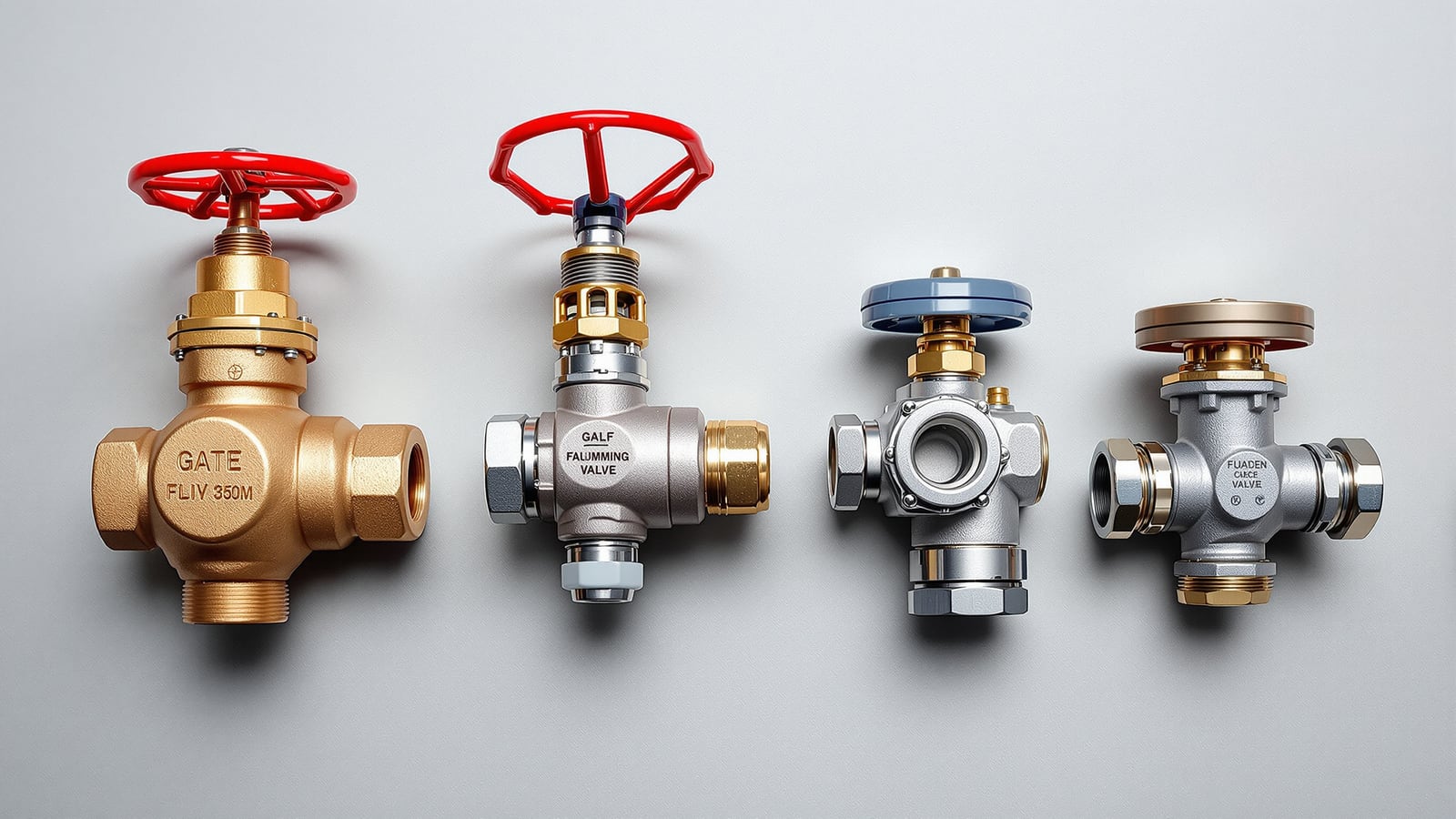
Plumbing Valves Guide (India): Every Valve, What It Does and Where It Goes
A homeowner's master overview of the valves in an Indian plumbing system — the four jobs valves do (isolation, throttling, one-way, pressure control), which valve type does which job, where each one belongs from the main to every fixture, plus materials, threaded versus flanged connections and how to choose.
A valve is simply a controllable gap in a pipe. Open it and water flows; close it and it stops; leave it half-way and you meter the flow. Everything a plumbing system does to control water — shutting a bathroom to fix a tap, stopping the pump from draining backwards, taming savage municipal pressure — is done by one valve type or another. This guide is the map: it names the four jobs valves do, matches each job to the right valve, and shows where every valve belongs in a typical Indian home.
This is the pillar page of the valves section inside the Studio Matrx Plumbing Knowledge Hub. It sits above the plumbing systems guide and the domestic water distribution guide, and links down to the detailed guides on each valve family. Read this first to understand why a valve is there; follow the links to learn how to specify one.
The single most useful idea in plumbing: a valve does exactly one job well. A ball valve is a brilliant on/off switch and a terrible flow regulator. A globe valve throttles beautifully and wastes money as a shut-off. Choosing the right valve is mostly a matter of matching the valve to the job — nothing more.
The four jobs a valve does
Strip away the brand names and the shapes, and every plumbing valve exists to do one of four things.
- Isolation (on/off). Fully open or fully closed, never in between. This is the workhorse job — the valve that lets you shut one fixture, one wet area, or the whole house so you can repair or replace something without draining the building. Ball valves and gate valves own this job.
- Throttling (regulation). Deliberately part-open, to set a steady reduced flow rate — for a garden line, a trickle feed, or balancing one branch against another. Globe valves and gate valves (used carefully) do this; ball valves must not be left part-open long term.
- One-way (non-return). Lets water pass in one direction and slams shut against reverse flow. This protects pumps from back-draining, stops the overhead tank feeding backwards, and keeps dirty water out of clean lines. Check valves (also called non-return valves, NRV) do this automatically, with no handle.
- Pressure control. Reduces a high, variable upstream pressure to a lower, steady downstream pressure — or relieves dangerous over-pressure. Pressure reducing valves (PRV) and relief valves do this.
Almost every problem you can name maps to one of these four. "I can't isolate the kitchen" is a missing isolation valve. "The tap dribbles even when the pump is off" may be a failed check valve. "My CPVC fittings keep bursting on the ground floor" is often a missing pressure reducing valve. Learn the four jobs and you can diagnose most of a plumbing system by reasoning backwards.
Which valve does which job
Names in the market are messy — a "wheel valve", a "full-way valve" and a "stop cock" can mean different things to different plumbers. The reliable way to buy is to ignore the shop name and match by mechanism and job. Here is the master map.
| Valve type | Primary job | How it works | Where it is used | Detail guide |
|---|---|---|---|---|
| Ball valve | Isolation (on/off) | A bored ball rotates a quarter-turn; lever shows state | Main shut-off, wet-area isolation, tank inlets/outlets | Ball valves |
| Gate valve | Isolation (on/off) | A wedge slides up/down on a wheel; full-bore when open | Older mains, pump lines, large-bore isolation | Gate valves |
| Globe / stop valve | Throttling | Disc seats against a flow-turning port | Garden taps, balancing a branch, hose bibs | — |
| Angle stop cock | Isolation (fixture) | Quarter-turn or compression stop at 90° | Under wash basins, WCs, geysers, mixers | — |
| Check valve (NRV) | One-way | Spring or swing flap opens with flow, shuts on reversal | Pump delivery, tank down-take, borewell riser | Check valves |
| Pressure reducing valve | Pressure control | Spring-loaded diaphragm holds a set downstream pressure | After the meter/pump on high-pressure supply | Pressure reducing valves |
| Foot valve | One-way + strainer | Check valve with a filter at a suction pipe's foot | Sump and borewell suction, at water's edge | — |
| Float / ball-cock valve | Level control | A float lifts to shut the inlet as water rises | Overhead tanks, WC cisterns, flushing tanks | — |
The two guides you will use most as a homeowner are ball valves (your isolation everywhere) and check valves (protecting your pump). Gate valves still turn up on older systems and large pump lines; pressure reducing valves matter the moment your incoming pressure runs high.
Isolation: the valves that let you fix things
If you take away one practical habit from this guide, make it this: you should be able to isolate every wet area and every major fixture without shutting the whole house. A well-planned Indian home has isolation valves at three levels.
- The main shut-off. One valve on the down-take from the overhead tank (and one on the municipal/underground inlet). This is the "everything off" valve — a full-bore ball or gate valve, ideally labelled, that everyone in the house can find in the dark.
- Wet-area isolation. One valve per bathroom, per kitchen, and per utility area, tucked in an accessible spot (often behind an access panel or in the shaft). This lets a plumber work on one bathroom while the rest of the house keeps running — and it turns a burst pipe from a house-wide emergency into a shrug.
- Fixture stops. A small angle stop cock at each individual point — under every wash basin, behind each WC cistern, at the geyser inlet, at each mixer. These let you replace a tap washer or a cistern without even isolating the room.
Getting this three-level layering right is a design decision, covered in depth in the domestic water distribution guide. The valves themselves are cheap; the cost of not having them is a flooded house and a plumber who has to shut your water for a whole afternoon.
A quiet rule that catches people out: never leave a ball valve half-open to reduce flow. The seat wears unevenly against the constant jet and the valve starts to drip within months. If you need a permanently reduced flow, use a globe valve, which is built to throttle.
One-way and pressure control: the quiet protectors
Two jobs run in the background, unattended, with no handle to turn.
Check valves (non-return valves) stop water going the wrong way. The most important one sits just after your pump: without it, every time the pump stops the whole delivery pipe drains backwards, the pump loses its prime, and it hammers on restart. A foot valve — a check valve with a built-in strainer — does the same job at the bottom of a suction pipe, holding the prime for a surface pump. These fail silently: a worn check valve lets a slow reverse leak through, which shows up as a pump that keeps cycling on its own. The check valves guide covers spring versus swing types and where each belongs.
Pressure reducing valves (PRV) matter most in two situations: a direct municipal supply that runs at high or wildly variable pressure, and the lower floors of a tall building where the column of water above creates crushing static pressure. Left unchecked, high pressure bursts CPVC fittings, makes taps spit and wastes water. A PRV after the meter or at the floor branch holds a steady, comfortable downstream pressure — 2 to 3 bar is a typical comfortable target for a home. See the pressure reducing valves guide for setting and sizing.
Materials: what the valve is made of
The body material decides where a valve can live and how long it lasts. Indian systems mix several.
- Forged brass. The default for good-quality home ball valves and angle stops. Strong, corrosion-resistant, takes chrome plating well. Forged (hot-pressed) brass is denser and far stronger than cheap sand-cast brass, which is porous and can crack — worth insisting on for anything on a pressure line.
- Gunmetal (bronze). A copper-tin-zinc alloy prized for wheel valves and check valves in harder-water and older systems. Very corrosion-resistant and repairable; heavier and dearer than brass.
- Cast iron (CI). For large-bore, low-pressure isolation on mains, pump headers and underground lines — sluice (gate) valves and butterfly valves. Cheap per size but heavy and prone to rust if the lining fails; usually flanged.
- Stainless steel (SS). For corrosive, high-purity or coastal duty where brass would dezincify. Premium price; used on RO/drinking-water lines and in salty coastal air.
- PVC / uPVC / CPVC. Plastic ball valves for cold-water and irrigation lines, and increasingly for concealed work to match plastic piping. Light, rust-proof and cheap, but lower temperature and pressure limits — never on a hot line unless rated CPVC.
A practical warning specific to India: avoid the very cheapest unbranded "brass" valves. High-zinc cast alloys dezincify in our often-hard water — the zinc leaches out, leaving a weak, porous body that fails after a couple of years. Spend a little more for forged brass or gunmetal from a known brand on anything you cannot easily reach.
Threaded versus flanged, and typical sizes
Small home valves connect by threads (BSP taper, sizes quoted in inches — half-inch, three-quarter, one inch), sometimes solvent-welded for CPVC/PVC. Large valves connect by flanges — bolted discs with a gasket between — which are stronger, easier to service and standard above roughly 50 mm. As a homeowner you will almost only meet threaded valves; flanged valves appear on the building's main, pump room and terrace headers.
| Valve | Typical size | Material | Connection | Typical use | Indicative price |
|---|---|---|---|---|---|
| Angle stop cock | 15 mm (½") | Forged brass, chromed | Threaded | Basin, WC, geyser inlet | ₹250 – ₹700 |
| Ball valve (lever) | 15–25 mm (½"–1") | Forged brass | Threaded | Fixture / wet-area isolation | ₹350 – ₹1,200 |
| Ball valve (large) | 32–50 mm | Forged brass / CI | Threaded / flanged | Main shut-off, pump line | ₹1,200 – ₹4,500 |
| Gate valve | 25–100 mm | Gunmetal / CI | Threaded / flanged | Large isolation, mains | ₹600 – ₹6,000 |
| Check valve (NRV) | 25–50 mm | Gunmetal / brass | Threaded / flanged | Pump delivery, down-take | ₹450 – ₹3,500 |
| Foot valve | 25–50 mm | Gunmetal / plastic | Threaded | Suction inlet at sump | ₹400 – ₹2,000 |
| Pressure reducing valve | 15–25 mm | Forged brass | Threaded | High-pressure branch | ₹2,500 – ₹9,000 |
Prices are broad, indicative retail ranges for domestic sizes — confirm locally, as brand and city vary widely.
How to choose a valve
Work through four questions and the answer is usually obvious.
1. What job? On/off, throttle, one-way or pressure? That alone narrows you to one or two types.
2. Where does it live? Reachable or buried? Hot or cold line? Coastal or hard water? This sets the material — forged brass or gunmetal indoors, SS for corrosive/coastal, CI only for large low-pressure lines, plastic for cold plastic-pipe runs.
3. What size and connection? Match the pipe bore; threaded below ~50 mm, flanged above. Never neck a valve down below the pipe size on a flow you care about.
4. Full-bore or not? For isolation, prefer a full-bore valve (the opening equals the pipe bore) so it does not choke flow when open — this is where ball and gate valves beat a globe valve.
Rule of thumb for the whole system: ball valves to isolate, globe valves to throttle, check valves to protect the pump, a PRV to tame high pressure — and an angle stop at every fixture. Get those five habits right and the plumbing behaves.
Once you know the type you need, follow the detailed guide for that family — ball valves, gate valves, check valves or pressure reducing valves — to pick the right size, material and brand for your specific line. For how these valves knit into the wider system, return to the plumbing systems guide.
References
- National Building Code of India (NBC), Part 9 — Plumbing Services, for water-supply and fixture requirements.
- CPHEEO Manual on Water Supply and Treatment (Ministry of Housing and Urban Affairs) for supply-system design guidance.
- Uniform Plumbing Code — India (IAPMO India) for valve and fixture installation practice.
- Manufacturer catalogues and IS product standards for the specific valve type, size and pressure rating you buy — verify ratings against your line before purchase.
Export this guide
Related Guides — Deep-dive reading
Butterfly Valves in India: Wafer vs Lug vs Flanged, Sizing, Operators & Cost
The compact quarter-turn disc valve that isolates and throttles large-diameter lines — building risers, pump headers, tank connections, HVAC chilled-water and fire mains — at a fraction of the size, weight and cost of a gate valve. How the rotating disc works, which body style to specify, lever versus gear operator, materials and sizes, pros, cons and indicative pricing.
PlumbingGate Valves in India: How the Wheel Isolation Valve Works, Where to Use It & When to Replace It
The multi-turn wheel valve that isolates larger water lines and mains with a full-bore, low-resistance opening — how the rising and non-rising wedge-gate mechanism works, why it is strictly ON/OFF and not for throttling, why it seizes and drips over time (and got replaced by ball valves at fixtures), where it still earns its place, and how to size, specify and cost it in an Indian home.
PlumbingFloat Valves (Ball Cock) in India: How They Work, Sizing, Fitting & Fixing Overflow
The self-acting valve that fills a tank and shuts off when it is full — how a float-arm ball cock works, where it is used in overhead tanks, sumps, WC cisterns and cooling towers, brass versus plastic, how it relates to overflow and float-switch backup, why it drips and overflows, adjustable water level, sizes, fitting, pros and cons, and indicative cost.
PlumbingRelated Tools — Try Free
Rainwater Tank Sizer
How big should your rainwater tank be? Computes annual harvest, recommended tank capacity in litres, water-bill savings, and payback — for 10 Indian cities.
RWH CalculatorShower Water Flow Calculator
Shower water use per shower, day and month by head type, plus a pressure-adequacy check for your tank height or pump and low-flow savings.
Bathroom CalculatorPlumbing Pressure-Test & Leak Checklist
Pre-closure pressure and leak test — 9 categories, 60+ checkpoints across water supply, drainage, fixtures, waterproofing, hot water, tanks.
Pre-Closure Test