
Butterfly Valves in India: Wafer vs Lug vs Flanged, Sizing, Operators & Cost
The compact quarter-turn disc valve that isolates and throttles large-diameter lines — building risers, pump headers, tank connections, HVAC chilled-water and fire mains — at a fraction of the size, weight and cost of a gate valve. How the rotating disc works, which body style to specify, lever versus gear operator, materials and sizes, pros, cons and indicative pricing.
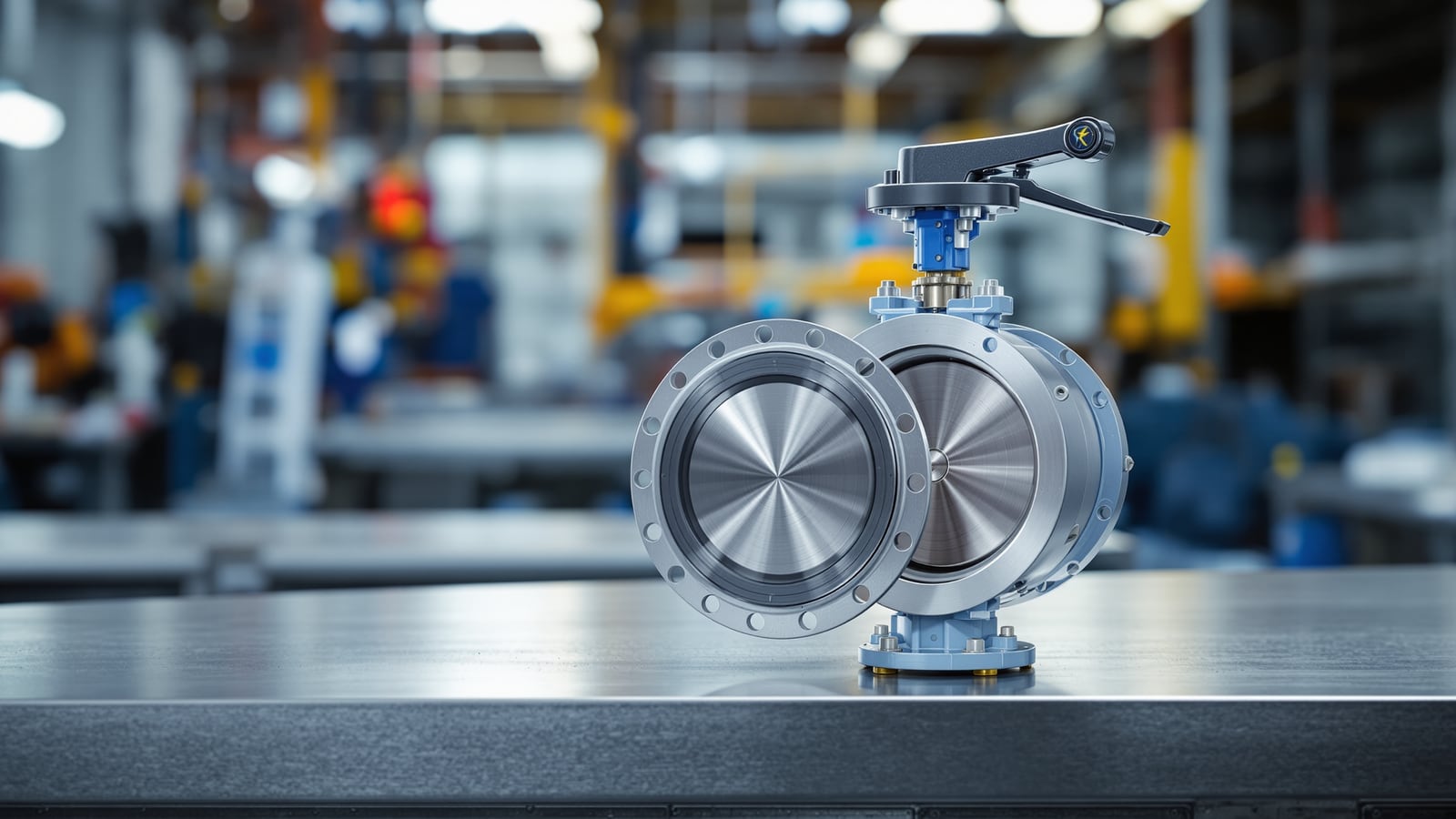
A butterfly valve is a quarter-turn valve whose closing element is a flat circular disc on a shaft running across the bore. Rotate the disc a quarter turn and it swings from lying edge-on in the flow (open) to sealing flat across the pipe (closed). It is the workhorse isolation valve for large-diameter lines — the ones a gate valve makes heavy, tall and expensive.
This is a professional's guide to specifying butterfly valves in Indian building services. It sits under the Studio Matrx plumbing valves guide, reads alongside the gate valves guide — the other classic isolation valve, and the one butterfly valves displace on big pipes — and connects to the building plumbing services guide, where risers, pump headers, tanks and fire mains are the lines you will actually put these valves on.
Where the butterfly earns its place
On a 50 mm domestic line a gate or ball valve is cheap and fine. Scale that pipe up to 200, 300 or 500 mm and the picture inverts. A gate valve at those sizes becomes a tall, massive casting needing serious headroom to withdraw the wedge. A butterfly valve at the same size is a short wafer disc clamped between two flanges — a fraction of the length, weight and price.
The rule of thumb on Indian projects: below roughly 50 mm, use gate or ball valves; from about 80 mm upward on water service, the butterfly valve almost always wins on cost, weight and space. On mains of 150 mm and above it is effectively the default.
That is why you find butterfly valves everywhere the pipe is big:
- Building risers and mains — isolating a wet riser, a zone header or a floor branch on a tall building.
- Pump headers and manifolds — isolation either side of each pump so one can be serviced while the others run.
- Tank connections — inlet and outlet isolation on underground and overhead tanks, and on hydro-pneumatic sets.
- HVAC chilled-water and condenser-water — chiller isolation, AHU branches, cooling-tower lines. This is one of the largest uses in Indian commercial work.
- Fire mains and hydrant systems — isolation on the ring main and at sectional valves (specify the pattern your fire consultant and the relevant standard require).
- Industrial and municipal water — treatment plants, distribution, process water.
They are not a domestic small-bore valve. You will rarely see one below 50 mm, and under a wash-basin they make no sense at all.
How the disc seals: concentric, resilient-seated
The common building-services butterfly is the concentric, resilient-seated type. A rubber seat (elastomer liner) lines the full bore; the disc rotates against it, and closed, the disc rim presses into the rubber all round for a bubble-tight seal. That liner usually doubles as the flange gasket, so no separate gaskets are needed.
- Seat — typically EPDM for water, HVAC and general service; NBR/Nitrile where oils are present. It also isolates disc and body from the fluid, so a cheaper body can carry a better disc.
- Disc — the moving element, always wetted, so corrosion-resistant: stainless steel, coated ductile iron, or aluminium-bronze.
- Shaft/stem — stainless steel, carrying the quarter turn to the disc.
- Body — usually cast iron (CI) or ductile iron (DI), protected by the resilient seat.
Isolation, and a bit of throttling
A butterfly valve is fundamentally an isolation (on/off) valve — its main job is to shut a large line fully open or fully closed. But unlike a gate valve, it can also throttle reasonably well, because the disc angle maps to flow in a usable way through the mid-range. It is common on Indian HVAC jobs to use a butterfly valve for balancing duty, holding a partly open position to set a branch flow.
Two cautions when throttling:
- The disc always sits in the stream. Even fully open, the disc and shaft remain in the bore, so a butterfly valve has a slightly higher pressure drop than a full-bore gate valve and is not the choice where you need an unobstructed pipe (e.g. for pigging).
- Throttling near closed is rough. At small openings, flow is turbulent and the seat can be eroded over time. For fine, frequent modulation choose a valve designed for control duty; for isolation and occasional balancing the standard resilient-seated valve is fine.
Body styles: wafer, lug, flanged
The body style decides how the valve joins the pipe — and how you can dismantle downstream of it. This is the single most important selection after size.
| Body style | How it fits | Can isolate one side & remove downstream pipe? | Typical use | Relative cost |
|---|---|---|---|---|
| Wafer | Sandwiched (clamped) between two pipe flanges by the connecting bolts | No — remove it and the line comes apart both sides | General in-line isolation where both sides stay put; most common, cheapest | ₹ lowest |
| Lug | Threaded lugs (bolt holes) each side; each flange bolts to the valve independently | Yes — acts as a pipe end; downstream can be removed with valve shut | End-of-line service, equipment isolation, anywhere you must open one side | ₹ higher than wafer |
| Flanged (double-flanged) | Its own flanges bolt to matching pipe flanges | Yes; robust, used at larger sizes and higher duty | Large mains, buried/critical lines, heavier industrial and water-utility work | ₹ highest |
The takeaway: wafer is the default and the cheapest, but if you ever need to isolate the valve and take apart the pipe on one side — servicing a pump, blanking a branch — you need lug or flanged. Deciding this at design stage saves a lot of grief on site.
Operators: lever vs gear
How you turn the quarter turn depends mostly on size:
- Lever (handle) — a hand lever gives a fast quarter turn, usually with a notched plate to lock intermediate positions for throttling. Practical up to roughly 150–200 mm; above that the torque to move the disc against line pressure is too high for a hand lever, and the fast swing can slam the line (water hammer).
- Gear operator (worm gearbox + handwheel) — a geared handwheel multiplies torque and slows the motion, so the valve closes gently. Used from about 200 mm upward, and desirable earlier on high-pressure or frequently operated valves. It also holds position under flow, which a lever can be pushed off.
- Actuated (electric/pneumatic) — for automatic control, BMS-driven HVAC isolation, or remote operation. Keep automation brief here; motorised and smart shut-off actuation belongs with the smart-plumbing and building-management scope, not this valve profile.
Sizes, materials and indicative cost
The table below is a specification and selection guide for common Indian building-services butterfly valves. Prices are indicative for resilient-seated CI/DI-bodied valves and move with size, pressure class (PN10/PN16), material and brand — always verify against a live quote.
| Size (mm / NB) | Body | Disc | Seat | Operator | Typical service | Indicative price |
|---|---|---|---|---|---|---|
| 50 / 2" | Cast iron | SS / ductile iron | EPDM | Lever | Small plant branch, tank tap-off | ₹1,200 – ₹2,500 |
| 100 / 4" | Cast iron | SS / ductile iron | EPDM | Lever | Riser, pump header, HVAC branch | ₹2,500 – ₹5,500 |
| 150 / 6" | Ductile iron | SS / ductile iron | EPDM | Lever or gear | Main riser, chilled-water header | ₹5,000 – ₹11,000 |
| 200 / 8" | Ductile iron | SS / ductile iron | EPDM | Gear + handwheel | Chiller isolation, fire ring main | ₹9,000 – ₹20,000 |
| 300 / 12" | Ductile iron | SS / ductile iron | EPDM | Gear + handwheel | Large main, tank inlet/outlet | ₹22,000 – ₹55,000 |
| 400+ / 16"+ | Ductile iron | SS / al-bronze | EPDM | Gear (or actuator) | Utility main, plant header | ₹60,000 upward |
For hot water and HVAC condenser lines confirm the seat rating; standard EPDM handles typical building temperatures but check the manufacturer's limit. For potable water insist on a seat and disc rated for drinking-water contact.
Installation, orientation and flow
- Shaft horizontal is preferred on media that may carry grit, so solids do not settle on the lower bearing; on clean water it is less critical. Follow the maker's mounting note.
- Mind the disc swing. The disc projects beyond the wafer body face as it opens, so against a reducer, lined pipe or another flanged fitting it can foul the neighbour — leave a short straight spool if in doubt.
- Bolt a wafer valve up evenly — the connecting bolts pass around the body and must compress the seat all round; do not over-torque.
- Don't dead-end a wafer valve on an open pipe end unless it is a lug or flanged pattern rated for it; a wafer relies on the downstream flange to retain the seat.
- Cycle valves periodically so a long-open valve does not stick to its seat and still closes when needed.
Pros and cons
Pros
- Compact and light — short face-to-face length, low weight; easy to handle and support at large sizes.
- Cheap at large diameters — the cost gap over a gate valve widens as the pipe grows.
- Fast quarter-turn operation; clear open/closed indication from disc/handle position.
- Isolation plus usable throttling and balancing from one valve.
- Bubble-tight with a resilient seat; the seat doubles as the gasket.
Cons
- Disc always in the flow — some pressure drop even when open; no full clear bore.
- Rough throttling near closed and possible seat erosion in that range.
- Elastomer seat is a wear part — it ages, takes a set, and is the usual cause of eventual leak-through.
- Not for small domestic sizes — below ~50 mm a ball or gate valve is simpler and cheaper.
- Disc-swing clearance must be checked against adjacent fittings.
Common failures
- Seat leak-by — aged, torn or debris-cut EPDM, or a set-in seat on a valve never cycled; reseat or replace.
- Stiff or seized operation — corroded shaft/bearings, dried-out seat gripping the disc, or grit under a shaft-vertical valve.
- Slam / water hammer from fast lever closure on a large line — the reason gear operators are specified above ~200 mm.
- Disc fouling an adjacent reducer or lined pipe because swing clearance was not checked, or the wrong body style — a wafer where a lug was needed.
Specifying one in practice
A tidy schedule line reads: "200 mm PN16 wafer butterfly valve, ductile-iron body, SS316 disc, EPDM seat, worm-gear operator with handwheel and position indicator." That fixes size, class, body style, wetted materials, seat and operator in one line. Decide wafer vs lug/flanged by whether you must ever open one side; lever vs gear by size and duty; and confirm the seat/disc against the fluid, temperature and any potable-water requirement.
For how these valves sit within risers, pump sets, tanks and fire lines, see the building plumbing services guide. For the isolation valve they most often replace on big pipe — and where a gate valve is still the better call — see the gate valves guide. Both sit under the plumbing valves guide.
References
- Bureau of Indian Standards — specifications for butterfly valves and for iron/ductile-iron valves for waterworks and general purposes (verify the current IS number and class for your application before quoting it).
- National Building Code of India — plumbing, water supply and fire-service provisions relevant to isolation on risers, mains and hydrant systems.
- Valve manufacturers' technical catalogues — for pressure/temperature limits, torque figures, face-to-face dimensions and seat/disc material selection. Always confirm figures against the specific product datasheet.
Export this guide
Related Guides — Deep-dive reading
Gate Valves in India: How the Wheel Isolation Valve Works, Where to Use It & When to Replace It
The multi-turn wheel valve that isolates larger water lines and mains with a full-bore, low-resistance opening — how the rising and non-rising wedge-gate mechanism works, why it is strictly ON/OFF and not for throttling, why it seizes and drips over time (and got replaced by ball valves at fixtures), where it still earns its place, and how to size, specify and cost it in an Indian home.
PlumbingGI Pipes in India: The Legacy Steel Water Pipe, Why It Rusts, and When It Still Makes Sense
Galvanised iron was the standard water pipe in Indian homes for decades. Here is what GI is, how its threaded joints work, why it corrodes and chokes flow, where it still earns its place, and how to read its sizes and IS 1239 classes.
PlumbingPlumbing Valves Guide (India): Every Valve, What It Does and Where It Goes
A homeowner's master overview of the valves in an Indian plumbing system — the four jobs valves do (isolation, throttling, one-way, pressure control), which valve type does which job, where each one belongs from the main to every fixture, plus materials, threaded versus flanged connections and how to choose.
PlumbingRelated Tools — Try Free
Plumbing Pressure-Test & Leak Checklist
Pre-closure pressure and leak test — 9 categories, 60+ checkpoints across water supply, drainage, fixtures, waterproofing, hot water, tanks.
Pre-Closure TestBefore & After Studio
Generate AI before-and-after renders to preview how your redesign could look.
DesignAIConcept Generator
Get 3 AI-generated design concepts for any room with style, materials, and cost estimate.
DesignAI