
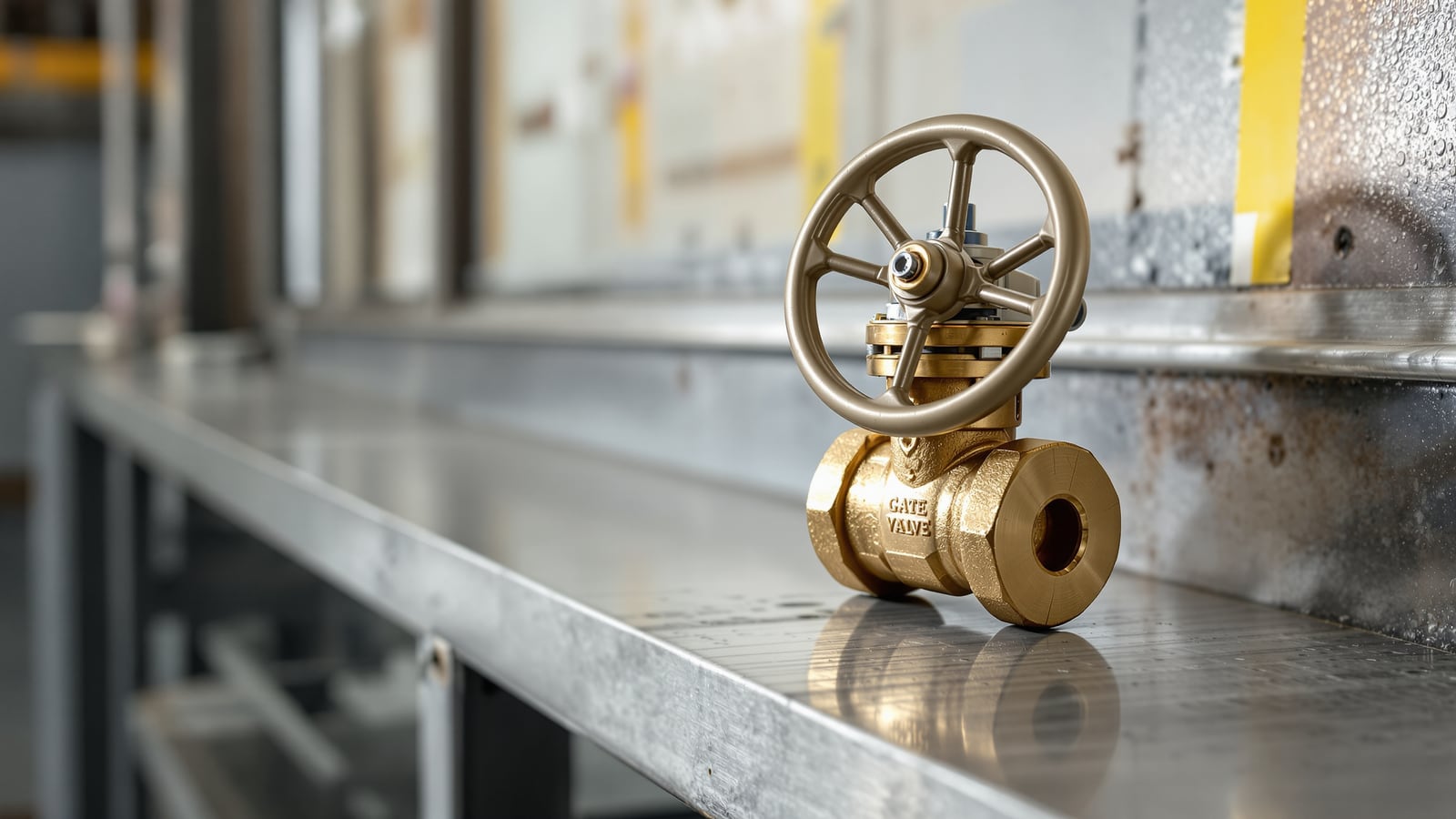
Gate Valves in India: How the Wheel Isolation Valve Works, Where to Use It & When to Replace It
The multi-turn wheel valve that isolates larger water lines and mains with a full-bore, low-resistance opening — how the rising and non-rising wedge-gate mechanism works, why it is strictly ON/OFF and not for throttling, why it seizes and drips over time (and got replaced by ball valves at fixtures), where it still earns its place, and how to size, specify and cost it in an Indian home.
A gate valve is the classic round-wheel valve you turn several times to open or shut a water line. It is one of the oldest and simplest control devices in plumbing: a solid wedge slides down between two seats like a sluice gate to block flow, and lifts clear out of the pipe to let water pass with almost no obstruction. For decades it was the valve at every Indian tap, tank and pump — until the quarter-turn ball valve took over the fixture. Understanding where a gate valve still belongs, and where it does not, saves you both money and midnight leaks.
This homeowner's guide sits under the Studio Matrx plumbing valves hub and is the companion to the guides on ball valves — the valve that replaced it at fixtures — and on globe valves, the valve you actually want when the job is throttling rather than isolation.
What a gate valve is and how it works
Picture a small guillotine inside a pipe. Turning the hand-wheel drives a threaded stem up or down, and that stem raises or lowers a wedge-shaped gate (also called a disc) that seats between two machined faces. When the gate is fully lifted, the waterway is completely clear — a full-bore opening the same diameter as the pipe. When it is fully lowered, the wedge presses tight against both seats and seals the line.
The defining trait is that a gate valve is multi-turn: you spin the wheel several full rotations to travel from shut to open. That is deliberate. The slow, geared travel lets a gate valve seal large pipes with modest hand effort, and it means the valve opens and closes gently, so it does not slam the water column and cause water hammer the way a fast quarter-turn valve can on a long main.
- Full-bore, low resistance when open. With the gate fully retracted, there is nothing in the flow path — no ball, no plug, no disc edge. Pressure loss across an open gate valve is close to negligible, which is exactly why it suits mains and large-bore lines where you do not want to throttle the supply.
- Positive shut-off when closed. The wedge seats on both faces, giving a tight bubble-tight seal on a valve in good condition.
- Bi-directional. Flow can pass either way, so there is no mandatory inlet or outlet — install orientation is flexible.
Rising stem vs non-rising stem
Gate valves come in two mechanical layouts, and telling them apart matters for the space above the valve:
- Rising stem (OS&Y / outside screw). The stem lifts up out of the hand-wheel as you open the valve, so the exposed length of stem is a visual gauge — stem up means open, stem down means shut. It needs vertical clearance above the valve. Common on larger and industrial lines.
- Non-rising stem (NRS / inside screw). The stem turns in place and the gate travels up the thread internally; nothing rises above the wheel. It suits tight spaces, valve chambers and buried or boxed installations where headroom is limited. You cannot tell open from shut by looking, only by turning.
ON/OFF only — never for throttling
This is the single most important rule for using a gate valve well: it is an isolation valve, not a regulating valve. Its only two correct positions are fully open and fully closed.
If you leave a gate valve part-open to reduce flow, the water is forced through a narrow gap at the bottom of the partly lowered wedge. That high-velocity jet, running for hours or years, erodes the seat and the gate edge — a wear process often called wire-drawing. Vibration and chatter of the loose gate add to the damage. The result is a valve that will no longer seal even when you close it fully, because the sealing faces are pitted. When you need to control a flow rate rather than simply switch it, use a globe valve, which is built for exactly that duty — see the globe valves guide.
Golden rule: a gate valve lives fully open or fully closed. Throttle with a globe valve; switch fast with a ball valve; isolate a big line slowly and cleanly with a gate valve.
Why ball valves replaced gate valves at fixtures
If gate valves are so simple, why does almost every new Indian tap, geyser and toilet connection now use a small lever-operated ball valve instead? Because the gate valve's weakness shows up exactly at the fixture, where a valve sits unused for months and is then expected to shut off instantly and completely.
- It seizes. The threaded stem and the gate run in the water. Over years, hard Indian water leaves scale, and dissimilar metals corrode, so a gate valve that has not been turned in a long time freezes solid or shears its stem when you finally force the wheel — the classic discovery mid-emergency that the shut-off will not shut off.
- It weeps. The stem passes through a gland packing that dries out and shrinks with age, so an old gate valve develops a slow drip around the spindle. It also relies on the wedge faces staying smooth; any erosion and it no longer seals fully, leaving a fixture that never quite stops dribbling.
- It is slow and bulky. Several turns to close is a nuisance at a fixture, and you cannot see at a glance whether it is open or shut.
A quarter-turn ball valve answers all three: it snaps shut in 90 degrees, the lever shows its state instantly, and its polished ball-in-seat design shrugs off long idle periods far better. That is why, at the point of use, the ball valve won. The trade-off — and the reason gate valves survive on mains — is covered next.
Where gate valves still belong
The gate valve did not disappear; it retreated to the jobs it does best — isolating large lines that are opened and closed rarely, and where a full-bore, low-loss path matters.
- Water mains and large-bore lines. On the incoming municipal main, the pump delivery header, or a building's main riser, an open gate valve barely restricts flow — important when every metre of head counts. See the municipal water supply guide and the domestic water distribution guide.
- Sluice valves on tanks, sumps and pumps. The heavy cast-iron valve on a sump outlet, an overhead tank feed, or a pump suction/delivery line is usually a gate (sluice) valve — see the water tank plumbing context and the borewell and pump system guide.
- Sectional isolation on distribution mains. Where a plumber needs to close off a whole wing or floor for maintenance, a gate valve on the sub-main isolates it slowly enough to avoid water hammer on a big pipe.
In short: think ball valve at the fixture, gate (sluice) valve on the main. The bigger the pipe and the rarer the operation, the more a gate valve makes sense.
Sizes, materials and how to specify
Gate valves for Indian domestic and building use come in two broad material families. Choose by pipe size, pressure and where the valve sits.
| Size (mm / inch) | Material & type | Connection | Typical home / building use | Indicative price |
|---|---|---|---|---|
| 15 mm (1/2") | Gunmetal / brass, NRS | Threaded (BSP) | Older tap / geyser isolation (now usually ball valve) | ₹250 – ₹600 |
| 25 mm (1") | Gunmetal / brass | Threaded | Branch main, tank inlet | ₹550 – ₹1,200 |
| 40 mm (1.5") | Gunmetal / brass | Threaded | Main riser, pump line isolation | ₹1,200 – ₹2,800 |
| 50 mm (2") | Gunmetal / brass | Threaded / flanged | Building main, sump/pump header | ₹2,500 – ₹5,000 |
| 80–100 mm (3"–4") | Cast iron (CI) sluice valve | Flanged | Underground mains, tank sluice, large sump | ₹6,000 – ₹18,000 |
| 150 mm+ (6"+) | Cast iron sluice valve | Flanged | Municipal / large building mains | ₹20,000+ |
- Gunmetal / brass: corrosion-resistant, used for potable water up to roughly 50 mm; the standard choice for home and small-building lines.
- Cast iron (CI) sluice valves: for large-bore and buried mains, usually flanged, often with a non-rising stem so they sit neatly in a valve chamber. Heavier and cheaper per size than brass at large diameters.
- Connection: small valves are threaded (screw onto GI or brass pipe with PTFE tape); large valves are flanged (bolted between pipe flanges with a gasket).
- Orientation: a gate valve is bi-directional, so there is no fixed flow direction. Rising-stem types need headroom above the wheel; leave access to turn the wheel and to re-pack the gland later. Prices are indicative retail ranges — verify current rates locally.
Pros, cons and common failures
| Factor | Gate valve verdict |
|---|---|
| Flow resistance when open | Excellent — full bore, near-zero loss |
| Isolation / shut-off | Good when new; positive tight seal |
| Throttling / flow control | Poor — never use part-open (erodes the seat) |
| Speed of operation | Slow — several turns to open or close |
| Water-hammer risk | Low — gentle, gradual closing suits big mains |
| Reliability after long idle | Weak — seizes, stem shears, gland weeps |
| Best home role | Mains, risers, pump and tank sluice lines |
Common failures to watch for:
- Seized wheel / sheared stem — from years of no operation plus scale. Exercise mains valves a couple of turns once or twice a year so they do not freeze.
- Gland drip around the spindle — usually cured by tightening or re-packing the gland nut; a cheap fix if caught early.
- Will not seal fully when closed — eroded or scaled seats, often from being left part-open. Replacement is the usual answer.
- Water hammer if slammed — not a gate-valve trait as such, but do not over-fast a large valve; close it steadily.
Indicative cost
For a typical Indian home, budget roughly ₹250 – ₹600 for a 15 mm gunmetal gate valve, ₹1,200 – ₹2,800 for a 40 mm main-riser valve, and ₹6,000 – ₹18,000 for an 80–100 mm cast-iron sluice valve on an underground main or large sump. Flanged large valves add gasket and bolting cost plus a plumber's fitting charge. These are indicative retail figures for planning — confirm brand, class and current price with your supplier and plumber.
References
- IS 778 — Copper alloy gate, globe and check valves for waterworks purposes: the Indian Standard covering gunmetal/brass gate valves used on domestic and small building water lines. (Confirm the current edition and pressure class with your supplier.)
- IS 780 and IS 2906 — Sluice valves (cast iron) for waterworks: the Indian Standards for the larger flanged gate/sluice valves used on mains, tanks and sumps. Sizes and classes vary by standard — verify the exact designation for your application.
- The Studio Matrx plumbing valves hub, the ball valves guide and the globe valves guide for choosing the right valve for isolation, quick shut-off or throttling.
- All sizes, prices and standard references here are indicative for planning; confirm the current IS edition, valve class and local rates with a licensed plumber and supplier before purchase.
Export this guide
Related Guides — Deep-dive reading
Butterfly Valves in India: Wafer vs Lug vs Flanged, Sizing, Operators & Cost
The compact quarter-turn disc valve that isolates and throttles large-diameter lines — building risers, pump headers, tank connections, HVAC chilled-water and fire mains — at a fraction of the size, weight and cost of a gate valve. How the rotating disc works, which body style to specify, lever versus gear operator, materials and sizes, pros, cons and indicative pricing.
PlumbingPlumbing Valves Guide (India): Every Valve, What It Does and Where It Goes
A homeowner's master overview of the valves in an Indian plumbing system — the four jobs valves do (isolation, throttling, one-way, pressure control), which valve type does which job, where each one belongs from the main to every fixture, plus materials, threaded versus flanged connections and how to choose.
PlumbingBathroom Water Supply India: Cold & Hot Feed, Pipe Sizing, Pressure & Booster Pumps (2026)
How water actually reaches your fixtures in an Indian home — gravity-fed cold from the overhead tank, hot from the geyser, the pipe sizes that decide whether your shower gushes or dribbles, isolation valves at every fixture, booster pumps and hard-water protection, all mapped to IS 1172.
BathroomsRelated Tools — Try Free
Rainwater Tank Sizer
How big should your rainwater tank be? Computes annual harvest, recommended tank capacity in litres, water-bill savings, and payback — for 10 Indian cities.
RWH CalculatorBefore & After Studio
Generate AI before-and-after renders to preview how your redesign could look.
DesignAIBefore vs After — Cost Reality Check
Compare what you expected to pay vs what you actually paid, category by category.
Reality Check