
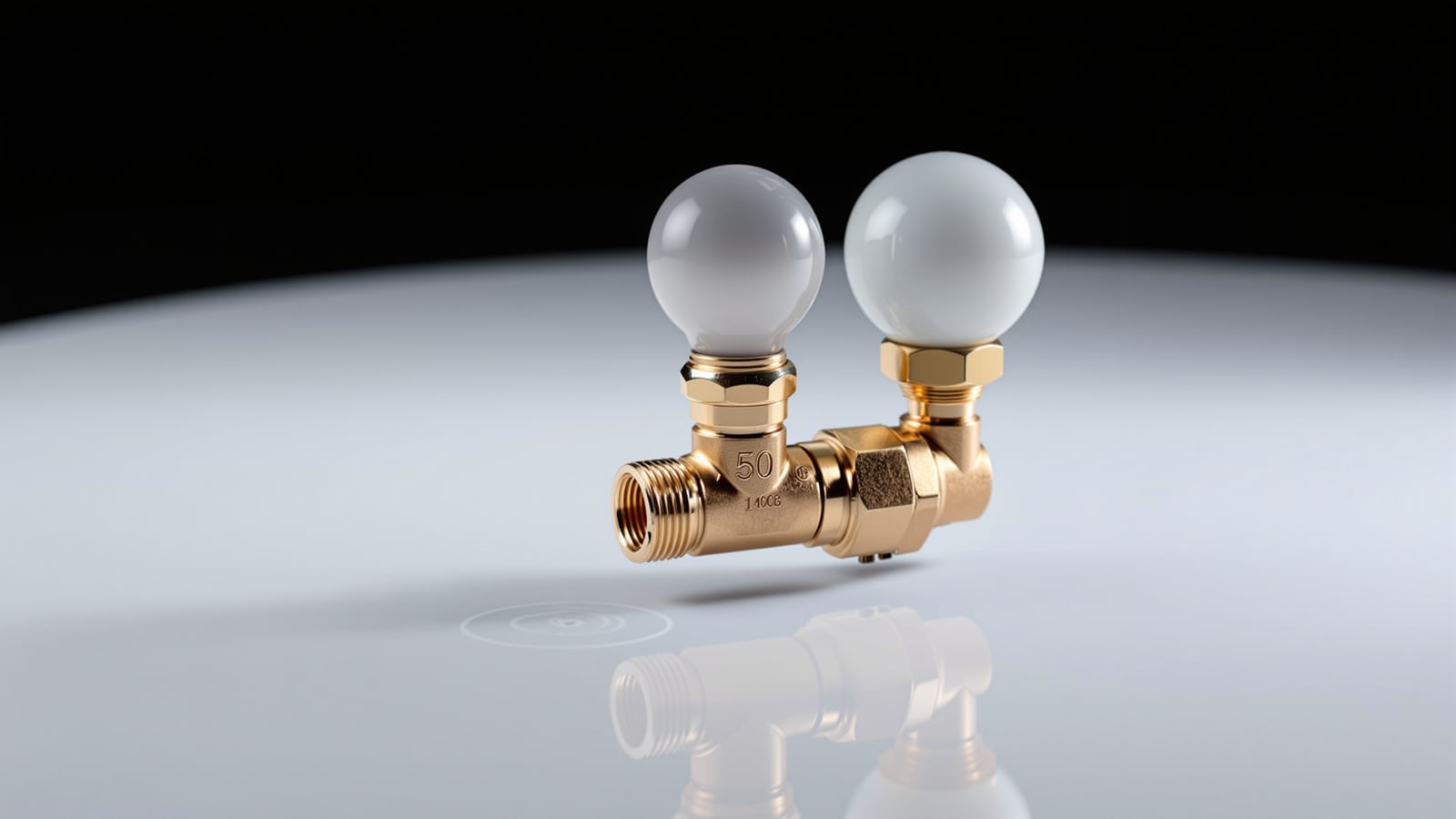
Float Valves (Ball Cock) in India: How They Work, Sizing, Fitting & Fixing Overflow
The self-acting valve that fills a tank and shuts off when it is full — how a float-arm ball cock works, where it is used in overhead tanks, sumps, WC cisterns and cooling towers, brass versus plastic, how it relates to overflow and float-switch backup, why it drips and overflows, adjustable water level, sizes, fitting, pros and cons, and indicative cost.
A float valve — the fitting most Indian plumbers and hardware shops call a ball cock — is the small self-acting valve that fills a water tank and shuts the supply off the moment it is full, with no electricity, sensor or attention from you. A hollow ball floats on the water surface; as the level rises the ball lifts a lever that presses a washer against the inlet seat and stops the flow. When you draw water and the level drops, the ball falls, the valve reopens, and the tank tops itself up. It is one of the oldest and most reliable pieces of plumbing in any home.
This guide sits under the Studio Matrx plumbing valves guide and is a companion to the guide on ball valves, which despite the similar name is a completely different device — a quarter-turn on/off tap, not an automatic filler. For how the tank itself is sized and specified, see the forthcoming water storage tanks guide and, for bathrooms specifically, the bathroom water tank calculator.
What a float valve does and how it works
A float valve is an automatic, level-controlled shut-off. Its job is not to throttle flow or control pressure — it is fully open or fully closed depending on one thing: the water level under the float.
The mechanism is simple and mechanical:
- A hollow float (ball or oblong) sits on the water and rises and falls with the level.
- The float is fixed to a lever arm, pivoted at the valve body.
- As the water rises, the arm swings up and drives a plunger and washer onto the inlet seat.
- When the washer seals the seat, inflow stops. As water is drawn off and the level falls, the arm drops, the washer lifts off the seat, and water flows again.
Because it needs no power and no external control, a float valve is what makes an overhead tank fed from a pump or the municipal main fill and stop by itself.
Think of the float valve as the tank's own brain. The pump or the mains delivers water; the float valve decides when the tank has had enough. If it fails, the tank has no way of knowing it is full — which is exactly why a failed float valve causes an overflow.
Where float valves are used
The same basic device appears wherever a vessel needs to be kept topped up automatically:
- Overhead (terrace) tanks — the classic use. The pump or municipal line feeds the tank; the float valve stops it overflowing. On pumped systems the float valve is the last line of defence, and a separate float switch usually cuts the pump (more on that below).
- Underground sumps — a large float valve on the municipal inlet keeps the sump filled without manual intervention, so the transfer pump always has water.
- WC cisterns — every flush tank has a small float valve (often a compact side-inlet or bottom-inlet type) that refills the cistern after each flush and shuts off silently.
- Cooling towers, RO feed tanks, cattle troughs, industrial process tanks — anywhere a level has to be held automatically, a heavier-duty float valve does the job.
Float valve vs float switch — a common confusion
These two things are often on the same tank and are easy to mix up:
- A float valve (ball cock) is a purely mechanical valve on the water pipe. It physically opens and closes the inlet. No wiring.
- A float switch is an electrical sensor with no valve at all. It floats up and down and switches a circuit — typically to start and stop the pump, or to sound a full-tank alarm.
A well-set-up overhead tank often has both: the float switch turns the pump off when full (saving energy and pump wear), while the float valve is the mechanical backup that stops an overflow if the switch sticks. Motorised or sensor-based smart shut-off and leak-detection valves are a separate topic — see the Studio Matrx smart-home material rather than relying on a ball cock for that role.
Materials: brass vs plastic float valves
Two families dominate the Indian market.
- Brass float valves — body, arm and internals in brass, usually with a copper or plastic float. Robust, tolerant of pressure and heat, long-lived, and repairable (you can replace the washer). Preferred for overhead tanks, sumps and anything on a pumped or high-pressure line. Costlier.
- Plastic (PP / nylon / PVC) float valves — light, cheap, corrosion-proof and fine for low-pressure WC cisterns and small tanks. The float is usually a sealed plastic ball. Cheaper and adequate, but the arm and clip can fatigue and the seat can wear faster under grit.
For a terrace tank on a booster pump, brass is the safer specification; for a flush cistern, a good plastic unit is normal and perfectly serviceable.
Sizes and a selection guide
Float valves are sized by their inlet connection (the thread that screws into the tank wall or the supply pipe), commonly 15 mm (½"), 20 mm (¾"), 25 mm (1") and up. Bigger inlets pass more water and are used where fast filling or higher flow is needed.
| Size (inch / mm) | Body material | Connection | Typical use | Indicative price |
|---|---|---|---|---|
| ½" / 15 mm | Plastic (PP) | Threaded | WC cistern, small tank | ₹120 - ₹350 |
| ½" / 15 mm | Brass | Threaded | Small overhead tank, RO feed | ₹350 - ₹900 |
| ¾" / 20 mm | Brass | Threaded | Domestic overhead tank | ₹600 - ₹1,500 |
| 1" / 25 mm | Brass | Threaded | Large tank / sump on mains | ₹1,200 - ₹3,000 |
| 1¼" - 2" / 32 - 50 mm | Brass / gunmetal | Threaded or flanged | Cooling tower, industrial / bulk tank | ₹3,000 - ₹12,000+ |
Prices are indicative retail ranges (2026) and vary by brand and city — verify locally.
Many modern valves are adjustable: you set the shut-off level either by bending the metal arm slightly, by an adjustment screw at the pivot, or (on cistern types) by sliding a clip on the float rod. Setting the level a little below the overflow gives you a safety gap.
Fitting a float valve
- Mount the valve near the top of the tank, threaded through the wall with the float swinging freely on the inside — nothing (pipe, wall, another fitting) must obstruct the ball's travel.
- Set the shut-off level below the overflow/warning pipe, so that even if the valve is slow to seat, water leaves via the overflow, not over the tank rim.
- Keep the supply isolated by a separate stop valve (a ball valve or gate valve) upstream, so you can shut off water to service the float valve without draining the system. See the plumbing valves guide for how these fit together.
- On pumped systems, don't rely on the float valve alone — pair it with a float switch so the pump actually stops, rather than dead-heading against a closed float valve.
- Ensure the tank has a correctly sized overflow pipe routed to a safe, visible discharge, so a stuck valve announces itself instead of soaking the slab.
Common failures and how to spot them
Nearly every float valve complaint reduces to one symptom — the tank overflows or the cistern keeps running — and a handful of causes:
| Symptom | Likely cause | Fix |
|---|---|---|
| Tank overflows, water runs from overflow | Worn / hardened inlet washer no longer seals | Replace washer (or valve) |
| Overflow even with new washer | Grit or scale on the seat | Clean or descale the seat |
| Valve never closes | Float has cracked and filled with water, so it sinks | Replace the float |
| Valve never opens / tank won't fill | Arm bent or jammed against tank wall; float stuck | Free the arm, reset the level |
| Water level too high or too low | Shut-off level maladjusted | Adjust screw / bend arm |
| Persistent slow drip into cistern | Seat worn or arm set too high | Re-seat washer, lower the level |
The costliest of these is a stuck-open valve on a terrace tank: it wastes water continuously and, if the overflow is undersized or blocked, floods the roof and the walls below. This is why the overflow pipe and, on pumped systems, a working float switch matter — they contain a float valve failure instead of letting it run for hours. A slow overflow can quietly waste thousands of litres a month, so a dripping float valve is worth fixing promptly.
Hard water is the biggest enemy: scale builds on the seat and washer and stops a clean seal. In hard-water areas, expect to replace the washer periodically as routine maintenance.
Pros and cons
Pros
- Fully automatic, needs no power, sensor or attention.
- Simple, cheap and near-universally available in Indian hardware shops.
- Easily repaired — usually just a washer — and long-lived in brass.
- Provides a mechanical overflow backstop even where a float switch controls the pump.
Cons
- Wears out silently; a failed valve overflows rather than warning you.
- Sensitive to grit and hard-water scale on the seat.
- Purely mechanical — it cannot turn a pump off; that needs a float switch.
- Cheap plastic units can fatigue, crack or sink over a few years.
Indicative cost
A domestic ¾" brass float valve is roughly ₹600 - ₹1,500; a plastic cistern valve ₹120 - ₹350; a large brass or gunmetal valve for a sump or cooling tower runs ₹3,000 - ₹12,000+. A replacement washer is a few rupees. Fitting is minor labour, usually bundled into a plumber's visit. These are indicative 2026 retail figures — confirm current local prices.
References
- National Building Code of India (NBC) — Part 9, Plumbing Services, for water supply and storage tank provisions.
- Uniform Plumbing Code of India (published by the Indian Plumbing Association).
- Bureau of Indian Standards specifications for float-operated (ball) valves for water supply fittings — confirm the current IS number and edition with a BIS source before quoting it.
Export this guide
Related Guides — Deep-dive reading
Toilet Maintenance India: Clean the Bowl, Fix a Running or Weak-Flush WC (2026)
The WC is the hardest-working fitting in an Indian bathroom and the quietest money-waster when it fails. This is the practical, do-it-yourself guide to keeping a toilet clean and working: scrubbing the bowl and under the rim, killing the hard-water limescale ring, and fixing the four things that actually go wrong — a running cistern, a weak flush, a leak, and a blockage.
BathroomsBody Jets Shower India: Body Spray Massage Systems, the Flow & Pressure They Really Need, and What It Costs (2026)
Wall-mounted horizontal body jets turn a shower into a spa massage — but every jet is a thirsty extra outlet. How many jets, at what heights, the big pump and geyser they force, the pipe sizing and concealed valves you must plan before tiling, the water and running cost, and exactly who it is worth it for.
BathroomsButterfly Valves in India: Wafer vs Lug vs Flanged, Sizing, Operators & Cost
The compact quarter-turn disc valve that isolates and throttles large-diameter lines — building risers, pump headers, tank connections, HVAC chilled-water and fire mains — at a fraction of the size, weight and cost of a gate valve. How the rotating disc works, which body style to specify, lever versus gear operator, materials and sizes, pros, cons and indicative pricing.
PlumbingRelated Tools — Try Free
Rainwater Tank Sizer
How big should your rainwater tank be? Computes annual harvest, recommended tank capacity in litres, water-bill savings, and payback — for 10 Indian cities.
RWH CalculatorBathroom Water Tank Calculator
Size the overhead storage tank and sump a home needs for its bathrooms and daily use, by people, bathrooms and reserve days.
Bathroom CalculatorWater Storage Days Calculator
Find how many days your water storage lasts in a supply cut from total capacity, occupants and per-person use.
Plumbing Calculator