
Ball Valves in India: The Quarter-Turn Isolation Valve Explained
Why the quarter-turn ball valve has become the default isolation valve in modern Indian plumbing — how the bored ball shuts off flow in a 90-degree turn, full-bore versus reduced-bore, why it replaced the seizing gate valve, materials from brass to CPVC, sizes, where to fit it, and what it costs.
A ball valve is the small lever valve you now find almost everywhere water needs to be turned on or off cleanly: at the base of a WC, under a wash basin, on the inlet to a geyser, at the tank outlet, and on the main coming into the house. Flick the handle a quarter turn and the flow stops dead; flick it back and it runs full again. That simplicity is exactly why it has quietly replaced the older gate valve as the default isolation valve in modern Indian plumbing.
This homeowner's guide explains what is happening inside that lever, how to pick the right one, and where each type belongs. It sits under the Studio Matrx plumbing valves guide, reads alongside the guide to gate valves it has largely displaced, and connects to how your home is plumbed in the domestic water distribution guide.
What a ball valve is and how it works
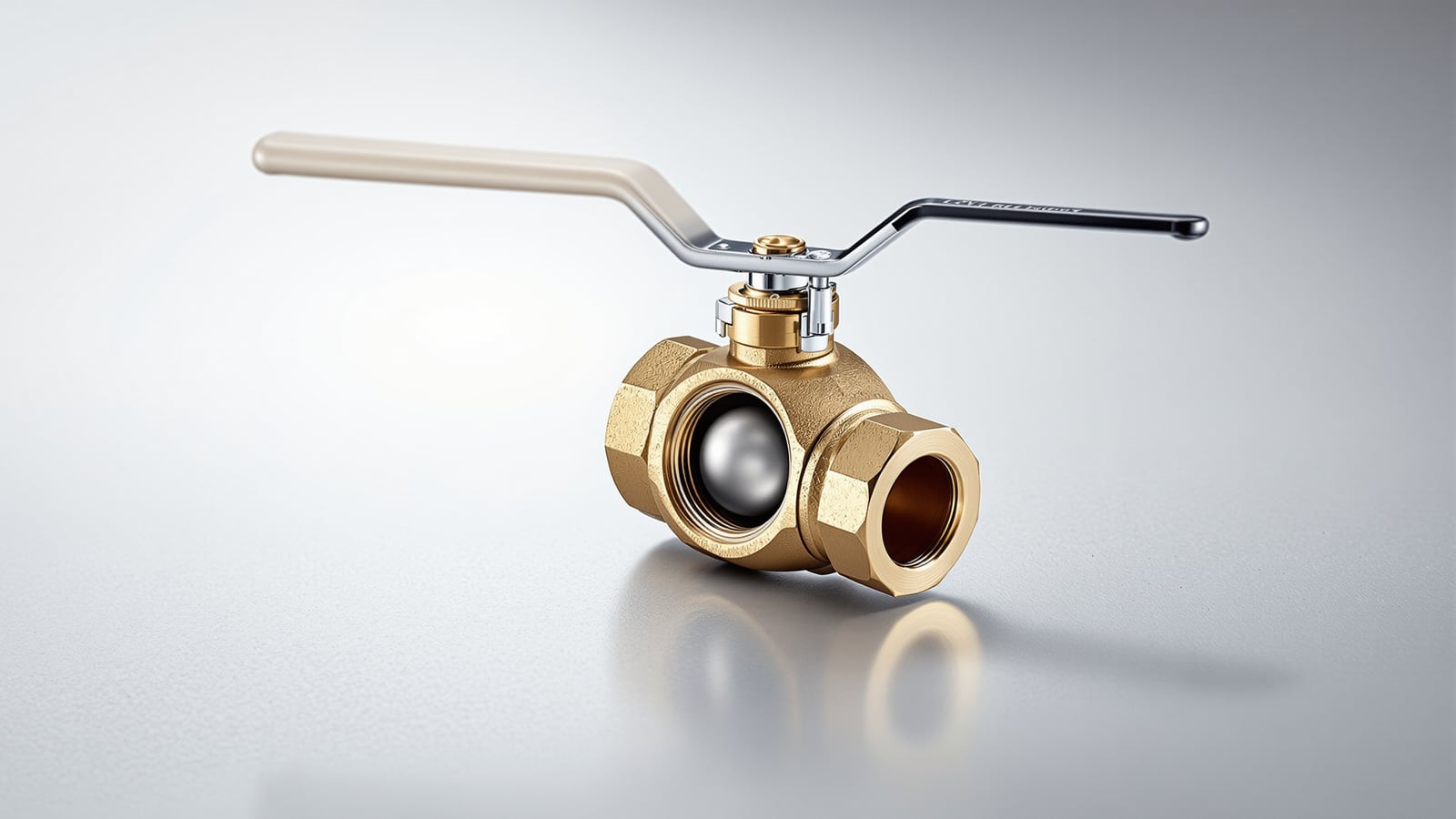
Inside the body sits a solid ball with a hole — a bore — drilled straight through it. The ball is trapped between two soft seats (usually PTFE, the same material as non-stick coating) that press against it and seal. The handle is fixed to the top of the ball through a stem.
The whole mechanism is a single, elegant idea:
- When the bore lines up with the pipe, water flows straight through the hole. The valve is open.
- When you turn the handle 90 degrees, the ball rotates so its solid face meets the flow. The bore now points sideways, and the two seats seal against the ball. The valve is shut.
That is the entire action — a quarter-turn from fully open to fully shut, with nothing to wind up or down. The lever also tells you the state at a glance: in line with the pipe means open, across the pipe means closed. There is no guessing.
The defining trait of a ball valve is the quarter turn. One short flick of the wrist takes you from full flow to a positive, drip-free shut-off — no threads to wear, no rising spindle, no half-open uncertainty.
Full-bore versus reduced-bore
Not all ball valves have the same size hole, and this matters more than most people realise.
- Full-bore (full-port): the hole through the ball is the same diameter as the pipe. Water passes with almost no restriction, so there is negligible pressure or flow loss. Bodies are chunkier and cost a little more.
- Reduced-bore (standard-port): the hole is one pipe-size smaller. The body is more compact and cheaper, but the flow pinches slightly as it squeezes through.
For a home running on gravity from an overhead tank — where pressure is already modest — a full-bore valve on the main and the tank outlet is worth the small extra cost so you do not throw away head. At an individual tap or WC, a reduced-bore valve is perfectly fine because the fixture itself restricts flow anyway.
Why it replaced the gate valve for isolation
For decades the gate valve — the round wheel you wind up and down — was the standard isolation valve. In practice it had a habit of failing exactly when you needed it:
- It seizes. A gate valve that sits untouched for two years often refuses to move, and forcing the wheel can snap the spindle or shear the wedge.
- It never quite shuts. Grit and scale collect in the seat, so a "closed" gate valve keeps weeping — no use when you are trying to change a tap.
- It is slow and unclear. Many turns to operate, and no obvious way to tell open from closed.
A ball valve answers all three. It turns instantly, it seals positively on soft seats even after long neglect, and its lever shows the state. The trade-off — that it is meant for on/off, not fine flow control — is a non-issue for an isolation valve, whose only job is on or off. That combination is why plumbers now reach for a ball valve wherever they simply need to shut a line.
| Feature | Ball valve | Gate valve |
|---|---|---|
| Action to shut | Quarter turn (90°) | Many turns of a wheel |
| Reliability after idle years | Excellent — rarely seizes | Poor — tends to seize |
| Shut-off tightness | Positive, drip-free | Often weeps at the seat |
| State at a glance | Clear from lever | Not obvious |
| Best job | On/off isolation | Slow throttling, large mains |
| Cost | Low to moderate | Low |
Materials: brass, CP, PVC and CPVC
The right material depends on where the valve goes and whether it will be seen.
- Forged brass: the workhorse. Strong, long-lasting and suitable for both hot and cold lines. Used on mains, tank outlets, geyser inlets and concealed isolation points. Insist on forged brass (denser, stronger) over cheap cast bodies.
- Chrome-plated (CP) brass: brass with a mirror finish for exposed, visible spots — the angle valve under a basin or beside a WC. Same guts, better looks.
- UPVC / PVC: plastic-bodied valves used on cold-water plastic pipework and in tank and garden lines. Light, rust-proof and cheap, but not for hot water.
- CPVC: matched to CPVC hot-and-cold piping and solvent-welded straight into the line. The natural choice when your home is plumbed in CPVC.
Match the valve to the pipe it joins — a brass valve threads onto a threaded line, a CPVC valve solvent-welds into CPVC. Mixing materials at a joint is where leaks begin.
Sizes and where each one goes
Ball valves come in the same nominal sizes as your pipes, quoted in inches or millimetres. This table is a practical guide for a typical Indian home; treat prices as indicative and verify locally.
| Size (inch / mm) | Typical body | Where it is used | Bore | Indicative price |
|---|---|---|---|---|
| 1/2" (15 mm) | CP brass angle / brass | Tap, WC, basin, geyser inlet | Reduced | ₹250 – ₹700 |
| 3/4" (20 mm) | Forged brass | Fixture group, small branch | Full/Reduced | ₹350 – ₹900 |
| 1" (25 mm) | Forged brass | Floor/branch isolation, tank outlet | Full-bore | ₹550 – ₹1,400 |
| 1.1/4" – 1.1/2" (32 – 40 mm) | Forged brass | Main riser, pump line | Full-bore | ₹900 – ₹2,500 |
| 2" (50 mm) | Brass / PVC | House main, overhead tank outlet | Full-bore | ₹1,600 – ₹4,000 |
The angle valve (also called a stop valve) is simply a compact CP ball valve with the outlet turned 90 degrees, made to sit neatly where a flexible connector rises to a tap or WC cistern — it is the most common ball valve in any home.
Where they sit in your plumbing
A ball valve earns its place wherever you might one day need to shut water to a part of the house without killing supply to the whole home.
- House main: one full-bore valve where supply enters, so the whole home can be isolated.
- Tank outlet: at the overhead tank, to shut the feed for cleaning or repairs.
- Floor / branch: one per floor or wing, so work on one bathroom does not dry out the rest.
- Fixture / angle valves: at every tap, WC and geyser, so a single fixture can be serviced with everything else still running.
Good practice is a small ball valve at each fixture — it turns a leaking tap from a house-wide shut-off into a two-minute job.
Installation and orientation
Ball valves are forgiving to fit, but a few points matter:
- Most home ball valves are bi-directional, so flow direction does not matter. Some (with a check feature) have a stamped arrow — follow it.
- Fit the valve where the handle can swing freely through its full quarter turn and stays reachable.
- On threaded brass, use PTFE tape on the male thread; on CPVC, solvent-weld to the pipe maker's instructions.
- Do not bury an isolation valve behind tile with no access. A concealed valve you cannot reach is worthless the day it matters.
Pros, cons and common failures
Pros: fast quarter-turn action, positive drip-free shut-off, reliable after long idle periods, visible open/closed state, low flow loss on full-bore, long life, low cost.
Cons and limits:
- Not for throttling. A ball valve run half-open erodes the seats and the ball edge, and gives poor, jumpy flow control. For adjusting flow, use a globe or gate valve instead — keep the ball valve fully open or fully shut.
- Water hammer. Because it shuts so fast, slamming a large ball valve closed can send a pressure shock through the pipes. Close big valves gently.
- Handle nuisance: a lever left in a walkway can be knocked. Lever-lock or oval handles help.
Common failures are few: a worn PTFE seat that lets a closed valve weep, a stiff stem from scale in hard-water areas (an occasional full open-and-shut keeps it free), or a cracked cheap cast body under pressure — which is why forged brass is worth paying for.
References
- IS 9890: Ball valves (brass) for general purposes — specification
- National Building Code of India (NBC), Part 9: Plumbing Services
- Bureau of Indian Standards (BIS) product standards for plumbing valves
Figures are indicative for Indian conditions and vary by brand, city and date — confirm sizes, pressure ratings and prices with your plumber and supplier before buying.
Export this guide
Related Guides — Deep-dive reading
Gate Valves in India: How the Wheel Isolation Valve Works, Where to Use It & When to Replace It
The multi-turn wheel valve that isolates larger water lines and mains with a full-bore, low-resistance opening — how the rising and non-rising wedge-gate mechanism works, why it is strictly ON/OFF and not for throttling, why it seizes and drips over time (and got replaced by ball valves at fixtures), where it still earns its place, and how to size, specify and cost it in an Indian home.
PlumbingButterfly Valves in India: Wafer vs Lug vs Flanged, Sizing, Operators & Cost
The compact quarter-turn disc valve that isolates and throttles large-diameter lines — building risers, pump headers, tank connections, HVAC chilled-water and fire mains — at a fraction of the size, weight and cost of a gate valve. How the rotating disc works, which body style to specify, lever versus gear operator, materials and sizes, pros, cons and indicative pricing.
PlumbingBathroom Water Supply India: Cold & Hot Feed, Pipe Sizing, Pressure & Booster Pumps (2026)
How water actually reaches your fixtures in an Indian home — gravity-fed cold from the overhead tank, hot from the geyser, the pipe sizes that decide whether your shower gushes or dribbles, isolation valves at every fixture, booster pumps and hard-water protection, all mapped to IS 1172.
BathroomsRelated Tools — Try Free
Cross-Ventilation Analyzer
Estimate airflow and air changes per hour (ACH) from room size, window areas, layout, and local wind — with NBC 2016 Part 8 compliance check.
Ventilation CalculatorPlumbing Pressure-Test & Leak Checklist
Pre-closure pressure and leak test — 9 categories, 60+ checkpoints across water supply, drainage, fixtures, waterproofing, hot water, tanks.
Pre-Closure TestBefore & After Studio
Generate AI before-and-after renders to preview how your redesign could look.
DesignAI