
Ramp Flooring in India: Anti-Slip Surfaces for Vehicle & Wheelchair Ramps
A ramp is the one floor where the surface is on a slope and wet, oily or rained on — so grip is a safety code, not a finish choice. Here is how to specify vehicle and accessibility ramp floors to NBC, RPwD and DIN R-ratings, with ₹/sq ft costs.
A ramp is the only floor in a building where the surface is permanently tilted, frequently wet, sometimes oily, and people or vehicles are moving across it under gravity. Every other floor can lose grip and you simply slow down; on a ramp, a slip becomes a slide. That is why on a ramp the finish is not a design choice — it is a safety specification governed by the National Building Code, the Rights of Persons with Disabilities Act and DIN slip ratings. This guide tells you, as a designer or builder, exactly how to floor the two ramps you will actually detail in India: the vehicle ramp into basement parking, and the pedestrian or wheelchair accessibility ramp.
Why a ramp is a different flooring problem
On a flat floor, slip resistance is one factor among many. On a ramp, three things conspire against grip and the surface has to fight all of them at once:
- Gravity is always pulling down the slope. A tyre or a foot needs far more friction to hold position on an incline than on the flat. The steeper and longer the ramp, the higher the slip rating you must specify.
- The ramp is usually wet, and often oily. A basement vehicle ramp catches rain dragged in on tyres, engine drips and washdown water that all run down the slope. An external accessibility ramp is rained on directly. Polished or glossy finishes that pass on a dry lobby floor are dangerous here.
- The user is least able to recover. A car loses traction and rolls back; a wheelchair user or an elderly person on an external ramp has no margin for a slip. The whole point of the ramp — to make movement safer and accessible — is defeated if the surface is not gripped.
So the governing driver for ramp flooring is maximum grip on a slope, in the wet, under load. Everything else — looks, cost, cleanability — comes second. The two ramp types have different priorities beyond that shared rule, so treat them separately.
Vehicle ramps: grip under turning, loaded tyres
A basement-parking ramp carries the full point load of cars and SUVs on tyres that are usually turning as the ramp curves. It must give grip to a wet, possibly oily tyre on a steep slope (vehicle ramps commonly run at 1:8 to 1:10, much steeper than a pedestrian ramp), resist abrasion from grit and turning tyres, and shed water down the slope to a channel at the bottom. The top surfaces in Indian practice:
1. Grooved / broom-finished concrete — the default vehicle ramp
A cast-in-situ concrete ramp finished with transverse grooves (or a stiff broom drag across the slope) is the standard, economical, durable vehicle-ramp surface. The grooves run across the direction of travel so tyres bite on each rib, and they channel water down the slope. Specify the grooves cut or formed while the concrete is green, roughly 6-10 mm deep at 30-50 mm centres, running across the ramp. This is a polished concrete substrate finished the opposite way — deliberately textured, never polished. Cheap, repairable and high-grip when detailed properly.
2. Cast-in grip grooves / ribbed concrete — engineered traction
For steeper or high-traffic commercial ramps, the grooves are formed deliberately as ribs rather than just broom-textured: a saw-cut or formwork-cast pattern of raised ribs across the slope gives a defined, durable anti-slip key that survives years of turning tyres. This is the most reliable grip for a long, steep basement ramp and is the detail you see in malls and large commercial basements. It targets the DIN 51130 R12-R13 band that commercial vehicle circulation needs.
3. Heavy-duty anti-slip epoxy with broadcast aggregate — the sealed ramp
Where the ramp must also be sealed, dust-free and easy to wash (premium basements, showroom approaches), a vehicle-grade epoxy flooring system with a broadcast quartz or aluminium-oxide aggregate gives a tough, non-absorbent, high-grip surface. The aggregate broadcast is what makes it safe on the slope — a plain smooth epoxy ramp is dangerous and must never be used. Hot turning tyres can mark thin coats, so specify a heavy-duty vehicle-grade build. Keep epoxy off externally exposed ramps as it is not UV-stable.
4. Anti-slip stone or tiles — only with grooves cut in
You can finish a covered vehicle ramp in stone or heavy-duty tile, but only flamed/leathered (never polished) stone or R12 structured tiles, laid on a full bed with anti-slip grooves cut across the slope. Most designers reserve this for the visible apron at the ramp head and use grooved concrete on the slope itself. Our anti-slip flooring for wet areas guide covers the finishes that hold up.
Pedestrian and wheelchair ramps: grip plus accessibility code
An accessibility ramp is a legal element under the RPwD Act 2021 and NBC 2016, not just a sloped path. Beyond grip, it must meet gradient, width, landing, edge and tactile-warning rules so a wheelchair user, a person with low vision and an elderly person can all use it safely. The surface priorities:
1. Anti-slip R11-R12 tiles or stone with grooves
Use matt, structured, anti-slip vitrified tiles or flamed/leathered natural stone rated R11-R12, with anti-slip grooves running across the slope. This is the workhorse accessible-ramp surface for entrances, hospitals and public buildings. Pair it with the accessibility detailing below. See anti-slip flooring standards for the R-rating logic and accessible flooring standards for the code requirements.
2. Textured / flamed natural stone
Flamed granite or leathered Kadappa/sandstone gives durable, high-grip, premium-looking grip for an external entrance ramp and weathers monsoon well. Never use polished stone on a ramp — it is dangerously slick when wet.
3. Anti-slip nosing and tactile warning strips
These are not the main surface but they are mandatory safety details:
- Anti-slip nosing in a contrasting colour at the top and bottom of the ramp and on any step edge nearby, so the slope start and end are visible and gripped.
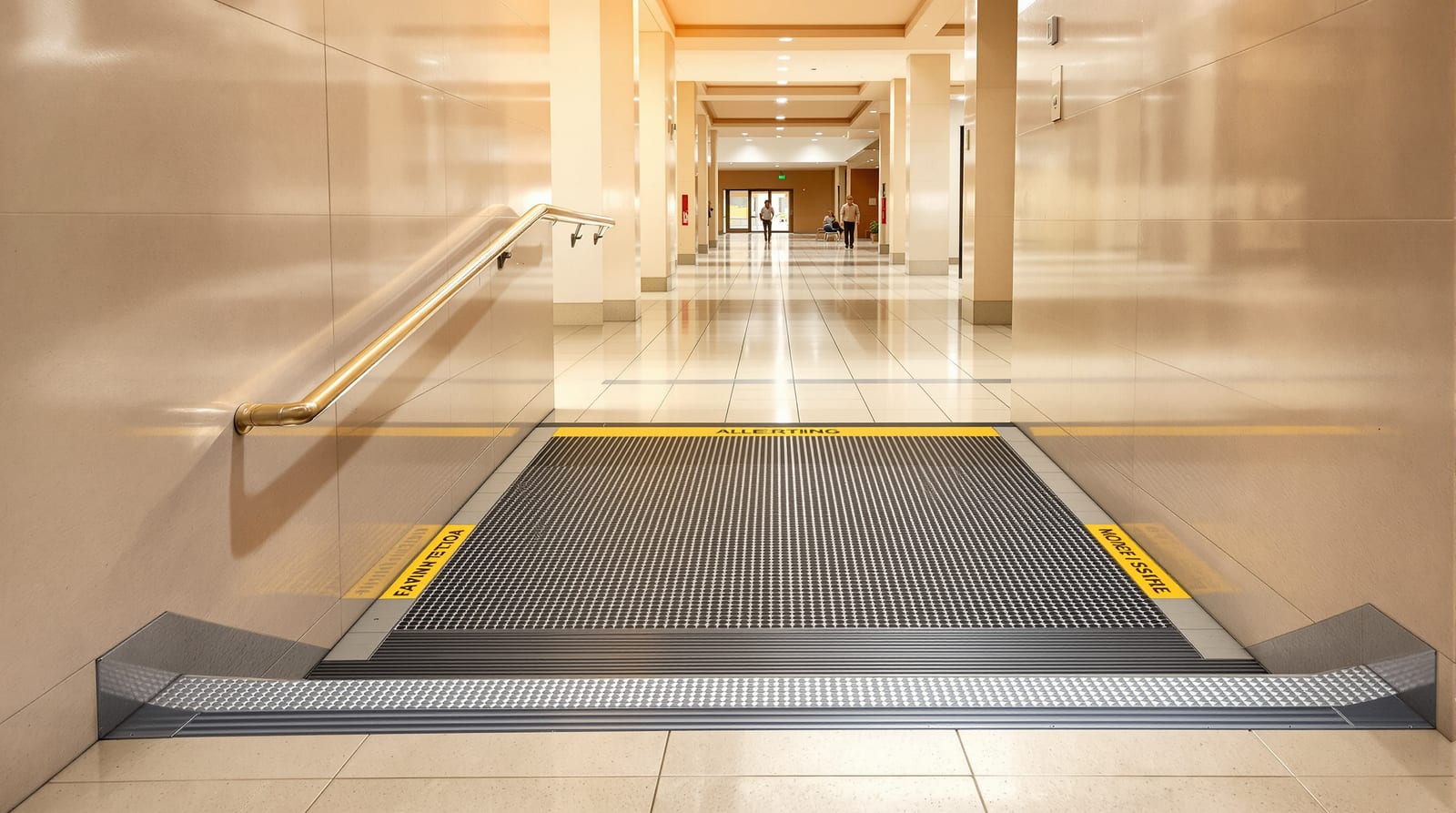
- Tactile warning strips (a band of truncated-dome / blister tactile tiles) at the top and bottom of the ramp to warn a person with low vision that the gradient is changing. Required under RPwD/NBC accessibility provisions.
- Colour and luminance contrast between the ramp surface, its edges and the handrail, so the ramp reads clearly for low-vision users.
The gradient is the law: 1:12
For an accessible ramp, NBC 2016 and the RPwD harmonised guidelines require a gradient no steeper than 1:12 (a rise of 1 unit for every 12 units of length), a minimum clear width of about 1.2 m, level landings at the top, bottom and at every 9 m of run, handrails on both sides, and a threshold transition not exceeding 12 mm. Get the gradient and landings right first — the floor finish sits on top of correct geometry, it cannot rescue a ramp that is too steep.
Ramp type, surface, grip and gradient at a glance
The table maps the two ramp types to the right surface, the slip rating to target and the gradient rule. Cost is indicative installed 2026 ₹/sq ft and shifts with city, base prep and finish.
| Ramp type | Recommended surface | Grip target | Gradient rule | Cost (₹/sq ft) |
|---|---|---|---|---|
| Basement vehicle ramp | Grooved / broom-finished concrete | DIN R12, grooves across slope | ≈1:8 to 1:10 (vehicle) | 130-280 |
| Steep / commercial vehicle ramp | Cast-in ribbed grip grooves | DIN R12-R13 | ≈1:8 to 1:10 | 150-320 |
| Sealed premium vehicle ramp | Anti-slip epoxy + broadcast aggregate | DIN R12-R13 | ≈1:8 to 1:10 | 180-450 |
| Covered vehicle ramp apron | Flamed stone / R12 tile, grooved | DIN R12 | per ramp | 130-350 |
| Pedestrian / wheelchair ramp | Anti-slip R11-R12 tile or flamed stone | DIN R11-R12 | ≤1:12 (RPwD/NBC) | 120-300 |
| External entrance ramp | Flamed granite / leathered stone | DIN R11-R12 | ≤1:12 | 150-350 |
| Ramp edges / warning | Anti-slip nosing + tactile strips | contrast + tactile | at top & bottom | add-on |
For deeper material costs, see parking area flooring for the vehicle side and the NBC flooring requirements guide for the code side.
How a ramp floor is detailed: gradient, grooves and tactile
The section below shows the elements that make a ramp safe: the controlled gradient, the anti-slip grooves cut across the slope, the tactile warning strip and nosing at top and bottom, and the fall that carries water down to a channel.
Cut or form the grooves across the direction of travel, never along it, so the tyre or foot crosses ribs rather than sliding in a channel. Give the ramp a slight cross or longitudinal fall so water runs to a channel at the foot and never ponds on the slope. Keep landings level — grooves and falls belong on the slope, not the landings.
Vehicle ramp vs accessibility ramp: specify differently
- Vehicle ramp (basement parking): prioritise abrasion resistance and grip under turning, loaded tyres. Best: grooved/broom-finished concrete as standard, cast-in ribbed grooves for steep or busy ramps, vehicle-grade anti-slip epoxy with aggregate where a sealed, washable surface is wanted. Target DIN R12-R13. Provide a drainage channel and oil-tolerant detailing at the foot.
- Accessibility / wheelchair ramp: prioritise the RPwD/NBC geometry first (≤1:12 gradient, 1.2 m width, landings every 9 m, handrails both sides, threshold ≤12 mm), then an R11-R12 anti-slip surface, then the mandatory tactile warning strips, contrasting anti-slip nosing and colour contrast. The floor finish completes a compliant ramp; it cannot fix a non-compliant one.
Do and don't
- Do cut anti-slip grooves across the direction of travel, and keep them clear of debris so they keep gripping.
- Do design the gradient first: ≤1:12 for accessible ramps, with level landings — get the geometry right before choosing the finish.
- Do add tactile warning strips and contrasting anti-slip nosing at the top and bottom of every accessibility ramp, per RPwD/NBC.
- Do give the ramp a fall to a channel at the foot so rain and washdown water never stand on the slope.
- Don't ever use polished stone, glossy tile or plain smooth epoxy on a ramp — they are dangerous on a wet slope.
- Don't run grooves along the slope (they channel a tyre rather than grip it) and don't omit the drainage channel at the bottom.
Care and upkeep
Keep grooves and the broom texture clear of silt and dead leaves so they keep gripping — a clogged groove is a smooth surface. Power-wash vehicle ramps to clear oil and grit; on epoxy and dense concrete it wipes off. Re-cut shallow grooves on a concrete ramp if years of tyre wear have worn them flat, and re-broadcast aggregate on an epoxy ramp when the texture polishes out. Repaint nosing and contrast lines as they fade, and keep tactile strips intact and replaced if loose. Reseal stone surfaces periodically — see our floor resealing guide.
Frequently asked questions
What is the best flooring for a basement car parking ramp in India?
Grooved or broom-finished cast-in-situ concrete is the standard, durable, economical choice, with the grooves cut across the slope for tyre grip. For steep or high-traffic ramps use cast-in ribbed grip grooves, and for a sealed, washable premium ramp use a vehicle-grade anti-slip epoxy with a broadcast aggregate. Target DIN R12-R13 and never use a polished or plain-smooth finish.
What gradient is required for a wheelchair ramp in India?
Under NBC 2016 and the RPwD Act 2021 harmonised guidelines, an accessible ramp must not be steeper than 1:12, with a minimum clear width of about 1.2 m, level landings at the top, bottom and every 9 m of run, handrails on both sides, and a threshold transition of 12 mm or less.
What slip rating should a ramp floor have?
Aim for DIN 51130 R11-R12 for a pedestrian or wheelchair ramp and R12-R13 for a vehicle ramp, always combined with anti-slip grooves cut across the slope. Our anti-slip flooring standards guide explains how the R-ratings map to wet, sloped surfaces.
Are tactile warning strips mandatory on accessibility ramps?
Yes. Under RPwD/NBC accessibility provisions, a band of tactile warning (truncated-dome) tiles is required at the top and bottom of an accessibility ramp to warn people with low vision that the gradient changes, together with contrasting anti-slip nosing and colour/luminance contrast at the edges. See accessible flooring standards.
How much does ramp flooring cost per sq ft in India?
Indicatively in 2026: grooved/broom-finished concrete ₹130-280, cast-in ribbed grooves ₹150-320, anti-slip epoxy with aggregate ₹180-450, flamed stone or R12 tile ₹130-350, and an anti-slip R11-R12 accessible ramp ₹120-300 per sq ft installed, with tactile strips and nosing as add-ons. City rates, slope length and base prep shift these figures, so verify current quotes locally.
Export this guide
Related Guides — Deep-dive reading
Flooring Standards in India: The Complete Code & IS Map (2026)
Every IS, NBC, BIS and slip code that decides whether your floor is safe, durable and legal — explained for homeowners and architects.
Flooring & SurfacesAccessible Flooring Standards in India: Age-Friendly & Barrier-Free Floors (RPwD, NBC, Harmonised Guidelines)
How to specify slip-resistant, level, glare-free and tactile flooring that meets India's accessibility law and codes for homes with elders or disabled users and for public buildings.
Flooring & SurfacesAnti Slip Flooring for Bathroom and Wet Areas in India: R-Ratings, Finishes and Genuinely Safe Tile Choices
How to choose genuinely safe flooring for bathrooms, kitchens, balconies, pools, entrances and elderly- or child-friendly homes — the R-rating system, finishes that grip wet feet, anti-skid natural stone, slope to drains and the tiles to avoid.
Flooring & SurfacesRelated Tools — Try Free
Accessible Door Checker
Check a door against wheelchair-accessibility guidance — clear width, threshold, handle and closer force per RPwD 2021.
Compliance ToolFlooring Cost Calculator
Estimate the all-in cost of a floor — material, laying, wastage, skirting and GST — by area and material.
Flooring CalculatorFlooring Material Selector
Get the best flooring material for your room, budget and climate, with anti-slip checks for wet areas.
Flooring Tool