
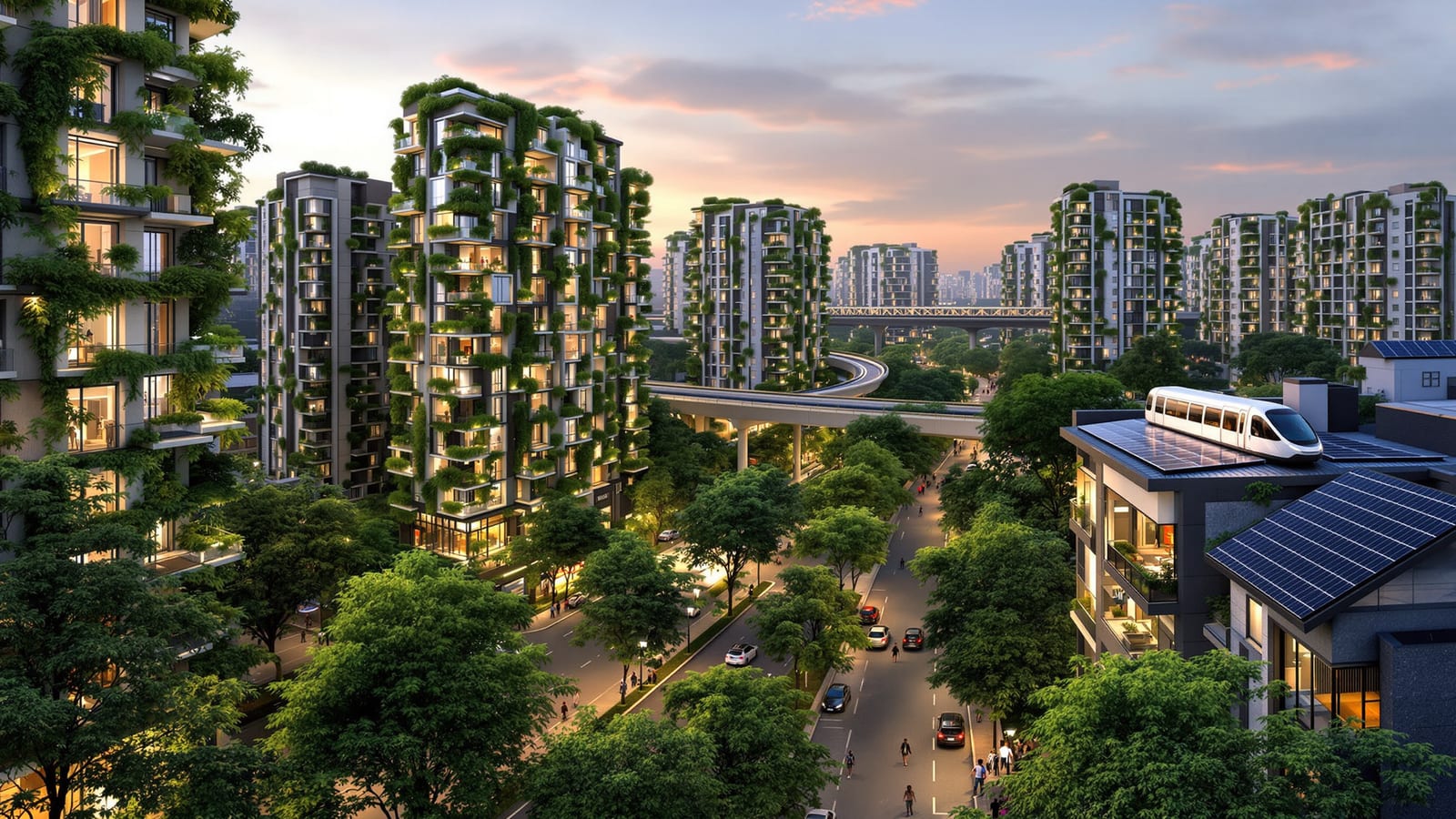
The Next Generation of Urban Living in India
How Indian cities are changing, and what the apartment, building and walkable neighbourhood of the near future look like for buyers
If you are buying or renting a home in an Indian city today, you are making a bet on the next twenty years. The flat that suits you now sits inside a city that is changing fast: getting taller, hotter, more crowded, more connected, and more app-run. Understanding where urban living is heading helps you choose a home that ages well instead of one that feels dated and stressful by 2035.
This guide is about the home, building and street scale of that change: what the apartment, the housing society and the walkable neighbourhood of the near future actually look like, and what a smart buyer should look for. It is a companion to our bigger-picture pieces on the future Indian township, which covers master-planned new-town development, and the anatomy of a good neighbourhood. Here we zoom in to the choices in front of you, and stay honest: India's urban future is shaped by real forces, but runs into equally real walls of affordability, patchy infrastructure and informality. The goal is to help you read the trends and protect yourself against the downsides.
1. The city is going up, and households are getting smaller
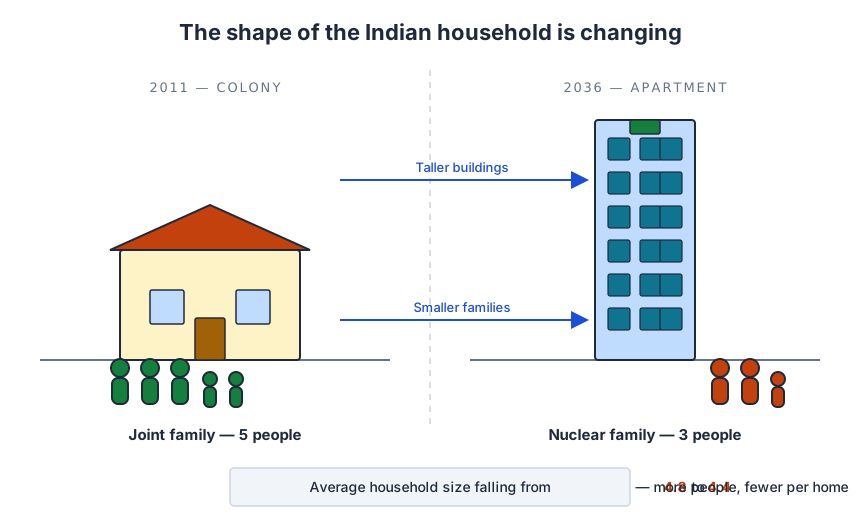
Two big numbers frame everything else. First, India's urban population is set to grow from about 377 million (31% of the country) in 2011 to roughly 600 million (40%) by 2036, according to the World Bank citing government projections. That is hundreds of millions of new city dwellers needing homes on land that is not expanding.
Second, the household those homes serve is shrinking. India's average household size has slipped from 4.8 people (Census 2011) to about 4.4 (National Family Health Survey 5, 2019-21), and nuclear families now make up roughly 58% of households. More people, smaller families, fixed land: the only direction left is up.
So expect verticality to keep rising. The cosy "ground-plus-two" colony is giving way to mid-rise and high-rise apartment living as the default urban home. This is not automatically bad. Done well, density supports good public transport, walkable shops and shared amenities. Done badly, it means towers crammed onto roads and drains built for a fraction of the load. As a buyer, the question shifts from "how big is my flat" to "how well does this building and locality carry its density."
2. The flexible, compact home, and the WFH room that fights it
Here is a genuine tension worth understanding, because the property market itself is pulling in two directions at once.
On one side, work-from-home made people want more room. After the pandemic, the need for a dedicated study or home-office and a study-from-home corner pushed average flat sizes in India's top seven cities up by about 32%, from roughly 1,145 sq ft (2019) to 1,513 sq ft (first half of 2024), per Anarock Research. Buyers who can afford it now treat a spare room as essential, not a luxury.
On the other side, affordability and land cost push the opposite way. In Mumbai, the most expensive market, flats have actually been getting smaller over the same period. Among young single professionals and renters across metros, compact formats and shared living are growing fast. Both trends are real; they simply apply to different people and different cities.
What this means for the future home is flexibility. The smart apartment of the next decade is designed to flex: a room that works as a study by day and a guest room at night, sliding partitions, foldaway furniture, balconies that double as workspace. If you are buying, value a layout that can change roles over a movable wall that is fixed. Your needs in 2030 will not match your needs today.
3. Renting first, co-living, and homes you do not own
The old assumption that every Indian adult marches toward owning a flat is loosening. Rental-first living is becoming a long-term choice, not just a waiting room before ownership.
The government's Model Tenancy Act, 2021 (approved by the Union Cabinet in June 2021) is meant to make renting safer for both sides, with registered agreements, deposit caps and fast dispute resolution. One aim is to unlock the roughly 11 million urban homes lying vacant because owners feared they could never get tenants out under old rent-control laws. It is a model law, so it only bites where a state actually adopts it, and adoption has been slow, but the direction is clear: a more formal, more renter-friendly market.
Alongside this, organised co-living, professionally managed shared housing with private rooms and shared kitchens and lounges, is growing. Colliers India estimated the organised co-living market at about ₹40 billion in 2025, projected to grow roughly fivefold to ₹200 billion by 2030, with managed beds tripling from about 0.3 million to 1 million. That still serves a tiny slice of the roughly 50 million urban migrants aged 20-34, so the gap between demand and supply is huge.
For a homeowner, this matters in two ways. If you are buying to live, expect more of your neighbours to be renters and more buildings designed for tenancy. If you are buying as an investment, rental demand, especially near workplaces and transit, is the engine of your returns.
4. The 15-minute idea: getting your life back within a walk
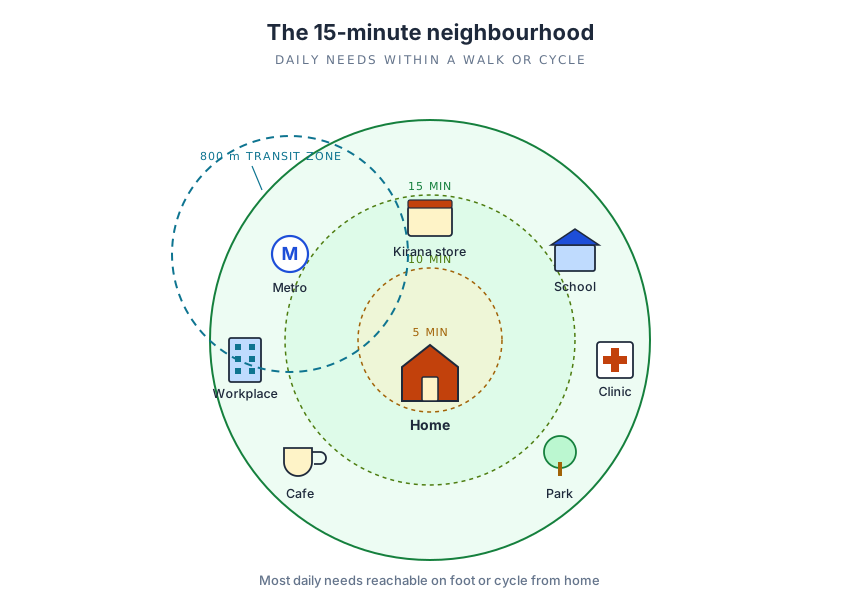
One of the most talked-about urban ideas is the 15-minute city: arranging neighbourhoods so most daily needs, groceries, school, clinic, park, work, sit within a 15-minute walk or cycle. In India this is still mostly aspirational, discussed in research and pilot studies rather than rolled out as a national programme. Be honest about that when you hear it in a builder's brochure.
But the underlying logic, walkable, mixed-use neighbourhoods, is genuinely shaping policy. India's National Transit Oriented Development (TOD) Policy (MoHUA, 2017) pushes higher-density, mixed-use, walkable development within roughly 500-800 metres of transit stations. The principles read like a wishlist for a good locality: walk, cycle, connect, mix, densify, compact. Our guide on walkable neighbourhood design goes deeper into what this feels like on the ground.
The honest caveat: implementation lags badly behind the metro lines being built. A policy on paper does not guarantee footpaths that exist. So when judging a locality, do not take the vision on trust. Walk it yourself. Can you reach a kirana store, a chemist and a bus or metro stop on foot, safely, after dark? That single test tells you more than any masterplan render.
5. Metros, EVs and the slow death of the parking podium
How people move is quietly reshaping the home itself. India's metro network has grown from about 248 km across 5 cities in 2014 to roughly 1,090 km across 26 cities by the end of 2025, the world's third-largest, with daily ridership climbing past 11 million (MoHUA figures). A home within walking distance of a metro station is becoming one of the most durable things you can own, because that access only gets more valuable as roads choke.
Electric vehicles are the next shift. EV penetration reached around 7.6% of vehicle sales in 2024 by NITI Aayog's count (other government data puts it nearer 5.6%), still far below the global average and far from the EV30@30 target of 30% by 2030, which NITI itself admits India is well behind. India leads on electric two- and three-wheelers; electric cars lag. But the policy machinery is moving: MoHUA's amended Model Building Bye-Laws now recommend that 20% of parking in new buildings be EV-charging-ready, and several states are adopting it.
Look further out and shared and eventually autonomous mobility could shrink how much parking a building needs at all. Today, parking podiums eat enormous space and cost in Indian apartments. If fewer households own cars, that space can become gardens, community rooms or cheaper homes. We are not there yet, but a future-proof building is one that can convert parking later rather than one welded to the assumption that every flat needs two car slots forever.
The practical buyer's move: prioritise transit access, check whether your society's wiring can support EV chargers (older buildings often cannot), and treat enormous mandatory parking as a cost, not a flex.
6. Designing for heat, flood and bad air
Climate pressure is no longer abstract; it is the texture of the Indian urban summer. 2024 brought one of the hottest summers in over a decade, with temperatures peaking above 50°C in Rajasthan, and 2025 saw an early, deadly heatwave. The IPCC warns that climate change will amplify the urban heat-island effect across South Asian cities, and that by 2080 close to a billion urban dwellers in South and Southeast Asia could face extreme heat for more than a month each year.
Flooding is the flip side. Chennai's 2015 deluge killed over 500 people; Bengaluru's 2022 floods were driven by lost lakes and paved-over drains, after the city lost an estimated 80% of its water bodies. Air is the third pressure: IQAir ranked India the 5th most polluted country in 2024 (PM2.5 of 50.6, about ten times the WHO guideline), with Delhi the world's most polluted capital and 13 of the world's 20 most polluted cities in India. And water stress looms: NITI Aayog warned back in 2018 that major cities including Bengaluru, Chennai and Delhi were heading toward groundwater crisis, a warning Chennai's 2019 "Day Zero" made painfully real.
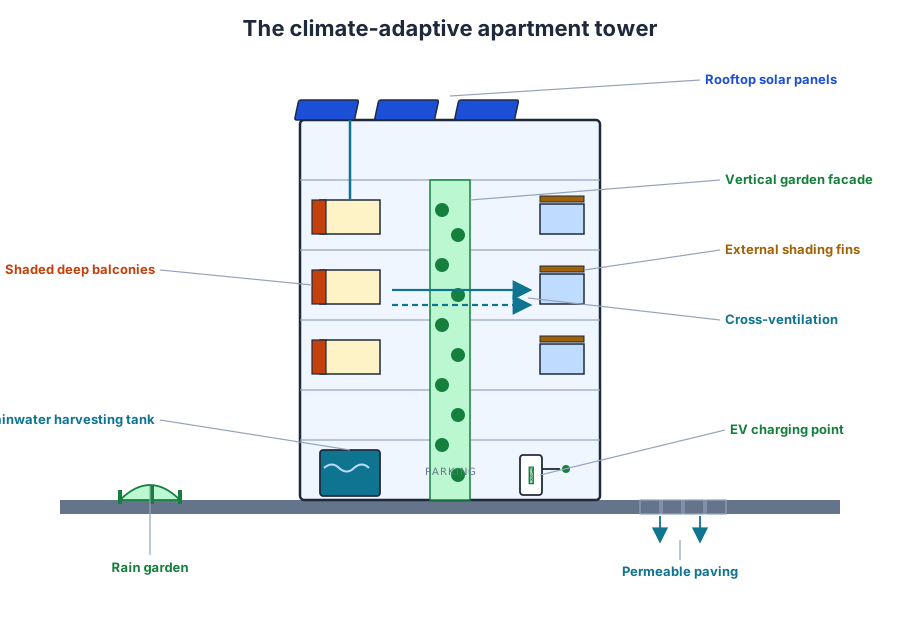
This is pushing housing toward greener, denser, climate-adaptive design. India now has a residential energy code, the Eco-Niwas Samhita (BEE, 2018), which limits heat gain through walls, roof and windows and encourages natural ventilation and daylight. Green rating systems like IGBC Green Homes and GRIHA reward shading, water recycling and rainwater harvesting. For a buyer, these are no longer green-tinted extras; they are protection against rising electricity bills, water tankers and unliveable afternoons. Our guide to climate-adaptive homes covers the design moves in detail.
7. Homes that work as you age, and across generations
India is getting older faster than most people realise. The 60-plus share of the population is set to roughly double, from about 10.5% (149 million) in 2022 to 20.8% (347 million) by 2050, per the UNFPA India Ageing Report 2023. By 2046, elderly Indians are projected to outnumber children. In tall, dense cities, that reshapes what a good home must do.
The next-generation urban home is quietly designed for long life: step-free entries, lifts that actually fit a stretcher, grab-friendly bathrooms, good lighting, and a layout that can host a live-in parent or carer without rebuilding. This is not just about the very old. Multi-generational urban homes, three generations sharing or living close in the same complex, are a practical Indian answer to childcare, eldercare and sky-high housing costs in one move.
If you are buying for the long term, ask the ageing-friendly questions now, while it is cheap to choose them: Is there a flat layout with a ground-accessible or lift-served bedroom? Can a bathroom take grab bars later? Does the society have a doctor on call, a ramp, benches in the common areas? A building that ignores ageing is a building you may have to leave at exactly the moment moving is hardest.
8. The digital layer: the app-run society
The last shift is invisible until you move in: your home is increasingly run through an app. Visitor entry, security, maintenance bills, complaints, amenity bookings and resident voting now flow through platforms like MyGate (around 3.5 million homes across some 25,000 societies as of 2023), NoBrokerHood, ADDA and ApnaComplex.
Done well, this is a real upgrade: transparent accounts, faster complaint resolution, safer visitor management, less cash and less caprice from a managing committee. Done badly, it is a new layer of friction, more surveillance, data about your movements held by a private company, and residents who cannot use the app being shut out of their own society's decisions.
The smart questions for a buyer are practical: Is the society's money managed transparently, app or not? Who controls the data, and can you function without a smartphone if you must? A well-run resident community matters more than the slickness of its software. The app is a tool; the governance underneath is the thing you are actually buying into.
What this means for you
The next generation of urban living in India is taller, smaller-household, greener by necessity, more rented, more walkable in aspiration, and more digital. None of it is guaranteed to arrive evenly, affordability and infrastructure will keep the gap between brochure and reality wide. So buy for the trends, but verify on the ground.
A short checklist for a future-proof urban home:
- Transit over car size: a home within a real walk of a metro or reliable bus corridor will hold its value as roads worsen.
- Walk the locality yourself: can you reach daily needs on foot, safely, after dark? Trust your feet over the masterplan.
- Flexible layout: rooms that can change roles beat a fixed plan you will outgrow.
- Climate resilience: shading, cross-ventilation, rainwater harvesting, solar-readiness and a non-flood-prone plot are cost savings, not luxuries.
- Ageing-friendly bones: step-free access, a lift that fits a stretcher, a bathroom that can take grab bars later.
- EV and digital readiness: wiring that can take a charger; a society run on transparent, fair governance.
- Density it can carry: ask whether the roads, drains, water and power were built for this many homes, not just the marketing render.
Choose the home that fits not only your life today but the city that is arriving. For the wider scales above the individual home, read the future Indian township and the anatomy of a good neighbourhood; for the longer horizon, see what homes will look like in 2050.
| Shift reshaping the city | What it changes for your home or locality | What to look for as a buyer |
|---|---|---|
| Densification and verticality (urban India to ~600M by 2036) | Mid- and high-rise becomes the default; pressure on roads, drains, water | Density the infrastructure can actually carry |
| Smaller, nuclear households (avg size 4.8 to 4.4) | Smaller and more flexible flat formats | Layouts that flex between roles over time |
| Rental-first and co-living (₹40B to ₹200B by 2030) | More renter neighbours; buildings designed for tenancy | Rental demand near workplaces and transit |
| 15-minute / walkable, mixed-use ideas | Shops, school, clinic, transit within a walk (where it exists) | Walkability you can verify on foot, after dark |
| Metro growth and EV/shared mobility | Transit access gains value; parking need may shrink later | Metro proximity; EV-ready wiring; parking as cost |
| Climate pressure (heat, flood, air, water) | Greener, climate-adaptive, energy-coded design | Shading, ventilation, rainwater harvesting, safe plot |
| Ageing and multi-generational living (60+ to ~21% by 2050) | Step-free, accessible, carer-friendly homes | Lift size, accessible bedroom, adaptable bathroom |
| Digital, app-run societies | Visitor, billing and governance through apps | Transparent governance and fair data practices |
Sources
- World Bank, "Gearing up for India's rapid urban transformation" (2024) — urban population 377M/31% (2011) to 600M/40% (2036). https://www.worldbank.org/en/news/opinion/2024/01/30/gearing-up-for-india-s-rapid-urban-transformation
- National Family Health Survey 5 (IIPS/MoHFW, 2019-21) — average household size 4.4; nuclear households ~58%. https://dhsprogram.com/pubs/pdf/FR375/FR375.pdf
- UNFPA India Ageing Report 2023 (UNFPA and IIPS) — 60-plus from 10.5% (149M, 2022) to 20.8% (347M, 2050). https://india.unfpa.org/en/news/india-ageing-elderly-make-20-population-2050-unfpa-report
- Colliers India, co-living market press release (2025) — ₹40B to ₹200B and 0.3M to 1M beds by 2030. https://www.colliers.com/en-in/news/press-release-coliving-segment-in-india
- PRS Legislative Research / MoHUA, Model Tenancy Act 2021 — Cabinet approval June 2021; ~11M vacant homes. https://prsindia.org/billtrack/the-model-tenancy-act-2021
- Anarock Research, via Business Standard and ThePrint (2024) — average flat size top-7 cities 1,145 to 1,513 sq ft (+32%); Mumbai shrinking. https://theprint.in/india/urban-india-going-for-bigger-flats-except-in-mumbai-where-theyre-getting-smaller-smaller/1623856/
- Ministry of Housing and Urban Affairs, National TOD Policy (2017). https://mohua.gov.in/upload/whatsnew/59a4070e85256Transit_Oriented_Developoment_Policy.pdf
- MoHUA / Construction World, metro network year-end data (2025) — ~1,090 km across 26 cities. https://www.constructionworld.in/transport-infrastructure/metro-rail-and-railways-infrastructure/mohua-marks-2025-with-major-urban-infrastructure-milestones/83768
- NITI Aayog, "Electric Mobility / Unlocking a USD 200 Billion Opportunity" (2025) — EV penetration ~7.6% (2024); EV30@30 target. https://www.niti.gov.in/sites/default/files/2025-08/India-Electric-Mobility-Index-2024-Report.pdf
- MoHUA, Model Building Bye-Laws EV Charging Infrastructure guidelines (2019) — 20% of parking EV-ready. https://www.mohua.gov.in/upload/whatsnew/5c6e472b20d0aGuidelines%20(EVCI).pdf
- IPCC AR6 Working Group II, Chapter 10 (Asia, 2022) — urban heat-island amplification; extreme heat exposure projections. https://www.ipcc.ch/report/ar6/wg2/chapter/chapter-10/
- IQAir, 2024 World Air Quality Report (2025) — India 5th most polluted (PM2.5 50.6); Delhi most polluted capital. https://www.iqair.com/newsroom/waqr-2024-pr
- Mongabay India, "As Bengaluru loses lakes" (2022) — wetland and lake loss driving urban floods. https://india.mongabay.com/2022/09/bengaluru-floods/
- Bureau of Energy Efficiency, Eco-Niwas Samhita residential energy code (2018, Part II 2021). https://www.beeindia.gov.in/WriteReadData/RTF1984/1772176104.pdf
- NITI Aayog, Composite Water Management Index (2018) — water stress warnings for major cities. https://social.niti.gov.in/uploads/sample/water_index_report2.pdf
- MyGate company information (2023) — ~3.5M homes across ~25,000 societies. https://en.wikipedia.org/wiki/MyGate
Export this guide
Related Guides — Deep-dive reading
How to Plan a Home for Multi-Generational Living
Designing for grandparents, parents and children under one roof — privacy, accessibility and harmony
Home PlanningWhat Will Homes Look Like in 2050?
A grounded vision of the Indian home a generation from now — and the handful of decisions today that keep your home relevant to it.
Future-Ready HomesRoof Access & Walkways
Someone will need to get onto your roof several times a year — to clear a drain, service the tank, wash the solar panels, check the waterproofing. Access designed into the house is far safer and cheaper than a ladder propped against a wall. This guide covers the ways up (mumty stairs, fixed ladders, hatches, loft ladders), the ways around (walkways and duckboards over fragile or waterproofed surfaces), and the guardrails and anchor points that make maintenance safe.
RoofingRelated Tools — Try Free
Rainwater Tank Sizer
How big should your rainwater tank be? Computes annual harvest, recommended tank capacity in litres, water-bill savings, and payback — for 10 Indian cities.
RWH CalculatorCross-Ventilation Analyzer
Estimate airflow and air changes per hour (ACH) from room size, window areas, layout, and local wind — with NBC 2016 Part 8 compliance check.
Ventilation CalculatorFull-Room BOQ — Living, Bedroom, Kitchen, Bath
Room-wise BOQ across living, bedrooms, kitchen, utility, and bathrooms with line-item pricing.
Full-Room BOQ