
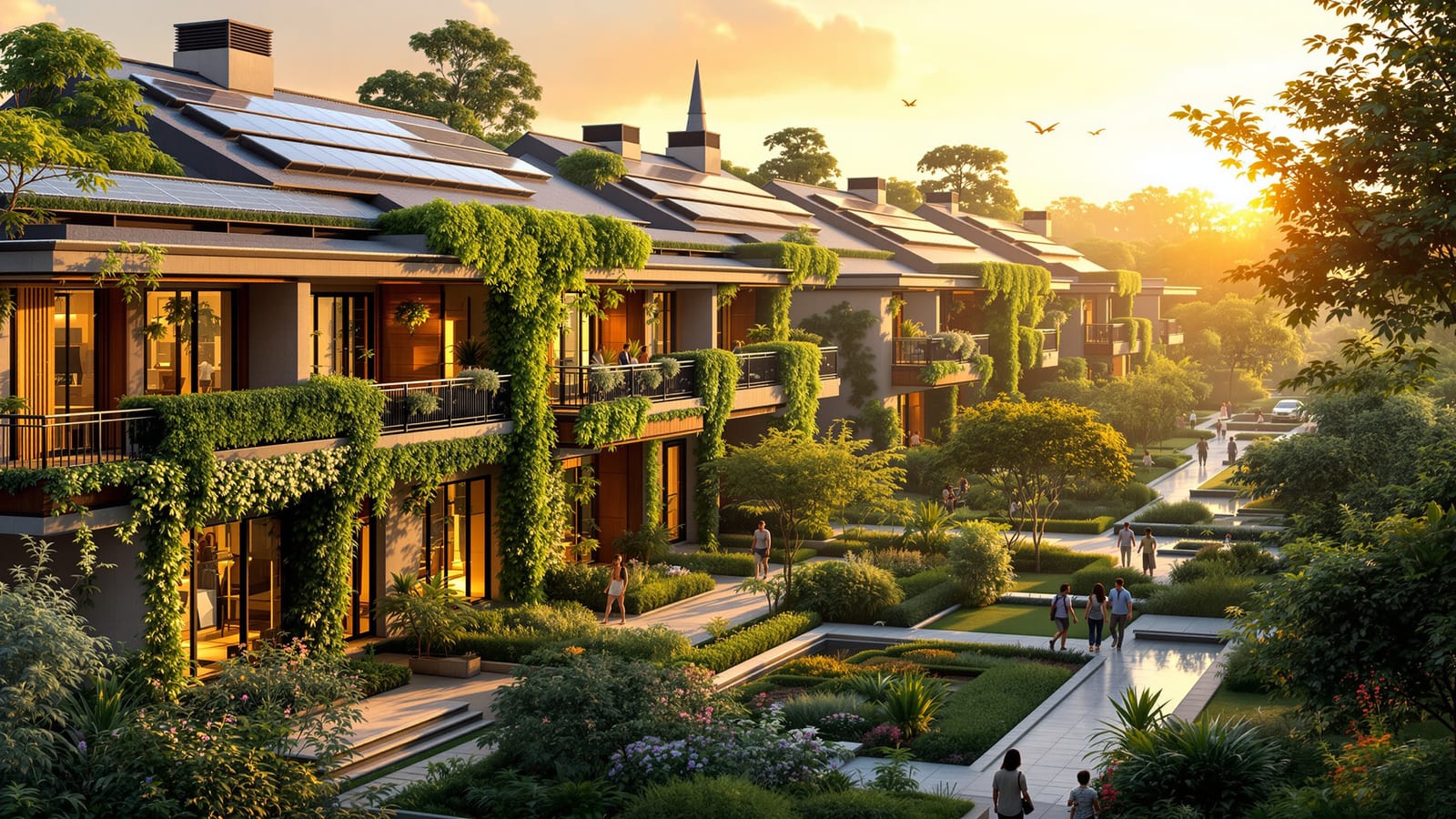
What Will Homes Look Like in 2050?
A grounded vision of the Indian home a generation from now — and the handful of decisions today that keep your home relevant to it.
A generation from now, the child who grows up in the home you build today will be in their twenties or thirties. The summers they remember will be hotter than yours. The car outside will charge instead of fill up. Their grandparents may live in the same house, on the ground floor, behind a door that has no step. The wall might quietly tell the family that the overhead tank is low before anyone notices the tap running dry. None of this is science fiction. Most of it is the straightforward continuation of trends that are already measurable in 2026 — they just have not finished arriving yet.
This guide is a companion that sits one floor above its sibling, designing your home for 2040. That guide is the practical one: it tells you which conduit to lay, which wall to leave openable, which slab to over-engineer, and what each of those things costs now versus later. This guide does something different. It paints a picture of the Indian home around 2050 — the conditions it will live in, the shape it might take, the way it might behave — and then works backward to the handful of decisions you make in 2026 that quietly keep your home relevant to that world. We assume you already understand the provisioning economics. Here we are after the longer horizon.
A warning to carry through every section: nobody can predict 2050. What follows separates the near-certain (direction locked in by physics, demography or policy already in motion) from the speculative (plausible and seriously discussed, but genuinely uncertain). Design for the first; stay flexible on the second. The whole craft of future-ready building is exactly that distinction.
1. The forces are already in motion
The single most useful thing to grasp is that 2050 is not a surprise waiting to happen. It is the sum of forces demographers, energy agencies and climate scientists can already see clearly. The table below sets out where each stands today and where the most credible projections point. The 2050 column is a careful reading of published trajectories, not a prophecy — but the direction of travel in every row is hard to argue with.
| Force | Roughly today (2026) | Credible direction by 2050 |
|---|---|---|
| Heat and cooling | Cooling is around a tenth of peak power load; AC is still a minority appliance | The IEA projects AC could reach close to half of peak electricity load; near-universal in cities |
| Water | Nearly 600 million people already face high water stress (NITI Aayog) | Per-capita availability projected near the scarcity line; about half of districts could face severe scarcity |
| Population age | Around 153 million people aged 60-plus | UNFPA projects roughly 347 million elderly, about a fifth of the population; 80-plus group rising fastest |
| Urbanisation | A little over a third of Indians live in cities | NITI Aayog and ADB estimate the urban population could roughly double, past half the country |
| Energy at home | Roof mostly sheds rain; grid-only supply | Self-generation, battery storage and sharing increasingly normal; roof as a power asset |
| Work | Hybrid and remote work normalised post-2020 | Home-as-workplace treated as permanent, designed-in rather than improvised |
| Mobility | EVs a small single-digit share of new sales | Electric the default for new vehicles; shared and possibly autonomous use reshaping parking |
| Materials | Cement-and-steel default, high embodied carbon | Low-carbon concrete, more timber and bio-based materials, design for reuse and longer life |
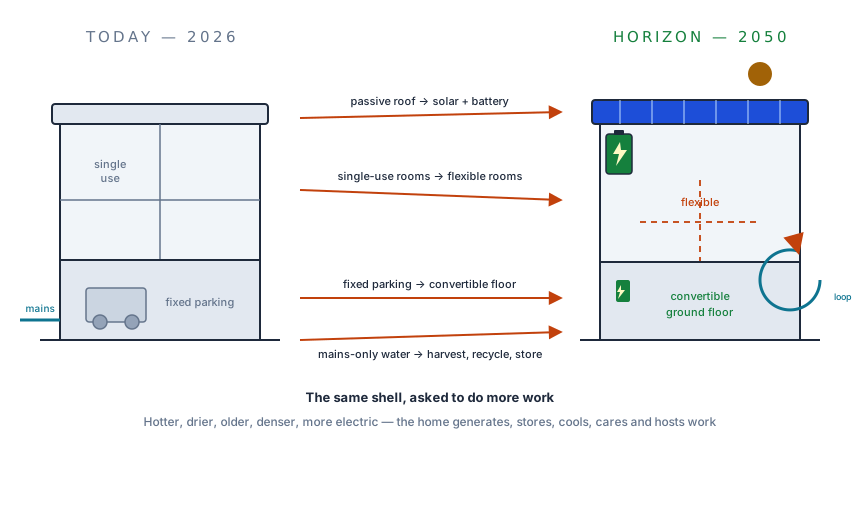
Read down that column and a composite picture forms: a hotter, drier, older, denser, more electric India, where the home does more work — generating, storing, cooling, caring, hosting work — with a smaller carbon footprint. The rest of this guide unpacks what that means for the home itself.
2. The climate the home must survive
This is the most near-certain force of all, because it is physics with a lag already built in. India is getting hotter, and the heat is concentrating in cities through the urban heat-island effect. The IEA has been blunt: each one-degree rise in outdoor temperature already adds several gigawatts to India's peak demand, and on current trends air conditioning could account for close to half of peak electricity load by mid-century. That is a staggering shift — it means the comfort of your home and the stability of the national grid become the same problem.
For the 2050 home, this points to a building whose first defence against heat is the building itself, not the air conditioner. Deep shading, light-coloured and possibly cool-coated roofs, cross-ventilation, thermal mass and orientation away from the harsh west sun do the heavy lifting; mechanical cooling becomes the smaller, efficient top-up rather than the whole answer. None of that is exotic — it is largely the climate-responsive logic explored in climate-adaptive homes, carried to its conclusion. The home that survives 2050 comfortably is the one that barely needed the AC in the first place.
Water sits right beside heat. NITI Aayog's own analysis warns that per-capita water availability is sliding toward the scarcity line and that roughly half of India's districts could face severe scarcity by 2050. The 2050 home almost certainly treats water as a closed-ish loop rather than something that simply arrives and leaves: rainwater harvested and stored, greywater recycled for flushing and gardens, and storage sized for genuine interruption rather than a day's buffer. A home that depends entirely on a municipal pipe is, on these projections, designing in a future vulnerability.
3. Who lives there: smaller, older, more varied households
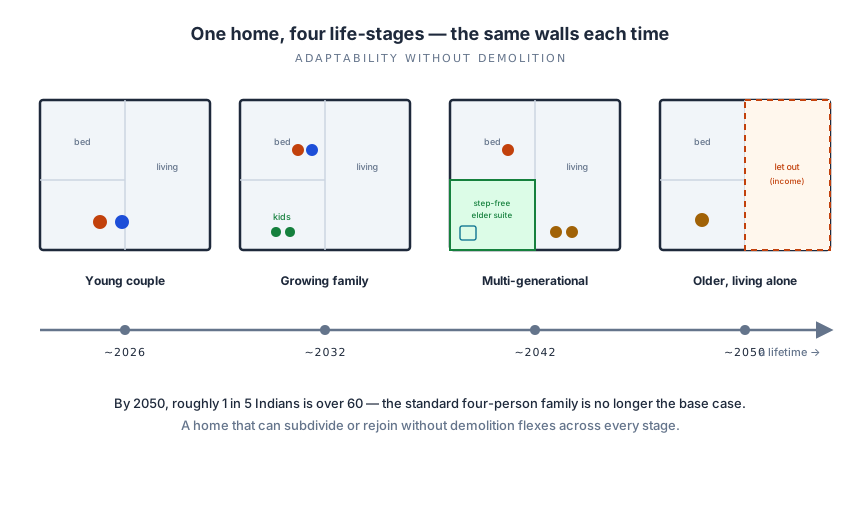
Demography is the quietest force and one of the most certain, because the people who will be old in 2050 are already alive. The UNFPA projects India's elderly population more than doubling to around 347 million by mid-century — roughly one in five Indians — with the over-80 group, predominantly women living alone, growing fastest of all. At the same time, households are fragmenting: more single-person homes, more couples without resident children, and, in tension with that, a renewed interest in multi-generational living as care needs rise and urban housing costs bite.
The 2050 home therefore cannot assume the standard four-person family. It is likelier to be a structure that flexes across a lifetime: a young couple, then a family, then a household caring for elderly parents, then perhaps an older person living alone or letting out part of the space. That argues for step-free access, a ground-floor room that can become a bedroom with an adjacent walk-in bathroom, doorways wide enough for a wheelchair or walker, and a plan that can be subdivided or rejoined without demolition. This lifelong adaptability is the heart of the sibling guide on flexible homes, and it is no longer a thoughtful extra — on the demographic numbers, it is the base case.
4. Energy: the home that makes, stores and shares power
By 2050 the relationship between a home and the electricity grid is likely to invert. Today most homes are pure consumers; the roof sheds rain and nothing else. The credible 2050 home is a small power station: solar generating on the roof, a battery storing the afternoon's surplus for the evening peak, and increasingly the ability to share or trade with neighbours and the grid. This matters specifically in India because, as the IEA notes, the daily rhythm of solar generation does not line up with cooling demand — the heat lingers long after sunset, when the panels have stopped. Storage is what closes that gap, which is why batteries, not just panels, define the self-sufficient home.
How fast this arrives is partly speculative — battery costs, tariff design and rules for peer-to-peer energy trading are all still moving. But the direction is near-certain enough that the structural decision is easy: a roof clear and strong enough for solar, conduits run for panels and a battery, and a little space set aside for that battery near the meter. You are not betting on a particular technology; you are keeping the door open to whichever version wins. The economics of doing this now versus retrofitting later are covered in detail in the 2040 guide — the point here is simply that the self-generating, self-storing home is where the line is heading.
5. Work, care and the home that does more jobs
The pandemic permanently rewired the relationship between home and work, and there is little sign of it snapping back. By 2050 the home is best understood as a place that holds several functions that used to live elsewhere: an office that does not empty on Monday morning, increasingly a place where some healthcare and elder care happen, and often a small income source through a let-out room or a home-run business. The home stops being a dormitory between activities and becomes the hub the activities orbit.
In built terms this means the 2050 home needs at least one room that is genuinely a workspace — daylight, quiet, a door that closes, power and data that were planned rather than trailed across the floor — and ideally more than one such adaptable room as needs shift over the years. It also means acoustic separation and a plan that lets one part of the house run on a different rhythm from the rest, so a video call, a sleeping toddler and a working parent can coexist. This is flexibility again, but pointed at function rather than family size: the rooms that earn their keep in 2050 are the ones that can change job without changing walls.
6. The home as a responsive system
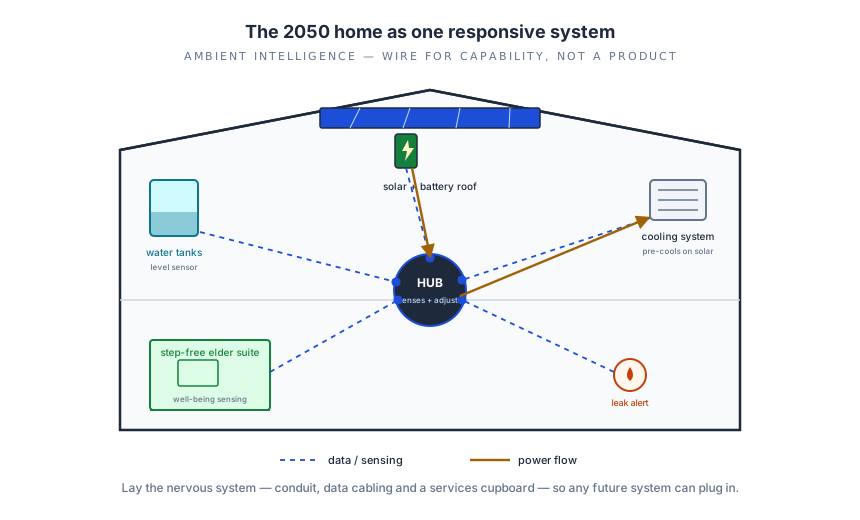
Here we move further into the speculative. The plausible trajectory is that the 2050 home behaves less like a box full of separate gadgets and more like a single responsive system — what is often called ambient intelligence. Rather than you operating an app, the home senses and adjusts: pre-cooling the bedroom before you arrive using cheap afternoon solar, flagging a slow leak before it becomes a flood, nudging the elderly resident's family if something seems off, balancing the battery against tomorrow's forecast. AI and the future of residential design goes deeper into how this changes the design process itself.
Be honest about the uncertainty here. The pace, the privacy trade-offs, which company's system wins, and how much people actually want their home watching them are all genuinely open. So the right posture for a 2026 builder is not to install today's smart-home kit, which will be obsolete in five years, but to lay the nervous system that any future system can use: conduit and data cabling to key points, a small services cupboard, neutral wires at switches, and a plan that does not depend on a particular brand. You are wiring for capability, not for a product. That keeps you out of the trap of betting on the wrong gadget while still being ready when the genuinely useful version arrives.
7. What it is built from, and what happens at the kerb
Two slower forces reshape the home from the outside in. The first is materials. Globally, the building sector is under hard pressure to cut embodied carbon — the emissions locked into cement, steel and bricks before anyone moves in. The IEA's net-zero pathway requires steep falls in cement's carbon intensity, and serious research points to low-carbon concrete, much greater use of timber and engineered wood, bio-based materials and, crucially, designing buildings to last longer and to be taken apart and reused rather than demolished. How far and how fast India adopts this is speculative and will depend on cost and codes — but the direction, a circular and lower-carbon palette, is set by the same net-zero logic driving everything else. For the homeowner, the durable takeaway is to build well and build to last, because the longest-lived home is also the lowest-carbon one.
The second is mobility, and its effect on the home is subtler than it looks. India's vehicles are electrifying — slower than the headline 2030 targets, but unmistakably. The near-certain change is that the parking spot becomes a charging spot. The speculative change is bigger: if shared and eventually autonomous vehicles take hold in dense cities, households may own fewer cars, and the ground floor and parking — often the least-loved part of an Indian home — could become the most valuable flexible space, ready to convert from car storage into a room, a workshop, a shop or an elder suite. The cheap insurance in 2026 is a charging conduit to the parking and a ground floor that was not designed to be a garage forever.
8. The likely shape of the home itself
Pull the forces together and a built form emerges, with the usual honesty about certainty. Near-certain: homes will be denser and more vertical, because NITI Aayog and ADB project the urban population roughly doubling, and land will not grow. They will be more passive and better shaded, because the climate and the grid both demand it. They will be more flexible inside, because households change shape over a lifetime. Speculative but plausible: more communal, with shared energy, shared water systems, shared mobility and shared amenity at the building or cluster scale, because many of these problems are cheaper to solve for fifty homes than for one. The broader shift toward shared, dense, service-rich neighbourhoods is the subject of the next generation of urban living.
The thread running through all of it is adaptability. The 2050 home is not defined by a gadget or a style but by its ability to absorb change — hotter weather, an ageing resident, a new way of working, a different car at the kerb — without being torn down. The home that wins is not the most futuristic one. It is the one most able to keep becoming something new.
What this means for you
If you are building or buying in 2026, you do not need to chase 2050's technology. You need to make the small number of decisions that keep the door open to it. From everything above, four matter most.
First, get the structure and orientation right, because these are the things you can never cheaply change. Face away from the worst western heat, shade deeply, build in cross-ventilation and thermal mass, and make the slab and roof strong enough to carry solar, a battery and an extra floor. A well-oriented, robust shell is the one bet that pays off in every plausible 2050.
Second, design for flexibility over your lifetime, not your current family. A step-free ground floor, a room that can become an elder bedroom with an adjacent walk-in bathroom, wide doorways, and a plan that can be subdivided or rejoined. The demographics make this the base case, not the exception.
Third, provision cheaply for energy, water and data while the walls are open — conduits, a services shaft, storage space, neutral wires — exactly as the 2040 guide lays out. You are not installing the future; you are leaving room for it.
Fourth, build to last and build low-impact where you can, because the longest-lived home is the lowest-carbon home and the one most likely to still be loved in 2050.
Do those four things and you have not predicted the future — you have made a home that does not need you to. When you are ready to test how these ideas land on your actual plot, Studio Matrx DesignAI can help you explore plans and visualise the options before you commit a single brick.
Sources
- International Energy Agency — The Future of Cooling and space-cooling analysis (AC share of India's peak load, temperature sensitivity of demand): iea.org/reports/the-future-of-cooling and iea.org/energy-system/buildings/space-cooling
- IEA — Buildings and Cement net-zero pathways (embodied carbon, low-carbon concrete and the NZE by 2050 scenario): iea.org/energy-system/buildings and iea.org/energy-system/industry/cement
- UNFPA India — India Ageing Report (elderly projected near 347 million / about 20% by 2050; fast-growing 80-plus cohort): india.unfpa.org
- NITI Aayog — Composite Water Management Index and water-stress projections (per-capita availability nearing scarcity; districts facing severe scarcity by 2050)
- NITI Aayog and Asian Development Bank — urbanisation projections (urban population roughly doubling past half the country by 2050)
- NITI Aayog — EV adoption targets and the National Mission on Transformative Mobility and Battery Storage
- Net-Zero Embodied Carbon in Buildings research, Environmental Science & Technology (timber, low-carbon materials and longer building life as decarbonisation levers)
Projections here are drawn from published trajectories and are presented as direction-of-travel, not certainty. Forecasts for 2050 carry real uncertainty; design for the near-certain trends and stay flexible on the speculative ones. Last reviewed June 2026.
Export this guide
Related Guides — Deep-dive reading
Future-Proof Home Design for Indian Families
Designing today for the family you will be in 10–20 years — flexibility, services and adaptability
Home PlanningDesigning a Naturally Energy-Efficient Indian Home
Comfort first, gadgets last — passive design, orientation, insulation, ventilation and the climate wisdom that cuts Indian energy bills
SustainabilitySecurity for People Living Alone in India (2026): Calm, Practical Habits When There Is No Second Person to Notice
Living alone is an ordinary and growing part of Indian life - the student in a new city, the working single, the elder whose children are abroad, the person after a separation. It does not call for fear. It calls for a few deliberate habits, because there is no second person in the home to notice trouble, raise the alarm, or catch an accident. This is calm self-reliance, layer by layer.
SecurityRelated Tools — Try Free
Cross-Ventilation Analyzer
Estimate airflow and air changes per hour (ACH) from room size, window areas, layout, and local wind — with NBC 2016 Part 8 compliance check.
Ventilation CalculatorRainwater Tank Sizer
How big should your rainwater tank be? Computes annual harvest, recommended tank capacity in litres, water-bill savings, and payback — for 10 Indian cities.
RWH CalculatorFuture Home Comfort Score
Score your home 0 to 100 on daylight, ventilation, thermal and acoustic comfort and find the weak link.
Window Tool