
Lift Capacity Guide (India): Persons, Kilograms and Sizing the Car
How home-lift capacity is expressed in persons and kilograms, how it ties to cabin floor area under IS 14665, and how to size for your household and a wheelchair.
When a lift brochure says "6 persons / 408 kg," it is answering two questions at once: how many people the car is meant to carry, and how much weight it is rated to lift. For a home, getting that single number right shapes everything downstream — how big the cabin feels, how wide your shaft has to be, how much the lift costs, how much power it draws, and whether a wheelchair will ever fit inside.
This guide explains how lift capacity is expressed in India, how to choose it for your household, and the one decision most homeowners get wrong: assuming the smallest car is the sensible car.
Capacity is not "how many people you usually carry." It is the worst plausible day — moving furniture, two adults helping an elderly parent, or a wheelchair with an attendant. Size for that, not for an average Tuesday.
How capacity is written: persons and kilograms
Lift capacity in India is quoted two ways, and both appear on the same nameplate:
- Persons — a friendly, marketing-facing number ("4 persons").
- Kilograms — the engineering rating the safety system is actually designed around.
The bridge between them is a long-standing convention: one person is taken as 75 kg. So a "6-person" lift is rated around 6 multiplied by 75, which is 450 kg, usually rounded to a standard step such as 408 kg or 480 kg depending on the model and cabin size. This 75 kg figure is an assumption for averaging, not a real limit on any individual — four heavier adults can be more total mass than four lighter ones, which is exactly why the kilogram rating, not the person count, is what the overload sensor watches.
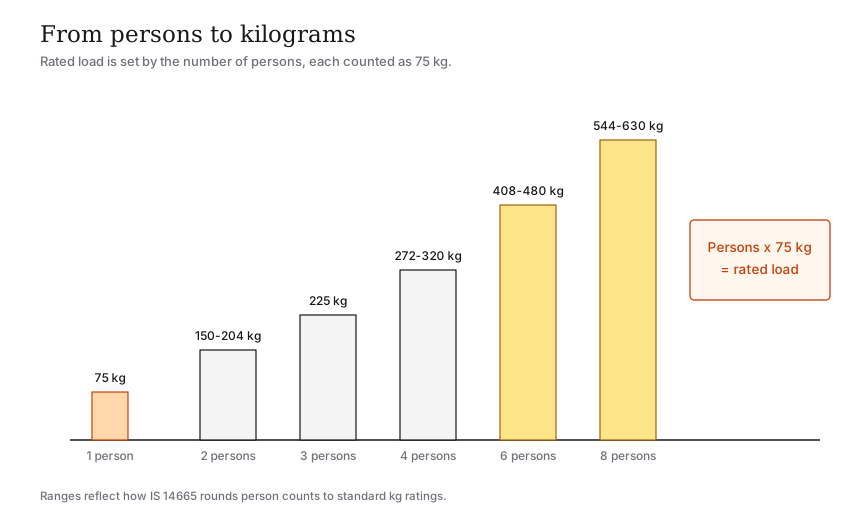
For homes, the practical range is roughly 2 to 8 persons. A 2-person car is the smallest thing the market sells; an 8-person car is what fireman and stretcher duty needs and is larger than most villas require. The table below is the one to keep beside you when you talk to a vendor.
The persons, kilograms and cabin-size table
| Persons | Rated load (approx) | Typical clear cabin (W x D) | Typical shaft / hoistway | Wheelchair + attendant? | Usual home fit |
|---|---|---|---|---|---|
| 2 | 150 to 204 kg | ~800 x 1000 mm | from ~1100 x 1300 mm | No | Tight retrofit, PVE, couples |
| 3 | ~225 kg | ~900 x 1100 mm | from ~1200 x 1400 mm | Marginal / no | Small G+1, two to three users |
| 4 | 272 to 320 kg | ~1000 x 1250 mm | from ~1300 x 1550 mm | Tight | Common family home |
| 6 | 408 to 480 kg | ~1100 x 1400 mm | from ~1500 x 1700 mm | Yes | Accessible-ready family home |
| 8 | 544 to 630 kg | ~1100 x 1400 mm (deeper) | from ~1700 x 1800 mm | Yes (and stretcher) | Larger villa, fireman duty |
All dimensions are indicative — confirm with your vendor, because clear cabin size depends heavily on door type (a swing door eats less wall than a sliding door's pocket) and on the drive system. A pneumatic vacuum elevator, for instance, hits its capacity ceiling around 2 to 3 persons by design.
Why capacity is tied to cabin floor area
Here is the part vendors rarely explain. You cannot simply quote a high kilogram rating for a tiny cabin. IS 14665 Part 1 (the Indian standard for lift outline dimensions) pairs every rated load with a maximum permitted cabin floor area. The logic is a safety one: if a small car were rated for a very high load, you could physically cram in far more people than the rated weight, overloading the lift while the person-count "looked" fine.
So the standard caps how much floor a given load is allowed, which in turn limits how many bodies can crowd in. The effect for you as a buyer is simple to state:
If you want a bigger, more comfortable cabin, you must also accept a higher rated load — and therefore a stronger machine, bigger shaft and more power. Capacity, cabin size and cost rise together. You cannot buy "a big cabin that is cheap to lift."
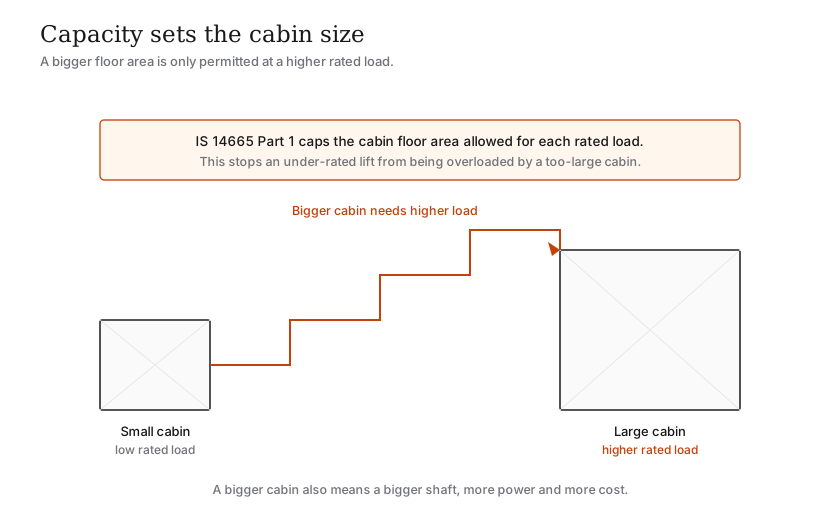
This is why a thoughtful capacity choice starts with the cabin you need to stand in, not with a kilogram number in isolation. For the full set of clearances — pit, headroom, shaft and lobby — read our companion guide on lift space requirements (sibling: lift specification checklist).
Sizing for the household
For most Indian homes, start from how the lift will actually be used:
- Couple or compact retrofit: a 2 to 3-person car is enough to move people between floors. This is the home of the pneumatic vacuum elevator and the smallest hydraulic and gearless cars. It will not carry a mattress or a wheelchair, and two people plus shopping bags feels full.
- Typical family (4 to 5 occupants): a 4-person car is the everyday sweet spot — two adults comfortably, or a parent with two children, plus room for a suitcase. It keeps the shaft and cost modest while not feeling claustrophobic.
- Multi-generation home or future accessibility: step up to a 6-person car. The jump from 4 to 6 persons is the one that buys you a cabin that genuinely works for a wheelchair and an attendant, which is the single most common regret among homeowners who sized down.
A useful rule: pick the capacity for the household you will have in fifteen years, not the one you have today. Ageing parents, a future wheelchair, and the day you carry a heavy piece of furniture all argue for one size up.
Sizing for a wheelchair and attendant
This is the decision that separates a lift you can grow old in from one you cannot. A 2-person car will not take a wheelchair. There is simply not enough clear floor for a chair plus the person pushing it, and the door is usually too narrow.
For an accessible home, the benchmarks come from the CPWD / MoHUA Harmonised Guidelines for a barrier-free built environment:
- Clear cabin of about 1100 x 1400 mm — large enough for a wheelchair user and an attendant. In person terms this is a 4 to 6-person car.
- Door clear width of at least 900 mm, which in practice means an automatic sliding/telescopic door, not a manual swing door (swing doors are cheaper but block wheelchairs).
- A handrail at least 600 mm long mounted 800 to 1000 mm above the floor near the controls, a mirror on the rear wall so a wheelchair user can reverse out without turning, and Braille / tactile buttons with audio-visual floor indicators.
- An automatic door closing time of at least 5 seconds so a slower user is not caught by the doors.
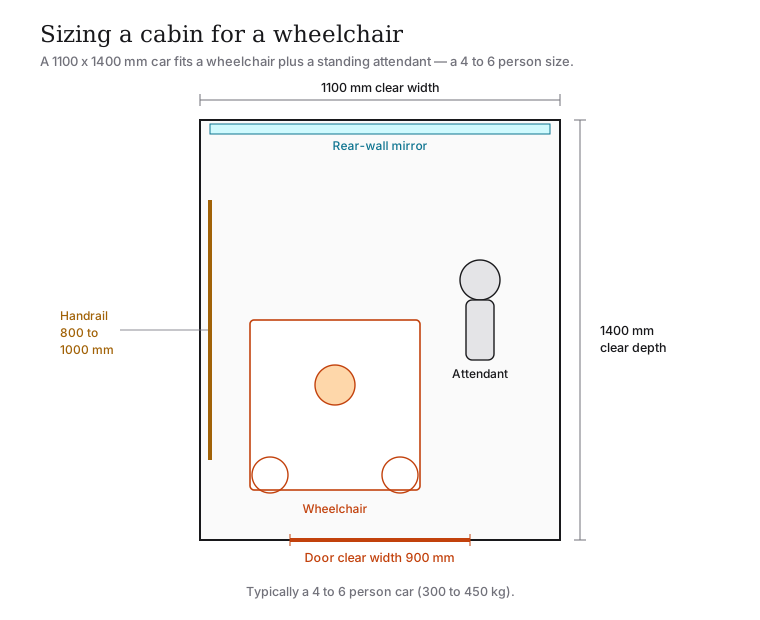
These standards legally bind public buildings under the RPwD Act 2016; private homes are not compelled to follow them, but they are the right best-practice benchmark — and far cheaper to build in now than to retrofit later. If anyone in the household may use a wheelchair, walker or simply find stairs hard in coming years, choose the 6-person / ~1100 x 1400 mm car. Our dedicated guide on the accessible home goes deeper on the wider house, not just the lift.
The knock-on effects of a bigger car
Capacity is never a free upgrade. Every step up the person count pulls a chain of consequences, and a good homeowner weighs them before signing:
| You increase | What follows |
|---|---|
| Rated load (persons / kg) | A heavier-duty traction machine or larger hydraulic ram |
| Cabin floor area | A wider, deeper shaft / hoistway — and that floor area is lost on every storey |
| Shaft size | More civil work: bigger RCC walls, larger openings, more cost |
| Motor size | Higher connected load, which can push you from single-phase to three-phase supply |
| Overall package | Higher purchase price, higher AMC, and a larger battery for the rescue device |
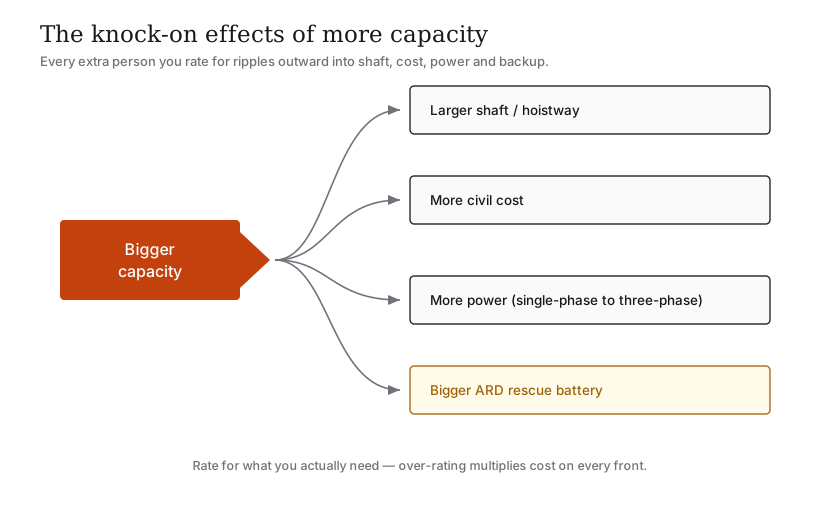
The shaft effect is the one that surprises people. A bigger cabin is not just more expensive machinery — it permanently consumes more floor on every level of the house, so an over-sized lift quietly costs you usable room for the life of the building. The power effect matters too: a larger, faster traction lift often needs a three-phase sanctioned connection where a small car would have run happily on ordinary single-phase. The structural and electrical knock-ons are covered in our home-lift structural design and lift power requirements guides.
Right-sizing is a balance. Too small, and you cannot carry a wheelchair, a stretcher or a sofa. Too large, and you pay — in money, floor space and power — for a cabin you rarely fill. For most family homes the honest answer sits at 4 to 6 persons.
Do not forget the overload sensor. Every well-specified lift refuses to move and sounds an alarm when loaded past its rating; this is a feature, not a fault, and it is precisely why the kilogram number, not the person count, is the one that protects you.
How to decide, in order
1. List your real loads — the largest group, an elderly parent with help, and bulky items you will move.
2. Decide on accessibility now — if a wheelchair is ever plausible, that fixes you at ~1100 x 1400 mm / 6 persons.
3. Read the cabin size, then the kilograms — choose the cabin you need to stand in; let IS 14665 area-vs-load set the matching load.
4. Check the knock-ons — confirm the shaft fits your plan and the power supply suits the motor before you commit.
5. Confirm everything with your vendor and a licensed lift contractor — every figure here is indicative.
For the bigger picture — drive types, costs and brands — start at our residential elevator buyer's guide, see how the machinery actually moves the car in how home lifts work, and price it with the home lift cost guide.
References
- IS 14665 Part 1 (BIS) — Electric traction lifts, outline dimensions (car, well, pit, headroom): https://law.resource.org/pub/in/bis/S05/is.14665.1.2000.pdf
- IS 14665 Part 2 (BIS) — Code of practice for installation, operation and maintenance: https://law.resource.org/pub/in/bis/S05/is.14665.2.1-2.2000.pdf
- National Building Code of India 2016, Part 8 Section 5 — Installation of lifts, escalators and moving walks (BIS): https://www.bis.gov.in/standards/technical-department/national-building-code/
- CPWD Harmonised Guidelines and Space Standards for a Barrier-Free Built Environment (2016) — accessible-lift cabin, door and handrail standards: https://www.cpwd.gov.in/Publication/Harmonisedguidelinesdreleasedon23rdMarch2016.pdf
- RPwD Act 2016 (full text) — accessibility obligations for buildings: https://ssepd.odisha.gov.in/sites/default/files/2024-01/RPWD%20ACT.pdf
Export this guide
Related Guides — Deep-dive reading
Home Lift Planning Checklist (India): Everything to Decide Before You Buy
A printable, ten-stage checklist that takes you from the first family conversation to a signed handover.
Home Lifts & AccessibilityLift Specification Checklist (India): The Spec Sheet to Hand Every Home-Lift Vendor
One fillable spec sheet that forces every vendor to quote like-for-like on your shaft, your stops, your safety features.
Home Lifts & AccessibilityResidential Elevator Buyer's Guide (India 2026): Types, Cost, Sizing, Regulation & How to Choose
Everything an Indian homeowner needs to choose, size, budget, license and maintain a home lift the right way.
Home Lifts & AccessibilityRelated Tools — Try Free
Lift Shaft Size Calculator
Required hoistway, pit and headroom dimensions for a home lift by capacity and drive type.
Lift CalculatorElevator Capacity Calculator
Pick the right home-lift capacity — 2 to 8 person — with car size and wheelchair fit.
Lift CalculatorHome Lift Cost Calculator
All-in home lift cost by floors, type, capacity and city — equipment, civil, GST and AMC, with a drive-type comparison.
Lift Calculator