
Copper vs CPVC Pipes: Which to Use in India (2026)
A fair, India-first head-to-head: copper is the premium, decades-lasting, heat-proof metal that needs a skilled brazier and costs a fortune; CPVC is the cheaper, corrosion-proof, DIY-friendly plastic that has become the default modern Indian supply pipe. Cost, lifespan, heat, install skill, water quality, theft — and a clear verdict by use-case.
For decades a copper supply line was the mark of a serious home; today most new Indian houses are plumbed almost entirely in cream-coloured CPVC and never miss the metal. This is a fair head-to-head between the two, and the honest verdict up front: CPVC is the right default for the vast majority of Indian homes, and copper earns its keep only in a few specific situations. The reason is not that copper is worse — it is superb — but that CPVC delivers most of what a home actually needs at a fraction of the cost and skill.
Neither pipe is "better" outright. They win on different axes. Copper wins on ultimate durability, heat tolerance and being a metal you can see and trust; CPVC wins on cost, corrosion immunity, ease of installation and sheer availability. This guide keeps to the direct comparison — for how each pipe actually works, its sizes, grades and fitting types, read the dedicated guides: Copper Pipes (India) and CPVC Pipes (India).
For the whole material family and how to slot this decision into it, go up to the pillar Plumbing Pipes Guide (India), or work through Choosing Plumbing Pipes (India). This article sits in the Plumbing Comparisons Guide (India).
The core distinction
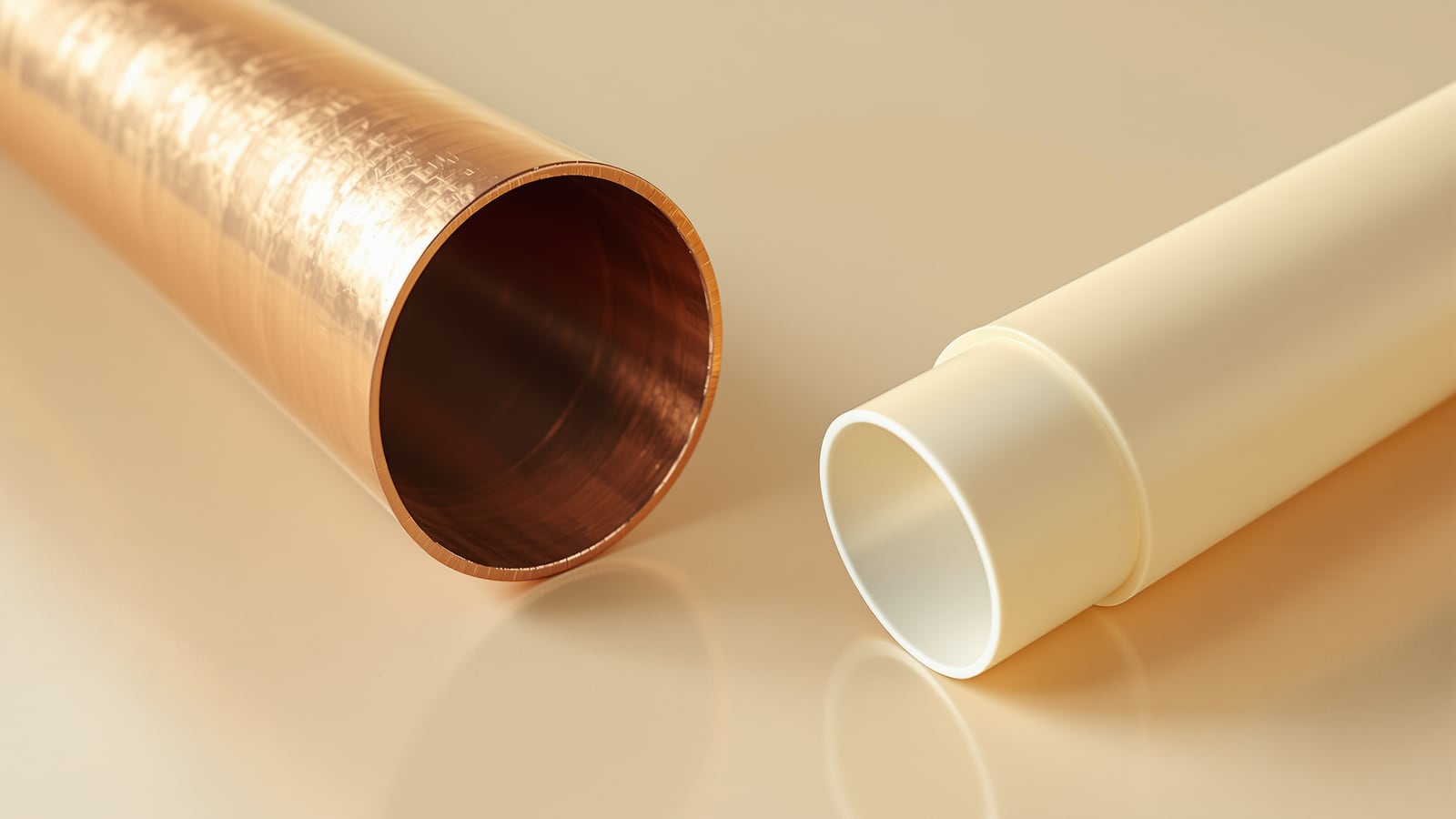
Copper is a metal pipe — drawn from copper, joined by soldering or brazing (heating the joint and flowing molten filler into a fitting). It is the old benchmark: it shrugs off very high temperatures, it is naturally antimicrobial, it does not burn or off-gas in a fire, and a good copper installation can last fifty years or more. Its problems are all practical: it is expensive, it needs a genuinely skilled tradesperson with a torch, it corrodes (pinholes) in aggressive or acidic water, and being valuable scrap metal it carries a real theft risk on sites and empty properties.
CPVC — Chlorinated PolyVinyl Chloride — is a plastic pipe engineered to carry hot and cold water, rated for continuous service around 93 C, well above any Indian geyser. It is joined by solvent cement, a chemical weld that fuses pipe and fitting into one mass with no flame, no skill certification and almost no tools. It cannot corrode, it is a small fraction of copper's price, and it is stocked in every hardware shop in the country. Its limits are that it is a plastic (lower ultimate strength, needs proper support spacing), it must not be used on lines that see open flame or extreme heat, and a bad solvent joint fails silently.
That is the crux: copper is the premium metal you buy for longevity and heat; CPVC is the affordable plastic you buy for value, corrosion immunity and easy installation. For a normal home water supply, CPVC covers the job.
Cost — the factor that decides most homes
This is where the two diverge most sharply. Copper pipe and copper fittings cost several times more per metre than CPVC, and the gap widens on labour: brazing is skilled, slow work, while solvent-welding CPVC is fast and needs no specialist. A full-home copper re-pipe can run into a figure that, for the same house, CPVC would deliver at a small fraction of the cost — the difference easily reaching ₹1,00,000 or more on a mid-size home once material and skilled labour are added up. Prices move constantly (copper especially, being a traded commodity), so treat every number here as indicative and confirm current rates in the Pipe Replacement Cost (India) guide.
| Factor | Copper | CPVC |
|---|---|---|
| Material cost / metre | High (several times CPVC) | Low |
| Fittings | Costly (brass/copper) | Inexpensive plastic |
| Install labour | Skilled brazing — slow, dear | Solvent weld — fast, cheap |
| Lifespan | 50+ years (good water) | ~40–50 years, corrosion-proof |
| Max temperature | Very high — handles anything domestic | ~93 C service — fine for geysers |
| Corrosion / hard water | Pinholes in acidic/aggressive water | Immune — never corrodes or scales |
| Install skill | High (torch, flux, solder) | Low — DIY-friendly |
| Availability (India) | Limited, specialist | Everywhere |
| Antimicrobial | Yes, naturally | No (but non-porous, smooth bore) |
| Theft / scrap risk | Real (valuable metal) | None |
| Best for | Heritage, exposed feature runs, extreme heat | Everyday concealed hot + cold supply |
Lifespan and durability
On paper copper wins longevity — a well-installed copper system in good-quality water routinely lasts fifty years and beyond, which is why it earned its reputation. But there is a large asterisk in India: copper corrodes from the inside in acidic or aggressively soft water, developing pinhole leaks that can appear in as little as a decade. Where that risk exists, copper's headline lifespan evaporates.
CPVC, by contrast, cannot corrode at all — no water chemistry pits it, no hard water scales its smooth bore shut the way it does old GI. A properly supported, properly jointed CPVC system realistically serves four to five decades, and it does so consistently regardless of whether your water is soft, hard or acidic. So the fair reading is: copper can last longer, but only if your water is kind to it; CPVC lasts a long time regardless. For most Indian homes on municipal or borewell water, that consistency matters more than copper's theoretical ceiling.
Heat, water quality and installation
- Heat. Copper handles any domestic temperature and then some — it is the choice if a line will ever see genuinely extreme heat or open flame. CPVC is rated to about 93 C, comfortably above a geyser's 55–65 C output, so for ordinary hot-water plumbing both are fine; only in unusual high-heat applications does copper's margin actually matter.
- Water quality. Copper is naturally antimicrobial, a genuine plus. But it can leach into acidic water and its corrosion is the real-world weakness. CPVC is inert, non-porous and does not react with water; it will not rust, scale or impart taste. Neither is a health problem when used correctly.
- Installation. This is CPVC's decisive practical edge. Solvent-cement jointing needs no torch, no flux, no fire-safety precaution and no certified brazier — a competent handyman can do it, and the whole job goes faster. Copper demands a skilled tradesperson with a torch, and mistakes are costly. In an era where good plumbing labour is scarce and expensive, "easy to install correctly" is worth a great deal.
The verdict
This is not a coin-toss. For the ordinary Indian home, CPVC is the sensible default and copper is a considered exception.
| Your situation | Choose |
|---|---|
| Everyday concealed hot + cold supply | CPVC |
| Tight budget / full-home re-pipe | CPVC |
| Hard, soft or acidic water | CPVC |
| No skilled brazier available | CPVC |
| Theft-exposed / under-construction site | CPVC |
| Heritage restoration or exposed feature run | Copper |
| Line that sees extreme heat / open flame | Copper |
| Lifetime metal system, water known to be kind | Copper |
- For everyday concealed hot-and-cold supply in a normal home — choose CPVC. It is far cheaper, immune to corrosion and hard water, easy to install correctly, stocked everywhere, and rated well above geyser temperatures. This covers the large majority of houses and flats.
- For a heritage restoration, an exposed designer feature run, or where you specifically want a lifetime metal system and have kind water — choose copper. It is beautiful exposed, unmatched on ultimate durability, and antimicrobial.
- For any line that will see genuinely extreme heat or open flame — choose copper. CPVC has no business near a flame; this is copper's clear technical win.
- For a site with theft exposure, an acidic/soft-water supply, or a tight budget — choose CPVC. Copper's scrap value and its pinhole vulnerability both count against it here.
- For hard-water cities — either beats old GI, but CPVC is the safer, cheaper pick since it cannot scale or corrode.
Common mistakes
- Paying for copper on a concealed run nobody will ever see. Copper's looks are wasted behind a wall; concealed supply is exactly where CPVC's value shines. Save the copper for exposed work.
- Putting copper on acidic or very soft water. You buy the fifty-year pipe and get pinholes in ten. Test your water, or default to CPVC where the chemistry is unknown.
- A sloppy CPVC joint. Solvent-welding is easy but not no-skill: use genuine CPVC solvent cement, clean the surfaces, and hold the joint. A rushed joint fails silently inside the wall.
- Ignoring theft risk on copper. On an empty or under-construction property, exposed copper is a target. Factor security in, or avoid it there.
- Skipping the IS mark on CPVC. Insist on the ISI/BIS mark and the printed IS 15778 — it is your proof of grade for a potable hot-and-cold pipe.
Whichever you pick, pressure-test the concealed supply run before you tile over it and hold it for the specified time. A joint that weeps on test is cheap now and a ruined ceiling later.
Bottom line: for the everyday Indian home, plumb in CPVC — it is cheaper, corrosion-proof, easy to install correctly and rated well past geyser temperatures. Reserve copper for heritage work, exposed feature runs and lines that see extreme heat, and only where your water is kind to it. Copper is the finer metal; CPVC is the smarter default.
References
- IS 15778 — Chlorinated PolyVinyl Chloride (CPVC) Pipes for Potable Hot and Cold Water Supply — Specification.
- IS 191 — Copper (grades and forms) — Specification.
- ASTM B88 — Seamless Copper Water Tube (Types K, L, M).
- ASTM D2846 — CPVC Plastic Hot- and Cold-Water Distribution Systems (Copper Tube Size).
- National Building Code of India (NBC) 2016, Part 9 — Plumbing Services (water supply and sanitation).
- CPHEEO Manual on Water Supply & Treatment and CPWD Specifications, Government of India — plumbing material and installation practice.
Export this guide
Related Guides — Deep-dive reading
PVC vs CPVC Pipes: Which to Use Where in Your Indian Home
A fair, India-first head-to-head. The one fact that decides it: CPVC carries hot water (~93 C) so it runs your geyser supply; PVC is a cold-water, drainage and outdoor pipe. Temperature and pressure ratings, cost, lifespan, jointing and a verdict by use-case.
PlumbingCPVC vs UPVC Pipe: Which Is Better for Bathroom Plumbing? (India)
A fair, India-first head-to-head: CPVC carries HOT water (geyser lines), UPVC is cold-only. Pressure and temperature ratings, cost, jointing, where each belongs, IS standards, and why confusing the two causes concealed-wall failures.
BathroomsPlumbing Pipes Guide: Every Material & How to Choose (India)
The section pillar for plumbing pipe materials in India — the full family of thermoplastics, metals, iron, concrete and clay, which pipe belongs on hot supply, cold supply, drainage, underground and sewer duty, a comparison-at-a-glance table, sizing basics, jointing methods, and a plain-language method for choosing.
PlumbingRelated Tools — Try Free
False Ceiling Cost Estimator
Live ₹/sqft across 8 ceiling types — POP, gypsum, designer, metal, PVC, wooden — with cove and spot lighting for 20 Indian cities.
Cost CalculatorMaterial Decision Framework (M-Score)
Score 30+ Indian construction materials across cost, durability, climate fit, maintenance, and sustainability.
MaterialsBefore vs After — Cost Reality Check
Compare what you expected to pay vs what you actually paid, category by category.
Reality Check