
LED Lighting Explained: Lumens, Watts, CRI & How to Buy Well
Why LED replaced everything else, and how to actually choose one — reading lumens instead of watts, understanding colour temperature and CRI, spotting the efficiency (lumens per watt) that decides your bill, and the quality signs that separate a good LED from a cheap one that fails early.
The LED quietly won the lighting world in barely a decade, and for good reason: it produces the same light as an old bulb for a fraction of the power, lasts many times longer, and comes in every colour and shape. But it also changed how you buy light — the old habit of asking for a "60-watt bulb" no longer works, because an LED gives that brightness for 8 watts. This guide explains how LEDs work, how to read their labels, and how to tell a good one from a cheap one that will flicker and die early.
It sits under the home lighting design guide and pairs with the colour temperature guide.
The safety line. Choosing and replacing plug-in LED bulbs is ordinary homeowner territory; hard-wired fittings, downlights and drivers are installed by a licensed electrician. For safety and performance, choose lamps conforming to IS 16102 (self-ballasted LED lamps) and, ideally, BEE-rated for efficiency.
Why LED replaced everything
An LED (light-emitting diode) produces light by passing current through a semiconductor, rather than heating a filament (incandescent) or exciting gas (CFL/tube). That difference gives it three decisive advantages:
- Efficiency — it turns far more of the electricity into light and far less into heat, so it uses a fraction of the power for the same brightness.
- Life — it lasts many times longer than incandescent or CFL, so you replace it far less often.
- Control — it switches instantly, dims well (with the right driver), and comes in any colour temperature.
The incandescent bulb is effectively obsolete, and the CFL is on its way out; for a modern home, LED is simply the answer — as the LED vs CFL vs halogen comparison below makes plain.
Reading an LED: the numbers that matter
Four numbers tell you almost everything about an LED. Learn them and you will never be mis-sold a bulb.
| What | Unit | What it tells you |
|---|---|---|
| Brightness | lumens (lm) | How much light — the number that replaced "watts" |
| Power | watts (W) | How much electricity it uses (your running cost) |
| Efficiency | lumens per watt (lm/W) | Light per unit power — higher is cheaper to run |
| Colour | kelvin (K) + CRI | The warmth of the light and how true colours look |
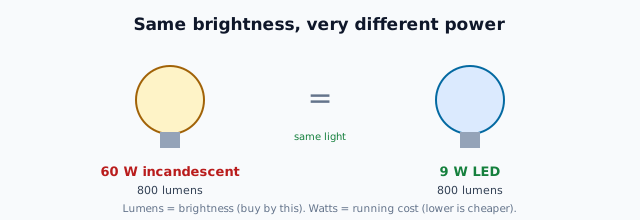
- Lumens is brightness. Roughly: 400 lm ≈ old 40 W bulb, 800 lm ≈ 60 W, 1,500 lm ≈ 100 W. Buy by lumens.
- Watts is now just the running cost. Lower watts for the same lumens = cheaper to run.
- Efficiency (lm/W) is the number that decides your electricity bill: a good modern LED delivers roughly 90–120+ lm/W. Compare lumens-per-watt between products, and look for the BEE star rating — more stars means more light per unit of power.
- Colour — the kelvin number (warm 2700K to cool 6500K) and the CRI (colour accuracy) — is important enough to have its own colour temperature & CRI guide.
LED vs CFL vs halogen
| Feature | LED | CFL | Halogen / Incandescent |
|---|---|---|---|
| Efficiency (lm/W) | Highest (~90–120+) | Moderate (~50–70) | Lowest (~10–20) |
| Life | Longest | Moderate | Shortest |
| Switch-on | Instant, full | Warms up | Instant |
| Dimming | Good (right driver) | Poor | Good |
| Contains mercury | No | Yes (dispose carefully) | No |
| Verdict | The default | Being phased out | Obsolete for general use |
The conclusion is not subtle: for general home lighting, choose LED. CFLs linger in some fittings but offer no advantage; halogen and incandescent are for niche or decorative use only.
Telling a good LED from a cheap one
This is where money is won or lost, because the market is full of cheap LEDs that flicker, shift colour, or fail in months. Signs of quality:
- Conforms to IS 16102 (self-ballasted LED lamps — safety and performance) and carries a genuine BEE star rating.
- A real efficiency figure (lm/W) stated, not just a watt number.
- Good CRI (ideally 80+, and 90+ where colour matters — see the colour guide).
- No visible flicker — cheap drivers flicker (test with a phone camera in slow-motion), which causes eye strain and headaches.
- A sensible warranty and a reputable brand — the driver, not the LED chip, is usually what fails, and quality brands use better drivers and thermal design.
- Right fitting and dimmability — if you want to dim it, buy a dimmable LED and a compatible dimmer; a non-dimmable LED on a dimmer flickers and fails.
The cheapest LED is rarely the cheapest to own. A quality lamp that lasts years and runs at high efficiency beats a bargain bulb you replace twice a year and that quietly costs more to run.
The one-line answer
LED won because it makes the same light for a fraction of the power and lasts far longer — but it changed how you buy: think in lumens (brightness), treat watts as just the running cost, compare lumens-per-watt efficiency (and the BEE star rating) to decide your bill, and check colour temperature and CRI for how the light looks. Choose IS 16102-conforming, BEE-rated lamps from a reputable brand with a stated efficiency, no flicker and a real warranty — because the cheapest LED is seldom the cheapest to own, and it's usually the driver, not the diode, that fails.
Where to go next
- The design context: Home Lighting Design Guide.
- The warmth and accuracy of light: Colour Temperature & CRI.
- Making it smart: Smart Lighting Guide.
- Estimate what you need: Room Lighting Calculator.
References
- IS 16102 : Part 1 : 2026 (Safety) and Part 2 : 2026 (Performance), Self-Ballasted LED Lamps for General Lighting Services, Bureau of Indian Standards.
- Bureau of Energy Efficiency, Standards & Labelling programme (LED lamps): https://beeindia.gov.in/
- IS 3646 : Part 1 : 2025, Interior Illumination — Code of Practice, BIS.
- National Electrical Code of India, SP 30 : 2023, BIS: https://www.bis.gov.in/
Efficiency figures and equivalences are indicative and vary by product; check the actual lumens, lumens-per-watt and BEE rating on the pack. Hard-wired fittings must be installed by a licensed electrician. Verify any standard's status via the BIS catalogue before relying on it.
Export this guide
Related Guides — Deep-dive reading
The Homeowner's Guide to Lighting Your Home: Start to Finish (2026)
The warm, plain-English capstone for the whole Lighting hub - how to light an Indian home from empty to done, in the order things actually happen, with the one rule that saves you the most money: decide the whole scheme before the electrician wires.
LightingLighting Controls & Dimming Design: Zones, Scenes & Switches (2026)
How to plan lighting control so an Indian home's light is flexible — split each room's layers onto separate switches, choose dimmers that actually work with LEDs, add two-way switching where you need it, and layer scenes on top. The design decisions you must settle before the electrician wires.
LightingEnergy-Efficient Lighting: Bright Homes, Lower Bills (2026)
A homeowner's design playbook for lighting an Indian home beautifully while cutting the electricity it burns — the LED switch, right-sizing so you never over-light, controls as the efficiency multiplier, daylight and solar first, and how to measure and lower the bill.
LightingRelated Tools — Try Free
Room Lighting Calculator
Estimate the target lux, total lumens and number of LED fixtures a room needs, from its type and size — a general-illumination planning guide.
LightingAccess-Control Power Calculator
Total current and power an access system draws, to size the power supply — locks, readers and controllers.
AC PowerCircadian Light Meter
Patient-centric circadian lighting visualizer for Indian healthcare design — time-of-day × intensity → CCT, melanopic lux (EML / mEDI), melatonin suppression, and an alertness curve. Calibrated against WELL v2 L03 Circadian Lighting Design, CIE S 026:2018, Brainard 2001, and Lucas et al. 2014.
Circadian Tool