

Land Documents Checklist Before Buying a Plot in India (2026)
Every document to collect and verify before you buy a residential plot in India - the title chain, encumbrance certificate, khata or patta, mutation, survey and layout, land-use conversion and tax dues - what each one proves, the red flag if it is missing, and how the same record is named differently in each state.
Buying a plot in India is really buying a stack of paper. The land does not change hands when money does - it changes hands when the right documents, in the right names, with an unbroken history, are handed over and registered. Most plot-buying regrets are not about price; they are about a missing or dud document that surfaces months later: a hidden loan on the land, a name that never got transferred, an "approved" layout that was never approved, or farm land never converted for housing.
This is the checklist of what to collect and verify before you pay. For each document it explains, in plain language, what it proves and the red flag if it is missing or does not match. It is the paperwork companion to the wider plot due-diligence guide and the how-to-buy-a-residential-plot pillar. Treat it as a collection list to hand to your advocate, not as a do-it-yourself clearance.
Scope and who must actually verify this. This is a plain-language checklist to help you understand and gather documents, not legal advice or a substitute for verification. A property lawyer or advocate must inspect the originals, run the title search, and give a written opinion before you pay anything. Document names, year-spans, khata systems, land-record portals, charges and rules vary by state and change over time - a khata in Karnataka is a patta in Tamil Nadu, a 7-12 extract in Maharashtra and a Dharani record in Telangana. Nothing here is a definitive rule or fee for your state. Statutory checks belong with the sub-registrar, revenue office and local planning authority; financial and tax specifics belong with a CA, bank or financial planner.
Why a documents checklist matters
The three questions every document set has to answer are simple: Does the seller really own it? Is it free of loans, dues and disputes? Is it legally usable for a house? A gap in any one of those is where money is lost. Because ownership in India is proved by a chain of documents rather than a single government title, one weak link, one un-transferred record or one unpaid due can undo the whole purchase. Collecting the full set first also gives your lawyer what they need to verify the land title properly instead of piecemeal.
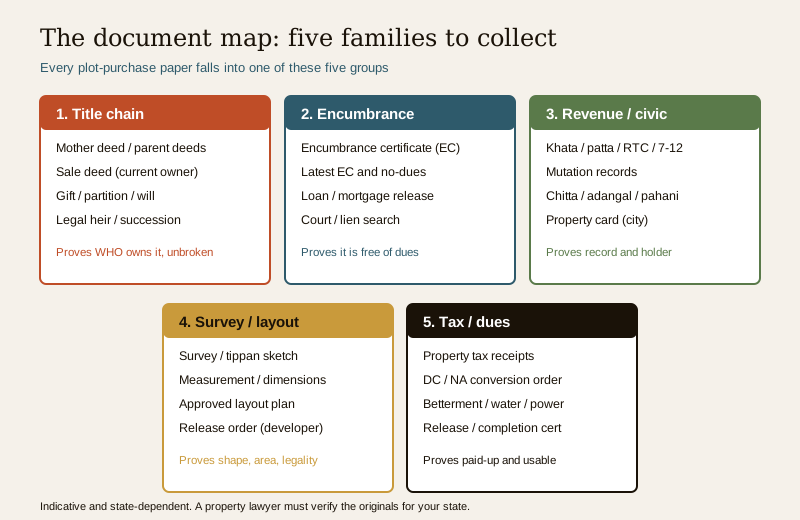
It helps to see the papers in five families, as above: the title chain (who owns it), encumbrance (is it free of charges), revenue and civic records (who is on record and pays tax), survey and layout (its shape, area and legality), and tax, dues and completion (is it paid-up and usable). Collect at least one document from every family; a set that is strong on title but silent on land-use, or strong on layout but missing the encumbrance certificate, is not a clean set.
The master checklist
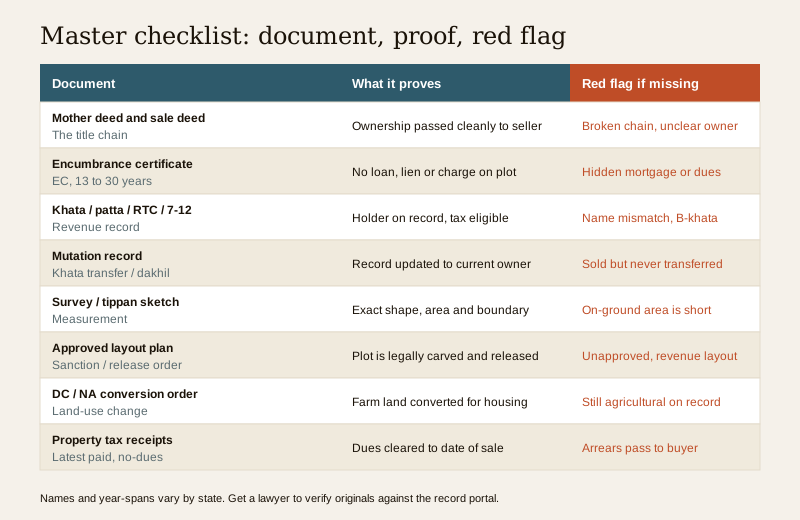
Here is the core list. Read it as document, what it proves, where to get it, and the red flag that should stop you until it is resolved. Each key document then links to its own deep guide below.
| Document | What it proves | Where to get it | Red flag if missing or off |
|---|---|---|---|
| Mother deed and prior deeds | The title chain back in time | Seller; sub-registrar records | A gap or unexplained jump in the ownership history |
| Sale deed (current) | Ownership passed to the present seller | Seller; sub-registrar | Names, area or schedule do not match other papers |
| Encumbrance certificate (EC) | No registered loan, lien or charge | Sub-registrar / land-record portal | Recent mortgage still shown, or EC not produced |
| Khata / patta / RTC / 7-12 | Holder on record, tax eligibility | Municipal or revenue office / portal | Name mismatch, or a "B-khata" style irregular record |
| Mutation record | Record transferred to current owner | Revenue / municipal office | Sold long ago but never mutated to the seller |
| Survey / tippan sketch and measurement | Exact shape, area and boundaries | Survey / revenue department | On-ground area is short of the deed area |
| Approved layout plan and release order | Plot is legally carved and released | Planning authority / developer | "Revenue layout" or unapproved sub-division |
| DC / NA conversion order | Farm land converted for non-agricultural use | Revenue / district office | Land is still agricultural on record |
| Property tax receipts and no-dues | Dues cleared up to the sale | Municipal office / portal | Arrears that will pass to you as buyer |
| Release / completion certificate | Developer plot handed over, dues cleared | Developer / authority | Mortgaged-to-bank plot not released |
Two habits make this table work. First, cross-check the schedule (the plot's survey number, boundaries and area) so it reads identically across the deed, the EC, the khata and the survey sketch - a mismatch is a red flag on its own. Second, insist on seeing originals, not photocopies or colour scans, which your lawyer inspects and compares against the sub-registrar's and revenue portal records.
Title-chain documents: mother deed and sale deed
The mother deed (also called the parent document) is the earliest available deed that starts the ownership story, and the sale deed is the one that transferred the plot to the current seller. Together with any gift, partition, will or legal-heir documents in between, they form the title chain. What they prove is continuity: that ownership passed lawfully, hand to hand, with no unexplained gaps, down to the person selling to you. The red flag is a break in the chain - a missing link, a name that appears from nowhere, or a partition that was never registered. The mother deed and sale deed guide explains how to read them and what a clean chain looks like.
Encumbrance certificate: is the land free of charges
An encumbrance certificate (EC) is the official record, from the sub-registrar, of every registered transaction on a property over a period - sales, mortgages, gifts and releases. It is the single best proof that the land is not quietly carrying a loan or a lien. Ask for an EC covering a long span (commonly thirteen to thirty years, depending on the state and what your lawyer advises), plus a latest EC right up to the sale date, and evidence of any loan being released. The red flag is a subsisting mortgage still showing, or a seller who cannot or will not produce the EC. The encumbrance certificate guide walks through how to read one and its limits (it only shows registered dealings, so unregistered claims can still exist).
Revenue and civic records: khata, patta, RTC, 7-12 and mutation
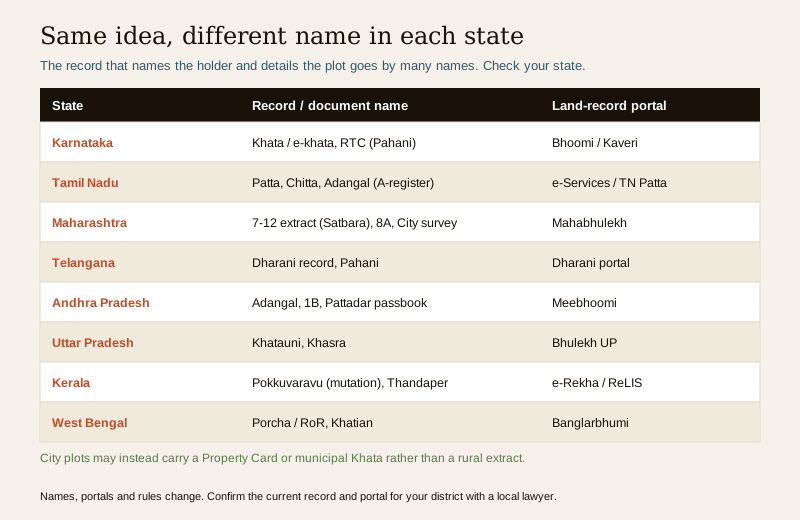
This is the family that varies most by state, so name it generally and check yours. The khata (Karnataka and its BBMP e-khata), patta and chitta (Tamil Nadu), RTC or Pahani (Karnataka rural), 7-12 extract or Satbara (Maharashtra) and Dharani record (Telangana) all do a similar job: they name who holds the land on the revenue or municipal register and make the holder liable for property tax. A mutation (khata transfer, dakhil kharij or pokkuvaravu) is the act of updating that register to the current owner after a sale or inheritance.
| State | Record / document name | Land-record portal (indicative) |
|---|---|---|
| Karnataka | Khata / e-khata, RTC (Pahani) | Bhoomi / Kaveri |
| Tamil Nadu | Patta, Chitta, Adangal | State e-services portal |
| Maharashtra | 7-12 extract (Satbara), 8A | Mahabhulekh |
| Telangana | Dharani record, Pahani | Dharani portal |
| Andhra Pradesh | Adangal, 1B, Pattadar passbook | Meebhoomi |
| Uttar Pradesh | Khatauni, Khasra | Bhulekh UP |
| Kerala | Pokkuvaravu (mutation), Thandaper | e-Rekha / ReLIS |
| West Bengal | Porcha (RoR), Khatian | Banglarbhumi |
The red flags here are a name that does not match the sale deed, a plot sold but never mutated to the seller (so the register still shows an older owner), or an irregular record such as a "B-khata" style entry that signals the property is not fully regularised. The khata and e-khata guide explains the A-versus-B distinction and why a clean khata matters for tax, loans and future permissions.
Survey, layout and land-use documents
These prove the plot's physical identity and its legal right to be a housing plot. The survey or tippan sketch and the measurement record show the exact shape, dimensions, survey number and boundaries - check the on-ground area against the deed, because a plot that measures short of its paper area is a classic dispute. Convert and sanity-check the figures with the land area unit converter so guntas, cents, ground and square feet all reconcile. The approved layout plan and release order prove the plot was legally carved out of a larger parcel and released by the planning authority; the red flag is an unapproved or "revenue" layout that was sub-divided without sanction.
Where the land was once agricultural, the DC conversion or NA (non-agricultural) order proves it was lawfully converted for residential use. Buying farm land that is still agricultural on record, believing you can convert it later, is one of the most expensive mistakes - see the DC / NA land-use conversion guide for why it must be done before you buy, not after. For a plot in a developer project, also ask for the release certificate confirming the developer has cleared any bank mortgage over the layout, and any completion or occupancy paperwork; the occupancy certificate guide explains the built-side equivalent.
Tax, dues and completion documents
Finally, prove the plot is paid-up. Collect the latest property tax receipts and, ideally, a no-dues or up-to-date tax confirmation, because in most states unpaid property tax and betterment charges attach to the property and become your problem as the new owner. Check the current standing with the property tax calculator and the municipal portal. Also clear any water, electricity or society dues, and any betterment or improvement charges the authority may have levied. Once every family in the checklist is satisfied and your lawyer has cleared the title, the transaction is completed through the property registration process at the sub-registrar, where stamp duty is paid and the sale deed is registered in your name.
How it connects
- Start at the how-to-buy-a-residential-plot pillar and the plot due-diligence guide for the full purchase journey this checklist sits inside.
- Have your lawyer verify the title using the land-title verification guide, reading the mother deed and sale deed chain and the encumbrance certificate.
- Understand the revenue record with the khata and e-khata guide and the land-use position with the DC / NA conversion guide.
- Sanity-check area with the land area unit converter and tax with the property tax calculator, then complete the deal via the property registration process.
Key takeaways
- Buying a plot is buying its documents - collect at least one from every family: title chain, encumbrance, revenue record, survey and layout, and tax and dues.
- The three questions are who owns it, is it free of charges, and is it legally usable - a gap in any one is where money is lost.
- Cross-check the schedule (survey number, boundaries, area) so it reads identically across the deed, EC, khata and survey sketch; a mismatch is itself a red flag.
- Names vary by state - khata, patta, RTC, 7-12 extract and Dharani are the same idea under different names; check your state and its land-record portal.
- Farm land must be converted (DC / NA) before you buy, unpaid property tax passes to the buyer, and an unapproved or "revenue" layout is a stop sign.
- A property lawyer must verify the originals and give a written title opinion; everything here is indicative and state-dependent, so confirm with your advocate and the sub-registrar.
References
- Registration Act, 1908 and the Transfer of Property Act, 1882 (named generally) - the framework under which deeds are registered and property is transferred in India; your lawyer applies the current provisions for your state.
- State land-record portals (for example Bhoomi and Kaveri in Karnataka, Mahabhulekh in Maharashtra, Dharani in Telangana, Meebhoomi in Andhra Pradesh, Bhulekh in Uttar Pradesh, Banglarbhumi in West Bengal) - for verifying revenue records; names and access vary and change.
- The office of the sub-registrar and the district revenue and municipal offices - the statutory sources for the encumbrance certificate, mutation, khata or patta, tax dues and conversion orders in your area.
- A practising property lawyer or advocate and a CA or bank - for binding title verification, document authentication and the financial and tax specifics of your purchase.
Every document name, year-span, charge and portal here is indicative and state-dependent, and rules change over time. This is a collection-and-understanding checklist only, not legal advice - have a property lawyer verify the originals and the title, and confirm procedure with the sub-registrar and revenue office for your state before you pay.
Export this guide
Related Guides — Deep-dive reading
Plot Due Diligence in India: The Complete Pre-Purchase Check (2026)
Before you pay a rupee for a plot, run the full pre-purchase check with your lawyer and a licensed surveyor - legal title, revenue records, planning approvals, physical survey and financial dues. This guide walks through each pillar, gives you a checklist and tells you when to walk away.
Buying LandHow to Verify Land Title Before Buying in India: Clear and Marketable Title Explained (2026)
What a clear and marketable title really means, and how it is verified before you buy a plot in India - tracing the chain of ownership back thirty years from the mother deed to the current sale deed, a lawyer's title search at the sub-registrar, a public notice, the encumbrance check, and the legal opinion that decides whether you should pay.
Buying LandProperty Registration Process in India: How a Plot Is Registered in Your Name (2026)
Registration is the step that makes you the legal owner. This guide walks through the sequence - agreement to sell, drafting the sale deed, calculating and paying stamp duty and registration fee, the sub-registrar appointment, the registration day, and the mutation and khata transfer that follow.
Buying LandRelated Tools — Try Free
Stamp Duty Calculator — All Indian States
Stamp duty + registration charges for all 28 states and 8 UTs — gender concessions, urban/rural variants, metro cess built in.
Stamp DutyAI Measurement Tool
Measure your room using voice, photos, or video sweep — no tape measure needed.
DesignAIAccess-Control Schedule Generator
Build the time schedules that decide when each access group can enter — an editable list for your integrator.
Time Schedules