
Agricultural to Non-Agricultural Land Use Conversion in India: DC / NA / CLU Explained (2026)
Most land in India is classified agricultural, and building a house on it usually needs the land use converted to non-agricultural or residential first - called DC conversion in Karnataka, an NA order in Maharashtra and Gujarat, and change of land use (CLU) elsewhere. This guide explains why it matters, who can buy agricultural land, how conversion works, and how to check whether a plot is already converted.
One of the most expensive mistakes a first-time buyer in India makes is paying for a cheap "plot" that is, on paper, still farmland. It looks like a building site, the seller calls it a site, neighbours may even have built on nearby patches - but until the land use has been legally converted from agricultural to non-agricultural, you usually cannot get building approval, cannot get a home loan, and risk penalties if you build anyway. This guide explains, in plain language, what land-use conversion is, why almost all land starts out agricultural, and exactly what to check before you buy.
Scope and honesty note: This is an explainer to help you understand and ask the right questions - it is not legal advice. Land-use rules, the authority in charge, the documents required and the fees all VARY HEAVILY BY STATE and change over time, so everything here is indicative only. Before you pay for any plot, have a property lawyer / advocate verify the records, and confirm the land use and zoning with the revenue office / local planning authority (and your bank, for loan eligibility). Never treat any figure or rule below as definitive.
Why most land is "agricultural" to begin with
For historical and revenue reasons, land across India was originally recorded by the revenue department as agricultural. That classification decides how the land may be used - and farming is the default. So a large share of land on the outskirts of any Indian city or town, even land that no longer grows a single crop, is still officially agricultural in the revenue record.
To use agricultural land for something else - a house, a shop, a factory, a layout of plots - the state generally requires you to formally change that classification. The land is "converted" from agricultural to non-agricultural (NA), and within NA it is earmarked for a specific purpose such as residential, commercial or industrial. Only after that conversion does the land legally become building land for a home.
The name of this process differs by state:
- Karnataka - "DC conversion", because the Deputy Commissioner (DC) traditionally issues the conversion order.
- Maharashtra and Gujarat - an "NA order" (non-agricultural permission / NA sanad).
- Many other states - "CLU" or "change of land use", handled by the revenue and or town-planning authority.
The label changes; the idea does not. If someone tells you a plot is "converted", ask which order proves it and who issued it.
Why it matters so much
Buying unconverted agricultural land for a house is a genuine top-tier mistake because three things you will almost certainly need are tied to the land being non-agricultural:
1. Building approval. The local body or planning authority sanctions building plans on land whose use permits a house. On agricultural land, that approval is generally not available - so any structure you raise may be treated as unauthorised.
2. Home loan. Most banks and housing-finance companies will not fund construction of a house on land still classified as agricultural. No conversion order often means no loan.
3. Legal risk and resale. Building on agricultural land without conversion can invite penalties, demolition risk, or a demand for regularisation later, and it makes the property far harder to sell, mortgage or transfer cleanly.
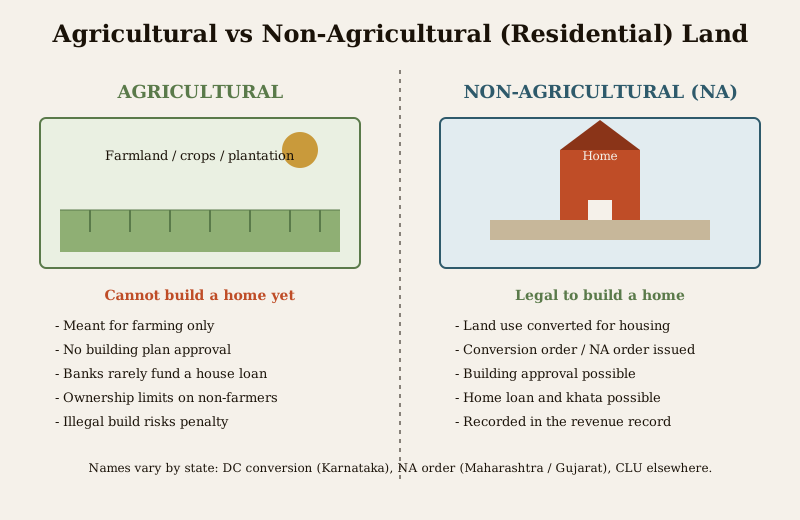
The temptation is the price - unconverted agricultural land is cheaper. But the gap often reflects exactly the cost, time, effort and uncertainty of getting it converted, which may not even be possible if the master plan does not allow housing there.
Who can even buy agricultural land
There is a second trap layered under the first: in several states, not everyone is allowed to buy agricultural land in the first place. Rules differ widely, but common restrictions include allowing purchase only by someone who is already an agriculturist, or capping how much land a person may hold, or restricting purchases by buyers from outside the state or district. Some states have relaxed these rules; others enforce them strictly, and a sale that breaks them can be void.
The practical takeaway: if a plot is agricultural, do not assume you are even eligible to buy it, let alone build on it. This is precisely the kind of state-specific question to put to a property lawyer / advocate before you commit, alongside the conversion question.
How the conversion process generally works
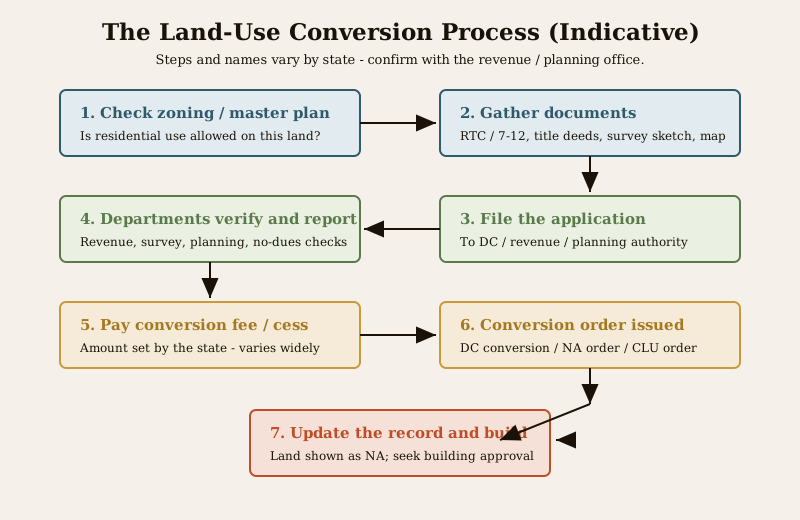
Conversion is an application to the government asking permission to change the land use. The broad shape is similar across states even though the authority and paperwork differ. The table below sets out the typical stages - treat the sequence, not the details, as the guide.
| Step | What happens | Who / what is involved |
|---|---|---|
| 1. Check feasibility | Confirm the plot falls in a zone where residential use is allowed in the master or development plan | Planning authority, master plan / zoning map |
| 2. Assemble documents | Title deeds, current revenue record (RTC / 7-12 / patta), survey sketch, mutation extract, tax receipts, ID | Owner, revenue office, licensed surveyor |
| 3. File application | Apply for conversion / NA / CLU to the prescribed authority (often online in some states) | DC / revenue authority / town planning |
| 4. Verification and reports | Departments verify ownership, encumbrances, dues and that the change suits the plan | Revenue, survey, planning, no-dues checks |
| 5. Pay conversion fee | Pay the conversion charge, cess or premium the state sets - amount varies widely | Owner, treasury / authority |
| 6. Conversion order | The authority issues the order changing land use to NA-residential | DC conversion order / NA order / CLU order |
| 7. Record and build | The change is reflected in the revenue record; you then seek building approval | Revenue office, then building-plan sanction |
Two things decide whether conversion is even possible. First, zoning / master-plan compatibility - if the plot sits in an agricultural, green-belt or non-residential zone, the authority can simply refuse, and no fee will change that. Second, a clean title and record - conversion does not fix ownership disputes; it assumes they do not exist. Timelines and fees are genuinely unpredictable and state-specific, so ask the local authority for the current position rather than relying on any published figure.
How to check if a plot is already converted
If the seller says the plot is already non-agricultural, do not take their word - verify it three ways, and have a lawyer confirm.
1. The conversion order itself. Ask for the actual DC conversion order / NA sanad / CLU order - the physical document, with its number and date, issued by the named authority. Match the survey number and extent on the order to the plot you are buying.
2. The land use in the revenue record. Pull the current revenue record for that survey number - the RTC or 7-12 extract or patta, from the state's land-records portal (Bhulekh, Dharani, Kaveri and similar systems vary by state). A converted plot should reflect non-agricultural use, not "agriculture".
3. The zoning in the master plan. Independently check that the plot falls in a residential zone in the current master or development plan. Land can be in a residential zone yet unconverted, or converted yet non-residential - you want both to line up.
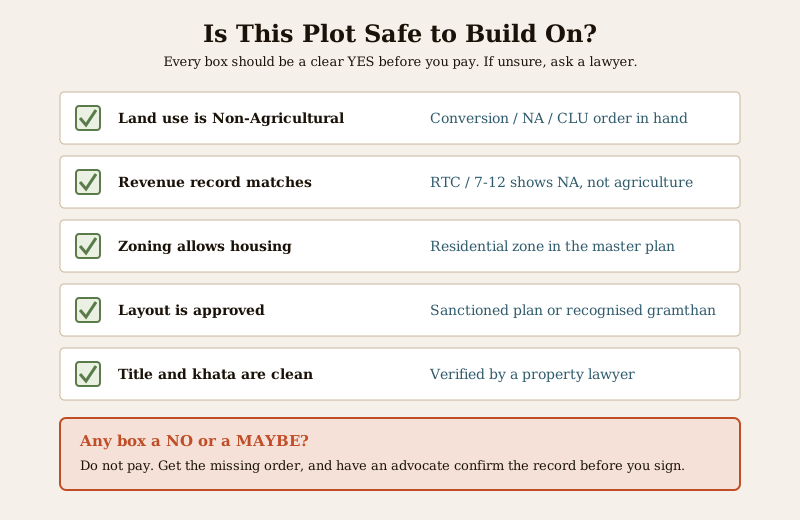
The checklist below turns this into a simple go / no-go.
| Check | What a clear "yes" looks like | If "no" or unsure |
|---|---|---|
| Land use is non-agricultural | Valid conversion / NA / CLU order in hand | Do not pay; get the order first |
| Revenue record matches | RTC / 7-12 / patta shows NA, not agriculture | Records disagree - stop and ask a lawyer |
| Zoning allows housing | Residential zone in the current master plan | Green-belt or agri zone may never convert |
| Layout is approved | Sanctioned layout, or a recognised gramthan / abadi plot | Unapproved layout - high risk, verify |
| Title and khata are clean | Verified by a property lawyer; khata in order | Fix title and khata before you commit |
Gramthan, village abadi and layout-approved land
Two special cases confuse buyers. Gramthan or village abadi land is the old inhabited core of a village - the settlement area, as opposed to the surrounding farmland. Building there often does not need the same conversion because it was never treated as cultivable, but the boundaries, records and approval routes for gramthan are murky and vary by state, so this is not a shortcut to assume - confirm the status in writing with the local authority.
Layout-approved land is a different comfort. When a developer gets a residential layout sanctioned by the planning authority, the parent land has typically already been converted and the individual plots carved out with approval. Buying a plot inside a properly sanctioned, converted layout is usually cleaner than buying a lone survey number - but only if the layout approval is genuine and current. Ask to see the sanctioned layout plan and the release / approval order, and cross-check the plot number against it.
For the wider set of records to inspect, see our land documents checklist, and use the plot due-diligence guide to structure the whole verification. To understand how khata ties into municipal recognition of a converted plot, read the khata and e-khata explainer. Once you know the land is buildable, the far and fsi guide and the building regulations and compliance hub explain what and how much you may actually build.
Key takeaways
- Most Indian land starts out classified agricultural; building a house usually needs the land use converted to non-agricultural / residential first.
- The process is called DC conversion (Karnataka), an NA order (Maharashtra / Gujarat) or CLU / change of land use elsewhere - same idea, different name.
- Buying unconverted agricultural land for a home is a top mistake: no building approval, usually no home loan, and penalty and resale risk.
- Some states restrict who may buy agricultural land at all - non-farmers or outsiders may be barred, so check eligibility first.
- Conversion depends on zoning / master-plan compatibility and a clean title; a fee alone cannot convert land the plan does not allow.
- Verify conversion three ways - the conversion order, the land use in the RTC / 7-12 / patta, and the zoning in the master plan.
- Gramthan / abadi and sanctioned layout-approved plots have their own rules; confirm status in writing, do not assume.
- Everything varies by state and changes - confirm with a property lawyer and the revenue / planning authority before you pay.
References
- Registration Act, 1908, and the Transfer of Property Act, 1882 - the framework for land transfer and registration (named generally; confirm current provisions with a lawyer).
- State land-revenue codes and town-and-country-planning laws - which define conversion / NA / CLU, the issuing authority and fees (state-specific).
- State land-records portals - for example Bhulekh, Dharani, Kaveri and equivalents - for the current RTC / 7-12 / patta and land use (varies by state).
- The applicable master plan / development plan and zoning maps of the local planning authority.
- Studio Matrx guides: how to buy a residential plot (/guides/how-to-buy-a-residential-plot-india), plot due diligence (/guides/how-to-do-plot-due-diligence-india), land documents checklist (/guides/land-documents-checklist-before-buying-india), khata and e-khata (/guides/khata-and-e-khata-explained-india), FAR vs FSI (/guides/far-vs-fsi-development-rights-india), and the building regulations and compliance hub (/guides/building-regulations-and-compliance).
Export this guide
Related Guides — Deep-dive reading
Plot Due Diligence in India: The Complete Pre-Purchase Check (2026)
Before you pay a rupee for a plot, run the full pre-purchase check with your lawyer and a licensed surveyor - legal title, revenue records, planning approvals, physical survey and financial dues. This guide walks through each pillar, gives you a checklist and tells you when to walk away.
Buying LandLand Documents Checklist Before Buying a Plot in India (2026)
Every document to collect and verify before you buy a residential plot in India - the title chain, encumbrance certificate, khata or patta, mutation, survey and layout, land-use conversion and tax dues - what each one proves, the red flag if it is missing, and how the same record is named differently in each state.
Buying LandGram Panchayat Building Approval in India: Rural and Peri-Urban Permissions, and the Unapproved-Layout Trap (2026)
How a home permission works outside municipal limits - who approves in a gram panchayat, the documents and process, and how to tell a genuine panchayat plot from an unapproved layout sold as "panchayat approved".
Building RegulationsRelated Tools — Try Free
Building Plan Approval Roadmap
Step-by-step building plan approval process by city with documents, timelines, and fees.
ArchitectAIConstruction Approval Checklist — 24-Stage Tracker
Track every approval, permit, and NOC from land title to occupancy certificate across 24 stages.
ApprovalsStamp Duty Calculator — All Indian States
Stamp duty + registration charges for all 28 states and 8 UTs — gender concessions, urban/rural variants, metro cess built in.
Stamp Duty