

Encumbrance Certificate (EC) Explained for Buying Land in India (2026)
The EC is the sub-registrar's record of every registered transaction on a property over a period - sales, mortgages, liens and releases. This guide explains what it shows, the Form 15 versus Form 16 difference, how to apply online or offline, how to read it, and its important limits, so you use it correctly and let a lawyer interpret it.
When you buy a plot in India, one document you will hear about again and again is the "encumbrance certificate", usually shortened to EC. Banks ask for it before a home loan. Lawyers pull it early in due diligence. Sellers offer it as proof the land is "clean". It sounds technical, but the idea is simple: an EC is an official statement from the sub-registrar's office listing every transaction that has been registered against a specific property over a period of time - sales, mortgages, gifts, leases, court attachments and the releases that cancel them.
In plain terms, an encumbrance is anything that hangs on the property as a monetary or legal claim - a loan the land secures, a lien, a charge. The EC tells you whether the property carries such claims on the public register, or whether it appears free of them for the years you searched. That is genuinely useful. But it is also frequently over-trusted, because an EC only ever reflects what was registered at that office. This guide explains what an EC is, how the two output forms differ, how to obtain and read one, and - just as importantly - what it cannot tell you.
Scope and who should interpret this. This guide explains the EC in plain language so you know what to ask for and what you are looking at. It is not legal advice. Land records, portals, forms, fees and the exact meaning of entries are state-specific and change over time. Always have the EC and the underlying deeds read by a property lawyer or advocate, and confirm the current procedure and any dues with the sub-registrar and local revenue office for the property. An EC is one input into a title opinion - never treat it as sole proof of clear title.
What an encumbrance certificate actually is
The sub-registrar's office is where property transactions are registered under the registration law. Every time a registrable deed for a property is presented and registered, it is indexed against that property. An EC is essentially a search report of that index for a stated property, over a stated period. It lists, in date order, each registered instrument: the type of deed, the date, the parties (who transferred to whom, or who created a charge in whose favour), the consideration where recorded, and the document number.
Read as a sequence, those entries form a chain. A typical healthy chain might show a sale to owner A, a mortgage A raised, a later release of that mortgage, then a sale from A to B, and so on down to the current seller. When a charge such as a mortgage is created and never released in the record, that is a red flag worth a lawyer's attention - the property may still stand as security for a loan.
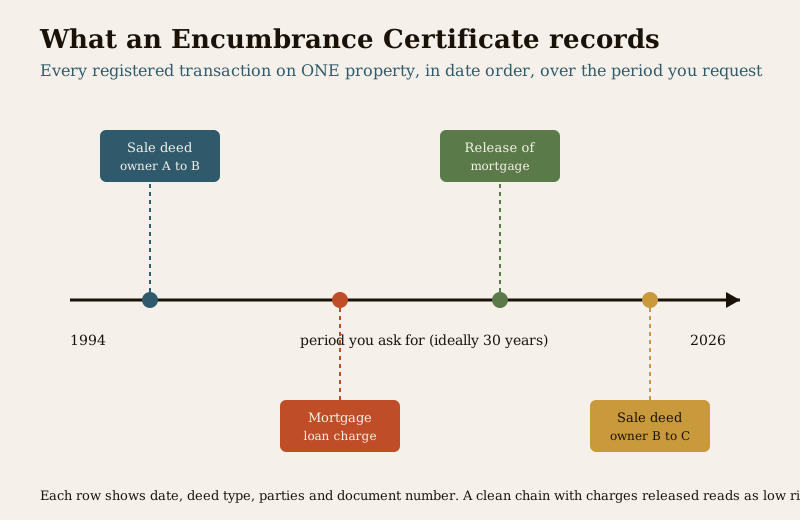
The EC is closely tied to the deed chain, so read it next to the mother deed and sale deed that establish how ownership travelled to the present seller. Together they let a lawyer trace title; separately, each tells only part of the story.
Form 15 versus Form 16: the two possible outputs
An EC application returns one of two broad outcomes, and it is worth understanding the distinction because sellers sometimes describe them loosely. The naming below follows a common convention (states use their own numbering, so confirm locally), but the underlying logic is universal.
- A certificate showing encumbrances (often called Form 15). For the period searched, the register found one or more registered transactions on the property. The certificate lists them. This does not automatically mean the property is problematic - a sale deed is itself a "transaction" and will show up. It simply means the search returned entries, which you then read to see whether any live charge remains.
- A nil-encumbrance certificate (often called Form 16). For the period searched, the register found no registered transactions on the property. This is issued when a search comes back empty for those years.
A nil certificate sounds like the best outcome, but treat it with care. A genuine nil can be reassuring; it can also mean the transactions simply were not registered, were registered under a different property description or survey number, or fall outside the years you searched. That is exactly why the period you request matters and why a nil result still needs a lawyer's eyes.
What an EC shows, and what it misses
The single most important thing to understand about an EC is the word registered. The certificate is only as complete as the register behind it. Anything that never reached the sub-registrar's index will not appear, no matter how real the claim is.
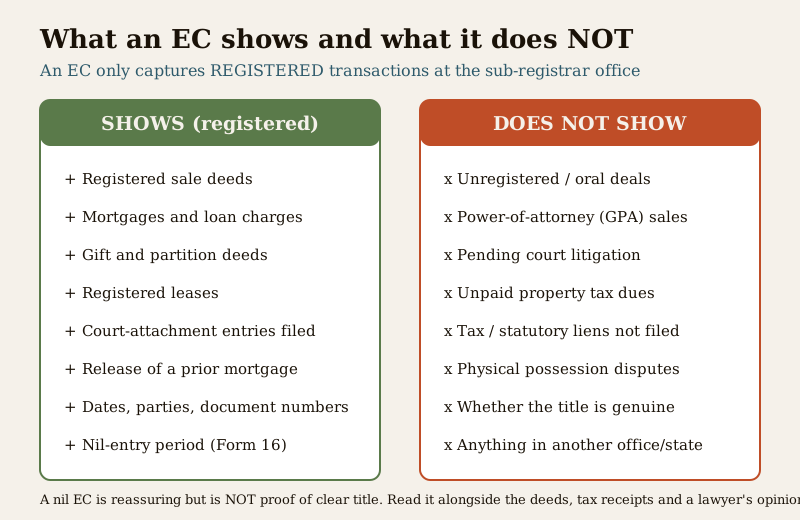
| What an EC does show | What an EC does NOT show |
|---|---|
| Registered sale, gift and partition deeds | Unregistered, oral or handshake transfers |
| Registered mortgages and loan charges | Sales done only on a power of attorney (GPA) |
| Registered leases (where applicable) | Pending court cases and litigation risk |
| Court-attachment entries that were filed | Physical possession or boundary disputes |
| Release of an earlier mortgage or charge | Unpaid property tax and utility dues |
| Dates, parties and document numbers | Statutory or tax liens not filed at that office |
| A nil period, if nothing was registered | Whether the title itself is genuine and marketable |
Because of these gaps, an EC is a necessary but insufficient check. It pairs with the wider plot due-diligence process and the land documents checklist, which cover tax receipts, approvals, possession and litigation searches the EC never touches. For the full picture of how these fit together, start from the residential plot buying guide.
The period to request: aim for the full title chain
You do not get an EC for "all time"; you request a period. The safe default is to ask for as long a span as the office allows - ideally around 30 years, which is the horizon lawyers commonly use to trace a marketable title, or long enough to cover the entire chain back to the mother deed. A short two or three year EC is nearly worthless for buying, because a charge created just before your window will not appear.
Ask for a period that at minimum starts before the earliest deed in the chain you have been shown and runs to the present date. If the seller offers a recent short-period EC, treat it as a starting point and obtain a longer one yourself. Confirm the maximum searchable period and the current per-year search fee with the sub-registrar or on the state portal, since both vary.
How to apply: online portals or offline at the sub-registrar
There are two routes, and which one is available depends on your state. Many states now offer online ECs through their land-records or registration portals; others still require an in-person application. Portals differ in name and layout, so the steps below describe the common shape rather than any one site.
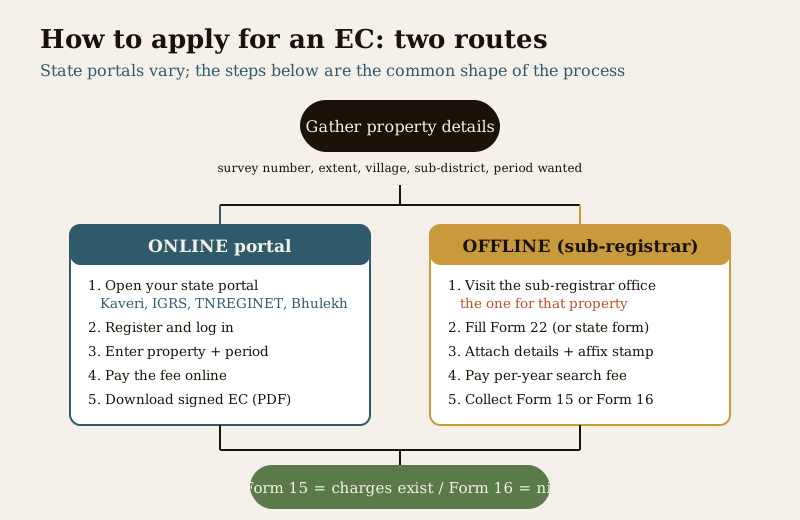
| Mode | How it works (typical, confirm for your state) |
|---|---|
| Online portal | Open your state registration or land-records portal (for example Kaveri in Karnataka, IGRS-type portals in several states, or TNREGINET in Tamil Nadu). Register or log in, select the encumbrance-certificate service, enter the property description and the period, pay the fee online, and download a digitally signed EC as a PDF. |
| Offline at sub-registrar | Visit the sub-registrar office that has jurisdiction over the property. Submit the prescribed application (a Form 22 or the state equivalent) with the property details, affix the required stamp or fee, pay the per-year search fee, and collect the EC (Form 15 or Form 16) after the office completes the search. |
Whichever route you use, you will need accurate property identifiers to get a correct search: the survey or plot number, the extent or area, the village or locality, the sub-district or registration district, and often the door or khata number. A wrong survey number returns the wrong property's history, so cross-check these against the sale deed. The online PDF is convenient, but for a high-value purchase many lawyers still obtain a certified EC directly from the office.
How to read an EC once you have it
An EC is laid out as a header identifying the property and search period, followed by rows for each registered transaction (or a statement that none were found). Work through it methodically, and hand it to your lawyer for the binding read.
- Confirm the property. Check that the survey number, extent and locality in the header match the plot you are buying. An EC for the wrong property is worthless.
- Check the period. Confirm the search covers the years you need, ideally the full chain. Note any gap between the period end date and today.
- Trace the chain. Follow the deeds in date order and see that ownership flows cleanly to the current seller, matching the deed chain the seller has shown you.
- Look for live charges. For every mortgage or charge, find the matching release. An unreleased mortgage means the property may still secure a loan.
- Note attachments. Any court-attachment entry is a serious flag for a lawyer to investigate.
- Cross-check against title. Read the EC alongside the full title-verification process; the EC supports a title opinion but does not replace one.
Why an EC is not proof of clear title
It bears repeating because so many buyers get this wrong: a clean or nil EC is reassuring, not conclusive. Because it captures only registered transactions at one office, it is silent on unregistered and power-of-attorney deals, pending litigation, tax and statutory dues, possession disputes and whether the title itself is genuine. A property can have a spotless EC and still be entangled in a court case or sold on a fraudulent chain of deeds.
Use the EC as one strong signal among several. The binding judgement - whether the title is marketable and safe to buy - is a legal opinion your property lawyer gives after reading the EC together with the deeds, revenue records, tax receipts, approvals and litigation searches. Treat the EC as evidence you gather for that opinion, not as the opinion itself.
Key takeaways
- An encumbrance certificate is the sub-registrar's record of every registered transaction on a property over a stated period - sales, mortgages, liens and their releases.
- A Form 15-type EC lists transactions found; a Form 16-type EC is a nil certificate showing none for the period. A nil result is reassuring but not automatic proof of a clean property.
- Request a long period, ideally around 30 years or the full title chain - a short EC misses charges created just outside the window.
- Apply online through your state portal (Kaveri, IGRS, TNREGINET and others vary by state) or offline at the sub-registrar with the prescribed form, using accurate survey and property details.
- An EC only shows registered dealings. It misses unregistered and GPA sales, pending litigation, and unpaid dues, so it is never sole proof of clear title.
- Have a property lawyer interpret the EC alongside the deeds and revenue records, and confirm procedure and fees with the sub-registrar for your state.
References
- Registration Act 1908 (India) - the statute under which property deeds are registered and indexed at the sub-registrar, forming the basis of an EC. Confirm current provisions with a lawyer.
- Transfer of Property Act 1882 (India) - governs sales, mortgages, leases and charges that appear as encumbrances.
- State registration and land-records portals - for example the Kaveri portal (Karnataka), IGRS-type portals in several states, and TNREGINET (Tamil Nadu); procedures, forms and fees vary by state and change over time.
- Your local sub-registrar office and revenue office - the authoritative sources for the current EC procedure, searchable period, fees and property records.
- A qualified property lawyer or advocate - for binding interpretation of any EC and a full title opinion.
Indicative and state-dependent. Studio Matrx is a not-for-profit guide; this is educational content, not legal or financial advice. Verify every step with a property lawyer and the sub-registrar for your state before you transact.
Export this guide
Related Guides — Deep-dive reading
How to Verify Land Title Before Buying in India: Clear and Marketable Title Explained (2026)
What a clear and marketable title really means, and how it is verified before you buy a plot in India - tracing the chain of ownership back thirty years from the mother deed to the current sale deed, a lawyer's title search at the sub-registrar, a public notice, the encumbrance check, and the legal opinion that decides whether you should pay.
Buying LandPlot Due Diligence in India: The Complete Pre-Purchase Check (2026)
Before you pay a rupee for a plot, run the full pre-purchase check with your lawyer and a licensed surveyor - legal title, revenue records, planning approvals, physical survey and financial dues. This guide walks through each pillar, gives you a checklist and tells you when to walk away.
Buying LandLand Documents Checklist Before Buying a Plot in India (2026)
Every document to collect and verify before you buy a residential plot in India - the title chain, encumbrance certificate, khata or patta, mutation, survey and layout, land-use conversion and tax dues - what each one proves, the red flag if it is missing, and how the same record is named differently in each state.
Buying LandRelated Tools — Try Free
Stamp Duty Calculator — All Indian States
Stamp duty + registration charges for all 28 states and 8 UTs — gender concessions, urban/rural variants, metro cess built in.
Stamp DutyInterior Red Flag Checklist — Before Signing
54 red flags across 8 categories with a live risk score and personalised PDF.
Red Flag ChecklistBefore & After Studio
Generate AI before-and-after renders to preview how your redesign could look.
DesignAI