

Occupancy Certificates Explained: A Home Buyer's Guide (India)
What an Occupancy Certificate is, why no Indian buyer should move in without one, and exactly how to verify it before you pay
You have paid for the flat. The keys are in your hand, the lift works, the paint smells fresh. Yet legally, you may not be allowed to live there. The single document that decides this is the Occupancy Certificate (OC) — and far too many Indian buyers discover its importance only after they have moved in, when the water connection is refused, the home loan stalls, or a notice from the municipal corporation arrives.
This guide explains, in plain language, what an OC is, why it matters more to a buyer than almost any other paper in the transaction, what genuinely goes wrong without one, and exactly how to check that a real, valid OC exists before you sign or take possession. Rules vary from city to city, so treat this as the map and verify the exact route with your local municipal body.
1. What an Occupancy Certificate actually is
An Occupancy Certificate is the document issued by your local municipal corporation or development authority that certifies a completed building has been constructed according to its sanctioned (approved) plan, complies with the applicable building bye-laws and safety norms, and is therefore fit and legal for people to occupy.
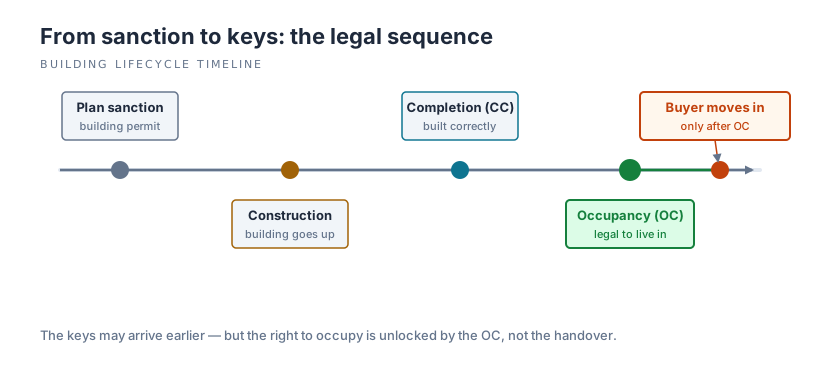
Think of the building's life in stages. First the authority approves a plan (the building permit). Then construction happens. Then, when it is finished, the authority comes back, inspects, and confirms that what was built matches what was approved — no extra floors, no encroachment on setbacks, fire safety in place, structure sound. The OC is the green light at the end of that check. It is the difference between a structure that physically exists and a home that is legally allowed to be lived in.
The OC is issued by the same kind of body that approved the plan — for example a municipal corporation (like BBMP, MCGM/BMC, MCD), a development authority (like DDA, GDA), or an urban local body, depending on where the property sits.
2. OC vs Completion Certificate (CC): the difference that confuses everyone
Buyers constantly mix up the OC with the Completion Certificate, and builders sometimes exploit the confusion by handing over one while implying it is the other. They are related but not the same.
A Completion Certificate (CC) says: "construction is finished, and it was done as per the approved plan." An Occupancy Certificate (OC) says: "this building is cleared, safe, and legal for people to move in." In the usual sequence the CC comes first and the OC follows, because the authority must confirm completion before it can certify the building as fit to occupy. In several states and cities the two are merged into a single combined CC-cum-OC, while in others they remain separate documents — this is one of the biggest sources of city-to-city variation, so always confirm which applies to you.
| Aspect | Completion Certificate (CC) | Occupancy Certificate (OC) |
|---|---|---|
| What it certifies | Construction is complete and matches the sanctioned plan | Building is safe and legally fit to occupy |
| Typical timing | Issued first, after construction ends | Issued after CC, once safety clearances are in |
| Core question it answers | "Is it built correctly?" | "Can people legally live here?" |
| Who needs it most | Builder / authority records | The buyer/occupant (you) |
| Combined form | In some states issued together as a single CC-cum-OC document |
For the technical, step-by-step view of how an architect or engineer secures these, see the deeper companion: OC, CC and plinth verification — the architect's workflow. For a buyer-focused walk-through of the CC itself, read completion certificates explained.
3. Why the OC matters enormously to you
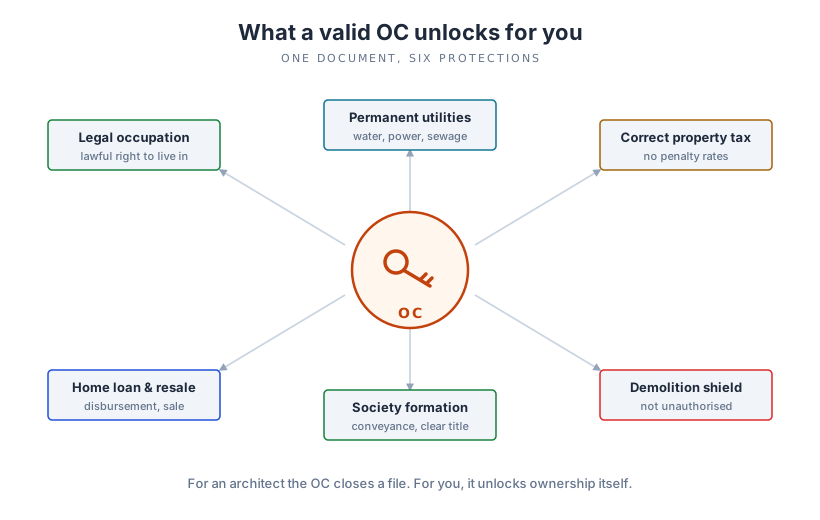
For an architect the OC closes a file. For you, it unlocks ownership itself. Here is what depends on it.
Legal occupation. Without an OC, occupying the building can be treated as unauthorised, even if construction is finished and the builder has formally "offered possession." The authority can, in principle, treat the dwelling as illegal.
Permanent water, electricity and sewage connections. Utilities typically grant permanent connections only against an OC. Without it you may be stuck on temporary or builder-arranged connections that are unreliable, costlier, or irregular.
Property tax at the correct rate. Property tax usually applies properly once an OC exists. In OC-less buildings, owners have in practice been charged punitive rates — reported cases describe property tax around 25% higher and water charges roughly 50% higher than normal — because the property is treated as irregular.
Home loan disbursement and resale. Lenders routinely ask for the OC before final loan disbursement, and again when the next buyer seeks a loan to buy from you. No OC can mean a stuck loan now and a flat that is very hard to sell later.
Society / association formation and clear title. A valid OC is part of the chain that lets the conveyance deed be executed and the residents' association or society be formed — i.e. lets ownership and common areas actually transfer to you.
Protection from demolition and penalty. A genuine OC is your shield against the building being declared unauthorised. The most extreme reminder is the August 2022 demolition of Supertech's twin towers in Noida — homes sold without the required approvals and OC.
4. What happens if you buy or occupy without an OC
It is worth being blunt, because builders often soften this. If you take possession of a flat without an OC, you carry several risks at once.
- Unauthorised-occupation exposure. The local body can serve notices, levy penalties, and in serious cases of deviation from the sanctioned plan, pursue demolition of the unauthorised portion.
- Utility hardship. Refusal or delay of permanent water and power connections.
- Higher recurring costs. Penalty rates on property tax and water, as noted above.
- Title and resale trouble. Difficulty executing the conveyance deed, forming the society, getting a loan, or selling — your buyer's bank will ask the same question you should have asked.
- Weak negotiating position. Once you have accepted possession and paid in full, your leverage to force the builder to deliver the OC drops sharply.
None of this means every OC-less building is doomed — some genuinely get the OC a little after handover. But the absence of an OC is a serious red flag that shifts risk onto you, and you should treat it as a reason to pause, not a formality to ignore.
5. How an OC is obtained (so you know what to ask for)
You usually will not apply for the OC yourself in a builder project — the promoter does. But understanding the process tells you what evidence to demand.
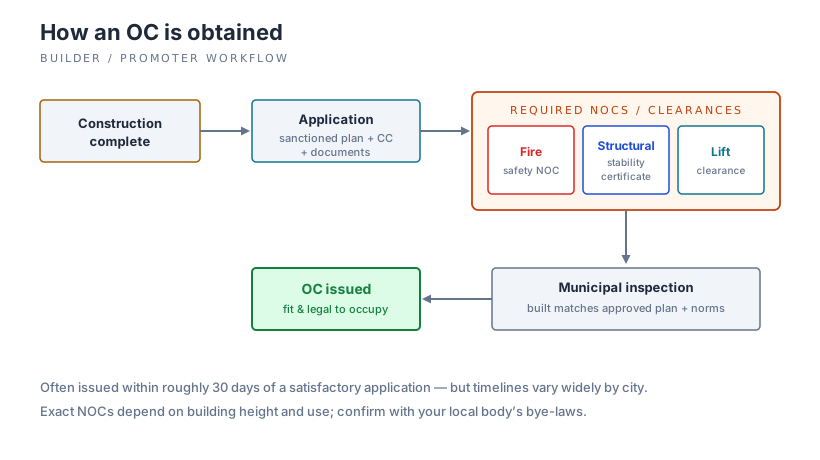
After construction is complete, the builder/owner applies to the municipal body or development authority for the OC, attaching documents that typically include the sanctioned building plan, the completion certificate, and a set of clearances. The authority then inspects the building to confirm it matches the approved plan and meets safety norms, and if satisfied, issues the OC (commonly within around 30 days of a satisfactory application, though timelines vary widely by city — treat this as illustrative, not a guarantee).
The supporting clearances (NOCs) commonly required — varying by building height, use and city — include:
- Fire department NOC / fire safety clearance (especially for taller and high-occupancy buildings — in many states the OC simply will not issue without it).
- Structural stability certificate from a qualified structural engineer.
- Lift / elevator clearance where applicable.
- Water, sewerage and sometimes electrical / environmental clearances, depending on the project.
The exact list and section references come from your state's building bye-laws and the local body's rules — the central reference frameworks are the National Building Code of India (NBC 2016) and the Model Building Bye-Laws 2016, which states adapt into their own bye-laws. Do not rely on a generic checklist; confirm the current requirements with your municipal corporation or development authority.
If you want to see the full approval journey end to end, the construction approval checklist tool lays out the stages, and why building plans get rejected and common approval mistakes that delay projects explain where OCs most often get stuck.
6. RERA's role — and what your builder is legally bound to do
The Real Estate (Regulation and Development) Act, 2016 (RERA) strengthened the buyer's hand considerably. Under RERA, the promoter is obliged to obtain the occupancy/completion certificate from the relevant authority and make it available to the allottees, and, after obtaining it and handing over possession, to transfer the necessary documents, plans and common areas to the association of allottees (broadly the framework around Section 17 and the promoter's obligations under Section 11).
In practice this means: if a RERA-registered builder offers you possession without an OC, or fails to hand it over, you have a defined channel of redress. You can take the matter to the State RERA authority, and consumer forums are also an avenue. Note one nuance — the absence of an OC does not by itself decide whether a project must be RERA-registered; ongoing projects can be covered regardless. The practical takeaway for you is simpler: a legitimate, completed RERA project should be able to produce a valid OC, and you are entitled to insist on it.
7. A buyer's checklist: verifying the OC is real and valid
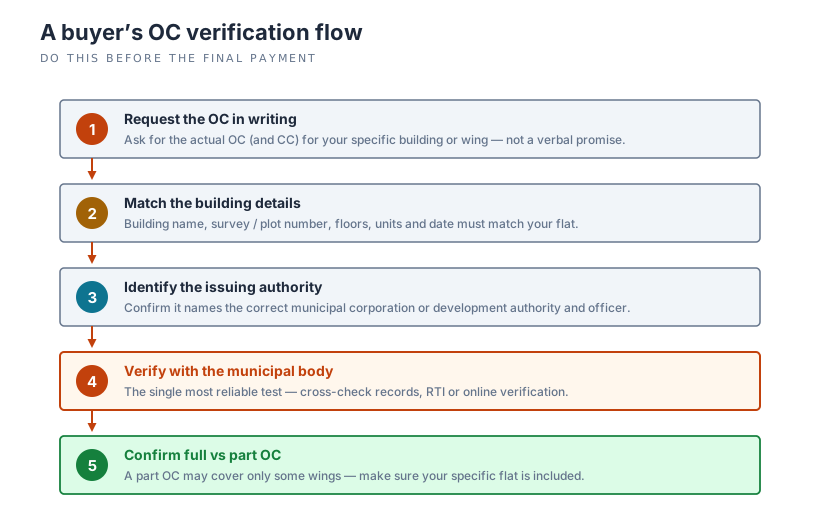
Never accept "OC is applied for" or a photocopy waved across a sales desk. Work through this before paying the final instalment or taking possession.
| Step | What to do | Why it matters |
|---|---|---|
| 1. Ask for the OC in writing | Request a copy of the actual Occupancy Certificate (and CC) for your specific building/wing | Confirms it exists for your tower, not a different phase |
| 2. Match the details | Check building name, survey/plot number, number of floors and units, date | Catches an OC issued for a different or smaller building |
| 3. Check the issuing authority | Confirm it is from the correct municipal corporation / development authority | A genuine OC names a real authority and officer |
| 4. Verify with the authority | Cross-check with the municipal body — many publish OC records or allow RTI/online verification | The single most reliable test of authenticity |
| 5. Confirm it is full, not partial | Some projects get a part OC for certain wings only | Your specific flat may not be covered by a part OC |
| 6. Tie it to your loan and registry | Have your lawyer and bank confirm the OC against the sanctioned plan and title chain | Lenders and resale buyers will ask the same later |
If the seller is an individual reselling an old flat, the same logic applies — ask whether an OC was obtained for the building when it was completed, and verify with the local body. For resales especially, this protects your own future resale and loan prospects.
8. City and state variation — read this honestly
There is no single national OC process. The names, the forms, the combined-vs-separate question, the NOCs required, the fees and the timelines all differ:
- Some states issue a combined CC-cum-OC; others keep them separate.
- Terminology differs — you may hear "occupancy certificate," "occupation certificate," or local equivalents.
- The fire NOC threshold, lift clearance and other NOCs depend on building height and use, which vary by bye-law.
- Online verification, RTI access and published OC registers exist in some cities and not others.
So use this guide to know what to look for, then confirm the precise procedure, documents and verification route with your own municipal corporation or development authority — and, for any transaction of this size, with a property lawyer.
What this means for you (buyer / owner)
The OC is not paperwork to be tidied up after you move in. It is the proof that your home is legal, safe, connectable to utilities, taxable at the right rate, loanable, sellable, and protected from being declared unauthorised. Before you pay the final amount or accept the keys: get the actual OC for your building, match every detail, and verify it independently with the municipal authority. If a builder cannot produce a valid OC, treat that as a stop sign, lean on RERA, and get legal advice — do not let possession of the keys be mistaken for the right to live there.
Continue your reading:
- OC, CC and plinth verification — the architect's workflow
- Completion certificates explained
- Why building plans get rejected
- Common approval mistakes that delay projects
- Construction approval checklist tool
- India Regulatory Atlas
Sources
- Real Estate (Regulation and Development) Act, 2016 — Section 17 (Transfer of title) and promoter obligations: IBC Laws — Section 17 of RERA, 2016
- RERA and the occupancy-certificate question (registration nuance): Cyril Amarchand Mangaldas — No Occupancy Certificate: not the only criteria for registration with RERA
- Occupancy Certificate — definition, who applies, documents and benefits: ClearTax — Occupancy Certificate
- OC for property buyers, verification and risks: Square Yards — What is an Occupancy Certificate (OC)
- OC vs CC and society perspective: ADDA — Building Completion Certificate vs Occupancy Certificate
- Penalty rates and risks of occupying without OC: Inventiva — Occupancy Certificate and homebuyer fraud
- OC and home loans / lender requirements: Kotak — Occupancy Certificate: why it's non-negotiable before moving in
- Fire NOC requirement for OC (state-wise): Lawrbit — Obtain Fire Safety Certificate (NOC) in India: state-wise guide
- Process and documents overview: IIFL Home Loans — Occupancy Certificate in India: process, benefits and rules
- National Building Code of India (NBC 2016) and Model Building Bye-Laws 2016 — Bureau of Indian Standards and Ministry of Housing and Urban Affairs (refer to your state's adapted building bye-laws and local municipal/development-authority rules for binding procedure).
Export this guide
Related Guides — Deep-dive reading
Common Approval Mistakes That Delay Projects in India
The avoidable errors that stall building-plan sanction and possession, and how first-time builders can sidestep each one
Building Regulations & ComplianceWhy Building Rules Exist in India: A Homeowner's Guide
What setbacks, FAR, height limits and certificates quietly protect — and why following them pays you back
Building Regulations & ComplianceCommencement Certificate (CC) Explained: When You Can Legally Start Construction in India (2026)
A plain-language guide to the commencement certificate - the permission to START building after your plan is sanctioned. What it is, why building without it is a serious risk, when it is issued, the plinth-level check, its validity and revalidation, and how it differs from the completion certificate and occupancy certificate.
Building RegulationsRelated Tools — Try Free
Pre-Possession Inspection Checklist
Inspect your flat before registration — 10 categories, 70+ checkpoints across legal, carpet area, structure, finishes, and deviations.
Homebuyer ChecklistConstruction Approval Checklist — 24-Stage Tracker
Track every approval, permit, and NOC from land title to occupancy certificate across 24 stages.
ApprovalsSociety Handover & NOC Checklist
Builder-to-RWA handover audit — 9 categories, 65+ checkpoints across legal docs, drawings, utilities, STP/WTP, fire safety, finances, warranties.
RWA Handover