

Khata and e-Khata Explained: What It Is, A vs B, and Why It Matters (2026)
A plain-language guide to khata, the municipal property record used for tax and civic identity in India, why it is not proof of ownership, the difference between A-khata and B-khata, and how khata transfer and e-khata work.
If you are buying a plot or house in India, someone will soon ask whether it has a "clean khata". The word gets treated as a magic stamp of safety, and B-khata is whispered like a warning. Both reactions miss what the document actually is. A khata is a civic account the local municipal body keeps for a property, mainly so it can bill and collect property tax and know who to deal with for civic purposes. Understanding what it does and does not prove will save you from one of the most common and expensive misreadings in Indian property.
Scope and disclaimer: This is a plain-language explainer, not legal advice. Khata systems, portal names, fees and rules are STATE-SPECIFIC and change often. The word "khata" is strongest in Karnataka; other states use different names for the same civic-record idea. Always confirm the current process for your city with a property lawyer or advocate and the local municipal body or sub-registrar office before you rely on anything here.
What a khata actually is
A khata (from the word for an account or ledger) is the municipal body's record of a property for taxation and civic administration. In Bengaluru the body is the BBMP; every city has its own. The khata answers a narrow question: for this property, who is the assessed person the corporation will send the property-tax demand to, and what are the property's basic particulars (size, location, built-up area, valuation for tax)?
Two documents usually come out of it. A "khata certificate" states that a property stands in a named person's account and is used when you apply for a building licence, a trade licence or a loan. A "khata extract" is a detail sheet of the property's assessment particulars. Together they let the corporation tax the property and let you transact with civic departments.
Crucially, the khata is about the property meeting the civic system, not about who legally owns it. Hold that thought, because it is the single point most buyers get wrong.
Khata is NOT proof of ownership
This is the misconception that causes real losses. A khata is a tax and civic record. It is not a title document and it does not, by itself, establish that you own the land. Ownership (title) is proved through the chain of registered deeds, the mother deed and the latest registered sale deed, supported by an encumbrance certificate and verified by a lawyer. A khata can name a person while the underlying title is weak, disputed, or held by someone else, and a property can have a khata entry that never matched a clean title in the first place.
Think of it this way. Title says who owns the property. Khata says who is on the hook for its tax and who the corporation deals with. You need both, but they are proved by different documents and one cannot substitute for the other.
| Question | Title proves it | Khata proves it |
|---|---|---|
| Who legally owns the property? | Yes, through registered deeds | No |
| Who is assessed for property tax? | No | Yes |
| Is there a mortgage or charge? | Shown via encumbrance certificate | No |
| Is the property known to the civic body? | Not directly | Yes |
| Basis for building or trade licence | Supports it | Often required for it |
| Enough on its own to buy safely? | Necessary, not sufficient | No, never on its own |
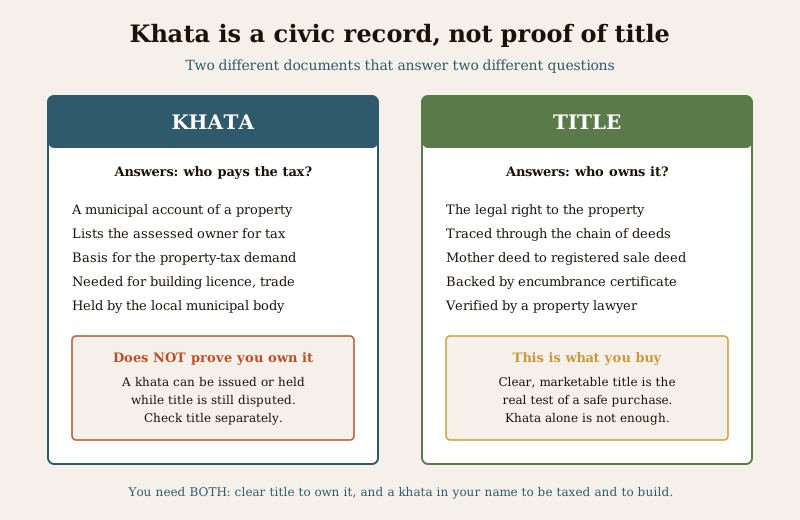
The practical rule: never accept a khata as a shortcut for title verification. Get the title checked independently. See our companion guides on how to verify land title and the land documents checklist, both linked below.
The same idea under different names across states
"Khata" is a Karnataka and BBMP term. Other states keep an equivalent civic or revenue record under different names, so do not expect the exact word or process elsewhere.
- Tamil Nadu uses patta and chitta as revenue records tying land to a holder, with the "A-register" and adangal as related documents.
- Many northern and eastern states use khatauni and khatian entries in the record of rights, with land-record portals such as Bhulekh.
- Telangana and Andhra Pradesh work through portals like Dharani and their own record systems.
- Broadly, every municipality maintains a property-tax assessment record that plays the khata role for civic and tax purposes.
The names, the issuing office (municipal body versus revenue department) and whether the record is civic or agricultural all differ. Treat "khata" as a concept to ask about, then find out the local equivalent and the office that issues it.
A-khata versus B-khata
In Karnataka you will hear about A-khata and B-khata, and the difference matters for what you can do with a property.
An A-khata property sits in the main register. It is treated as a legally compliant, fully assessed property: it has followed the applicable rules and approvals, so banks lend against it, building plans can be sanctioned, and trade and occupancy uses are permitted. It transacts and resells cleanly.
A B-khata property sits on a separate B-register the corporation created to still collect tax from properties that have some deviation, are on unapproved layouts, or otherwise fall short of full approval. The B-register let the body tax these properties without conferring the same status. As a result, B-khata properties typically face restrictions: home loans are harder to get and many banks refuse, building plan sanction is usually not granted, and resale value and the buyer pool shrink.
| Feature | A-khata | B-khata |
|---|---|---|
| Register | Main khata register | Separate B-register |
| Legal or approval status | Compliant and approved | Deviation or unapproved |
| Home loan | Banks lend readily | Hard, often refused |
| Building plan sanction | Available | Usually not granted |
| Trade or occupancy licence | Permitted | Restricted |
| Resale | Cleaner, higher value | Smaller pool, lower value |
| Can it change? | Already the goal state | Sometimes regularised to A via due process |
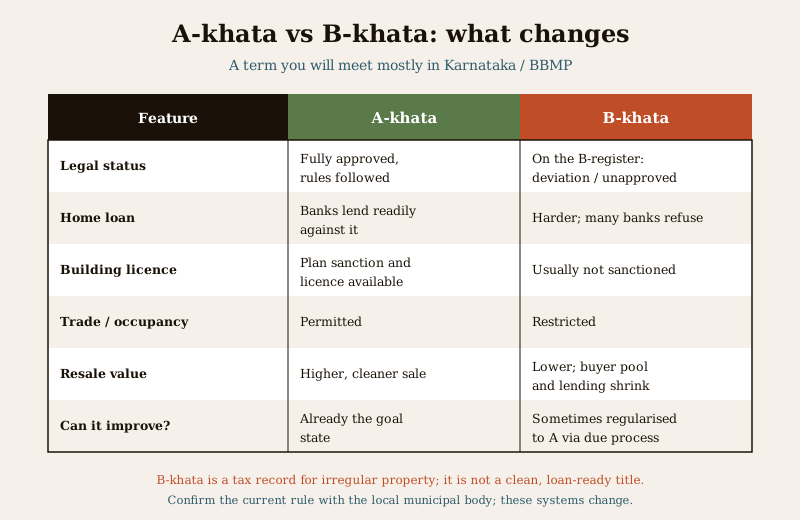
A B-khata is not automatically a scam, but it is a flag. It signals that the property has an approval or regularisation gap you must understand before buying, ideally with a lawyer, and it will constrain finance and future construction. Whether a B-khata property can be moved to A-khata depends on the rules in force at the time, which have changed repeatedly, so confirm the current position with the municipal body.
The move to e-khata
Many cities are shifting khata onto digital rails, often called e-khata. The idea is to make the record online and verifiable: you apply, pay the fee and download the khata certificate and extract through a portal, and the property is linked to a unique identifier so the record is harder to fake and easier to check. Part of the wider e-khata push has also been to clean up and formalise records, including tightening how B-khata properties are handled.
For a buyer, e-khata mostly changes the mechanics, not the meaning. It is still a civic and tax record, still not proof of title. What it improves is transparency: a genuine e-khata is easier to verify against the official system, which helps you spot a forged or stale document. Because the rollout and the exact portal differ by state and city, check what your local body currently offers.
How to get or transfer a khata after buying
When you buy, the khata does not update itself. You must apply to transfer it into your name, a process usually called khata transfer or mutation. Skipping it leaves the tax record and civic paperwork in the previous owner's name, which blocks loans, licences and a clean future sale.
The typical flow, subject to local variation:
1. Register the sale deed at the sub-registrar so ownership is legally recorded and you hold the registered deed.
2. Gather the papers: registered sale deed, latest property-tax paid receipts, encumbrance certificate, identity proof, the prior owner's khata, and any land-use conversion or NA order where relevant.
3. Apply through the e-khata portal or the municipal or revenue office, whichever your city uses.
4. Pay the khata transfer fee and let the office verify the records and clear any pending dues.
5. The office effects the mutation, changing the assessed owner's name in the register.
6. The khata certificate and extract are issued in your name.
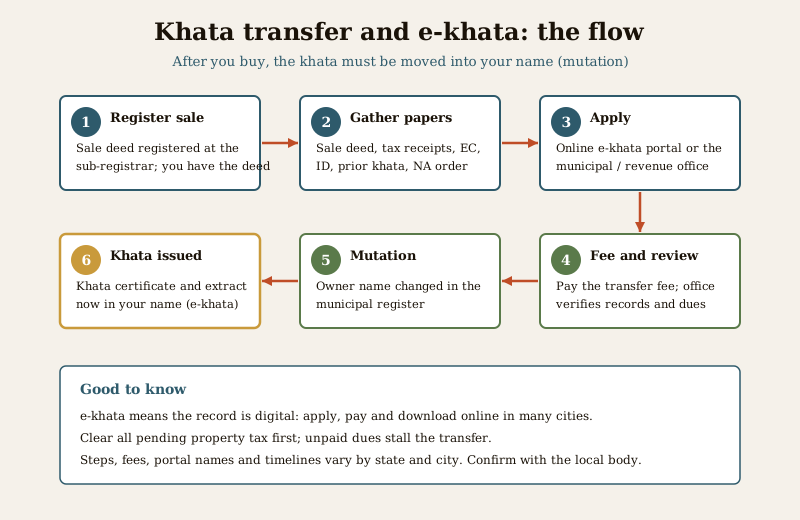
Clear all pending property tax before you start; unpaid dues stall the transfer. Fees, timelines and the exact document set vary widely, so ask the local body or a lawyer for the current checklist in your city.
Why khata matters for loans, building and resale
Even though it is not title, a khata in your name matters practically at three moments. For a home loan or construction loan, lenders want the property fully assessed and, in Karnataka terms, on A-khata, because it signals compliance and a cleaner security. For a building licence or plan sanction, the corporation generally expects a valid khata as part of the file, and B-khata usually cannot get plans sanctioned. And at resale, buyers and their banks scrutinise the khata; a clean A-khata property sells to a wider pool at better value, while a B-khata narrows both.
So the khata is not a substitute for title, but ignoring it is its own mistake. Verify title independently, and also make sure the khata is valid, in the right register, and transferred into your name.
Key takeaways
- Khata is a municipal record of who is assessed for property tax and the corporation's civic contact for a property. It is not proof of ownership.
- Title (registered deeds plus encumbrance certificate, checked by a lawyer) proves ownership; khata does not. You need both, verified separately.
- A-khata means a compliant, loan-ready, buildable property; B-khata sits on a separate register for properties with deviations and carries loan, sanction and resale restrictions.
- e-khata digitises the record, making a genuine khata easier to verify, but does not turn it into a title document.
- After buying, apply for khata transfer or mutation, clearing pending tax first, so the record reflects your name.
- Names, portals, fees and rules are state and city specific and change; confirm the current process with the municipal body and a lawyer.
References
- Registration Act 1908 and the Transfer of Property Act 1882, named generally for how ownership is registered and transferred (confirm sections with a lawyer).
- Municipal and corporation property-tax and khata frameworks, which differ by state and city (for example BBMP in Bengaluru).
- State land-record and property portals such as Bhulekh, Dharani and Kaveri, and the Tamil Nadu patta and chitta system, cited generally as equivalents of the civic and revenue record.
- Studio Matrx buying-land guides: how to buy a residential plot, plot due diligence, land documents checklist, property registration process, DC and NA land-use conversion, and the building regulations and compliance hub.
This guide explains the idea in general terms. For your specific property, confirm every step with a property lawyer and the local municipal body or sub-registrar.
Export this guide
Related Guides — Deep-dive reading
Land Documents Checklist Before Buying a Plot in India (2026)
Every document to collect and verify before you buy a residential plot in India - the title chain, encumbrance certificate, khata or patta, mutation, survey and layout, land-use conversion and tax dues - what each one proves, the red flag if it is missing, and how the same record is named differently in each state.
Buying LandPlot Due Diligence in India: The Complete Pre-Purchase Check (2026)
Before you pay a rupee for a plot, run the full pre-purchase check with your lawyer and a licensed surveyor - legal title, revenue records, planning approvals, physical survey and financial dues. This guide walks through each pillar, gives you a checklist and tells you when to walk away.
Buying LandProperty Registration Process in India: How a Plot Is Registered in Your Name (2026)
Registration is the step that makes you the legal owner. This guide walks through the sequence - agreement to sell, drafting the sale deed, calculating and paying stamp duty and registration fee, the sub-registrar appointment, the registration day, and the mutation and khata transfer that follow.
Buying LandRelated Tools — Try Free
Construction Approval Checklist — 24-Stage Tracker
Track every approval, permit, and NOC from land title to occupancy certificate across 24 stages.
ApprovalsHomestay Licence Finder
Pick your state for the homestay registration picture — room caps, residence rules and fees — plus the three compliance layers every host needs.
Licence FinderStamp Duty Calculator — All Indian States
Stamp duty + registration charges for all 28 states and 8 UTs — gender concessions, urban/rural variants, metro cess built in.
Stamp Duty