

Mother Deed and Sale Deed Explained (India): Chain of Title and What Each Deed Does (2026)
The sale deed is the document that actually transfers a plot to you on registration; the mother deed is the earliest parent document that traces where the title came from. This guide explains both, how the chain between them must stay unbroken, and how they differ from a title search and encumbrance certificate.
When you buy a residential plot in India you do not just buy the land - you inherit its paper history. Two documents sit at the centre of that history. The sale deed is the document that actually hands ownership to you when it is registered, and the mother deed is the oldest available document that shows where the seller's ownership originally came from. Buyers often treat every deed as interchangeable "papers," but they answer different questions, and knowing which does what is the first step to not overpaying for a title that turns out to be defective.
This guide explains both documents in plain language: what a sale deed is and what it must contain, what a mother deed (also called the parent document) does, how the two connect through an unbroken chain of title, the difference between an agreement to sell and a sale deed, the related deeds you will meet (gift, partition, release, will, conveyance), and how to reconstruct a mother deed that has been lost. It also draws the line between reading the deeds and actually verifying title.
Scope and how to read this. This is a plain-language explainer to help you understand documents and ask better questions - it is not legal advice. Deeds are legal instruments that a property lawyer or advocate must draft, read and verify for your specific transaction, and the underlying law (the Transfer of Property Act 1882, the Registration Act 1908, the Indian Stamp Act and state amendments) plus stamp duty, probate rules and land-record systems vary by state and change over time. Never rely on a deed you have only skimmed yourself; get a lawyer's title opinion and confirm every record with the relevant sub-registrar and revenue office.
The sale deed: the document that transfers ownership
A sale deed (sometimes called a conveyance deed in the sale context) is the instrument by which a seller transfers ownership of a property to a buyer for a price. It is the single most important document in your file, because once it is properly stamped and registered at the sub-registrar office, it is the legal record that you now own the plot. Everything else - tax receipts, khata, utility connections - flows from it.
Two things are worth underlining. First, a sale deed only does its job when it is registered; a signed but unregistered sale deed does not pass valid title to immovable property. Second, the sale deed you sign becomes, in time, the mother deed for the next buyer - the chain never stops, it just adds a link. The property registration process guide walks through how a sale deed is actually stamped, presented and registered.
The mother deed: tracing where the title came from
The mother deed, also called the parent document or root of title, is the earliest available deed that establishes the origin of ownership and lets you follow the property forward through every successive transfer to the present seller. If the current sale deed says "the seller owns this," the mother deed and the deeds after it are the evidence of how that came to be true.
A mother deed is not a special type of deed - it can itself be an old sale deed, a grant, a partition deed, a gift deed or a court order. What makes it the "mother" is that it is the oldest link you can reach. From it, a lawyer reads the property forward: this person acquired it here, transferred it to that person there, who gifted it, whose heirs partitioned it, and so on, down to your seller. That sequence is the chain of title.
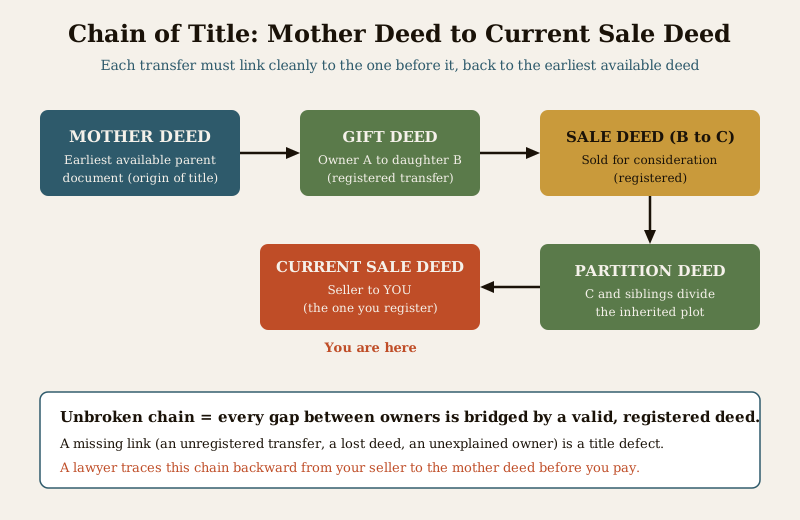
Why the chain must be unbroken
An unbroken chain of title means every change of owner from the mother deed to the current seller is bridged by a valid, registered document, with no unexplained gaps. If ownership jumps from one name to another with nothing to explain the move - an unregistered transfer, a missing deed, an heir who never formally inherited - that is a break in the chain, and it is a title defect that can surface years later as a rival claim.
This is exactly why a mother deed matters even though you are only buying today's sale. You are not just checking that the seller can sell; you are checking that everyone before the seller could validly pass ownership along. A defect anywhere in the chain can travel down to you. Tracing the chain backward from the seller to the mother deed is a core part of a lawyer's title verification work.
Agreement to sell versus sale deed
One of the most common - and most expensive - confusions is between an agreement to sell and a sale deed. They are not the same document and they do not have the same effect.
- An agreement to sell is a promise: the seller agrees to sell and the buyer agrees to buy on stated terms (price, timeline, conditions), usually with an advance or token paid. It does not transfer ownership. It is a contract to do something in the future.
- A sale deed is the performance of that promise: it actually transfers ownership when executed and registered.
Put simply, an agreement to sell says "I will sell"; the sale deed says "I have sold." Treating an agreement to sell, or a "GPA sale" (general power of attorney arrangement), as if it were a completed transfer is a classic mistake - courts have repeatedly held that such arrangements do not by themselves convey ownership of immovable property. Always confirm with your lawyer what a given paper actually does, not what it is loosely called.
The main deed types and what they do
Beyond sale deeds you will meet several other deeds in the chain, each moving ownership in a different way. The table below and the figure that follows summarise the common ones. All of these are registered documents, and the exact names, stamp treatment and probate requirements vary by state.
| Deed | What it does | Money involved? |
|---|---|---|
| Sale deed (conveyance) | Transfers ownership from seller to buyer; the primary title document once registered | Yes, a price (consideration) |
| Gift deed | Transfers ownership as a gift, often within family | No |
| Partition deed | Divides jointly held or ancestral property into separate defined shares | No (a division, not a sale) |
| Release / relinquishment deed | One co-owner gives up their share in favour of another co-owner | Sometimes a small consideration |
| Will / probate | Passes property on the owner's death per the will; probate is the court order confirming it where required | No |
| Conveyance deed (layouts) | Conveys a plot or flat from a developer or housing society to the individual buyer | Usually as part of the purchase |
| Agreement to sell | A promise to sell later on agreed terms; does NOT transfer ownership by itself | Advance / token |
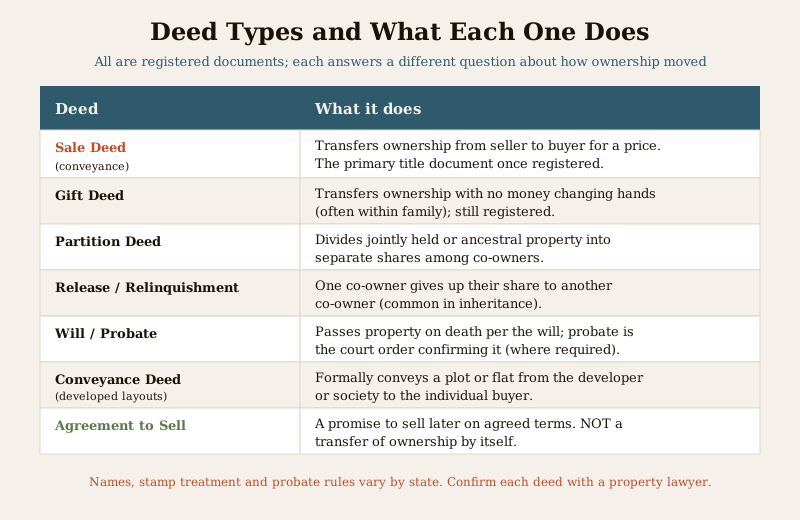
For developed layouts and gated projects, the conveyance deed matters especially: until the developer or society formally conveys the plot to the buyer, the individual owner may not hold a clean, independent title even after paying in full. Ask your lawyer to confirm the conveyance position before you commit.
The anatomy of a sale deed
A well-drafted sale deed is not a formality to be signed blindly - its parts are what a lawyer checks for accuracy and internal consistency. Understanding the anatomy helps you follow along and spot when something is missing or does not match the property on the ground.
| Part | What it contains | Why it matters |
|---|---|---|
| Parties | Full details of seller (vendor) and buyer (vendee): name, age, address, PAN, father or spouse name | Names must match ID and the earlier deeds in the chain |
| Recitals | The seller's source of title: the chain from the mother deed through prior deeds | Shows the seller actually has the right to sell |
| Consideration | The price, mode of payment and acknowledgement of receipt | Ties to stamp duty and proves value paid |
| Operative words | The clause where the seller conveys the property to the buyer | The actual act of transfer |
| Schedule of property | Survey number, extent, boundaries and measurements of the exact plot | Must match revenue records, khata and the site |
| Signatures and witnesses | Both parties, two witnesses, stamping and the registration endorsement | Makes the deed valid and registrable |
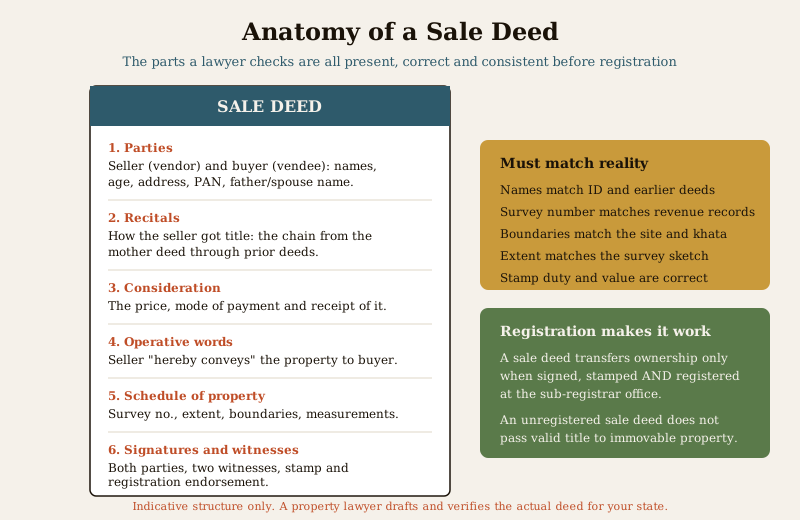
The schedule of property deserves special attention. The survey number, extent and boundaries in the deed should match the revenue records, the khata and the physical site. A mismatch between the deed schedule and the actual plot - different survey number, wrong extent, boundaries that do not line up - is a red flag your lawyer and surveyor should resolve before you pay. The land documents checklist sets out the wider set of papers the schedule should reconcile against.
Reconstructing a lost mother deed
It is common for an old mother deed to be lost, damaged or simply never handed over between owners over the decades. A missing original is a problem, but usually a solvable one, because registered documents are recorded by the state.
The standard route is to obtain a certified copy of the deed from the sub-registrar office where it was originally registered. Because registration creates an official record, the sub-registrar can issue a certified copy against the registration details (year, book, document number, or the parties and property). Where those details are unknown, an encumbrance certificate or an index search at the sub-registrar can help identify the relevant registration so the certified copy can be pulled. Land-record portals (named differently by state, such as Bhulekh, Dharani, Kaveri and others) may also help locate references.
A few practical points, all to be confirmed with your lawyer and the local sub-registrar:
- A certified copy is legally usable in place of a lost original for tracing title; you do not necessarily need the physical original if a clean certified copy exists.
- If a deed cannot be traced at all, that gap itself must be explained - an untraceable link is a chain defect, not a mere paperwork nuisance.
- For a genuinely lost original where fraud is a worry, a lawyer may advise a public notice, police complaint or affidavit; the appropriate step is state- and situation-specific.
How this differs from title verification and the EC
Reading the deeds is necessary but not sufficient. Two related tasks are often confused with it:
- Title verification is the lawyer's overall examination - reading the mother deed and the whole chain, checking that each transfer is valid, that the seller has clear and marketable title, and issuing a legal opinion. The deeds are the inputs; the title opinion is the conclusion. See how to verify land title before buying.
- The encumbrance certificate (EC) is a separate record from the sub-registrar listing registered transactions (sales, mortgages, gifts) against a property over a period. It helps confirm the chain and surface loans or charges, but it is not the deed itself and it does not, on its own, prove clean title. The encumbrance certificate guide explains its scope and limits.
In other words: the mother deed and sale deed are the documents; the EC is a supporting register; and title verification is the professional judgement that pulls them together. You need all three, done by the right people. Start from the buying a residential plot pillar for how these steps fit into the whole purchase.
Key takeaways
- The sale deed is the document that actually transfers ownership when it is stamped and registered - the primary title document. An unregistered sale deed does not pass valid title.
- The mother deed (parent document, root of title) is the earliest available deed; from it, the property is traced forward through every transfer to today's seller.
- An unbroken chain of title - every owner change bridged by a valid registered deed - is what protects you; a gap is a defect that can travel down to you.
- An agreement to sell is a promise to sell, not a transfer; only the sale deed transfers ownership.
- Related deeds - gift, partition, release, will/probate, conveyance - each move ownership differently; check the conveyance position for layouts and societies.
- Check the schedule of property against revenue records, khata and the site; mismatches are red flags.
- A lost mother deed can usually be reconstructed via a certified copy from the sub-registrar; an untraceable deed is a chain defect, not a formality.
- Deeds are read, but title is verified - get a property lawyer's title opinion, and pair it with the EC and record checks. Everything here is indicative and state-dependent.
References
- Transfer of Property Act 1882 (named generally) - the framework for how immovable property is transferred; confirm current text and state amendments with your lawyer.
- Registration Act 1908 (named generally) - requirement and effect of registering deeds; procedures administered by state sub-registrar offices.
- Indian Stamp Act and state stamp legislation (named generally) - stamp duty on deeds varies by state; confirm current rates with the sub-registrar or a lawyer.
- State land-record and registration portals (Bhulekh, Dharani, Kaveri and other state systems, named generally) - for index searches, encumbrance certificates and certified copies; availability and names vary by state.
- Studio Matrx buying-land guides: verify land title, encumbrance certificate, land documents checklist and the property registration process.
This guide is educational and indicative only. It is not legal advice. Consult a qualified property lawyer or advocate and the relevant sub-registrar and revenue office for your state before relying on any deed or making a purchase.
Export this guide
Related Guides — Deep-dive reading
Property Registration Process in India: How a Plot Is Registered in Your Name (2026)
Registration is the step that makes you the legal owner. This guide walks through the sequence - agreement to sell, drafting the sale deed, calculating and paying stamp duty and registration fee, the sub-registrar appointment, the registration day, and the mutation and khata transfer that follow.
Buying LandHow to Verify Land Title Before Buying in India: Clear and Marketable Title Explained (2026)
What a clear and marketable title really means, and how it is verified before you buy a plot in India - tracing the chain of ownership back thirty years from the mother deed to the current sale deed, a lawyer's title search at the sub-registrar, a public notice, the encumbrance check, and the legal opinion that decides whether you should pay.
Buying LandLand Documents Checklist Before Buying a Plot in India (2026)
Every document to collect and verify before you buy a residential plot in India - the title chain, encumbrance certificate, khata or patta, mutation, survey and layout, land-use conversion and tax dues - what each one proves, the red flag if it is missing, and how the same record is named differently in each state.
Buying LandRelated Tools — Try Free
Interior Contract Clause Checklist
16 sections and 98 checkboxes covering scope, BOQ, milestones, penalties, warranty, and disputes.
Contract ChecklistStamp Duty Calculator — All Indian States
Stamp duty + registration charges for all 28 states and 8 UTs — gender concessions, urban/rural variants, metro cess built in.
Stamp DutyContract Studio
AI generates professional architecture service agreements with milestones and scope.
ArchitectAI