
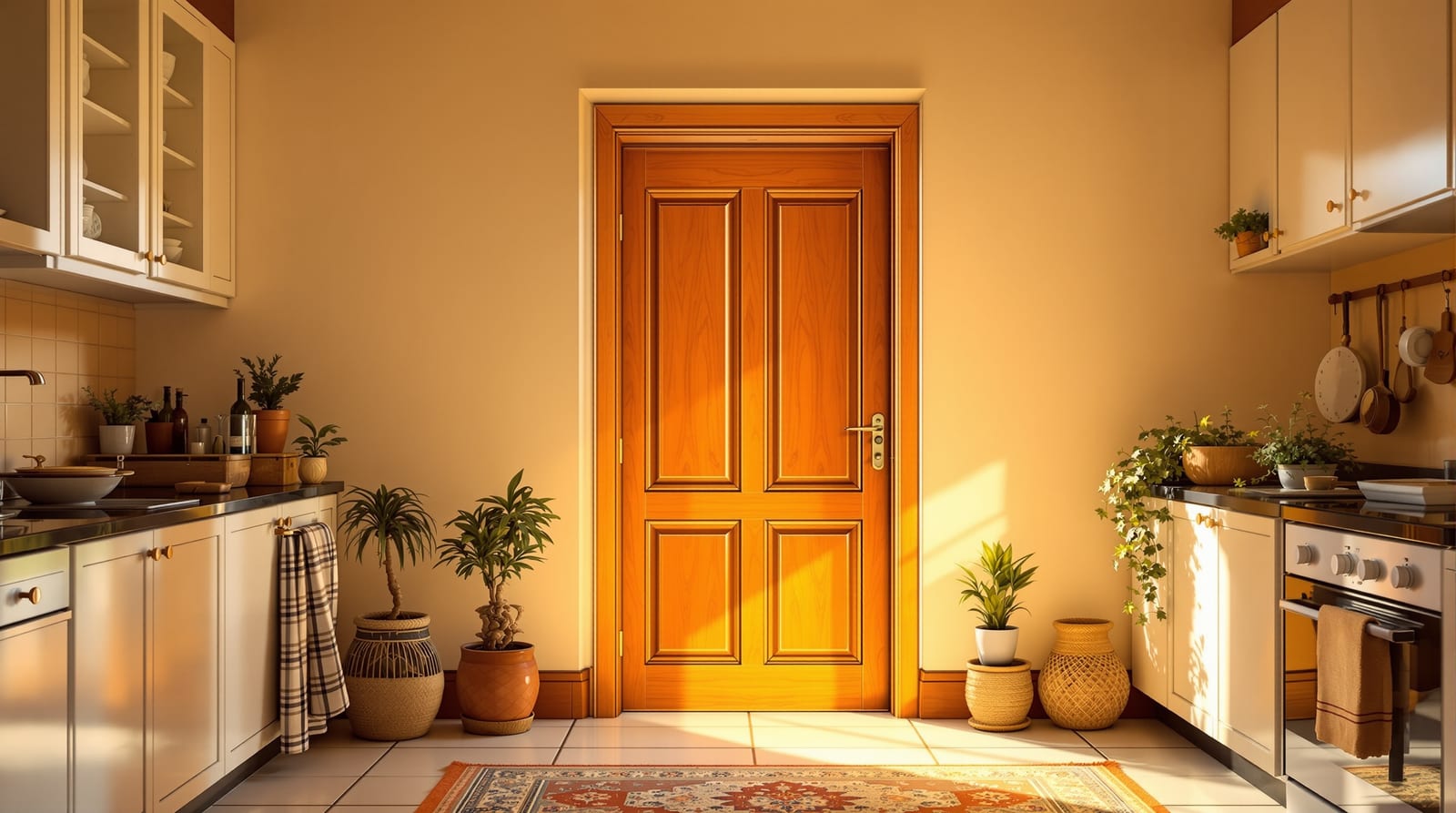
Kitchen Door Vastu for Indian Homes: Direction, Placement & Remedies
Where to place the kitchen door, which way it should open, and how to fix the alignments Vastu warns against — explained as tradition plus practical kitchen sense.
In Vastu Shastra the kitchen is the seat of Agni, the fire element, and the door is where energy, people and — just as importantly — smoke and smell move in and out. Most of the kitchen-door rules that families ask about turn out to make plain practical sense once you set the belief beside the building physics: a door placed for good ventilation also clears smoke, a door that does not face the main door also gives the cook some privacy, and a door that does not open into the toilet wall is simply more hygienic. This guide gives you the traditional Vastu guidance for the kitchen door and the practical reasoning behind each rule — plus honest remedies when your existing layout cannot be changed.
This is a deep-dive on the kitchen door specifically. For the whole-home picture see our main door Vastu guide and the broader entrance Vastu explainer; for the non-Vastu, practical side of the kitchen door — material, size, swing, mosquito mesh — read kitchen doors in India.
First, the kitchen itself: the south-east (agni) corner
Before the door comes the room. Vastu places the kitchen in the south-east (SE) corner of the home, the corner ruled by Agni. The second preference is the north-west (NW). The cook is asked to face east while cooking, so the platform sits against the eastern or south-east wall.
Where does the practical reasoning come in? The south-east receives strong morning and forenoon sun, which historically kept the cooking zone dry, warm and less prone to the damp and pests that plague a north or monsoon-facing kitchen. Facing east while cooking puts the morning light on the worktop. None of this needs you to believe in the doctrine to benefit from it — it is good orientation for a hot, humid country.
Once the room is fixed, the door follows.
Kitchen door direction: where it should sit
The kitchen door is an internal door (kitchen to dining, lobby or corridor), so the rules are gentler than for the main door. The aim is to enter the kitchen from a "good" zone and to avoid the door landing in the most inauspicious corner.
For a south-east kitchen, Vastu prefers the door on the north, east or north-east wall of the kitchen — the cool, "light" directions — so you walk in from the auspicious side and the heavy fire-corner stays at the far south-east. The single direction to avoid for the door is the south-west wall (the earth/stability corner), and a door cut directly into the south is also discouraged.
| Kitchen door aspect | Traditional Vastu guidance | Practical reasoning |
|---|---|---|
| Kitchen location | SE (agni) first choice; NW second | Morning sun keeps the cooking zone dry; less damp and pests in a hot climate |
| Door wall (in a SE kitchen) | North, east or NE preferred; avoid SW and due-south | Entering from the cooler side; the hot fire-corner stays away from the doorway and circulation |
| Opening direction | Open inward, swinging clockwise, ideally toward NE | An inward door does not block the corridor; clockwise feels natural to most right-handed cooks |
| Number of leaves/panels | Single leaf is fine; if double, even number of panels | A single light leaf suits a smaller kitchen; even panels read as balanced |
| Door size | Smaller than the main door; not oversized | The main door stays the visual and symbolic "head" of the house |
| Threshold (dehleez) | Low threshold or marked sill at the kitchen door | A small lip contains spills and grain, and marks the transition into the fire zone |
| Facing another door | Avoid the kitchen door directly facing the main door or a toilet door (dwar vedha) | Privacy for the cook; keeps cooking smells away from the entrance and away from the WC |
A note on over-precision: many "kitchen door must be at exactly N-E-3 degrees" claims online are stricter than mainstream Vastu and stricter than anything you need for a comfortable kitchen. Treat the wall-level guidance above as the workable version.
Which way the kitchen door should open
Vastu asks internal doors to open inward and to swing clockwise — the leaf moving from left to right as you enter. The recommended ideal is for the door to open toward the north-east inside the room.
The practical case is strong here. An inward-opening kitchen door does not swing out and clip someone in the corridor or dining area. A clockwise swing is the natural reach for a right-handed person carrying a hot pan or a tray, and it keeps the open leaf away from the gas hob if the hob is in the south-east, as it should be. If your kitchen is tight and an inward door eats the worktop, a pocket or sliding door is a perfectly acceptable practical substitute — and Vastu has no objection to a sliding kitchen door so long as the opening sits on a good wall. See pocket doors and sliding doors for the hardware side.
The two alignments Vastu warns against — and why they actually matter
Kitchen door facing the main entrance door
Vastu calls two doors directly facing each other dwar vedha, and the kitchen door facing the main door is one of the more commonly flagged ones. Belief: the energy entering through the front door should not rush straight into the fire zone, and the kitchen — a private working room — should not be on display to every guest who walks in.
The practical reading is genuinely sensible. A kitchen door in the direct line of the entrance means cooking smells and oil smoke greet visitors at the threshold, the cook has no privacy, and in joint-family homes the kitchen — often the busiest room — is exposed to the front circulation. Most people would design against this even without the Vastu label.
Kitchen door facing a toilet door
The kitchen door directly facing a toilet/bathroom door is treated as a strong negative, because Vastu keeps the pure fire element of the kitchen away from the impure water-and-waste element of the WC. Here the practical reasoning is almost self-evidently hygienic: you do not want a bathroom door opening straight across into the room where food is prepared and stored, both for odour and for plain food safety.
A related rule — the kitchen sharing a wall with, or sitting directly above/below, a toilet — is about the same fire-versus-water logic and about plumbing running near the cooking zone.
Remedies when you cannot move the door
Most flats and built homes cannot relocate a kitchen door, so Vastu offers symbolic and practical remedies. The honest framing: the symbolic remedies belong to belief, but several double as good design.
| Problem | Symbolic remedy | Practical fix that helps regardless |
|---|---|---|
| Kitchen door faces the main door | Hang a toran or bead curtain; place a small partition or screen | A jali screen, console or planter breaks the sightline and gives the cook privacy |
| Kitchen door faces a toilet door | Keep both doors shut; place a threshold/curtain between | Always-closed toilet door + an exhaust fan kills odour transfer; a door-bottom seal helps |
| Door on a "wrong" wall (SW/south) | Place a dehleez/threshold strip and keep it clean | A marked sill contains spills; good lighting offsets a dim corner |
| Door swings the "wrong" way | Re-hang to open inward/clockwise if feasible | Convert to a sliding or pocket door in a tight kitchen |
| No remedy possible | Pyramid/Vastu yantra at the door (belief-based) | Focus the budget on ventilation and exhaust instead |
Shut doors, a chimney/exhaust, a threshold lip and a curtain or screen are the four moves that satisfy nearly every kitchen-door Vastu concern while also making the kitchen objectively nicer to use. For more on dwar-vedha fixes across the home see door alignment Vastu and the full toolkit of Vastu door remedies.
Threshold, panels and the small details
- Threshold (dehleez): a low marble or wood sill at the kitchen door is traditional. Practically it stops water, oil and grain from migrating into the corridor and gives a clean edge between zones. Keep it shallow — under about 12 mm — so it is not a trip hazard, in line with door threshold standards.
- Panels: if you fit a double or panelled kitchen door, an even number of panels reads as balanced in Vastu; a single flush or WPC door is fine and well suited to a steamy, splash-prone kitchen.
- Size: keep the kitchen door clearly smaller and plainer than the main door — the entrance stays the symbolic "head" of the house. Standard internal sizes (around 750-900 x 2100 mm) work well; plan with the door size calculator.
- Material: kitchens are hot and humid, so moisture-resistant choices age better. WPC, UPVC or a well-sealed flush door beat raw plywood here; if you want the practical comparison rather than the Vastu one, the kitchen door guide covers it.
Putting it together
A Vastu-friendly, practical kitchen door is: a south-east kitchen, the door on the north, east or north-east wall, opening inward and clockwise toward the NE, not directly facing the main door or a toilet, with a shallow threshold and good exhaust ventilation. Where the existing layout fights you, a screen, a kept-closed door, a threshold and an exhaust fan do most of the work — and happen to be exactly what a good kitchen needs anyway. Map your whole-home doors with the door Vastu planner.
Frequently asked questions
Which direction should the kitchen door face as per Vastu?
For the ideal south-east kitchen, place the door on the north, east or north-east wall so you enter from the cooler, auspicious side. Avoid cutting the door into the south-west wall or due south. The door should open inward and swing clockwise, ideally toward the north-east.
Is it bad if the kitchen door faces the main door?
Vastu discourages it (dwar vedha), and it is also impractical — cooking smells and smoke reach the entrance and the cook loses privacy. If you cannot move either door, break the sightline with a screen, console or planter and hang a toran; keep the kitchen door closed when not in use.
Can the kitchen door face the bathroom or toilet door?
Vastu treats this as a strong negative because it mixes the fire and water elements, and it is genuinely unhygienic for food prep. Keep both doors shut, fit an exhaust fan and a door-bottom seal, and add a curtain or threshold between them. Relocating the door is best where feasible.
Should the kitchen door open inward or outward?
Vastu prefers internal doors, including the kitchen door, to open inward with a clockwise swing. It is also more practical — it does not block the corridor and keeps the leaf clear of the hob. In a tight kitchen, a sliding or pocket door is a fine alternative.
Do I really need a threshold at the kitchen door?
The dehleez is traditional and useful: a shallow sill (under ~12 mm) contains spills and grain, marks the fire zone and keeps the floor clean. Keep it low so it is not a trip hazard.
Export this guide
Related Guides — Deep-dive reading
Orientation, Light & Views: Designing With Your Space, Not Against It
How reading your plot's sun, breeze and views — and placing each room on the right face — gives an Indian home that is cooler, brighter and quietly right, instead of one that fights its site forever.
Design PrinciplesVastu Door Remedies: Practical Fixes for Door Defects (India Guide)
When you cannot move or rebuild a door, these are the common Vastu remedies for a wrong-facing entrance, two doors facing each other, a missing threshold, doors near a toilet or under stairs, and squeaky or broken doors — each framed as belief plus the practical reasoning that makes it sensible anyway.
Home Doors & EntrancesDoor Alignment Vastu (Dwar Vedha) for Indian Homes: Doshas & Remedies
Why two doors facing each other, a door facing a toilet or stair, or a straight line from the main door to the back door is called dwar vedha, the reasoning behind the belief, and practical, buildable remedies.
Home Doors & EntrancesRelated Tools — Try Free
Cross-Ventilation Analyzer
Estimate airflow and air changes per hour (ACH) from room size, window areas, layout, and local wind — with NBC 2016 Part 8 compliance check.
Ventilation CalculatorMain Door Vastu Planner
Check your main door direction against Vastu, with remedies and colour and material suggestions.
Vastu PlannerDoor Cost Calculator
Estimate the all-in cost of a door — leaf, frame, hardware, fitting and GST — by type, material and size.
Door Calculator