
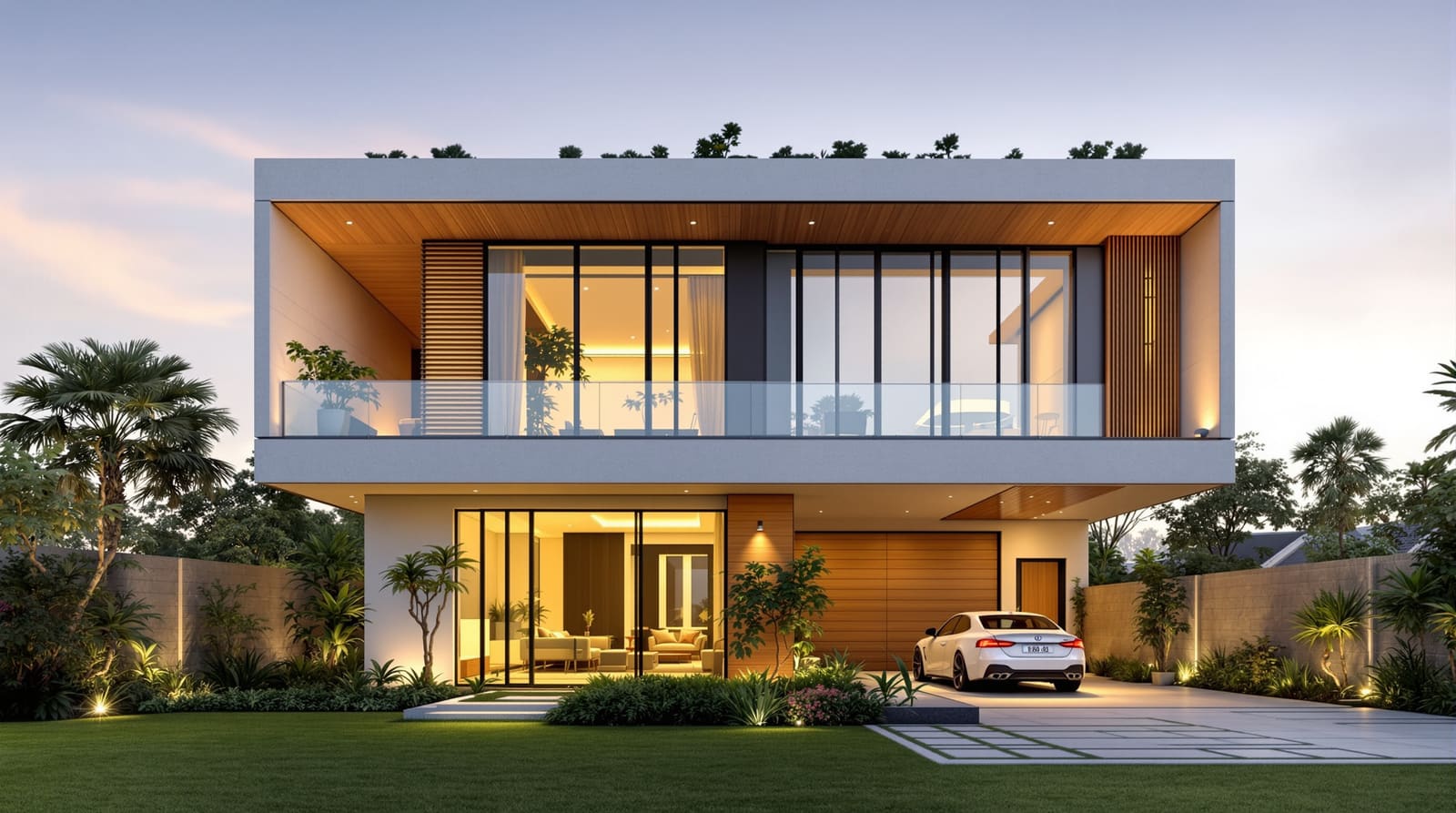
Designing Homes on Irregular Plots
Triangular, trapezoidal, L-shaped and acute-angled plots — reading the buildable envelope, absorbing the awkward angle, and turning odd corners into courtyards, vistas and feature entries
A young couple in a fast-growing peri-urban layout outside Pune signs for a plot they can barely afford, thrilled because it is the cheapest one on the street. The reason it was cheap reveals itself only when the architect overlays a measuring tape: the plot is not a rectangle at all. One side runs along a gently curving access road, the rear boundary cuts back at a lazy angle, and the north-west corner pinches into a sharp wedge where two surveyor's lines refused to meet at ninety degrees. The brochure had drawn it as a tidy box. The reality is a trapezoid with a pointed ear.
This is far more common in Indian layouts than the glossy site plans admit. Roads follow old field bunds and cart tracks rather than a grid; subdivisions leave odd leftover parcels; a curving approach road slices a diagonal across what should have been a square; a gunta-sized fragment gets stitched onto a neighbour's holding and sold on. The buyer panics — Vastu fears about cut corners, worries about wasted area, a builder muttering about "non-standard work." Yet some of the most characterful homes in the country sit on exactly these awkward parcels. An irregular plot is not a defective rectangle to be apologised for — it is a brief, and the angle you were handed is usually the cheapest piece of architecture you will ever buy.
Why plots end up odd — and why it matters
Before you design anything, understand where the shape came from, because the cause tells you what you are allowed to do. Organic layouts trace pre-existing field boundaries and watercourses, so plots fan out and pinch in. A curving or radial road — common in newer planned colonies that mimic garden-city loops — leaves every plot along the bend as a wedge or a trapezoid. Subdivision arithmetic creates leftover slivers when a large khasra is cut into saleable units and the remainder does not divide evenly. And acute, splayed corners appear wherever two roads meet at anything other than a clean cross.
The reason this matters so much in India is the setback. Your usable footprint is not the plot — it is the buildable envelope that remains after the front, rear and side setbacks mandated by your local Development Control Regulations are subtracted. On a rectangle, setbacks shave a neat border. On an irregular plot, setbacks are measured perpendicular to each boundary, so they eat the corners viciously: a sharp wedge can lose its entire tip to a side setback and contribute almost nothing buildable. Two plots of identical area on paper can yield wildly different usable footprints once you draw the envelope honestly. This is precisely the kind of constraint covered in our pillar on understanding site constraints, and it is the first thing to test when you evaluate a residential plot before you buy.
A note on what this guide is not about. Awkward shape is its own problem, distinct from three neighbours it is often confused with. A long thin plot is a question of proportion, handled in narrow plot design strategies. A plot with two or three road frontages is a question of access and exposure, handled in corner plot design strategies. A plot that falls or rises is a question of levels, handled in sloping site design. Here we are concerned only with the geometry of the boundary — the non-ninety-degree, non-rectangular outline itself.
Read the geometry before you draw a single wall
Get a proper survey. Not the layout brochure, not a pacing estimate — a measured survey with bearings and dimensions on every boundary, tied to the khata and the registered document, with any encumbrance checked. Irregular plots are where boundary disputes hide, because nobody is quite sure where the pointed corner actually ends. Cross-check the area on the title against the area the survey computes; on odd shapes the two often disagree.
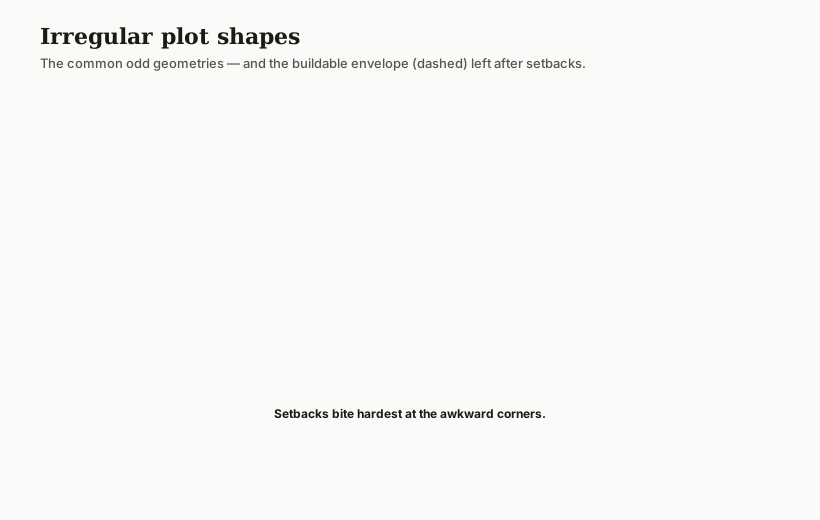
With dimensions in hand, draw the buildable envelope first and the building second. Apply each setback perpendicular to its boundary and see what polygon survives. Then lay a true orthogonal grid — squares aligned to a comfortable structural bay — over that polygon and observe two things: how much of the envelope the rectangle captures cleanly, and where the leftover slivers fall. Those slivers are your raw material. The cardinal mistake is to force a rectangle into the centre and treat everything outside it as loss; that is how a plot ends up two-thirds wasted. Pair this geometric reading with an orientation check — the angle of the plot rarely lines up with the cardinal directions, so use site orientation to decide whether your grid should follow the sun and breeze or follow the boundary.
Turning the angle into an asset
The whole craft of the irregular plot is this: keep your rooms orthogonal and absorb the irregularity in zones that tolerate odd shapes. Rooms want square corners — beds, wardrobes and tables sit badly in a triangle. But courtyards, gardens, verandahs, stair cores, service yards, parking, water tanks and planting beds are perfectly happy in a wedge. So you set a clean rectangular living core true to the sun, and you let the leftover triangle become a courtyard, a garden wedge, a car porch or a utility spine along the splayed edge.
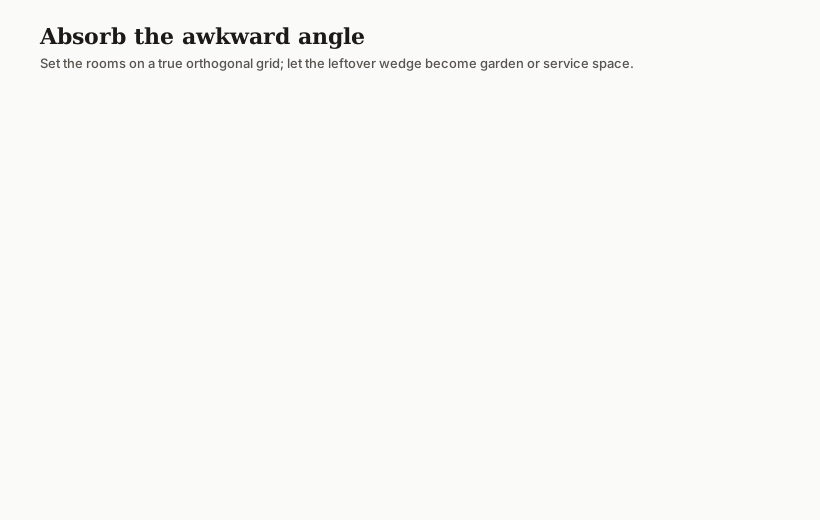
There is a second, bolder strategy: embrace the angle rather than hide it. Let a key wall follow the splayed boundary, run the diagonal through the plan, and you gain something a rectangle can never give — a long internal vista that reads as far more spacious than the square footage suggests, and an angled facade that makes the house instantly distinctive on a street of identical boxes. A pointed corner can become a dramatic double-height entry; a trapezoidal living room can fan toward a view; an acute tip can hold a sculptural staircase or a tall planted column. The angle creates depth and surprise for free.

Choose between absorbing and embracing by where the awkwardness sits. If the irregularity is at the rear or a side away from the entry, absorb it quietly into service and garden. If it is at the front or commands a view, embrace it and make it the face of the house. Often the answer is both — orthogonal bedrooms, an expressive angled living-and-entry sequence.
Matching the shape to the move
Different irregular shapes reward different strategies. The table below is a starting palette, not a prescription — your setbacks, orientation and the road side decide the final move.
| Plot shape | The core challenge | The design move |
|---|---|---|
| Triangular | One or two acute tips lost to setbacks; hard to fit rooms in the point | Orthogonal core along the wide base; the tip becomes a planted garden wedge, water feature or feature entry |
| Trapezoidal | Front & rear widths differ; rooms want a constant width | Fan rooms so the widest face the view or street; absorb the taper in corridors, wardrobes & service |
| L-shaped | Re-entrant corner; one leg often too thin to build deep | Build the fatter leg solid; wrap a private garden or courtyard into the notch of the L |
| Splayed / skewed | No boundary is parallel; the grid fights the plot | Set the grid true to sun & breeze, not the boundary; let the skewed gap become side garden & parking |
| Acute-angled corner | A sharp wedge at a road junction yields little buildable area | Curve or chamfer the building line; the wedge becomes landscape, porch or a sculptural stair |
| Gunta / odd leftover sliver | Tiny, irregular, awkward access | Single clean rectangular block; treat the rest as setback-mandated open space & planting |
The cost and structure of non-square walls
Be honest with your client and your contractor: non-ninety-degree work costs more and wastes more. Angled walls mean every brick course meets the corner at an odd cut, formwork for a skewed slab or beam needs bespoke shuttering rather than reusable panels, flooring tiles must be cut along the diagonal with offcut wastage, and false ceilings and skirting all need custom mitres. None of this is ruinous, but it is real, and it argues for the discipline of keeping the structural grid orthogonal even when the boundary is not. Let the columns and beams form clean rectangles; resolve the angle in lightweight infill walls, planters and parapets where a skew costs almost nothing.
Two angle-specific cautions. First, avoid genuinely acute internal angles — anything sharper than about sixty degrees becomes unusable floor and an awkward, dust-trapping corner; chamfer or curve it into a niche or planter instead. Second, remember that an irregular boundary often comes with an irregular site in other ways too — check the contours, the soil bearing with a proper geotechnical test, the water table and the monsoon drainage, because the same organic layout that bent your boundary may also have left you the low corner where water collects.
Handling the Vastu anxiety calmly
For many Indian families this is the real worry, not the geometry. Traditional Vastu prizes the regular square or rectangle and treats "cut corners" and "extended corners" as inauspicious, with particular weight on the north-east and the south-west. An irregular plot will, almost by definition, have a cut or extended corner somewhere, and a buyer can talk themselves out of an otherwise excellent parcel over it.
Handle it without drama. The standard, time-honoured remedy is to regularise the plot in plan: draw the largest clean rectangle that fits within your boundary, build the house true within that rectangle, and let the leftover irregular portions become garden, courtyard, parking or planting — open ground, which Vastu treats far more kindly than built mass in the wrong corner. A protruding north-east is generally considered benign or even favourable; a cut north-east or a protruding south-west is what tradition cautions against, and both are easily resolved by where you place open space versus built form. Keep the heavy, tall mass toward the south-west and the lighter, lower, open zones toward the north-east, and most classical concerns dissolve. Our guide to Vastu for plot selection sets out which corners matter and why, so you can reassure the family with specifics rather than superstition.
Getting the most saleable, usable area
A home is also an asset, and irregular plots are where careless design quietly destroys resale value by leaving rooms that no buyer can use. Protect value by maximising the count of fully rectangular, fully usable rooms — a buyer pays for bedrooms with square corners, not for clever angled nooks they cannot furnish. Push all the geometric compromise into circulation, storage, service and landscape, which are forgiving. Make sure the carpet area you can actually inhabit, not the plot area on paper, is what drives your decisions; on odd shapes those two numbers can diverge sharply.
Three practical disciplines. Confirm your real buildable envelope and FSI consumption early — the irregular outline changes both, so read FSI and FAR computation against your actual polygon, not an assumed rectangle. Get the municipal sanction drawings right the first time; non-standard plots invite more queries at the planning desk, and a clean, clearly dimensioned set saves weeks. And think about the long view — a thoughtfully resolved irregular home, with its garden wedge and its angled entry, often ages into the most loved house on the street, which is exactly the durable resale value that a forgettable box never earns.
References
- Bureau of Indian Standards, National Building Code of India 2016 (SP 7) — setbacks, open spaces and means of access.
- Local Development Control Regulations / municipal building bye-laws — setback, ground coverage and FSI provisions, which vary by city and authority.
- Kevin Lynch & Gary Hack, Site Planning (MIT Press) — reading site geometry and shaping the buildable envelope.
- Joseph De Chiara & Lee Koppelman, Site Planning Standards — dimensional standards for residential layouts.
- IS 1904 and IS 6403 — soil bearing capacity and foundation design for variable ground.
- The relevant State Town & Country Planning Act and RERA registration for layout approvals and plot title verification.
Read alongside understanding site constraints and how to evaluate a residential plot — and when you are ready to test an angled layout against the sun, setbacks and your family's brief, let DesignAI sketch the options with you.
Export this guide
Related Guides — Deep-dive reading
Sloping Site Design: Building on a Gradient
How to read a slope, choose between terracing, cut-and-fill and stilts, and turn a hillside plot in Pune, Bengaluru's outskirts or the Ghats into an asset instead of a liability.
Site PlanningSite Analysis for Homeowners: How to Read a Plot Before You Build
The master guide to reading your land — its legal envelope, sun, wind, slope, soil, access, neighbours, views, services and microclimate — before you buy a plot or draw a plan.
Site PlanningThe Trade-Offs Every Homeowner Has to Make
No one gets everything — every home is a stack of compromises. This is about the sacrifices: the cost-quality-time triangle, the recurring homeowner trades, and how to make your cuts on purpose instead of having them forced by a blown budget.
Planning Your ProjectRelated Tools — Try Free
False Ceiling Cost Estimator
Live ₹/sqft across 8 ceiling types — POP, gypsum, designer, metal, PVC, wooden — with cove and spot lighting for 20 Indian cities.
Cost CalculatorRoom Programming Worksheet
Add every space, size it to feel right and rank it A/B/C — then generate an architect-ready design brief.
Design ToolWardrobe Storage Capacity Calculator
India-specific garment math — sarees, lehengas, kurtas, shirts, shoes. Pick a layout (2-door → walk-in), see live fill and saturation gauges.
Capacity Calculator