
Indo-Saracenic Architecture in India
The Raj-era revival that gave India its grandest landmarks
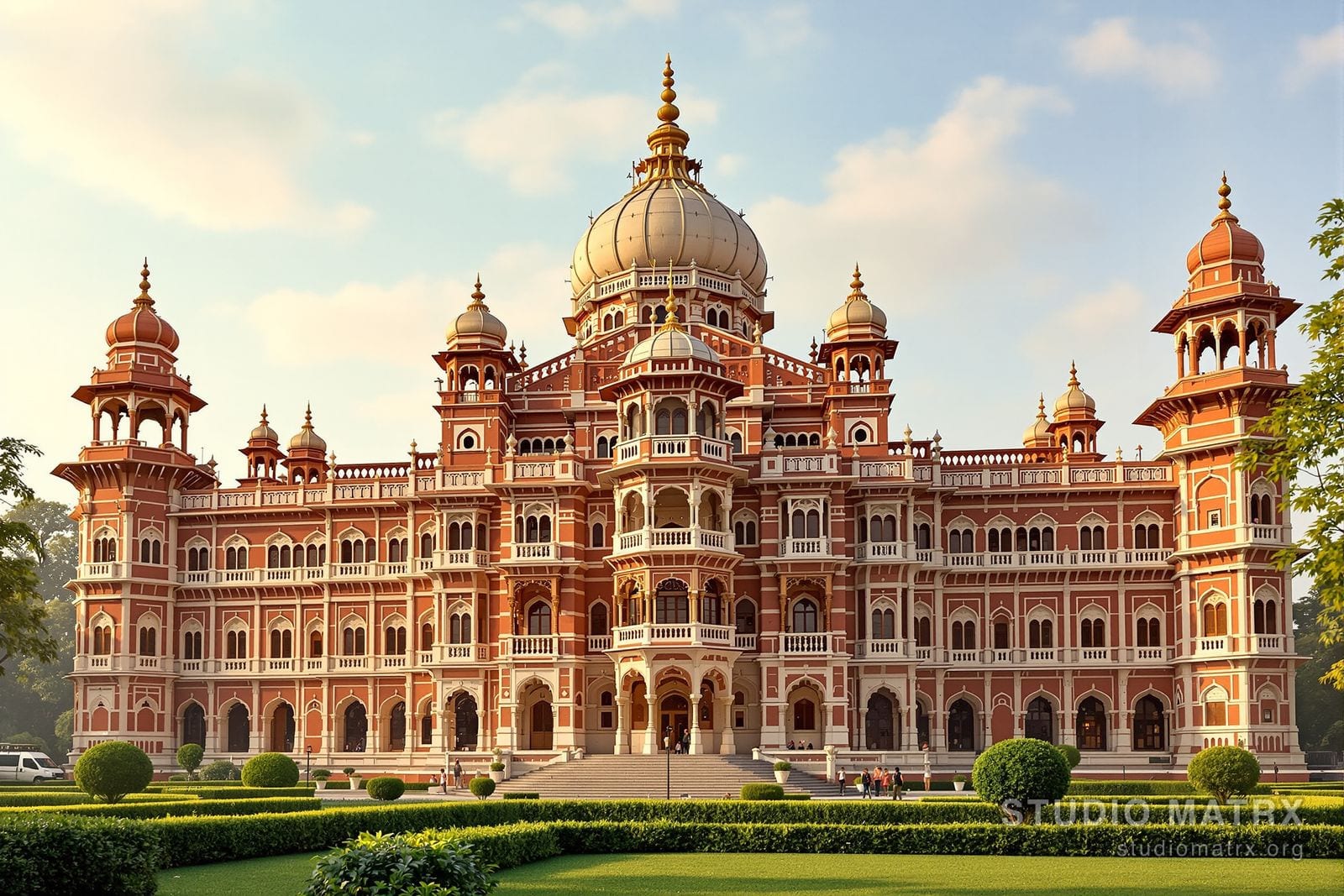
Stand in front of Mumbai's Chhatrapati Shivaji Maharaj Terminus, or Mysore's Amba Vilas Palace, and you are looking at the most ambitious architectural experiment of the British Raj: a deliberate fusion of Indian and European building, invented to give imperial institutions an Indian face. Indo-Saracenic - sometimes called Indo-Gothic or Hindoo-Gothic - took a European plan and structure and dressed it in the domes, arches and pavilions of Mughal, Rajput and Indo-Islamic architecture. The result, between roughly 1870 and 1930, gave India some of its most recognisable landmarks.
It is a revival style, and a complicated one - born of empire, yet built largely by Indian craftsmen and drawing on genuinely Indian forms. Today it survives in railway stations, high courts, universities, museums and palaces across the country, and its grand vocabulary still appears in heritage hotels and palatial homes that want unmistakable Indian grandeur.
What defines it
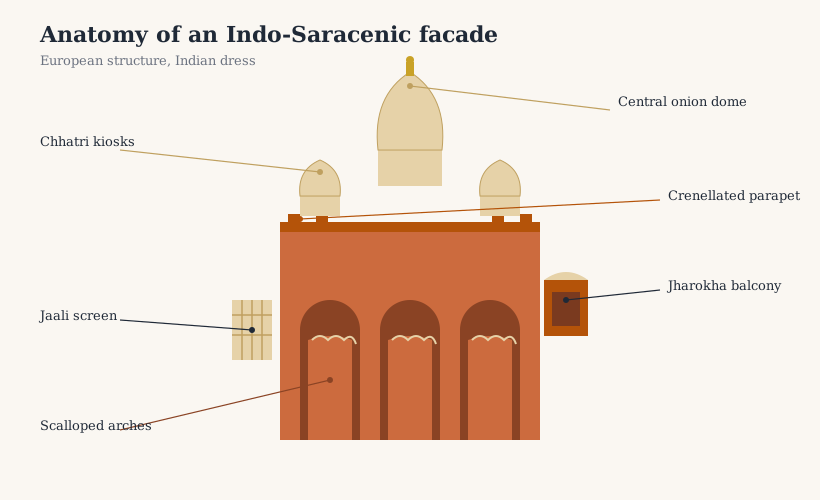
Indo-Saracenic is a marriage of two systems: a European body wearing Indian dress.
| Trait | What it looks like | The idea behind it |
|---|---|---|
| European structure | Symmetrical plans, load-bearing masonry, sometimes iron and steel | Modern Victorian engineering and institutional planning |
| Indian ornament | Domes, chhatris, arches, jharokhas, jaali | An Indian identity grafted onto imperial buildings |
| Composite skyline | A central dome flanked by kiosks, turrets and pavilions | Drama and silhouette borrowed from Mughal and Rajput palaces |
| Stone and craft | Red sandstone, cream limestone, marble, hand-carving | The labour and material traditions of Indian masonry |
The style works at the scale of the monument. Its forms were conceived for big civic and palatial buildings, which is why a faithful Indo-Saracenic home almost always reads as grand rather than intimate.
The design elements
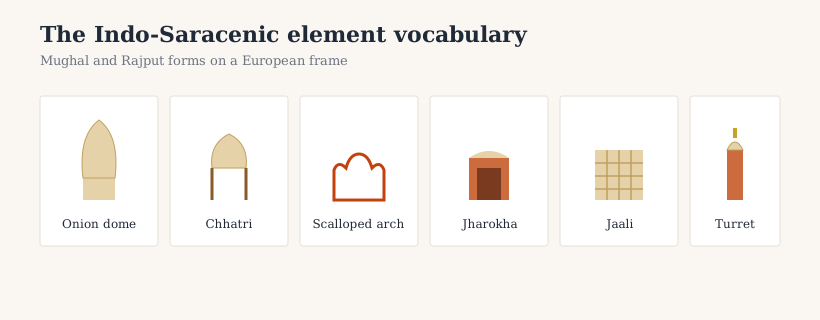
The vocabulary is borrowed mostly from Mughal and Rajput architecture, reassembled on a European frame.
| Element | Borrowed from | Where it appears |
|---|---|---|
| Onion domes | Mughal architecture | Crowning the central mass and pavilions |
| Chhatris | Rajput palaces | Domed kiosks on parapets and corners |
| Scalloped (multifoil) arches | Indo-Islamic building | Arcades, verandahs and entrances |
| Jharokha balconies | Rajasthani havelis | Projecting carved windows |
| Jaali screens | Mughal and Rajput craft | Shaded, filtered openings |
| Corner turrets and minarets | Mosque and fort architecture | Anchoring the silhouette |
Where you'll find it
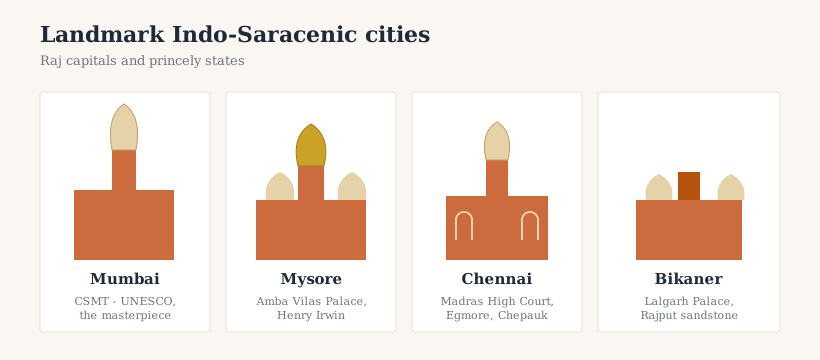
The style was an imperial commission, so it clusters around the great Raj cities and the princely capitals that competed with them.
| City | Landmark | Note |
|---|---|---|
| Mumbai | Chhatrapati Shivaji Maharaj Terminus | A UNESCO World Heritage Site; the style's masterpiece |
| Mysore | Amba Vilas (Mysore) Palace | Princely Indo-Saracenic grandeur by Henry Irwin |
| Chennai | Madras High Court, Egmore Station, Chepauk Palace | One of the richest Indo-Saracenic cities |
| Bikaner | Lalgarh Palace | Rajput sandstone carving on a Raj-era plan |
For the carved sandstone, jharokha and jaali language this style draws on, see the Rajasthani vernacular and the wider Indian vernacular tradition.
Best for
Indo-Saracenic is a grand idiom, and it sits most convincingly on:
- Palatial residences and farmhouses with the plot and budget to carry domes, arches and stone carving at scale.
- Heritage hotels and resorts, where the theatrical silhouette and craftsmanship are the entire appeal.
- Restorations and adaptive reuse of genuine Indo-Saracenic landmarks - careful work that begins with heritage documentation.
It is the hardest of these styles to do at the scale of an ordinary home: shrink the domes and arches too far and the grandeur curdles into theme-park pastiche. A lighter touch - a single scalloped arch, a jaali, a chhatri over the porch - usually serves a modern home better than the full apparatus.
Notable architects and landmarks
The style was shaped by a small group of Raj architects working with Indian master craftsmen. Frederick William Stevens designed Mumbai's CSMT; Henry Irwin gave Mysore its palace and Chennai several of its landmarks; Samuel Swinton Jacob, in Jaipur, compiled the influential portfolios of detail that spread the language across India. Their best buildings - CSMT above all, now a UNESCO World Heritage Site - remain the standard against which the style is measured.
For where this sits among India's other styles, see our Art Deco and Neo-Traditional profiles and the deeper Contemporary Indian Architecture guide; if you are choosing, start with the right style for your home.
Indo-Saracenic remains India's grandest architectural set-piece - a style invented for empire that the country has since claimed entirely as its own. At full scale it produces monuments; used with restraint, a few of its arches and screens can still lend a modern home a note of unmistakable Indian ceremony.
This profile refreshes every 12 months. Last verified: June 2026 · Next verify: June 2027.
Export this guide
Related Guides — Deep-dive reading
Chhatrapati Shivaji Terminus, Mumbai: A Cathedral Built for the Age of Steam
How the British raised a Gothic cathedral to the railway in the heart of Bombay — gargoyles beside peacocks, a ribbed dome over the platforms — the most exuberant and most Indian of all the empire's Victorian buildings
Architectural WondersHampi: The Stone City of Vijayanagara
How a medieval South Indian empire built an entire capital out of the boulder field it stood on — granite that sings, a chariot carved in rock, two architectural worlds fused into one — and how the whole of it fell in a single year.
Architectural WondersThe Victoria Memorial, Kolkata: The Raj Answers the Taj
How the British Empire built its own white-marble monument in a Mughal city — a European dome dressed in Indian kiosks and arches, the grandest and most revealing statement of the Indo-Saracenic style
Architectural WondersRelated Tools — Try Free
Window Material Comparison Tool
Compare uPVC, aluminium, wood, steel and composite windows on cost, life, upkeep and insulation.
CompareCross-Ventilation Analyzer
Estimate airflow and air changes per hour (ACH) from room size, window areas, layout, and local wind — with NBC 2016 Part 8 compliance check.
Ventilation CalculatorAI BOQ Generator
AI generates detailed Bill of Quantities with city-specific rates and labour breakdown.
ArchitectAI