
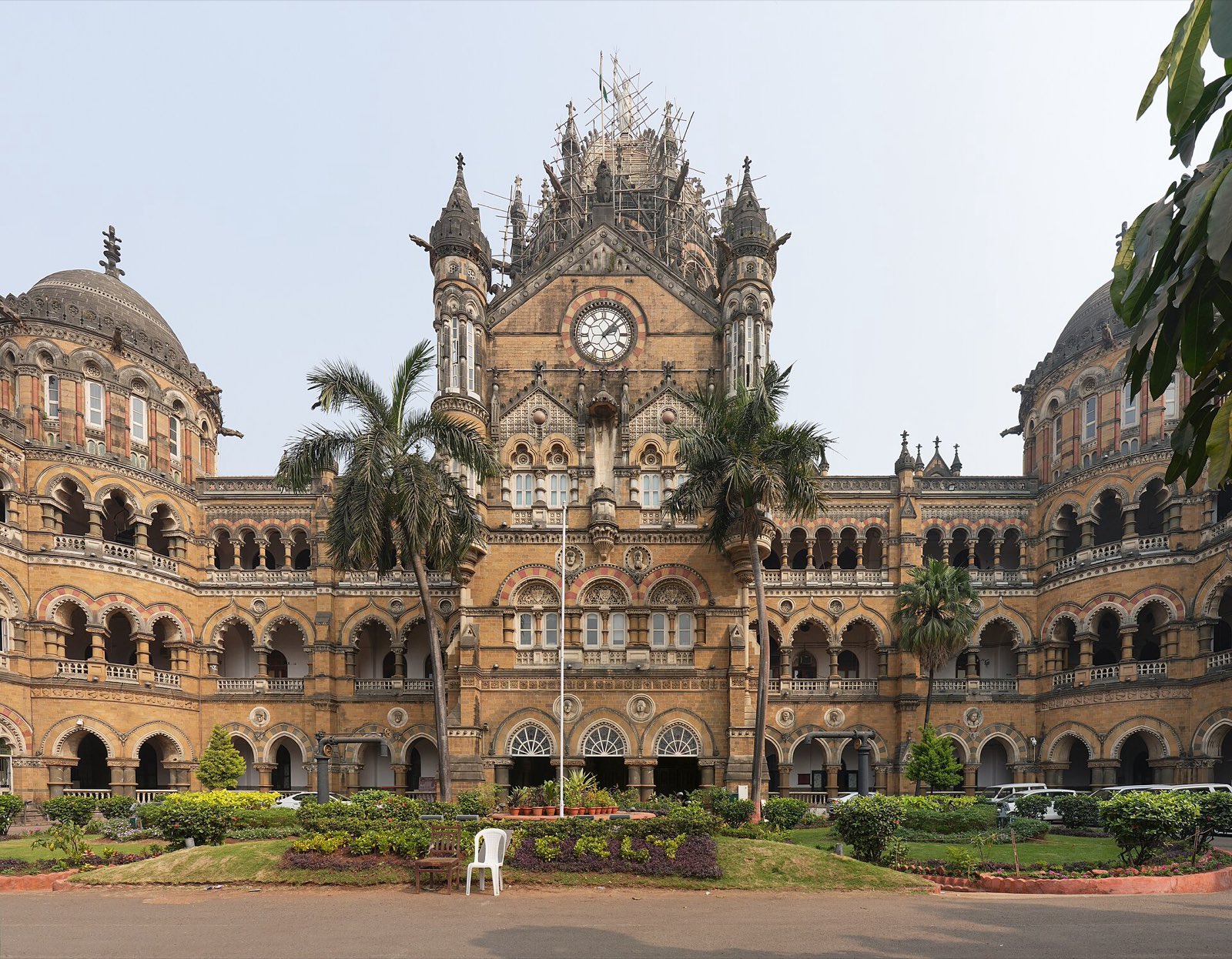
Chhatrapati Shivaji Terminus, Mumbai: A Cathedral Built for the Age of Steam
How the British raised a Gothic cathedral to the railway in the heart of Bombay — gargoyles beside peacocks, a ribbed dome over the platforms — the most exuberant and most Indian of all the empire's Victorian buildings
There is a building in the heart of Mumbai that looks, at first glance, exactly like a great European cathedral — pointed arches, stained-glass windows, soaring turrets and pinnacles, gargoyles leaning from the walls, and a mighty ribbed dome crowned by a statue. Then you notice the crowds pouring in and out beneath it in their millions, and the platforms and the trains, and you realise it is a railway station. Chhatrapati Shivaji Terminus — for most of its life called Victoria Terminus, and still known to everyone as "VT" or "CST" — is the most magnificent railway station in India and one of the most extraordinary anywhere in the world: a cathedral built not to a god but to the railway, the great engine of the nineteenth century.
It belongs in this series alongside the Victoria Memorial as the second face of British imperial architecture in India — but where the Victoria Memorial dressed a classical building in Indian clothes, CSMT dresses a Gothic one, and the difference is the whole story of Victorian architecture in miniature.
A temple to the railway
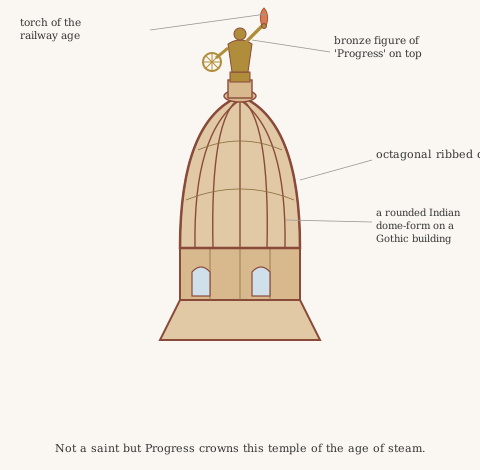
The station was designed by the British architect Frederick William Stevens and completed in 1887 — the year of Queen Victoria's Golden Jubilee, which is why it was named for her. It was built as the headquarters and terminus of the Great Indian Peninsula Railway, and no expense was spared, because it was meant to proclaim a message: that the railway, which the British were driving across India, was the supreme achievement of the age, worthy of a building as grand as any temple or palace. Bombay was the commercial capital of British India, booming on cotton and trade, and it wanted a monument to match its wealth and its faith in progress. CSMT was that monument — a secular cathedral for the religion of steam, commerce and empire.
That idea, the station-as-cathedral, was not unique to Bombay; the great Victorian termini of London were built in the same spirit. But nowhere was it done with more exuberance, or more fascinating local inflection, than here.
Gothic bones: the cathedral form
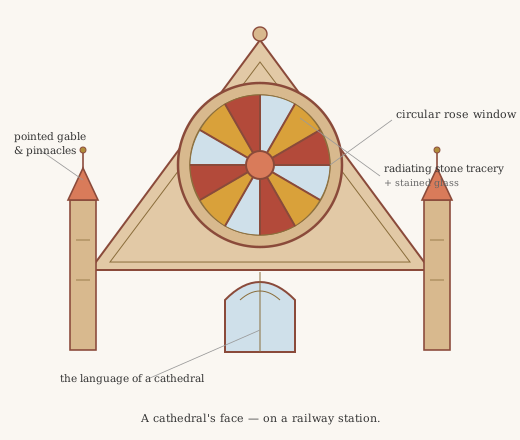
Look at the building's shape and vocabulary and it is High Victorian Gothic — the style of the great medieval cathedrals of Europe, revived and reinterpreted by nineteenth-century architects who saw in Gothic a moral seriousness and structural honesty they prized.
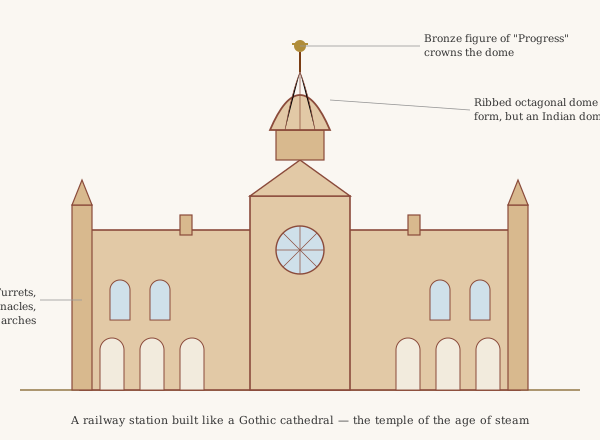
The elements are all drawn from the Gothic cathedral: pointed arches everywhere, on windows and arcades; a great circular rose window; turrets, pinnacles and gables breaking the skyline; ribbed surfaces; stained glass; and a wealth of carved stone decoration including the gargoyles and grotesques that scowl from medieval churches. At the centre rises a tall octagonal ribbed dome, and on its summit stands not a saint but an allegorical bronze figure of Progress, torch in hand — the presiding deity of this temple, exactly the confident Victorian idea the whole building exists to express. Where a cathedral would place its high altar, CSMT places its booking hall and platforms; the sacred and the functional have swapped, but the architectural language of awe is identical.
Indian flesh: the ornament that belongs to Bombay
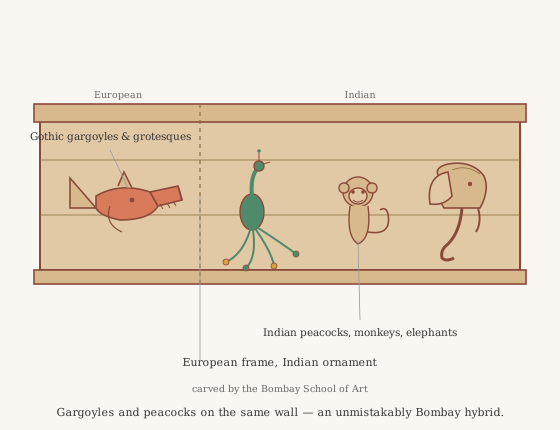
And yet CSMT is emphatically not a European building transplanted whole. Stevens and his Indian craftsmen wove Indian elements all through it, and it is this fusion that makes it live.
The very dome is a clue: a ribbed dome is unusual in European Gothic, which preferred spires and towers, and its rounded form here owes something to the domes of Indian and Mughal architecture — a Gothic idea given an Indian shape, and reputedly one of the first domes successfully married to a Gothic building. The carved decoration, executed largely by students of the Bombay School of Art, sets the standard menagerie of Gothic gargoyles alongside distinctly Indian animals and motifs — peacocks, monkeys, elephants, Indian plants — so that European grotesques and Indian creatures share the same walls. This is the same Indo-Saracenic impulse we met at the Victoria Memorial: a European frame given Indian ornament to root imperial architecture in local soil. At CSMT it is warmer and less calculated than at Kolkata — a genuine, exuberant Bombay hybrid rather than a cool imperial statement, which is one reason the city has always loved it.
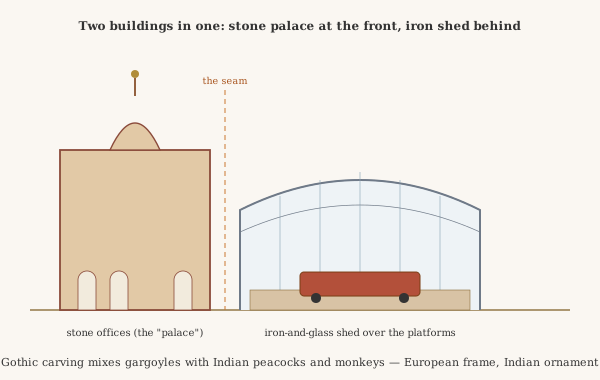
The section reveals a second, more practical duality that every great railway terminus shares. What faces the city is an ornate stone "palace" — the administrative offices and grand booking halls, all Gothic carving and stained glass. But behind that decorated masonry front stretches a long shed of iron and glass, a frankly modern engineering structure covering the platforms and trains. The nineteenth-century railway station was always two buildings stitched together: a romantic historical costume at the front for the public and the city, and a functional industrial hall behind for the machines. CSMT is the most gorgeous costume in India, and you can find the seam where the stone palace meets the iron shed.
How to read it
CSMT raises the same honest question as the Victoria Memorial: what to feel about a magnificent building that is also a monument of colonial rule, built to celebrate the empire's grip on India. And the answer here is, if anything, more complicated and more generous — because CSMT was not built as a monument to conquest but as a working piece of the city's daily life, and it has never stopped being one. It remains one of the busiest railway stations in the world; millions of Mumbaikars of every background pass through it each day; it was renamed in 1996 for Chhatrapati Shivaji, the great Maratha king, reclaiming it firmly as an Indian place. The building the British raised to their own idea of progress has become, simply, the beating heart of Mumbai's commute, loved by the people who use it. It is a UNESCO World Heritage Site not only for its architecture but as an outstanding example of the meeting of Victorian Gothic and Indian traditions.
Set it beside the other imperial and modern buildings in this series and it finds its exact place. The Victoria Memorial is imperial classicism at rest, cool and grand; CSMT is imperial Gothic in full cry, warm and teeming. Chandigarh, a lifetime later, would reject both the borrowed Gothic and the borrowed classicism for raw modern concrete. And running underneath all three is the same deep question that this series keeps returning to in its later chapters — how a foreign architecture and an Indian one meet, and who, in the end, the building comes to belong to.
Stand in the great booking hall of CSMT as the light falls through its stained glass and the crowds surge past under the stone vaults, and you are inside the cathedral of the railway age — a European dream of Gothic progress, built by Indian hands, carved with Indian creatures, and now wholly and unmistakably Mumbai's own.
Part of the Architectural Wonders series. For imperial architecture in the classical key, read the Victoria Memorial; for the modern architecture that broke with both, Chandigarh; and for an Indian dome of the kind its crown echoes, the Gol Gumbaz.
Hero photograph: “Chhatrapati Shivaji Terminus, Mumbai” by Ingo Mehling, via Wikimedia Commons, licensed under CC BY-SA 4.0.
Export this guide
Related Guides — Deep-dive reading
The Victoria Memorial, Kolkata: The Raj Answers the Taj
How the British Empire built its own white-marble monument in a Mughal city — a European dome dressed in Indian kiosks and arches, the grandest and most revealing statement of the Indo-Saracenic style
Architectural WondersIndo-Saracenic Architecture in India
The Raj-era revival that gave India its grandest landmarks
Design StylesThe Mud Mosques of Timbuktu: The University Made of Earth
On the edge of the Sahara, a city that Europe turned into a byword for the middle of nowhere was in truth one of the great centres of learning in the medieval world — with a university of 25,000 students and libraries of hundreds of thousands of manuscripts. Its three great mosques are built entirely of mud, bristling with wooden beams, and must be re-plastered by the whole community every single year — which is exactly why, after seven centuries, they still stand.
Architectural WondersRelated Tools — Try Free
Architectural Style Identifier
Upload a building photo and an on-device AI names its likely architectural style and era, with the visual cues — private and free.
On-device AICross-Ventilation Analyzer
Estimate airflow and air changes per hour (ACH) from room size, window areas, layout, and local wind — with NBC 2016 Part 8 compliance check.
Ventilation CalculatorWindow Cleaning Cost Calculator
Estimate professional window cleaning cost per visit and per year by access and frequency.
Window Calculator