
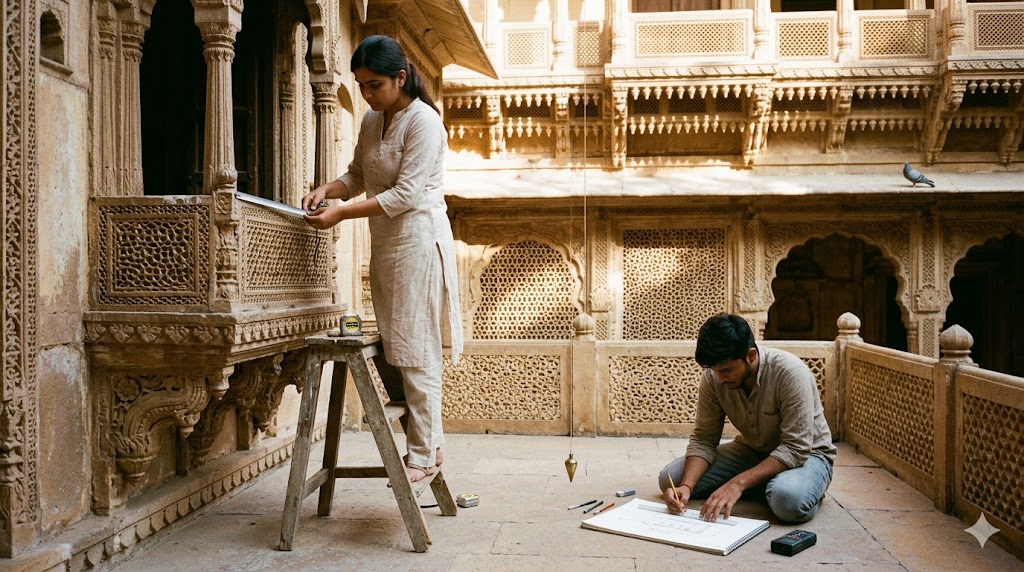
Heritage Documentation & Measured Drawing Studio
The 2026 Working Reference for the Indian B.Arch Year-3/Year-4 Heritage Documentation Studio — Three-Stage Process (Preliminary Survey, Detailed Measurement, Drawing Production), Eight Typologies (Haveli, Temple, Vernacular Cluster, Urban Precinct, Industrial, Colonial, Stepwell, Single Element), Tools (Tape to Total Station to Photogrammetry), Drawing Conventions, INTACH and ASI Frameworks, and the Conservation Career Pathway
Heritage documentation is the most distinctive single discipline of the Indian B.Arch programme. No other architectural exercise asks the student to witness a building, draw it as it is rather than as it is designed, and produce a record that preserves knowledge that may otherwise be lost. The Year-3 or Year-4 heritage documentation studio is, for many students, the first time they understand what measured means in architecture — and it is the studio that often shifts a student towards conservation as a career interest.
This guide is the working reference for that studio. It is structured around the three-stage process every measured-drawing exercise follows, the eight typologies Indian B.Arch students typically document, and the tool kit and drawing conventions of measured architectural records. The orientation throughout is towards Indian heritage contexts — havelis, temples, vernacular clusters, urban precincts, colonial buildings, stepwells, and industrial-heritage sites — and the regulatory and institutional frameworks (INTACH, ASI, Ancient Monuments Act 1958, AMASR Act) within which Indian heritage practice operates.
The treatment is structured around four clusters. The map cluster (sections 1-3) covers why heritage documentation matters, the eight typologies, and the regulatory framework. The process cluster (sections 4-7) covers the three-stage documentation workflow, the tool kit (traditional and modern), drawing conventions, and condition mapping. The output cluster (sections 8-9) covers final deliverables and archiving. The career cluster (sections 10-12) covers the conservation profession, INTACH and ICOMOS pathways, and the long-horizon contribution.
"You measure a building you respect. The measured drawing is an act of careful witness. The architect who has measured ten heritage buildings carries a depth of architectural understanding that no amount of design studio can produce." — Faculty paraphrase, Indian heritage documentation studio
1. Why Heritage Documentation Matters
The discipline of measured drawing has three distinct values, each independently important.
1.1 Preservation of Knowledge
Indian buildings older than 50 years are at structural risk. Many historic havelis, vernacular clusters, and even colonial monuments are demolished or substantially altered each year. Measured drawings produced by B.Arch students — many archived at INTACH, school libraries, ASI regional offices — are sometimes the only surviving record of buildings now lost. The student documenting a Pol house in Ahmedabad in 2026 may, in 2056, hold the only measured plan of a building that no longer exists.
This is not hyperbole. INTACH's archives contain measured drawings of buildings that have been demolished in the years since documentation. The student's drawing is the record. The discipline matters because the record matters.
1.2 Training in Architectural Reading
The act of measuring forces the student to see a building in ways that designing does not. The architect designing a contemporary residence does not stop to consider how the wall meets the floor, how the door frame is detailed, or how the wall thickness varies across the building. The architect measuring a haveli has no choice — every dimension must be recorded, every wall thickness verified, every joint examined. This is the cognitive instrument that distinguishes the architect who has measured from the architect who has only designed.
The graduate who has measured ten heritage buildings reads contemporary architecture differently — with attention to the same details, the same questions, the same craft instinct. The discipline transfers.
1.3 Foundation for Conservation Work
The conservation profession in India — INTACH conservation architects, ASI documentation teams, private practice conservation architects working on World Heritage sites and listed buildings — requires measured-drawing fluency. A B.Arch graduate who wishes to pursue conservation has, in the heritage documentation studio, the foundation that subsequent post-graduate study (M.Arch in Conservation at SPA Delhi, CEPT, or international programmes) builds on. The graduate who has not measured at student level enters conservation at a meaningful skill deficit.
2. The Eight Typologies — What Indian B.Arch Studios Document
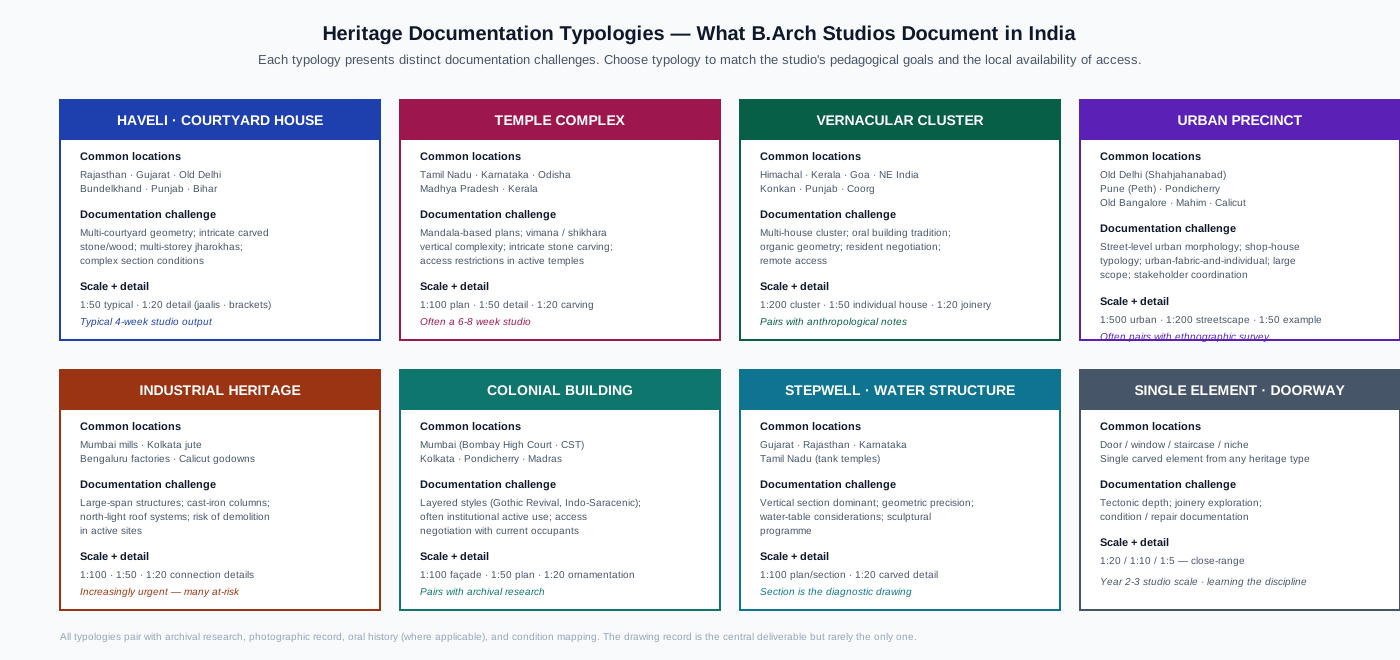
Heritage documentation studios in Indian B.Arch programmes typically document one of eight typology classes. Each presents distinct documentation challenges; each rewards a slightly different approach.
2.1 Haveli / Courtyard House
The haveli — the multi-courtyard merchant or aristocratic house of Rajasthan, Gujarat, Old Delhi, and parts of north-central India — is the most-documented typology in Indian B.Arch heritage studios. The challenges are multi-courtyard geometry, intricate carved stone or wood ornament (jharokhas, jaalis, brackets), multi-storey vertical complexity, and often complex section conditions where mezzanines and projecting balconies overlap.
Typical scope: 4-week studio with one team of 3-5 students per haveli; 1:50 plan and section, 1:20 detail of jaalis or jharokhas.
2.2 Temple Complex
Temple complexes — Hindu, Jain, Buddhist — present documentation challenges of mandala-based plan logic, vertical complexity in the vimana / shikhara, intricate stone carving, and often access restrictions in active temples. The documentation discipline includes negotiation with the temple committee for access, scaffolding limits, and (where applicable) photography restrictions in inner sanctums.
Typical scope: 6-8 week studio (longer than haveli) given the carving detail; 1:100 plan, 1:50 detail, 1:20 carving fragment.
2.3 Vernacular Cluster
Vernacular clusters — Himachal hill towns, Kerala traditional homes, Goan settlements, Northeast traditional structures, Konkan villages, Punjab rural courtyards, Coorg estates — present the challenge of cluster geometry rather than single-building documentation. The discipline is to capture how individual structures form a coherent settlement; oral building tradition (no architects' drawings exist) means the documentation often pairs with anthropological notes.
Typical scope: 1:200 cluster plan, 1:50 individual house plan, 1:20 joinery detail. Ethnographic notes accompany.
2.4 Urban Precinct
Urban precincts — Old Delhi (Shahjahanabad), Pune (the Peths), Pondicherry French Quarter, Old Bangalore, Mahim/Bandra's older fabric, Calicut historic core — present the challenge of urban morphology: how the streets, plots, shop-houses, and public spaces interact. The documentation produces a layered record: street-level drawings, individual building examples, urban-fabric overall plans.
Typical scope: 1:500 urban context, 1:200 streetscape elevations, 1:50 example buildings. Often pairs with stakeholder ethnographic survey.
2.5 Industrial Heritage
Industrial-heritage sites — Mumbai mill compounds, Kolkata jute factories, Bengaluru industrial sheds, Calicut godowns — present the challenge of large-span structural systems, cast-iron columns, north-light roof systems, and the urgency that many such sites are at active risk of demolition. Industrial heritage in India is among the most under-documented heritage layers; B.Arch student documentation is sometimes the only record produced.
Typical scope: 1:100 plan, 1:50 structural section, 1:20 connection details (rivets, cast-iron column-to-beam junctions).
2.6 Colonial Building
Colonial buildings — Mumbai (Bombay High Court, CST, Elphinstone College), Kolkata (Writers' Building, Indian Museum, GPO), Pondicherry, Chennai (Madras High Court, Chepauk) — present the challenge of layered styles (Gothic Revival, Indo-Saracenic, Classical), often institutional active use requiring access negotiation, and the need to pair documentation with archival research at the British Library, ASI archives, or Indian institutional archives.
Typical scope: 1:100 façade, 1:50 plan, 1:20 ornamentation detail. Pairs with archival research.
2.7 Stepwell / Water Structure
Stepwells (baolis, vaavs, kunds) and tank temples — concentrated in Gujarat (Rani-ki-Vav, Adalaj), Rajasthan (Chand Baori), Karnataka (Hampi tanks), Tamil Nadu (temple tanks) — present the unusual documentation challenge of vertical section as the dominant drawing. The plan reveals only the surface footprint; the section reveals the building. Geometric precision and water-table considerations (where do the steps meet the water level historically) are central.
Typical scope: 1:100 plan and section, 1:20 carved detail.
2.8 Single Element / Doorway / Joinery
Year-2 and Year-3 studios sometimes use single-element documentation — a door, a window, a staircase, a niche, a carved panel — as an entry-level introduction to measured drawing. The scale is intimate (1:20, 1:10, 1:5), the focus is tectonic detail, and the studio teaches the act of measuring without the scope of a whole building.
This is a useful pedagogical entry point. Students who do a single-element exercise in Year 2 are better prepared for whole-building documentation in Year 4.
3. The Indian Heritage Regulatory Framework
Heritage documentation in India operates within a layered regulatory framework. The student must understand which authorities govern access, permission, and documentation rights.
3.1 The Ancient Monuments and Archaeological Sites and Remains Act, 1958 (AMASR Act)
The AMASR Act is the foundational national heritage statute, governing buildings declared Centrally Protected Monuments by the Archaeological Survey of India (ASI). Approximately 3,700 monuments across India are ASI-protected.
For ASI-protected monuments:
- Documentation generally requires ASI permission for measured-drawing exercises beyond casual visitor sketching
- Photography is permitted but commercial use requires a permit
- No alteration / digging / surface disturbance is permitted without ASI approval
- Heritage zone (100m / 200m) protections restrict construction near the monument
For B.Arch student studios documenting ASI-protected monuments, the studio coordinator typically secures bulk permission from the relevant ASI Circle Office (regional). Individual student visits operate under that bulk permission.
3.2 State Heritage Acts
In addition to the AMASR Act, most Indian states have heritage protection acts covering buildings of state-level significance. Maharashtra, Karnataka, Delhi, West Bengal, Kerala, Tamil Nadu, Gujarat, Rajasthan all have state heritage frameworks. State-protected monuments are governed by the State Department of Archaeology rather than the ASI.
3.3 Municipal Heritage Lists
Major Indian cities (Mumbai, Delhi, Bengaluru, Kolkata, Chennai, Hyderabad) operate municipal heritage lists — locally-protected buildings governed by the municipal corporation. Mumbai's Heritage Regulations and the Heritage Conservation Committee are the most-developed; Delhi's UTTIPEC and the Heritage Conservation Committee operate similar mandates.
For student documentation of municipally-listed buildings, the local heritage committee secretariat is the relevant authority.
3.4 Privately-Owned Heritage Buildings
Many heritage buildings in India remain in private ownership — havelis, vernacular houses, smaller temples. Documentation requires owner consent. Building owner conversations are part of the studio process; respect for residents and current uses is essential.
3.5 INTACH and ICOMOS India
The Indian National Trust for Art and Cultural Heritage (INTACH) is the largest non-governmental heritage organisation in India, with chapters across most states. INTACH operates conservation projects, documentation archives, and student-engagement programmes.
ICOMOS India is the Indian chapter of the International Council on Monuments and Sites — the global heritage NGO. ICOMOS standards (the Venice Charter, the Burra Charter, ICOMOS principles for heritage documentation) form the international reference framework.
Student documentation work that is well-produced is often accepted into INTACH archives and recognised in ICOMOS-affiliated conservation reports. The institutional partnership pathway is real.
4. The Three-Stage Process
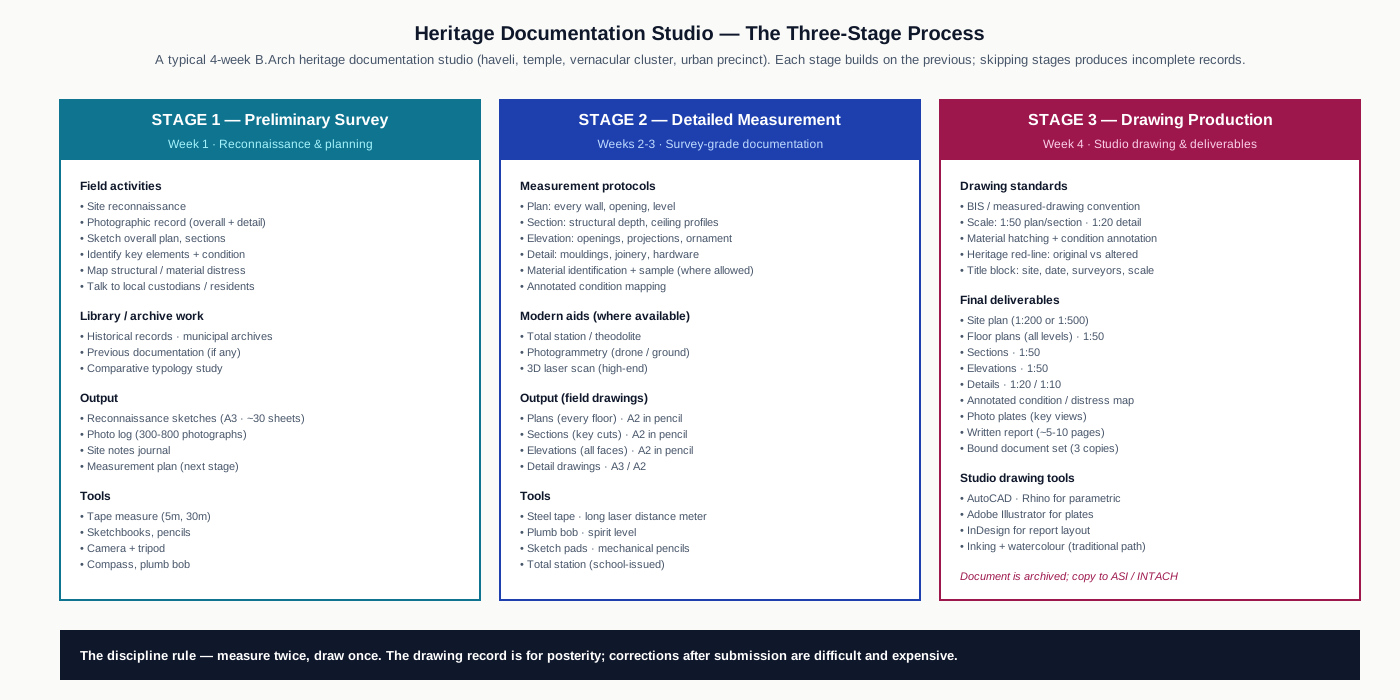
Heritage documentation studios follow a recognisable three-stage workflow. Each stage builds on the previous; skipping stages produces incomplete records.
4.1 Stage 1 — Preliminary Survey (Week 1)
The reconnaissance phase. The team visits the site, makes overall sketches, photographs comprehensively, and identifies key documentation priorities.
Field activities:
- Site reconnaissance — walk the site, understand the overall geometry
- Photographic record — overall views from multiple angles, plus detail photographs of significant elements
- Sketch the overall plan in a notebook — not survey-grade, but enough to plan subsequent measurement
- Identify key elements (doors, windows, ornament, structural elements)
- Map structural and material distress — cracks, water damage, missing fragments
- Interview local custodians or residents — oral history, building age claims, alteration history
Library / archive work:
- Historical records (municipal archives, ASI archives, state heritage department)
- Previous documentation (if any) — INTACH, school libraries, published papers
- Comparative typology study — what does the literature say about this typology?
Output:
- 30-50 reconnaissance sketches at A3
- 300-800 photographs (comprehensive log)
- Site notes journal
- Measurement plan for Stage 2 (which drawings, which scale, which details)
4.2 Stage 2 — Detailed Measurement (Weeks 2-3)
The survey-grade documentation phase. The team produces field drawings — pencil-on-paper measured drawings of every plan, section, elevation, and detail.
Measurement protocols:
- Plan: every wall, every opening, every level (using base-line method or trilateration for rooms with non-rectangular geometry)
- Section: structural depth, ceiling profiles, mezzanine relationships
- Elevation: openings, projections, ornament — measured in horizontal and vertical bands
- Detail: mouldings, joinery, hardware — in close range
- Material identification + sample (where heritage authority permits)
- Annotated condition mapping — distress mapped onto field drawings
Modern aids (where institution provides):
- Total station / theodolite for survey-grade external measurements
- Drone photogrammetry for inaccessible elevations (rooflines, façade upper portions)
- Ground-based photogrammetry for high-detail surfaces
- 3D laser scanning (high-end institutions) for definitive geometric record
Output (field drawings):
- Plans (every floor) at A2 in pencil
- Sections (key cuts) at A2 in pencil
- Elevations (all faces) at A2 in pencil
- Detail drawings at A3 / A2
The discipline rule in Stage 2 is measure twice, draw once. The field drawings are the basis of the studio output; errors at this stage propagate to the final deliverables.
4.3 Stage 3 — Drawing Production (Week 4)
The studio drawing phase. Field drawings are converted to studio-quality output following measured-drawing conventions.
Drawing standards:
- BIS / measured-drawing convention (line weights, hatching, scale annotation)
- Scale: 1:50 plan and section, 1:20 detail (typical)
- Material hatching by Indian Standard (IS 10711, IS 696)
- Heritage red-line: original construction shown distinctly from later alterations
- Title block: site name, date, surveyor names, scale, north arrow, drawing number
Final deliverables:
- Site plan (1:200 or 1:500)
- Floor plans (all levels) at 1:50
- Sections at 1:50
- Elevations at 1:50
- Details at 1:20 / 1:10
- Annotated condition / distress map
- Photo plates (key views with labels)
- Written report (~5-10 pages — significance, history, condition, recommendations)
- Bound document set (3 copies — institution, INTACH/ASI, owner)
Studio drawing tools:
- AutoCAD for plans / sections / elevations (most common Indian studio path)
- Rhino for parametric or carved-detail work
- Adobe Illustrator for final plate composition
- Adobe InDesign for the bound report
- Inking and watercolour (traditional path, still practised at some institutions including SPA Delhi for thesis-grade documentation)
The bound document is archived. A digital copy is typically deposited with INTACH, the school library, and (where applicable) the ASI Circle Office or state heritage department.
5. The Documentation Tool Kit
The heritage documentation tool kit spans traditional and modern instruments. Most B.Arch studios provide some of the modern tools (theodolite, total station) institutionally; students bring the traditional ones.
5.1 Traditional Measurement Tools
| Tool | Use | Indian price (2026) |
|---|---|---|
| Steel tape (5m, 30m) | Linear measurements | ₹500-1,500 (depending on length) |
| Plumb bob | Vertical reference | ₹150-300 |
| Spirit level | Horizontal reference | ₹200-500 |
| Compass | Orientation | ₹300-600 |
| Set-square (large) | Right-angle reference | ₹400-800 |
| String / chalk line | Straight-line reference | ₹100-200 |
| Sketchbooks (multiple A3, A2) | Field drawings | ₹500-1,500 |
| Pencils, mechanical pencils | Field drawings | ₹200-500 |
| Camera + tripod | Photographic record | Variable; phone camera often adequate |
5.2 Modern Measurement Tools
| Tool | Use | Source |
|---|---|---|
| Laser distance meter (Bosch, Leica) | Long linear measurements | ₹3,000-15,000 (worth purchase for serious heritage interest) |
| Total station / theodolite | Survey-grade external coordinates | School-issued; some heritage studios rent |
| Drone (small, with camera) | Aerial photography, photogrammetry | School-issued or shared |
| Photogrammetry software (Agisoft Metashape, RealityCapture) | 3D model from photographs | Educational licences typically free |
| 3D laser scanner (Leica, Faro) | Definitive geometric record | High-end institutions (CEPT, IIT Roorkee, IIIT Delhi) |
| GPS / RTK GPS | Site geolocation | Variable |
5.3 The Essential Field Bag
A working heritage documentation field bag for a B.Arch student:
- Steel tape (5m + 30m)
- Laser distance meter (if available; otherwise just steel tapes)
- Plumb bob
- Spirit level (small + medium)
- Set-square (large)
- Sketchbook (A3 + A2)
- Mechanical pencils (HB, 2B) + sharpeners
- Eraser
- Camera (phone or DSLR) with tripod
- Compass
- Notebook + pen
- Water bottle (long studio days in heat)
- First-aid kit (basic)
6. Drawing Conventions for Measured Drawings
Measured drawings follow specific conventions that distinguish them from design drawings. The student must understand and apply these conventions.
6.1 Line Weights and Hatching
Per IS 10711 and IS 696 (the BIS architectural drawing standards):
| Element | Line weight | Notes |
|---|---|---|
| Cut walls (intersected by section/plan) | Heavy (0.5-0.7mm) | Solid fill or material hatching |
| Visible edges | Medium (0.3-0.4mm) | All visible building lines |
| Hidden edges (overhead) | Dashed medium | Beams, lintels, projections |
| Centrelines | Dot-dash thin | Where applicable |
| Dimensions | Thin (0.15-0.2mm) | Always clearly readable |
| Annotation text | Standardised height | Typically 2-3mm at 1:50 scale |
6.2 Material Hatching
Material hatching makes measured drawings legible without colour. Standard Indian convention:
| Material | Hatching pattern |
|---|---|
| Stone / RCC | Diagonal cross-hatching, dense |
| Brick | Horizontal lines with offset bond pattern |
| Wood (cut) | Wood-grain pattern (curved lines) |
| Wood (elevation) | Linear grain |
| Metal | Solid black or fine cross-hatching |
| Earth / mud | Stippled dots |
| Plaster | Single fine line at edge |
| Glass | Short parallel diagonals |
6.3 Heritage-Specific Convention — The Red Line
In heritage documentation, the original construction is distinguished from later alterations by colour or line type:
- Original: standard line weight, standard hatching
- Later alteration / addition: red overlay or distinct hatching pattern
- Removed (now-missing): dashed in red
This convention allows the drawing to read as a historical record showing both what is and what was.
6.4 Title Block
Every measured drawing must carry a title block with:
- Site name and address
- Drawing title (e.g., "First Floor Plan — Khanna Haveli, Old Delhi")
- Scale
- Date of measurement and drawing
- Surveyor names
- Drawing number (in the document set)
- North arrow
- Site coordinates (where relevant)
- Studio / institution
- Reference to bulk documentation set
7. Condition Mapping — The Diagnostic Layer
A measured drawing without a condition map records what is. A measured drawing with a condition map records what is and what is failing. The condition map is the diagnostic layer that supports conservation decisions.
7.1 Condition Categories
| Condition | Typical indicators |
|---|---|
| Sound | No visible distress |
| Surface degradation | Flaking plaster, weathered paint, patina |
| Structural distress (minor) | Hairline cracks, small spalls |
| Structural distress (major) | Wide cracks, displaced masonry, leaning elements |
| Active water damage | Damp patches, salt efflorescence, biological growth |
| Material loss | Missing carved fragments, eroded mouldings |
| Inappropriate alteration | Modern materials (cement plaster on lime walls), introduced openings, structural modification |
| Critical (immediate risk) | Imminent collapse risk, structural failure |
7.2 The Condition Map Drawing
The condition map is typically drawn over the plan / elevation, with each area shaded or hatched per its condition category. A legend explains the mapping. Photographic close-ups document key distress points.
The output is one of the most valuable single deliverables of the heritage documentation studio — it is the basis for any subsequent conservation intervention.
8. Final Deliverables and Archiving
8.1 The Complete Document Set
A typical heritage documentation studio output:
| Deliverable | Format | Quantity |
|---|---|---|
| Cover sheet | A2 | 1 |
| Significance statement | A4 (~3 pages) | In report |
| Site context / location plan | A2 (1:500 or 1:1000) | 1 |
| Site plan | A2 (1:200) | 1 |
| Floor plans | A2 (1:50) | 1 per level |
| Sections | A2 (1:50) | 2-4 typical |
| Elevations | A2 (1:50) | 4 (one per face) |
| Details | A2 / A3 (1:20 / 1:10) | 6-12 |
| Condition map | A2 (1:50) | 1 per floor |
| Photo plates | A3 (multiple per plate) | 3-6 plates |
| Written report | A4 (5-10 pages) | 1 |
| Bound document set | All above bound | 3 copies |
8.2 Archival Discipline
The bound document is archived at:
- Institution library (mandatory)
- INTACH chapter (where partnership exists)
- ASI Circle Office (for ASI-protected monuments)
- State heritage department (for state-protected monuments)
- Owner / current occupant (where private)
- Digital copy in public archive (where available — student may upload to academic.edu, ResearchGate, or Internet Archive)
Digital archiving in 2026 includes high-resolution image scans of all drawings, the AutoCAD / DWG source files, and the photogrammetric models (where produced). This digital record extends the document's accessibility and durability significantly.
8.3 Publication and Recognition
Strong student documentation work is often published — in INTACH chapter newsletters, in academic journals (Architectural Heritage, Conservation Studies), in conference proceedings (ICOMOS conferences), and increasingly on academic-archive platforms. The student whose work is published has a portfolio asset that compounds across career.
9. The Conservation Profession in India
For students whose heritage documentation studio shifts their interest towards conservation as a career, the path is structured.
9.1 The Conservation Architect Role
The conservation architect in India works on:
- Restoration of listed and ASI-protected buildings
- Adaptive reuse projects (heritage buildings repurposed for contemporary use)
- Conservation master plans (city-scale or precinct-scale)
- Technical condition surveys
- Restoration drawings and specifications
- Heritage Impact Assessments (required for development near listed buildings)
9.2 The Educational Pathway
| Stage | Programme | Duration |
|---|---|---|
| B.Arch foundation | Standard 5-year B.Arch | 5 years |
| M.Arch in Conservation | SPA Delhi · CEPT · others | 2 years |
| PhD (research path) | SPA Delhi · CEPT · IIT · international | 3-5 years |
| Practical training | INTACH conservation projects · ASI · private practice | Ongoing |
| International exposure | ICCROM courses · international conservation programmes | Varies |
9.3 Major Indian Conservation Institutions
| Institution | Role |
|---|---|
| Archaeological Survey of India (ASI) | National-level statutory authority; maintains 3,700+ centrally-protected monuments |
| INTACH | National NGO; documentation, conservation projects, advocacy |
| State Departments of Archaeology | State-level statutory authorities |
| Municipal Heritage Committees | City-level (Mumbai HCC, Delhi UTTIPEC, etc.) |
| Aga Khan Trust for Culture (AKTC) India | Major restoration projects (Humayun's Tomb, Qutb Shahi, Sunder Nursery) |
| World Monuments Fund India (WMF) | International heritage restoration partnership |
| Conservation chapters of architecture practices | Studio Lotus heritage arm, Vir Mueller, Arun Rewal, conservation specialists |
9.4 Career Trajectories (Conservation Specialism)
| Stage | Typical role | Salary range (2026) |
|---|---|---|
| 0-2 years post-grad | Conservation associate at INTACH / private practice | ₹3-5 LPA |
| 2-5 years | Project conservation architect | ₹5-9 LPA |
| 5-10 years | Senior conservation architect / project lead | ₹8-15 LPA |
| 10+ years | Independent conservation practice / academic / institutional senior role | ₹15-30 LPA |
The conservation career is not the highest-paid architectural career — it pays modestly compared to large-firm corporate practice. It compensates with cultural-mission alignment, intellectual depth, and durable engagement with India's architectural memory.
10. INTACH and ICOMOS Engagement Pathways
10.1 INTACH Student Engagement
INTACH offers multiple student-engagement pathways:
- Student membership — modest annual fee; access to INTACH chapter events, resources
- Documentation projects — INTACH partners with B.Arch institutions on city-specific documentation campaigns; students often participate
- Internships — INTACH chapter offices accept student interns for documentation, condition survey, and research projects
- Awards — INTACH operates annual heritage awards including student categories
- Scholarships — INTACH-affiliated scholarships for M.Arch in Conservation programmes
10.2 ICOMOS India
ICOMOS India operates international standards-based conservation work. Student-affiliation is possible through:
- Participation in ICOMOS-organised conferences and symposiums
- Volunteering on ICOMOS documentation projects
- Pathway to ICOMOS membership at professional stage
10.3 International Conservation Programmes (Post-B.Arch)
| Programme | Country | Notes |
|---|---|---|
| ICCROM courses | Italy | The international reference conservation training; competitive admission |
| Aga Khan Programme for Islamic Architecture | MIT (USA) | Strong Indian connections via Charles Correa, Doshi |
| University of York Centre for Conservation Studies | UK | Top-tier conservation programme |
| Politecnico di Milano | Italy | Strong heritage architecture programme |
| Columbia GSAPP Historic Preservation | USA | Global perspective; competitive |
For the Indian B.Arch graduate aiming at international conservation practice, these programmes are the post-graduate pathway. M.Arch in Conservation at SPA Delhi or CEPT is the strong domestic alternative.
11. Common Mistakes in Heritage Documentation Studios
- Skipping the preliminary survey. Teams that begin measuring on Day 1 produce confused documentation. The reconnaissance week is non-negotiable.
- Inadequate photographic record. A documentation set with 100 photos is meaningfully thinner than one with 800 photos. Photograph everything; archive ruthlessly.
- Measuring inconsistently. Switching between metric and imperial units, between rounded and precise measurements, between steel-tape and laser-meter without recording method — all introduce errors that compound.
- No condition map. A measured drawing without a condition map records the building but does not support conservation decisions. The condition layer is part of the deliverable.
- No oral history. Buildings have stories. Residents and custodians often hold knowledge — alteration history, historical use, family connections — not visible in the building. The 30-minute conversation produces a richer document.
- No archival research. A measured drawing produced without consulting existing archives misses comparative typology, historical photographs, and earlier documentation. Archive work is part of the studio.
- Late submission. Heritage documentation is heavy production. Teams that begin drawing production in Week 4 instead of Week 3 typically miss the deadline. Budget time across all four weeks.
- No copy archived. Producing a beautiful document and not archiving copies at INTACH / ASI / school library defeats the purpose. The drawing exists for posterity.
- Disrespecting current occupants. Heritage buildings are often actively occupied. Respectful conduct, polite negotiation, and clear communication of what students are doing are essential. Cultural sensitivity matters as much as technical skill.
- Treating documentation as design exercise. Heritage documentation is not "make it look good" — it is "record it accurately". The discipline rewards accuracy over aesthetic flourish.
12. Twelve-Test Self-Diagnostic for the Heritage Documentation Studio
Use this diagnostic before submission:
1. Reconnaissance complete. Did Stage 1 produce 30+ sketches, 300+ photos, full site notes?
2. Measurement consistency. All measurements in metric, recorded with method?
3. All elevations measured. Every visible building face documented, not just the front?
4. Sections at correct cuts. Are sections cut at locations that reveal the building, not just convenient locations?
5. Detail coverage. At least 6-12 detail drawings at 1:20 or 1:10?
6. Condition map produced. A separate drawing showing distress and condition?
7. Original-vs-altered distinction. Is later construction visually distinguished?
8. Photographic plates assembled. Key views composed and labelled?
9. Written report finalised. Significance, history, condition, recommendations covered?
10. Title blocks complete. Every drawing has full identifying information?
11. Bound copies produced. Three copies bound (institution, archive, owner)?
12. Digital archive. AutoCAD / DWG / image scans uploaded to public archive?
Studios scoring 9+ on this diagnostic produce documentation that is genuinely useful as a conservation record. Studios scoring below 7 produce records that, while educationally valuable to the students, may not survive scrutiny at INTACH or ASI archive review.
13. References and Further Reading
Statutory and Regulatory References
- Ancient Monuments and Archaeological Sites and Remains Act, 1958. Government of India.
- AMASR Amendment Act 2010. Updates to the 1958 framework.
- State Heritage Acts. Maharashtra, Karnataka, Delhi, West Bengal, Kerala, Tamil Nadu, Gujarat, Rajasthan.
- Municipal Heritage Regulations. Mumbai HCR, Delhi DUAC, Kolkata, Chennai, Bengaluru.
International Heritage Standards
- Venice Charter (1964). International standard for conservation of monuments.
- Burra Charter (1979, revised 2013). ICOMOS Australia framework, internationally adopted.
- ICOMOS Principles for Heritage Recording (1996). Standards for measured documentation.
- UNESCO World Heritage Convention (1972). International framework for sites of outstanding universal value.
Heritage Documentation References
- Letellier, R. (2007). Recording, Documentation, and Information Management for the Conservation of Heritage Places: Guiding Principles. Getty Conservation Institute.
- Eppich, R., Chabbi, A. (2007). Recording, Documentation, and Information Management for the Conservation of Heritage Places: Illustrated Examples. Getty Conservation Institute.
- Rüther, H. (2014). Documenting Heritage with Architectural Photogrammetry. CIPA Heritage Documentation.
Indian Architectural History and Heritage References
- Mehrotra, R. (2011). Architecture in India since 1990. Pictor Publishing.
- Tillotson, G. (1998). The Tradition of Indian Architecture. Yale University Press.
- Nath, A., Wacziarg, F. (2007). An Architectural Approach to Indian Architecture. India Book House.
- Hardy, A. (2007). The Temple Architecture of India. Wiley.
- Lang, J., Desai, M., Desai, M. (1997). Architecture and Independence: The Search for Identity, India 1880-1980. OUP.
INTACH and ICOMOS India Publications
- INTACH Charter for the Conservation of Unprotected Architectural Heritage and Sites in India (2004).
- INTACH chapter newsletters and project reports.
- ICOMOS India proceedings and publications.
Companion Studio Matrx Guides
- Architectural Drawing & Representation Fundamentals — the line-weight and hatching conventions that measured drawings apply.
- Vernacular Architecture of India — the broader vernacular context.
- Vastu in Modern Homes — historical Indian planning principles relevant to traditional buildings.
- Building Your Architecture Portfolio — measured drawings become portfolio assets.
- Career Pathways After B.Arch — conservation as a career trajectory.
- Architecture Thesis Methodology — many heritage thesis projects begin in the documentation studio.
Author's Note: Heritage documentation is the studio that most reliably produces architects who see. The discipline of measuring a building you respect — recording every wall, every joint, every condition — is the cognitive instrument no other architectural exercise produces. Many of India's finest conservation architects, and a meaningful number of its leading contemporary practitioners, trace their architectural orientation to a measured-drawing studio that rewired how they read buildings. If your school offers a heritage documentation studio, take it seriously. The drawings you produce may, in fifty years, be the only surviving record of a building. That is rare professional contribution at student level — and it is worth your full attention.
Disclaimer: Heritage regulations, ASI permissions, and access protocols vary by site, state, and time. Always verify current regulations and permission requirements directly with the relevant authority (ASI, state heritage department, municipal heritage committee) before commencing documentation. This guide is for informational and educational purposes only; Studio Matrx, its authors, and contributors accept no liability for outcomes based on it.
Export this guide
Related Guides — Deep-dive reading
Architectural Drawing & Representation Fundamentals
Module 1 of the Student Foundations Track — Orthographic Projection, Axonometric, Isometric, Perspective, BIS Line-Weight Standards, Material Hatching Conventions, the Sketchbook Discipline, and the Hand-to-Software Translation for Indian B.Arch and B.Des Students
Student FoundationsVernacular Architecture — Lessons for Modern Homes
Regional Building Traditions of India and Their Architectural Logic — A Reference for Contemporary Practice
Design StylesCase-Study Analysis — How to Read an Architectural Project
Module 7 of the Student Foundations Track — Selecting Case Studies that Match Your Design Problem, Five-Layer Analysis Framework (Site, Programme, Form, Material, Detail), Data Collection Methods, How to Apply Findings to Your Own Studio Project, the Citation Discipline, and a Twelve-Test Pre-Submission Diagnostic for Indian B.Arch Students
Student FoundationsRelated Tools — Try Free
Property Tax Calculator — 10 Indian Cities
Estimate annual municipal property tax across BBMP / MCD / MCGM / GHMC / GCC / KMC / PMC / AMC / TMC / PCMC — with self-occupied, tenanted, and age-rebate adjustments.
Property TaxBrise-Soleil Visualizer
Interactive horizontal-louvre cut-off angle calculator — sun altitude, louvre depth, and spacing inputs with a live shadow preview. Computes θ = arctan(spacing/depth) for façade shading, ECBC envelope compliance, hospital daylight design, and tropical sun-control detailing.
Sun Shading ToolCCTV Camera Quantity Calculator
How many cameras a site needs from boundary length, coverage width per lens and key points — plus the recorder channel count.
Camera Count