
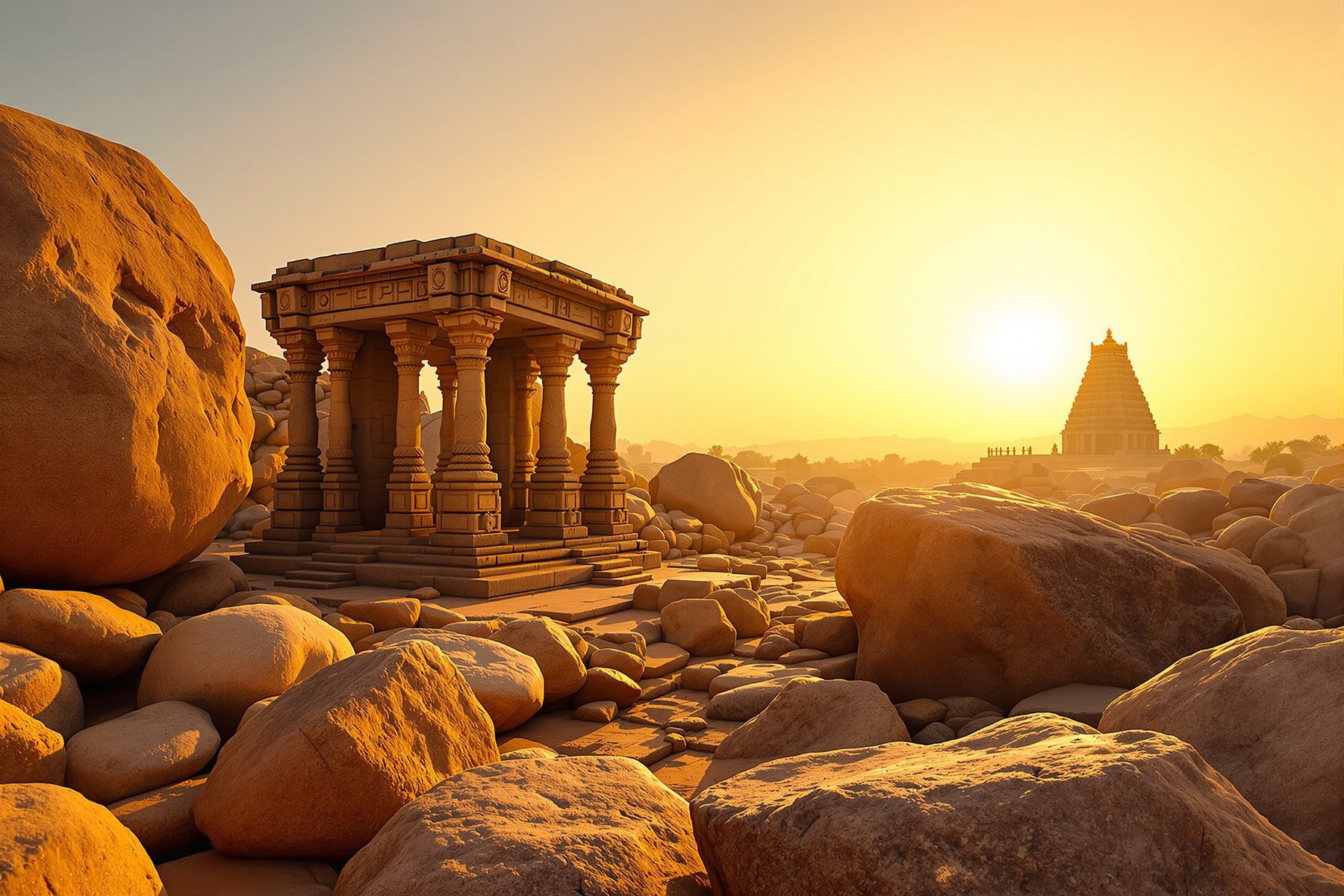
Hampi: The Stone City of Vijayanagara
How a medieval South Indian empire built an entire capital out of the boulder field it stood on — granite that sings, a chariot carved in rock, two architectural worlds fused into one — and how the whole of it fell in a single year.
Most of the wonders in this series are single buildings — a temple, a tomb, a treasury. Hampi is a city. For more than two hundred years it was Vijayanagara, the capital of the greatest empire South India had ever seen, and one of the largest and richest cities anywhere on earth. Travellers from Persia and Portugal walked its bazaars and struggled to describe what they saw: streets where gems were sold by the heap, temples sheathed in gold, half a million people living in a metropolis spread across some twenty-five square kilometres of the Deccan.
And then, in 1565, it ended — not slowly, but in a matter of months. What you walk through today is the most beautiful ruin in India: a few hundred surviving monuments scattered across a strange, magnificent sea of giant granite boulders, with the river still running through it and one temple still, after all these centuries, holding worship.
This is the third article in our Architectural Wonders series, and it widens the lens. Petra was a city carved _out of_ a cliff; Konark was a single building carried _to_ the coast, stone by quarried stone. Hampi is the third way to make architecture from rock — a whole imperial capital built _from_ the very ground it stands on.
1. A capital, not a monument
Vijayanagara — the name means "city of victory" — was founded in 1336 CE by two brothers, Harihara I and Bukka Raya I, founders of the Sangama dynasty, on the south bank of the Tungabhadra river in what is now Karnataka. Over the next two centuries it became the seat of an empire that, at its height, controlled almost all of southern India and held the Deccan sultanates to the north at bay.
Its golden age came under Krishnadevaraya (reigned 1509–1529), a soldier-poet-king under whom Vijayanagara reached a wealth and sophistication that astonished foreign visitors. This is the crucial thing to hold onto as you read: Hampi is not the relic of a temple-building cult but the surviving fabric of a working imperial city — palaces, markets, barracks, water systems, treasuries and temples, all planned together.
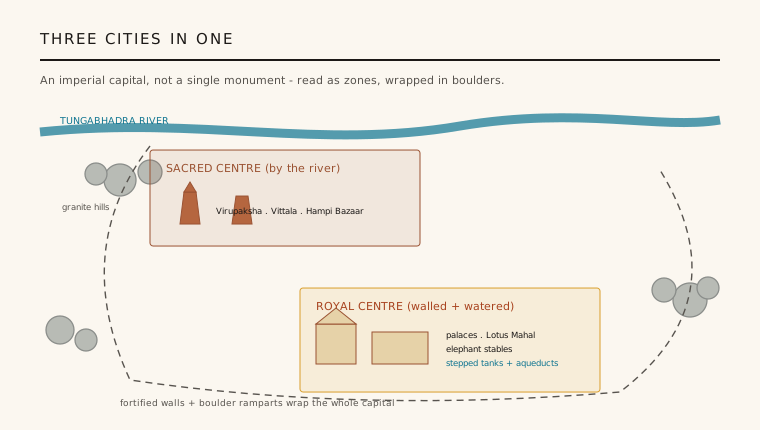
An empire's capital read as zones. The sacred centre clusters along the river; the royal centre sits walled and watered to the south; boulder hills and fortifications defend the whole.
2. Built from a sea of boulders
The first thing that strikes anyone at Hampi is the landscape: thousands upon thousands of enormous, rounded granite boulders, piled and balanced across the hills as though scattered by a giant. This is one of the oldest exposed rock surfaces on the planet, and it gave the Vijayanagara builders both their greatest constraint and their greatest material.
They did not clear it. They built from it. The granite of Hampi is the architecture of Hampi. Blocks were freed from the living rock by the ancient wedge-and-groove method — cutting a neat line of holes along the stone, driving in wedges (often timber, then soaked so they swelled), and splitting the boulder along a clean plane. The freed blocks were dressed and laid, very often as dry masonry — cut so precisely that they hold by fit and gravity, with little or no mortar. Walls, platforms, gateways and entire shrines rise straight out of the boulder field, sometimes incorporating a house-sized boulder directly into a temple wall.
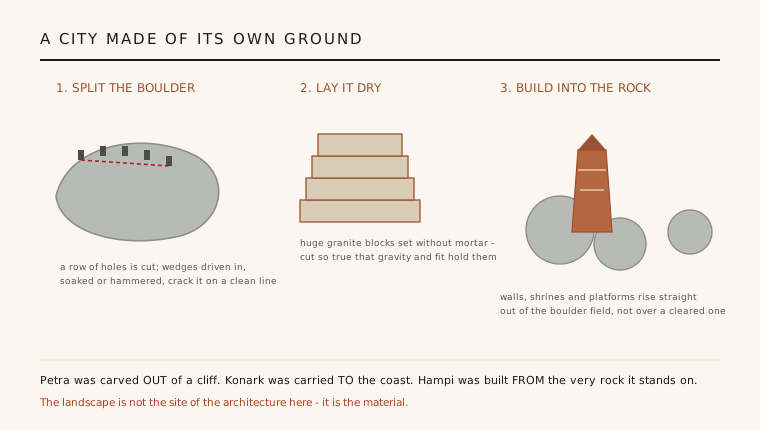
This is a profoundly different relationship between building and ground from the other wonders in this series. Granite is one of the hardest building stones on earth — brutally slow to work, almost impossible to carve with the fineness of Konark's soft khondalite. Yet the Hampi masons coaxed it into lace. The discipline this imposes — _work with the stone you are given, not the stone you wish for_ — runs through everything here.
3. The three cities in one
A capital this size needed planning, and Vijayanagara was planned with real sophistication. Archaeologists read its surviving fabric as a set of linked zones:
- The sacred centre, strung along the river to the north, dense with temples, monasteries and the long colonnaded bazaar streets that ran in front of the great temples — including the still-living Virupaksha temple, dedicated to a form of Shiva, which has been a place of continuous worship since at least the 7th century, long before the empire and long after it.
- The royal centre, set further south and ringed with fortifications, holding the palaces, audience halls, the Lotus Mahal, the elephant stables, ceremonial platforms and the great stepped tanks.
- The fortified and inhabited zone wrapping the rest — defended cleverly by the boulder hills themselves, which were laced together with walls into natural ramparts.
Binding it all was water. The Tungabhadra was led into the city through an extraordinary network of aqueducts, stone channels, wells and stepped tanks (pushkarani) — over twenty wells and ponds connected within the royal centre alone, with some channels still carrying water today. The famous stepped tank, a flawless geometric pyramid of black schist steps descending to the water, is one of the most photographed objects in India, and it is, at heart, a piece of civic infrastructure: a place to store and sanctify water in a hot, dry land. Hampi is a master-class in water urbanism five centuries before the phrase existed.
4. The stone that sings — and the stone chariot
The single greatest monument at Hampi is the Vittala temple, begun in the 15th century and elaborated under Krishnadevaraya — and never quite finished, because the city fell first. It holds the two most famous objects in all of Hampi.
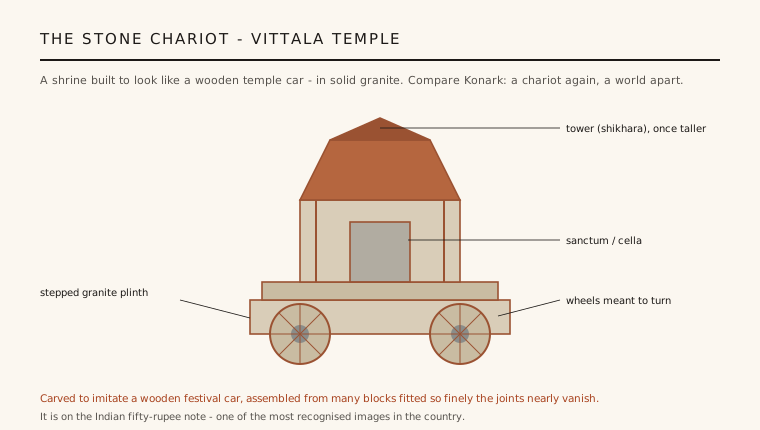
The first is the stone chariot: a small shrine carved to look exactly like a wooden temple car (_ratha_), complete with four great wheels that were, by tradition, once able to turn. It is cut and assembled from many blocks of granite fitted so finely the joints almost vanish — and it is so iconic that it appears on the Indian fifty-rupee note, one of the most recognised images in the country. Note the rhyme with Konark: again a temple imagined as a chariot, but here in unyielding granite rather than soft sandstone, and built up from blocks rather than carved as one.
The second is more astonishing still. The temple's great hall is ringed with the famous musical pillars, also called the SaReGaMa pillars after the first notes of the Indian scale. Each massive composite pier is surrounded by a ring of slender granite colonettes — and when you tap a colonette, it rings with a clear, bell-like musical note. There are 56 of them, each tuned to a pitch. They are not hollow tubes or hidden instruments: they are solid granite, and the tone is governed by the colonette's length, its thickness and the precise density of the stone chosen, each one effectively cut to pitch like a colossal tuning fork. A millimetre of stone changes the note — which means the tuning had to be achieved _by carving_, not adjusted afterwards.
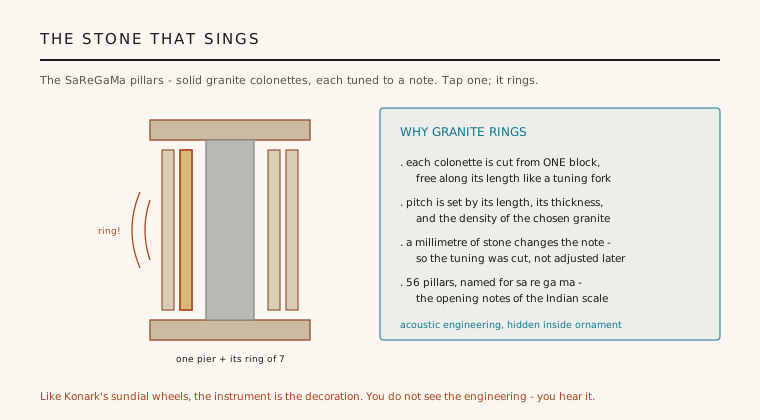
Here is a direct echo of Konark's sundial wheels: at both sites the instrument is the ornament. You do not see the engineering at Hampi — you _hear_ it.
5. A Hindu empire that borrowed the arch
One of the most quietly radical things about Hampi sits in the royal centre, and most visitors walk past its significance. The temples of Vijayanagara are built in the classic South Indian Dravidian manner the empire inherited — soaring gopuram gateway towers, pillared mandapas, the trabeated (post-and-beam) language of Hindu temple architecture, in which stone spans by bridging, never by arching.
But in its secular royal buildings, Vijayanagara did something its temples never did: it borrowed the Islamic arch and dome. The Lotus Mahal — a cool, two-storey pavilion for the royal women — sets a symmetrical Hindu mandala plan beneath delicately lobed (cusped) arches and recessed vaults straight out of the Indo-Islamic tradition, crowned with a dome shaped like a half-open lotus bud. The neighbouring elephant stables — eleven great domed chambers in a row, the most monumental secular structure of the capital — are frankly Indo-Islamic in their domes and arched openings, built to house the war elephants of a Hindu emperor.
This is not confusion; it is confidence. An empire at the height of its power took the most useful ideas from the architectural world around it — including from the very sultanates it fought — and absorbed them into a fusion that is unmistakably Vijayanagara. The lesson for any architect is permanent: a strong tradition is not threatened by borrowing; it is enlarged by it.
6. The year it ended
In 1565, the Vijayanagara army met the combined forces of the Deccan sultanates at the Battle of Talikota, north of the capital. The empire's army was shattered. And then something rare in history happened: the great city itself, left undefended, was entered and systematically looted and burned over a period of months. The richest city in the south was stripped, smashed and abandoned. It was never reoccupied.
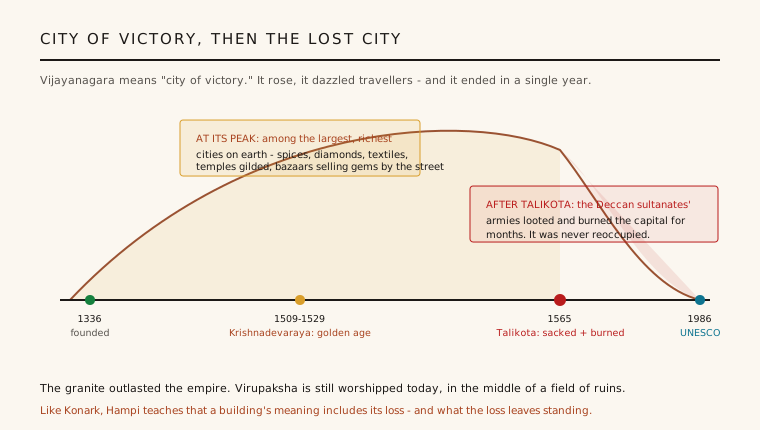
What the fire and the hammers could not finish, the granite refused. Walls too heavy to topple, platforms too vast to break, the stone chariot, the singing pillars — they stayed. The empire was gone in a year; its architecture is still standing after four and a half centuries. And at the heart of the ruin, the Virupaksha temple never stopped: it has held daily worship straight through the rise of the empire, its catastrophe, and the long silence after, and it does to this day. The Group of Monuments at Hampi was inscribed as a UNESCO World Heritage Site in 1986.
Hampi makes the same hard point as Konark, at the scale of a whole civilisation: a place's meaning is not only what survived, but what it attempted — and a ruin can teach more than an intact thing ever could, precisely because you can see how it was made, and how it ended.
7. What a modern architect can learn from Hampi
- Let the site give you the material. Vijayanagara did not fight its impossible boulder landscape; it built _out of_ it, turning the hardest of stones and the most awkward of grounds into the signature of a city. The most rooted architecture almost always grows from what the place already is.
- Plan the city, not just the building. Hampi's genius is at the urban scale — sacred, royal and commercial zones, defended by terrain, knitted together by water. Great architecture is rarely a single object; it is the relationship between many. (This is the thinking our home planning and site-planning guides return to again and again.)
- Hide the engineering inside the beauty. The musical pillars and the stepped tanks are, underneath, pure performance — acoustics and hydraulics — wrapped in objects so lovely you forget they are working. Performance and expression should be one move, not two — the same lesson our Facade Engineering course makes for the modern envelope.
- Borrow without fear. Vijayanagara took the arch and the dome from a rival tradition and was made larger, not smaller, by it. Confidence in your own language is what lets you absorb another.
- Design for water. Five hundred years ago a Deccan capital treated the storage, movement and celebration of water as central architecture, not plumbing. In a warming, water-stressed India, that priority reads as startlingly modern.
References & further reading
1. UNESCO World Heritage Centre — Group of Monuments at Hampi (inscribed 1986). https://whc.unesco.org/en/list/241/
2. Encyclopaedia Britannica — Hampi and Vijayanagara. https://www.britannica.com/place/Hampi
3. Karnataka Tourism — Hampi. https://karnatakatourism.org/en/destinations/hampi/
4. Archaeological Survey of India / Incredible India — Vitthala Temple Complex, Hampi. https://www.incredibleindia.gov.in/en/karnataka/hampi/vitthala-temple-complex
Last verified 2026-06-30. Dates, dimensions and population figures follow standard archaeological and historical reference sources and are given as widely accepted approximations; the account of the 1565 sack follows the historical record, and the "city of victory" etymology and the continuous worship at Virupaksha follow established tradition and scholarship.
Export this guide
Related Guides — Deep-dive reading
Chan Chan: The Vast City of Mud Where Every King Built His Own Palace
On the desert coast of Peru sprawl the ruins of the largest city ever built of mud — a thousand-year-old capital of adobe walls three storeys high, carved with fish and seabirds, that survived only because it almost never rains. It was a city of ten royal palaces, one for each king, driven by a strange rule of inheritance; and today, an earthen city in a warming world, it is racing the rain to survive. The ninth article in our chapter on the palaces and pleasures of worldly power.
Architectural WondersVirupaksha & the Temple-Town: What Hampi Teaches About Architecture That Is Never Finished
The Virupaksha temple at Hampi is the living heart of a medieval city that grew for a thousand years along a single sacred axis of temple, tank and colonnaded street. Read as a case study, the Vijayanagara temple-town is a model of incremental, water-organised, participatory urbanism — an argument that architecture's future may lie in buildings designed to be added to forever.
The Future of ArchitectureGreat Zimbabwe: The Stone City Europe Refused to Believe Africans Built
In the hills of southern Africa stand the largest ancient stone ruins south of the Sahara — a whole city of massive granite walls built without a drop of mortar, the wealthy capital of a gold-trading kingdom. For a century, colonists refused to accept that Africans had raised it, and invented every other builder they could. This is the story of that architecture, and of the lie it outlived. The article that closes our chapter on the palaces and pleasures of worldly power.
Architectural WondersRelated Tools — Try Free
Acoustic Privacy (STC) Visualizer
Indian healthcare acoustic visualizer — compare wall assemblies and noise sources, see received SPL after STC attenuation, and check FGI 2018 / IS 1950 / NABH speech-privacy compliance with live dual-canvas waveform.
Acoustic ToolApartment Furniture Size Chart
Standard furniture dimensions for Indian apartments — sofas, beds, tables, dining, storage.
Reference ChartBefore & After Studio
Generate AI before-and-after renders to preview how your redesign could look.
DesignAI