
How to Choose a Toilet in India: A Buyer's Guide to WCs, Traps, Flush & Budget (2026)
The make-or-break trap and rough-in check, floor-mounted vs wall-hung, one-piece vs two-piece, flush type and water use, seat and rimless upgrades, good/better/best rupee tiers, what's actually in the box, and how to spot a fake before you pay.
A toilet is a fifteen-year purchase you make in fifteen minutes on a showroom floor, usually while the salesperson talks about colour and brand. Colour and brand are the easy part. The parts that decide whether the commode even bolts to your drain, whether it stains in one hard-water season, and whether the warranty is worth the paper — those are the parts nobody volunteers. This is a buyer's guide: how to choose a toilet in India so the box that arrives fits your bathroom, flushes on the first press, and lasts.
This guide is about the decision and the purchase. For the full technical breakdown of squat versus Western, trap geometry, flush mechanics and mounting types, read the pillar bathroom toilet guide for India. For the wider buying context — how to shop for the whole bathroom — see the bathroom shopping guide for India. When you have narrowed the mount, go deep on the floor-mounted toilet or the wall-hung toilet.
The single most expensive toilet mistake in India is paying before you have measured your drain. Confirm your trap — S or P — and your rough-in distance first. Everything else can be swapped; the drain cannot.
The make-or-break check: trap type and rough-in
Before you like a single model, do the one measurement that voids ninety percent of returns.
Every commode has a built-in trap — the bend that holds a water seal against sewer gas. What matters at purchase is which way waste leaves the pan:
- S-trap exits downward through the floor. This is the traditional Indian outlet, because most of our waste stacks run below the slab.
- P-trap exits horizontally through the wall behind the pan. Standard on wall-hung units and many modern apartments.
An S-trap pan will not connect to a wall drain, and a P-trap pan will not connect to a floor drain — not without ugly adaptors that leak. So step one is to look at your existing drain: does the waste hole sit in the floor or in the wall?
Then, for an S-trap floor commode, measure the rough-in (the trap distance or set-out): the distance from the finished wall to the centre of the floor drain. Buy a pan whose rough-in matches. Get it wrong and the commode sits a hand's width off the wall, or crushes against it.
| What to measure | S-trap (floor outlet) | P-trap (wall outlet) |
|---|---|---|
| Where waste exits | Down, through the floor | Back, through the wall |
| Number that must match | Rough-in: wall to drain centre | Height: floor to outlet centre |
| Common India value | 220 mm (also 250 / 300 / 400 mm) | 180 mm (wall-hung frames) |
| Ask the vendor | "Which rough-in is this pan?" | "Frame outlet height?" |
The commonest Indian S-trap rough-in is 220 mm, but 250, 300 and 400 mm all exist. Measure yours with a tape, write it on your phone, and refuse any pan that does not match. "It's close enough" is how a leak starts.
Floor-mounted or wall-hung
This is the decision that most shapes cost and cleaning.
- Floor-mounted bolts to the floor and is the default across India. Any plumber can fit or service it, it needs no in-wall work, and it is far cheaper. The floor bolts and the base collect grime, and it reads as ordinary.
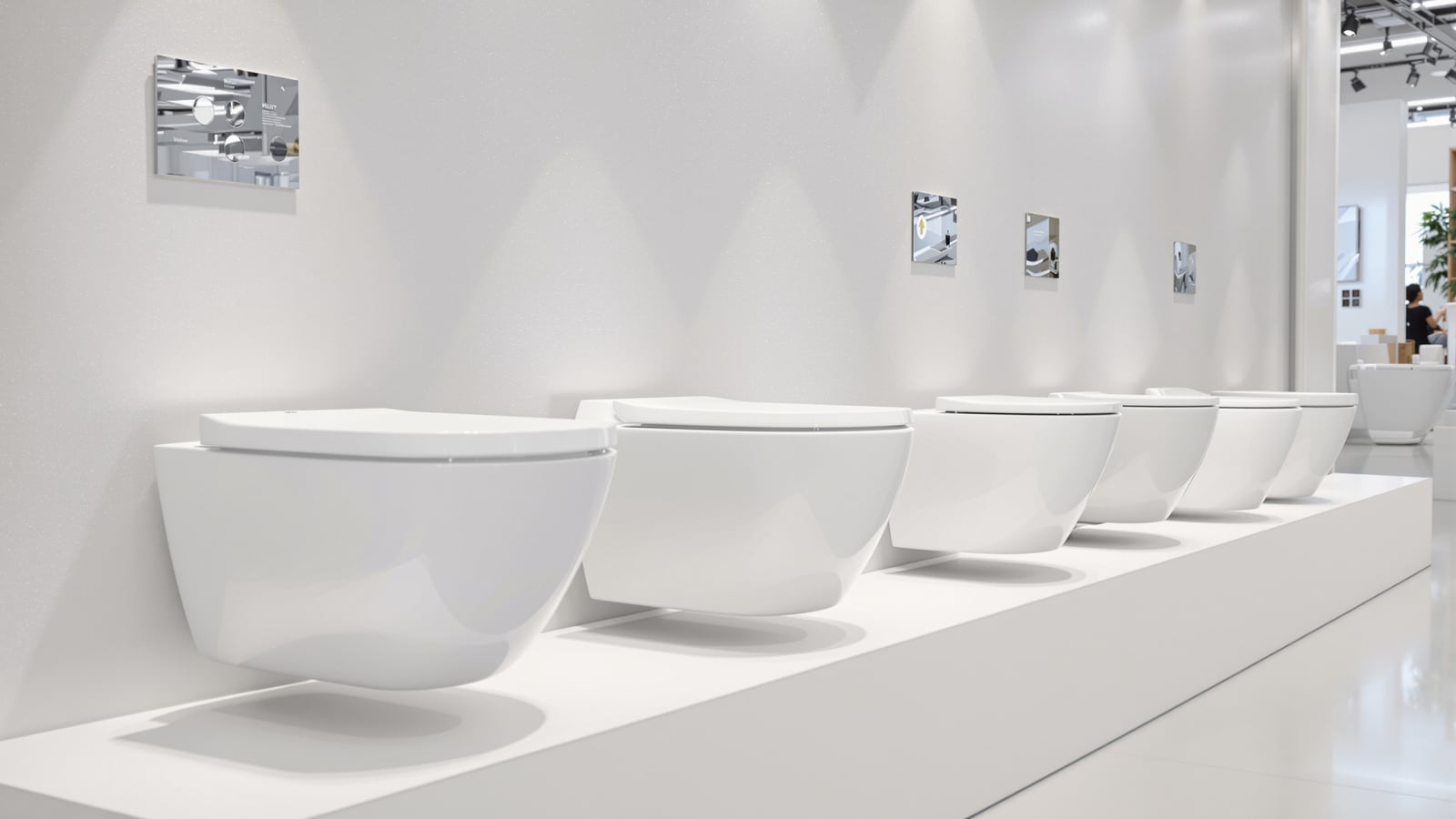
- Wall-hung cantilevers off a hidden steel frame with the cistern buried in the wall behind a flush plate. The floor underneath is clear, so mopping is effortless and the look is premium. It costs the most, must be planned during civil work because the frame is load-bearing, and any future repair means opening the wall.
Buy wall-hung only if you decide during construction or a full renovation. Retrofitting it into a finished bathroom means breaking tiles and walls. If you are replacing a commode in a lived-in home, floor-mounted is almost always the sane choice.
One-piece or two-piece
Within floor-mounted, you choose how the cistern joins the bowl.
- Two-piece (close-coupled) — bowl and tank are separate, bolted together. Cheapest, universally serviceable, spare parts everywhere. The tank-to-bowl joint and floor bolts trap dirt.
- One-piece — bowl and cistern moulded as one seamless unit. No joint to leak, easier to wipe, sleeker. Costs more and is heavier to handle.
For value, a good two-piece is hard to beat. Pay up for one-piece when you want the cleaner look and fewer crevices to scrub.
Flush type and water use
The flush decides your water bill and your green rating.
- Single-flush dumps one fixed volume every time — wasteful and effectively obsolete for new work.
- Dual-flush gives two buttons: a full flush around 6 litres for solids and a half flush around 3 litres for liquids. The 6/3 (some 4.5/3) split is the sensible default and what water-efficiency schemes such as IGBC and GRIHA reward. Make dual-flush non-negotiable.
Check the actual litres printed on the box, not just the "dual-flush" label — some cheap units still push 8 litres on full.
Seat, rimless and glaze — the upgrades worth paying for
- Rimless bowl. A conventional bowl hides a hollow rim where hard-water scale and bacteria breed unseen. Rimless opens that channel so water sweeps the whole bowl. In Indian hard water this is the single upgrade most worth the extra rupees.
- Soft-close (slow-close) seat. No slamming, longer hinge life. Confirm whether the seat is included — on budget models it often is not.
- Easy-clean glaze. A branded dirt-resistant glaze (EasyClean, Hygienicglaze and similar) stops hard-water film bonding to the surface. Thin cheap glaze stains within a season.
Good / better / best — rupee tiers
Indicative supply-only ranges for the WC and its cistern or frame, excluding tiling and plumbing labour. Brands such as Jaquar, Hindware, Cera, Parryware and Kohler span these tiers; treat names as neutral examples, not endorsements.
| Tier | Typical spend (₹) | What you get | Good for |
|---|---|---|---|
| Good | 5,000 – 12,000 | Two-piece dual-flush, standard bowl, seat often extra | Rentals, utility and second toilets |
| Better | 12,000 – 30,000 | One-piece or rimless two-piece, dual-flush, soft-close seat, easy-clean glaze | Most family and master bathrooms |
| Best | 30,000 – 90,000+ | Wall-hung bowl + concealed frame + flush plate, rimless, premium glaze; or integrated bidet WC | New builds, premium ensuites |
The value pick for most homes: a rimless two-piece dual-flush with a soft-close seat in the "Better" band. It delivers almost all the hygiene and comfort of a wall-hung setup at a fraction of the cost and complexity.
What's actually in the box
The price tag is for the bowl far more often than buyers assume. Before you pay, confirm each line in writing:
- Seat and cover — included or extra? Budget WCs frequently exclude it.
- Cistern / flush tank — included for two-piece; the concealed frame and flush plate are usually separate for wall-hung and add a lot.
- Fixing kit — floor bolts, wax/rubber gasket, tank-to-bowl bolts and washers.
- Inlet fittings — flush valve and inlet (fill) valve; check they are pre-fitted or in the box.
- Health faucet — almost never included; budget ₹400–2,500 separately, since every WC in India is expected to have one.
Spotting fakes and mis-selling
Counterfeit and seconds-grade sanitaryware is a real problem in Indian markets. Protect yourself:
- Look for the IS 2556 mark and the BIS Standard Mark stamped on the ceramic and printed on the box. IS 2556 covers vitreous china sanitary appliances; genuine product carries it.
- Check for "seconds" or factory-reject marks — a stamped dot, a paint smear or a scratched-out logo signals a rejected piece sold as first quality.
- Inspect the glaze under light for pinholes, waves and dull patches; run a hand inside the bowl for gritty texture.
- Distrust "same as branded, half price" pitches and unbranded "export surplus" — genuine warranty needs a genuine invoice.
- Get a GST invoice with the model number, not a hand-written slip, or the warranty is worthless.
Warranty, showroom versus online, and questions to ask
Reputable brands offer long ceramic warranties — often 10 years or lifetime on the vitreous body — but only 1–5 years on the flush mechanism, seat and fittings, which are the parts that actually fail. Read which is which.
Buying in a showroom lets you check glaze, sit on the bowl for comfort-height, and confirm the trap in person; online is cheaper and wider but you cannot inspect, so stick to authorised brand stores and keep the invoice. Either way, ask the vendor:
- What is the exact rough-in / trap of this model?
- Is the seat included, and is it soft-close?
- What flush volumes — 6/3 litre?
- Is it rimless, and what is the glaze?
- What does the warranty cover on the fittings, not just the ceramic?
- Who installs it, and is fitting included or extra?
Get those six answers before the payment, and the toilet you carry home will be the one your bathroom actually wanted.
References
- IS 2556 — Vitreous sanitary appliances (vitreous china): specifications for WC pans, cisterns and squat pans.
- NBC 2016 (National Building Code of India), Part 9 — Plumbing Services: water supply, drainage and sanitation.
- IS 1172 — Basic requirements for water supply, drainage and sanitation.
- Bureau of Indian Standards (BIS) — Standard Mark scheme and current sanitaryware standards.
- IGBC Green Homes and GRIHA rating manuals — water-efficiency credits for dual-flush and low-flow WCs.
Export this guide
Related Guides — Deep-dive reading
Bathroom Toilet India: The Complete Guide to WCs, Commodes & Water Closets (2026)
Indian squat vs Western commode, floor-mounted vs wall-hung with concealed cistern, the S-trap and P-trap outlet and its rough-in distance, dual-flush water norms, rimless and comfort-height trends, the health-faucet rule, and a rupee cost comparison — everything that decides which toilet is right for an Indian home.
BathroomsFloor Mounted Toilet India: S-Trap vs P-Trap, Rough-In & Cost (2026)
The practical default WC for most Indian homes — one-piece vs two-piece close-coupled, why the S-trap vs P-trap and trap-distance decision is the number one replacement mistake, floor fixing and sealing, cistern types, rupee costs, and an honest comparison with wall-hung.
BathroomsHow to Choose a Wash Basin in India: Mount Type, Size, Tap Holes & Budget (2026 Buyer's Guide)
A buyer's decision guide to picking the right wash basin — matching the mount type to your vanity and space, sizing it to the room, getting the tap-hole config right for your faucet, judging material and durability, checking what's in the box, good/better/best rupee tiers, the IS 2556 vitreous-china mark, and how to spot seconds, hairline cracks and warranty traps.
BathroomsRelated Tools — Try Free
Bathroom Renovation Cost Calculator
Cost to renovate an existing bathroom with a replace-vs-keep model — demolition, re-waterproofing, tiles, fittings and the money saved by keeping items.
Bathroom CalculatorPlumbing Pressure-Test & Leak Checklist
Pre-closure pressure and leak test — 9 categories, 60+ checkpoints across water supply, drainage, fixtures, waterproofing, hot water, tanks.
Pre-Closure TestRenovation vs New Build Calculator
Compare renovating vs building new interiors city-wise across 13 work scopes with GST and per-sqft rates.
Cost Comparison